
Game review
Crow Country
8 / 10
- Developer
- SFB Games
- Publisher
- SFB Games
- Released
- 9 May 2024
- Platforms
- Windows, PlayStation 4, PlayStation 5, Xbox One, Xbox Series X|S, Nintendo Switch
- Genre
- Survival Horror
- Monetisation
- One-time purchase, no DLC or in-game currency
- Players
- Single-player
The short version
Crow Country sends investigator Mara Forest into an abandoned, PS1-era-styled theme park two years after its mysterious closure, and it's one of the more complete critical and commercial successes this library has covered from 2024: 84 on Metacritic, and Overwhelmingly Positive on Steam at 98% across more than 7,600 reviews. Critics and the overwhelming majority of players agree it captures classic PS1 survival horror's atmosphere and puzzle design with real craft rather than shallow nostalgia-baiting. The minority who disagree raise a specific, coherent point rather than a vague complaint: resources aren't meaningfully limited, so the genre's classic tension around choosing when to fight, flee or conserve ammunition is largely absent, leaving several detailed reviewers to argue the game replicates the genre's look far more successfully than its actual pressure.
Biggest strengths
- The PS1-era visual style is executed with real craft rather than surface-level nostalgia, and critics consistently credit the developers with understanding what made the era's horror atmosphere work rather than just imitating its look
- Puzzle design draws consistent praise for being genuinely clever without feeling obtuse, striking a rare balance for the genre
- Sound design and atmosphere are repeatedly singled out as genuinely unsettling, with several reviewers describing real, physical startle reactions
Biggest weaknesses
- Resources aren't meaningfully scarce, which several detailed reviews argue removes the classic survival-horror tension of deciding when to fight, flee or conserve ammunition — a specific, structural complaint rather than simple difficulty grumbling
- Multiple reviewers describe several puzzles as over-explained by in-game notes, reducing the sense of discovery the best examples of the genre are built around
- Keyboard controls exist but cannot be rebound at launch, and aiming is deliberately slow and imprecise by design — the developers have said this is intentional rather than an oversight, but several reviewers found it made keyboard-and-mouse play a genuinely frustrating way to experience the game
Who it's for: Players who want PS1-era survival horror's atmosphere, tank-adjacent combat feel and puzzle design without its punishing resource scarcity are exactly who this is built for, and the overwhelming majority who love it are proof the approach works for most of its audience. Genre purists who specifically want scarcity-driven tension, in the vein of the original Resident Evil or Silent Hill games, should read the detailed minority complaints below before assuming the PS1 aesthetic guarantees that particular feeling.
Our recommendation: Recommended, and confidently so given how consistently both critics and its enormous player base agree on its quality. Go in for the atmosphere, the mystery and genuinely well-crafted puzzle design rather than expecting classic survival-horror scarcity, and be aware upfront that keyboard controls are functional but deliberately unforgiving, with no key rebinding at launch.
8 / 10
A tribute built by people who understand the genre, not just its look
Crow Country sends Mara Forest into the shuttered remains of the titular theme park two years after its owner, Edward Crow, vanished without explanation. From the moment the low-polygon character models and fixed camera angles appear, the debt to PS1-era Resident Evil and Silent Hill is obvious — but SFB Games earns the comparison rather than merely invoking it. Critics were close to unanimous in crediting the developers with genuinely understanding what made that era's horror atmosphere effective, rather than simply reproducing its visual shorthand, and the numbers back up how well that landed: 84 on Metacritic from 29 critics, and an Overwhelmingly Positive 98% across more than 7,600 Steam reviews, one of the strongest scores this library has recorded for a 2024 release in any genre.
Where the tribute succeeds without qualification
Sound design and puzzle craft are where the praise is most consistent and least contested. Multiple reviewers describe genuine, physical startle reactions to the game's audio work, and the atmosphere of Crow Country's abandoned attractions — animatronics, overgrown walkways, the specific unease of a theme park built for joy now standing silent — carries real weight rather than trading purely on the retro aesthetic to do the atmospheric work. Puzzle design draws similarly strong, consistent praise for striking a balance the genre often gets wrong in one direction or the other: clever enough to feel earned, rarely so obtuse that a walkthrough starts to feel necessary. The central mystery around Edward Crow's disappearance is well-paced across a roughly nine-hour first playthrough, and reviewers across the critical spectrum — including several of the detailed negative reviews discussed below — specifically credit the story as one of the game's genuine strengths.
The specific, coherent case the minority makes
What separates Crow Country's negative reviews from typical genre grumbling is how consistently they land on the same structural point rather than scattering across unrelated complaints. Several detailed reviews argue that resources in Crow Country aren't meaningfully scarce, and that this single design choice quietly removes the tension that defines classic survival horror as a genre rather than just an aesthetic. The choice to fight or flee, to spend a precious healing item now or save it for a worse encounter later, to feel genuinely under-resourced against a threat — reviewers making this argument say none of that pressure exists here, because ammunition and healing items simply aren't limited enough to force those decisions. It's a specific, falsifiable claim rather than vague dissatisfaction, and it's echoed independently across multiple detailed reviews rather than appearing once and getting amplified. A related complaint concerns puzzle solutions being over-explained by in-game notes, which several reviewers say undercuts the sense of discovery the genre's best examples build their reputation on.
A second cluster of complaints is more straightforwardly technical. Keyboard controls exist, but key rebinding wasn't available at launch, and aiming is deliberately slow and imprecise — a choice the developers have described as intentional, tied to both the mechanical feel and the story's pacing, rather than an oversight to be patched away. Several reviewers found this made keyboard-and-mouse play a genuinely frustrating way to experience the game regardless of the design intent behind it, and at least one reviewer reports not realising a controller was effectively expected until well after purchase. A smaller but specific accessibility complaint concerns in-game notes and memos brightening the screen sharply against the game's otherwise dark visual palette, described by at least one reviewer as a real eye-strain problem with no dark-mode alternative offered.
A trap-difficulty patch that reads as a shortcut
One more specific complaint deserves its own mention because it's less about design philosophy and more about execution: several reviewers report that as the game progresses, traps begin appearing in rooms the player has already fully explored and cleared, seemingly as a way of maintaining tension once the map itself has been mapped out. Read charitably, it's a reasonable solution to a real problem every exploration-driven horror game faces — once a player has learned a space, that space stops being scary. Read less charitably, and at least a few reviewers do read it this way, it feels like a shortcut rather than a deliberate escalation, retroactively punishing familiarity with a space instead of building new tension into it. It's a minor point next to the resource-scarcity argument above, but it's specific enough, and repeated by enough independent reviewers describing the same late-game rooms, to be worth a buyer's attention rather than dismissed as noise from a single frustrated player.
Verdict
Crow Country earns its exceptional critical and commercial reception through real, specific craft — sound design, puzzle balance and a well-told central mystery that critics and the overwhelming majority of its enormous Steam audience credit without reservation. The minority who disagree aren't nostalgia-blind detractors; they're making a coherent, structural argument that the game borrows PS1 survival horror's look and atmosphere while quietly removing the resource scarcity that made the genre's tension work in the first place, alongside real, specific frustrations with unrebindable keyboard controls and deliberately imprecise aiming. Go in for atmosphere, mystery and puzzle craft, and you'll likely land with the 98% who loved it. Go in specifically hoping for classic survival-horror scarcity, and it's worth knowing upfront that a real, detailed slice of reviewers say that particular feeling isn't actually here, however faithfully the game recreates the era's look and sound around it.
Pros and cons
Pros
- The PS1-era visual style is executed with real craft rather than surface-level nostalgia, and critics consistently credit the developers with understanding what made the era's horror atmosphere work rather than just imitating its look
- Puzzle design draws consistent praise for being genuinely clever without feeling obtuse, striking a rare balance for the genre
- Sound design and atmosphere are repeatedly singled out as genuinely unsettling, with several reviewers describing real, physical startle reactions
- The central mystery of Edward Crow's disappearance and the park's closure is well-paced and satisfying enough that reviewers across the critical spectrum credit the story specifically
- At roughly 9 hours for a first playthrough with real replay value, the length suits the experience without overstaying its welcome
Cons
- Resources aren't meaningfully scarce, which several detailed reviews argue removes the classic survival-horror tension of deciding when to fight, flee or conserve ammunition — a specific, structural complaint rather than simple difficulty grumbling
- Multiple reviewers describe several puzzles as over-explained by in-game notes, reducing the sense of discovery the best examples of the genre are built around
- Keyboard controls exist but cannot be rebound at launch, and aiming is deliberately slow and imprecise by design — the developers have said this is intentional rather than an oversight, but several reviewers found it made keyboard-and-mouse play a genuinely frustrating way to experience the game
- Some detailed reviews describe traps re-spawning in previously-cleared rooms as a way of raising difficulty later in the game, which reads to at least a few reviewers as a shortcut rather than a deliberate design escalation
- Reading in-game notes and memos brightens the screen sharply against the game's otherwise dark palette, which at least one reviewer specifically flags as an eye-strain and accessibility issue with no dark-mode alternative offered
Screenshots
-

Crow CountryImage: SFB Games via Steam -

Crow CountryImage: SFB Games via Steam -

Crow CountryImage: SFB Games via Steam -
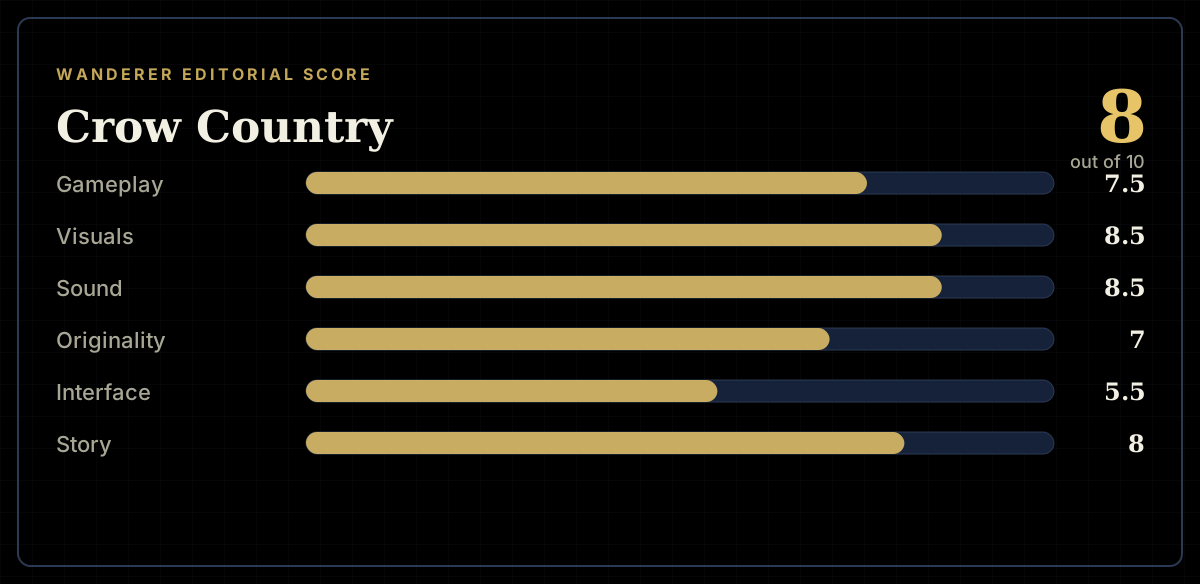
How the review scores each part of the gameWanderer Editorial -
The short versionWanderer Editorial