Game review
Minecraft
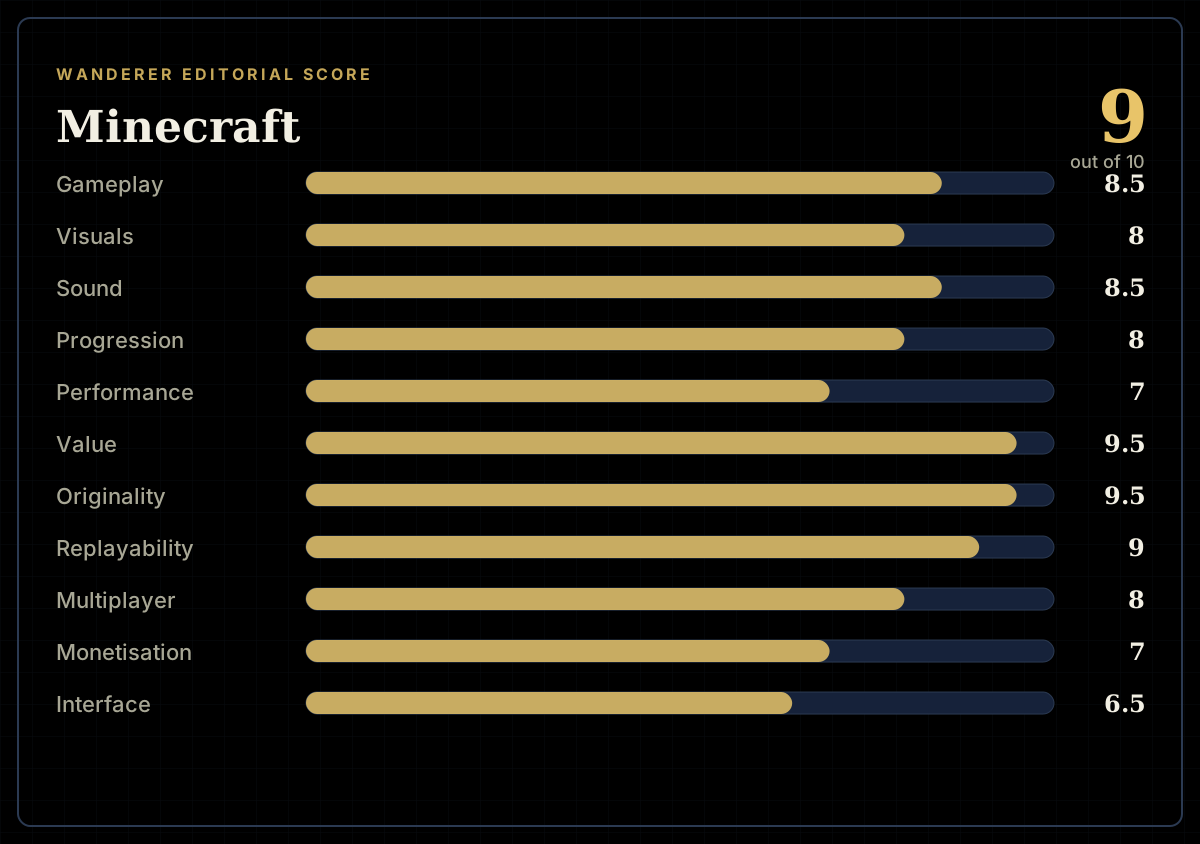
9 / 10
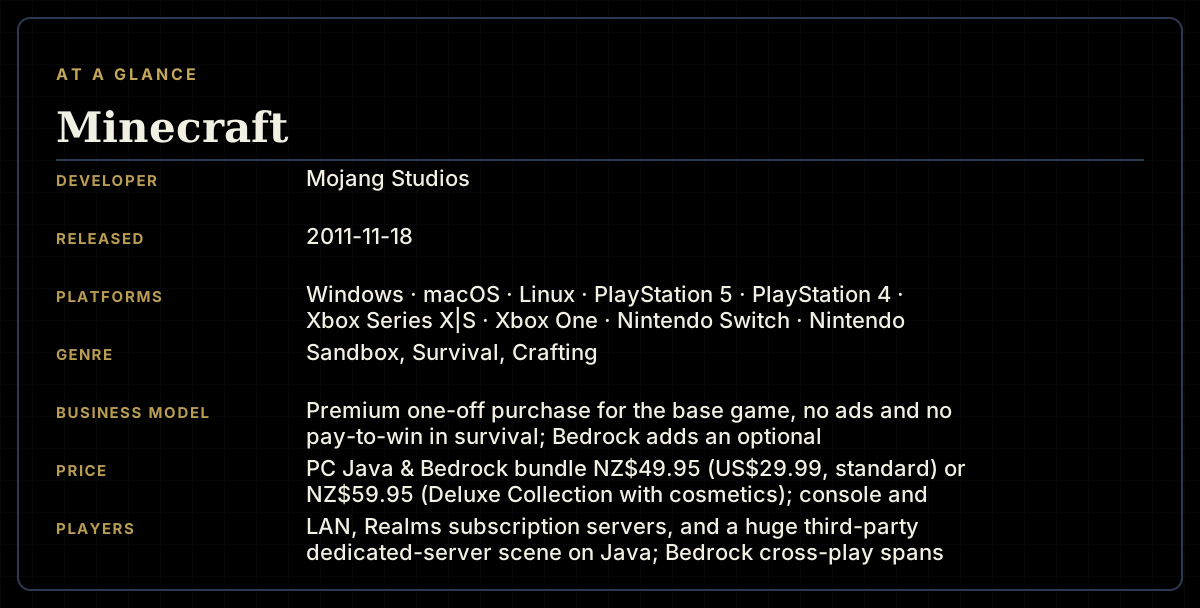
- Developer
- Mojang Studios
- Publisher
- Xbox Game Studios (Microsoft)
- Released
- 18 November 2011
- Platforms
- Windows, macOS, Linux, PlayStation 5, PlayStation 4, Xbox Series X|S, Xbox One, Nintendo Switch, Nintendo Switch 2, iOS, Android
- Genre
- Sandbox, Survival, Crafting
- Monetisation
- Premium one-off purchase for the base game, no ads and no pay-to-win in survival; Bedrock adds an optional real-money Marketplace and Minecoins currency, and both editions offer an optional Realms server subscription on top of the purchase
- Players
- LAN, Realms subscription servers, and a huge third-party dedicated-server scene on Java; Bedrock cross-play spans console, PC and mobile but does not connect to Java worlds
The short version
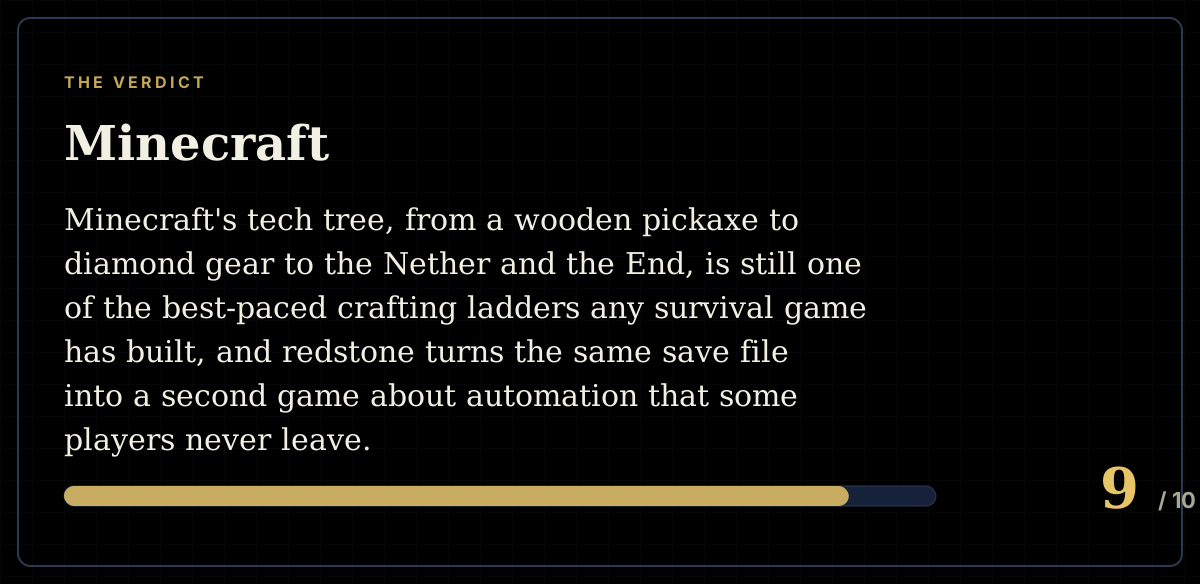
Minecraft's tech tree, from a wooden pickaxe to diamond gear to the Nether and the End, is still one of the best-paced crafting ladders any survival game has built, and redstone turns the same save file into a second game about automation that some players never leave. Fifteen years of free content updates and a single one-time purchase for both engines make it an easy value argument even in 2026.
It's just as honest to say what hasn't moved. Combat has barely changed since 2016, mob pathing still breaks around doors and water, there's no real destination after the Ender Dragon beyond whatever project you invent yourself, and Bedrock's Marketplace is a real-money storefront built for an audience of children who can't always tell a good deal from a bad one.
Biggest strengths
- The wood-to-diamond-to-Nether-to-End tech tree is still the best-paced crafting ladder in the survival genre, with no dead stretches before the endgame
- Redstone turns the same world into a genuine automation sandbox, deep enough that some players never touch the survival goals again
- A single NZ$49.95 PC purchase now bundles Java and Bedrock permanently, and both keep receiving free content drops instead of paid expansions
Biggest weaknesses
- Combat has barely changed since the 2016 attack-cooldown rework and still reduces to backpedalling and clicking, with mob pathing that breaks down around doors, water and multi-level builds
- There is no real endgame; beating the Ender Dragon is a genuine climax that hands the player nothing further to chase beyond a goal they set for themselves
- The Bedrock Marketplace sells skins, maps and Minecoins to an audience that skews very young, and its coin bundles are priced to make the real cost of any single item hard to work out
Who it's for: Anyone who wants a genuinely open sandbox with a real crafting ladder underneath it, players chasing automation for its own sake through redstone, groups who want a persistent shared world that survives years of on-and-off play, and parents who need to understand exactly what the Marketplace sells before handing a child an account.
Our recommendation: Buy the PC bundle once and treat the $29.99 as covering both engines permanently. Play Bedrock if your group spans consoles, phones and PC and you want simple cross-play; play Java if anyone in that group wants mods, a bigger server scene, or full control over a dedicated world. Skip Realms unless you genuinely need someone else to host; skip the Marketplace entirely if a child's account is involved, or set spending limits before handing over the login.
9 / 10
Minecraft doesn't need an introduction, and any review that spends its opening paragraphs explaining that you mine blocks and build things with them is wasting a reader's time. What actually needs answering in 2026 is the stuff nobody explains clearly: which of the two engines you should install, whether the famous progression ladder still teaches itself the way it did in 2011, whether the much-discussed automation side of the game is worth the hours it demands, and how honest Mojang's current monetisation really is once you get past the headline "no in-app purchases in survival" line. Those questions have real answers, and getting them wrong costs real money and real time.
Mojang switched to year-based versioning in 2026 — the old 1.21.x line gave way to 26.1 ("Tiny Takeover"), 26.2 ("Chaos Cubed," released 16 June 2026 with a new sulfur caves biome), and a third drop due later in the year. That's the current release rhythm: three smaller content drops a year instead of one enormous yearly update. It's a genuine change in how the game is maintained, and it matters for anyone judging whether Minecraft still feels alive or just still exists.
The buying decision nobody explains well
Here's the fact that most coverage still gets wrong or leaves out entirely: since June 2022, buying Minecraft for PC through the official store gets you both Java Edition and Bedrock Edition in one purchase, permanently, for one price. They are not sold separately any more. If you already own one, Mojang gave you the other for free years ago. The standard PC bundle sits at NZ$49.95 (US$29.99), with a Deluxe Collection at NZ$59.95 that adds cosmetic extras. So on PC, "Java or Bedrock" isn't really a purchase decision in 2026 — it's a which-one-do-I-launch decision, made fresh every session from the same launcher.
That doesn't make the distinction irrelevant, because the two are still, under the hood, different games built on different codebases with different feature sets. Bedrock is the one true cross-play platform: the same account can play together across Windows, Xbox, PlayStation, Switch, iOS and Android, in the same world, with the same purchased skins and Marketplace content following along. If your group is a mixed bag of consoles and phones, Bedrock is not a compromise — it's the only option that actually works for everyone at once. Java, by contrast, is PC-only (Windows, macOS, Linux) and does not cross-play with Bedrock at all; a Java world and a Bedrock world cannot connect without a third-party bridge like Geyser. What Java trades cross-play for is depth: full mod support through Forge, Fabric and NeoForge, direct access to the enormous CurseForge and Modrinth libraries built on those loaders, unrestricted server hosting with total control over plugins and world behaviour, and first access to new features since Java is still where most updates land before Bedrock's parity pass catches up (Chaos Cubed hit Java as 26.2 and Bedrock as its own 26.30 build soon after, not simultaneously).
The honest recommendation: if your group is PC-only and modding or dedicated servers matter to anyone in it, install Java. If the group spans consoles and phones and simple, reliable cross-play is what you actually need, install Bedrock. If you genuinely don't know yet, the bundle means you've already paid for both, so there's no cost to trying each one before committing a world to it. Console and mobile buyers don't get this choice — those platforms only ever shipped Bedrock, at roughly NZ$17-40 depending on platform — so the Java-vs-Bedrock question is really a PC-only conversation, and most console coverage skips past that distinction entirely.
The tech tree: where it paces well, and where it stalls
Strip the sandbox framing away and survival Minecraft is a crafting and gathering ladder with a real tech tree underneath it, and it's still one of the best-designed examples of that structure in gaming. Wood tools open stone, stone opens iron, iron opens the tools that make diamond viable, and diamond gear is the functional gate to the Nether — a genuinely dangerous, differently-textured dimension that reframes the entire game around a new resource set (blaze rods, ghast tears, netherite) and a new risk profile. That's the strongest stretch of the game: every tier change is legible, motivated by a specific wall the previous tier can't get past, and rewarded almost immediately with access to new recipes, new biomes and new threats. Compare it to <a href="/game-reviews/terraria">Terraria</a>'s hardmode, which gates progression behind boss kills that visibly transform the map — Minecraft's version is quieter and more personal, tracked through your own inventory and travel rather than a world-state flag, but it's just as legible while it lasts.
Where it stalls is after the Ender Dragon. Beating it is a genuine, well-earned climax — the build-up through the Nether, the Eye of Ender hunt, and the fight itself all land — but the moment it's over, the game hands you an achievement, an End poem, and nothing resembling a new goal. There's no next tier of gear to chase, no harder version of the fight, no mechanical reason to keep playing beyond whatever project you personally decide matters. Some players read that as the whole point: Minecraft was never really about a finish line, and handing the reins back to the player at the moment of "completion" is the design working as intended. That's a defensible read, but it's also a real gap compared to games in this library that keep a mechanical ladder running well past their first major boss — <a href="/game-reviews/core-keeper">Core Keeper</a> and <a href="/game-reviews/necesse">Necesse</a> both keep gear tiers and boss fights escalating for dozens of hours after their equivalent midpoint. Minecraft's honest answer to "what's the endgame" is "building, redstone, or a modpack," not a system the base game itself keeps building for you.
Redstone is the real second game
This is the part of Minecraft that keeps a specific kind of player logged in for years after the survival goals stop mattering. Redstone dust, repeaters, comparators, pistons and hoppers form a genuine logic system — not a metaphor for one, an actual one, capable of building calculators, sorting machines, flying machines and fully automated farms that run whether or not anyone's watching. It's the same itch that <a href="/game-reviews/factorio">Factorio</a> scratches with belts and inserters, just rendered in a completely different visual and spatial language: where Factorio is a top-down blueprint you optimise on paper, redstone is a 3D structure you walk through and debug by eye, block by block, often at 1:1 scale with the rest of the survival world sitting right next to it.
The learning curve is real and mostly self-taught, the same way Terraria's crafting tree leans on its community wiki rather than in-game guidance — there's no tutorial for redstone logic beyond a handful of loading-screen tips, and most players build their first working farm by copying a design from a video rather than deriving it from first principles. That's a legitimate criticism of how little the base game does to teach its own deepest system. But once it clicks, it's close to bottomless: automated farms that free a player from ever manually gathering food again, item sorters that make large storage systems actually usable, and increasingly elaborate builds that have nothing to do with survival goals at all. It's also the one part of Minecraft where the ceiling keeps rising purely from what the community does with the toolset, not from what Mojang adds to it.
Mods and servers are where the value actually compounds
It's worth being blunt about where a large share of Minecraft's long-term value actually lives, and it isn't entirely in Mojang's own content drops. CurseForge reports more than 800 million mod downloads a month and upward of 11 million active monthly users; Modrinth, the newer and more community-governed alternative, hosts tens of thousands of mods, modpacks, resource packs and datapacks of its own. Between them, they support everything from small quality-of-life tweaks to total conversions that turn Minecraft into a tech-heavy automation game, a magic RPG, or something that barely resembles vanilla survival at all. None of that runs on Bedrock — Java's open modding architecture is the reason that entire economy exists, and it's the single strongest argument for choosing Java over Bedrock if your group is PC-only.
Servers do similar work for the multiplayer side. Realms is Mojang's own hosted option and it's genuinely convenient — no port forwarding, no home PC that has to stay on, just a subscription that keeps a small group's world alive — but the far larger and more interesting scene is the independent server world: minigame networks, economy servers, roleplay communities and long-running SMP worlds that have been operating continuously for years, entirely outside anything Mojang built or maintains. A fair assessment has to admit that a meaningful share of "why people still play Minecraft in 2026" is answered by community-run infrastructure and player-made content, not by what shipped in the last update. Mojang built an exceptional foundation and then, largely through Java's openness, got out of the way enough to let a second, much larger ecosystem grow on top of it. That's not a criticism of the base game so much as an honest account of where its actual ceiling comes from.
Monetisation: a clean base game wrapped around a real storefront
The core purchase is honest: NZ$49.95 once, for both engines, no ads, no energy timers, no pay-to-win item in survival mode on either edition. That's the easy part of this section. The part that deserves real scrutiny is the Bedrock Marketplace, the real-money storefront built into that edition and largely absent from Java's culture (which leans on free community mods instead). The Marketplace sells skins, texture packs, maps and full add-on content, priced in Minecoins rather than direct currency — coin bundles start around US$1.99 for 320 coins and scale up past US$19.99 for larger packs, and most individual items cost somewhere between 300 and 1,500 coins. That conversion step is not neutral: it's a well-understood pattern from mobile free-to-play design, deliberately making the real-dollar cost of any one purchase slightly harder to calculate than a direct price tag would be, and Bedrock's install base skews heavily toward console and mobile players, including a lot of young kids with their own device and, often, their own linked payment method.
Realms sits on top of that as a separate, optional subscription — Bedrock splits into Realms Core (US$3.99/month, two players) and Realms Plus (US$7.99/month, up to ten players, bundled with a Marketplace Pass that grants access to a rotating selection of paid content), while Java keeps a single US$7.99/month tier. None of this is predatory in the way a loot-box system or a pay-to-win gacha game is — nothing sold anywhere in Minecraft grants a competitive advantage, because there's no competitive mode to have an advantage in. But "no pay-to-win" is a low bar, and it's worth being specific rather than letting that bar stand in for the whole picture: a determined kid with the family card details and no adult in the room could spend real money on a rotating cast of cosmetic content inside a game they already paid for, priced in a currency designed to obscure what any of it actually costs. Parents evaluating this game for a child's account should treat that as the one part of Minecraft that needs an actual conversation before handing over the login, not the base purchase or the Realms subscription.
Where it still shows its age
Combat is the clearest example of a system that stopped evolving. The attack-cooldown rework landed in 2016 and hasn't fundamentally changed since; moment-to-moment fighting still comes down to backing away and re-engaging on a timer, with almost no positional or timing depth beyond that. Mob AI compounds the problem — pathfinding still struggles around doors, water, multi-level builds and anything more architecturally interesting than an open field, so a base defended by actual design rather than a solid wall often just doesn't work the way it looks like it should. None of this is new information to anyone who's spent real time in the game, but it's worth stating plainly in 2026: fifteen years and multiple full rewrites of nearly everything else in Minecraft, and this specific system has had one meaningful pass in a decade.
Inventory management is the other persistent complaint, and it's compounded by scale rather than fixed by it — a 36-slot personal inventory plus double-chest storage was a reasonable design for 2011's much smaller item count; it's cramped against the hundreds of distinct blocks and items the game has accumulated since, and large multiplayer worlds with shared storage make the sorting problem worse, not better, without a mod or a data pack doing the organising work the base game never learned to do itself.
Presentation, performance and stability
The blocky aesthetic was a technical constraint in 2009 and has aged into a genuine style choice — readable at a glance, endlessly reskinnable through resource packs, and one of the few visual languages in gaming that scales cleanly from a phone screen to a 4K monitor without looking wrong on either end. The soundtrack, still carrying C418's original ambient work alongside Lena Raine's additions from recent years, remains one of the most quietly beloved scores in games, doing more emotional work through absence and reverb than most orchestral scores manage through volume.
Performance is the more mixed story. Java has always been the less optimised of the two engines — chunk loading and large redstone builds can genuinely tax it, and heavily modded instances multiply that cost — while Bedrock generally runs smoother across the same hardware range, including console and mobile. 2026's updates have targeted this directly: Chaos Cubed's patch notes specifically cite optimised chunk loading and reduced stutter in heavily modded environments, and the native PlayStation 5 client that rolled out this year runs at 4K/60fps with a genuinely larger render distance than the old backward-compatible PS4 build it replaced. It's a real improvement, not a marketing line, but it's also an admission that the previous baseline needed the work.
Verdict
Minecraft earns its reputation the honest way: the wood-to-diamond-to-Nether-to-End tech tree remains one of the best-paced crafting ladders any survival game has built, redstone gives it a genuinely deep second game for players who want one, and a single one-time purchase that now permanently bundles both engines is difficult to argue with on value alone. Set against that: combat and mob AI have barely moved in a decade, there's no real destination after the dragon beyond a goal you invent yourself, and the Bedrock Marketplace is a real-money storefront aimed at an audience that includes a lot of children who can't always price what they're buying. None of that undoes what's here, but it keeps this out of the flawless tier — a 9.0 reflects a genuinely excellent, still-evolving game with a couple of systems that have been left alone for far too long.
Buy the PC bundle once. Pick Java if modding or dedicated servers matter to your group, Bedrock if cross-play across consoles and phones is the priority, and treat the Marketplace as something to actively manage on any account a child is using rather than something to assume is harmless because the base game was.
Players who like a world that keeps developing whether or not you're the one actively driving it, gathering and crafting loops that respect time away from the keyboard, may find a smaller-scale version of that idea in Wanderer.
Price and store details checked 1 August 2026.
Pros and cons
Pros
- The wood-to-diamond-to-Nether-to-End tech tree is still the best-paced crafting ladder in the survival genre, with no dead stretches before the endgame
- Redstone turns the same world into a genuine automation sandbox, deep enough that some players never touch the survival goals again
- A single NZ$49.95 PC purchase now bundles Java and Bedrock permanently, and both keep receiving free content drops instead of paid expansions
- Modding on Java, through Forge, Fabric and NeoForge and the enormous CurseForge and Modrinth libraries built on top of them, genuinely extends the game's life well past what Mojang ships itself
- Realms and a huge independent server scene make it easy to keep a shared world alive for years without anyone hosting it from a home PC
Cons
- Combat has barely changed since the 2016 attack-cooldown rework and still reduces to backpedalling and clicking, with mob pathing that breaks down around doors, water and multi-level builds
- There is no real endgame; beating the Ender Dragon is a genuine climax that hands the player nothing further to chase beyond a goal they set for themselves
- The Bedrock Marketplace sells skins, maps and Minecoins to an audience that skews very young, and its coin bundles are priced to make the real cost of any single item hard to work out
- Inventory and shared-storage tools are still years behind the genre's better sorting and search systems, and large worlds and servers make the problem worse rather than better
- Java and Bedrock remain functionally different games under one purchase, so a buyer who picks the wrong one for their friend group's mods or crossplay needs won't find out until it's already installed
Screenshots
-
How the review scores each part of the gameWanderer Editorial -
The game at a glanceWanderer Editorial -
The short versionWanderer Editorial