Game review
Subnautica
9 / 10
- Developer
- Unknown Worlds Entertainment
- Publisher
- Unknown Worlds Entertainment
- Released
- 23 January 2018
- Platforms
- Windows, macOS
- Genre
- Survival exploration
- Monetisation
- Premium, one-off purchase. No in-game currency, no live-service systems. The only add-on is an optional soundtrack; there is no story or content DLC for the base game
- Players
- None; single-player only
The short version
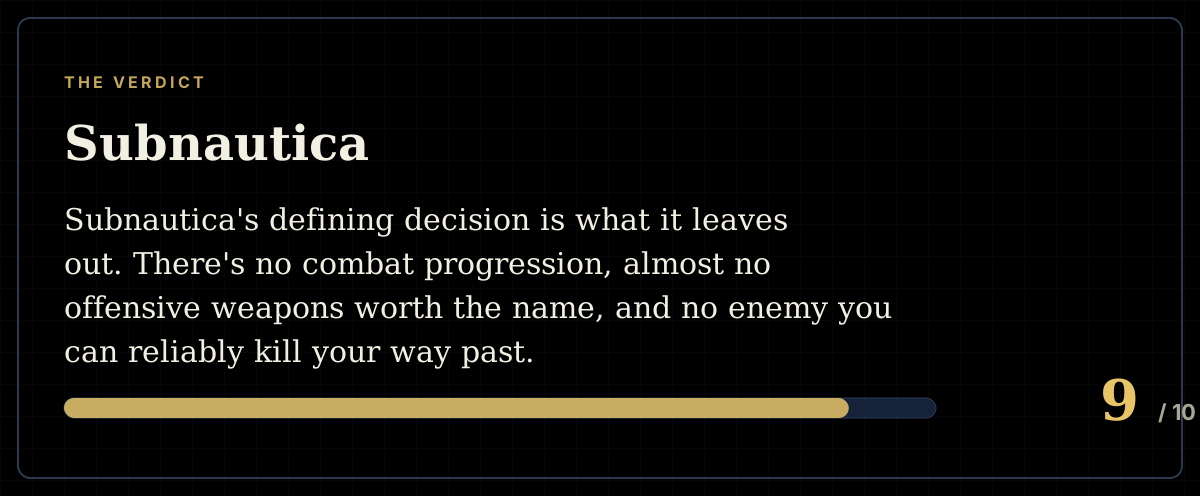
Subnautica's defining decision is what it leaves out. There's no combat progression, almost no offensive weapons worth the name, and no enemy you can reliably kill your way past. Instead the game builds every threat around depth, darkness and a finite oxygen supply, and that constraint turns exploration itself into the tensest system a survival game has built in years.
It isn't flawless — the inventory fights you constantly, the back third of the game slows down once the map is known and the fear has nowhere left to hide, and a small but persistent slice of players still report crashes on Windows nearly a decade on. None of that undoes what the first twenty hours accomplish. Very few games make an empty ocean feel this dangerous.
Biggest strengths
- The oxygen gauge functions as the game's real antagonist, turning ordinary exploration into a constant risk calculation no weapon can solve
- Blueprints are found in wrecks and data boxes rather than unlocked on a tech tree, so the map's layout doubles as the progression curve
- The Seamoth, Prawn Suit and Cyclops gate access to deeper, more dangerous biomes in a way that paces fear instead of just paces stats
Biggest weaknesses
- Inventory space is punishingly small for a game built around hauling resources back to base, and it never really gets fixed
- Once the major biomes and their landmarks are memorised, the dread that defines the first half largely evaporates
- A locker-room of near-identical raw materials (six ore types, several fish species) clutters crafting menus without adding real decisions
Who it's for: Survival and exploration fans who want a genuinely tense single-player world rather than a co-op base-building project; anyone curious what a survival game looks like with the weapons taken out; players who don't mind a slow, log-and-wreck story over a scripted one.
Our recommendation: Buy it, ideally away from a big discount cycle so the wait doesn't feel wasted. It's a one-time purchase with no DLC treadmill, still gets maintenance patches years after launch, and remains one of the few survival games confident enough to make you the prey.
9 / 10
What kind of survival game removes the weapons?
Subnautica opens with your escape pod smacking into an alien ocean, no distress call answered, no land in sight, and precisely one flare gun in your locker that's better at signalling than fighting. That's not a soft opening before the real game starts. It's the whole design thesis. Unknown Worlds took the survival-crafting genre, which almost always resolves its tension through combat — better sword, bigger axe, tougher armour — and built one instead where the only weapon that consistently works is distance. You cannot out-fight a Reaper Leviathan. You can only not be near it, or not be seen, or not run out of air before you get away.
That's a genuinely unusual bet for a genre built on power fantasies, and it's the reason Subnautica still gets talked about eight years after full release while a lot of its contemporaries have faded. It doesn't ask "what can you kill." It asks "what can you survive," and it never lets you forget the answer is often "not much."
The oxygen gauge is the real enemy
Every survival game has hunger and thirst bars ticking down in the corner, and in most of them those bars are a light tax on your attention — top them up, forget about them, get back to the interesting stuff. Subnautica takes the same UI convention and turns it into the interesting stuff. Oxygen is a countdown that starts the moment you leave the surface, and unlike hunger or thirst it can't be ignored or managed on a schedule you set. It scales with depth, with tank tier, with how far you've swum from your last air pocket, and it compounds with every other threat in the game: a creature that startles you into the wrong direction, a cave system that loops back on itself, a base you built slightly too far from the wreck you're salvaging.
The result is that panic in Subnautica has a specific, mechanical shape. It isn't "I'm about to lose a fight." It's "I don't actually know if I can get back to air in time," which is a much harder feeling to shake because there's no boss health bar telling you how close you are to winning. You're doing arithmetic on the fly — tank capacity, swim speed, distance travelled — and the game is quietly betting that you'll misjudge it at least once in a way that actually hurts. Rebreathers and better tanks extend the clock without ever removing it, which is the correct call: a survival game that lets you solve its central tension is a survival game that stops being tense.
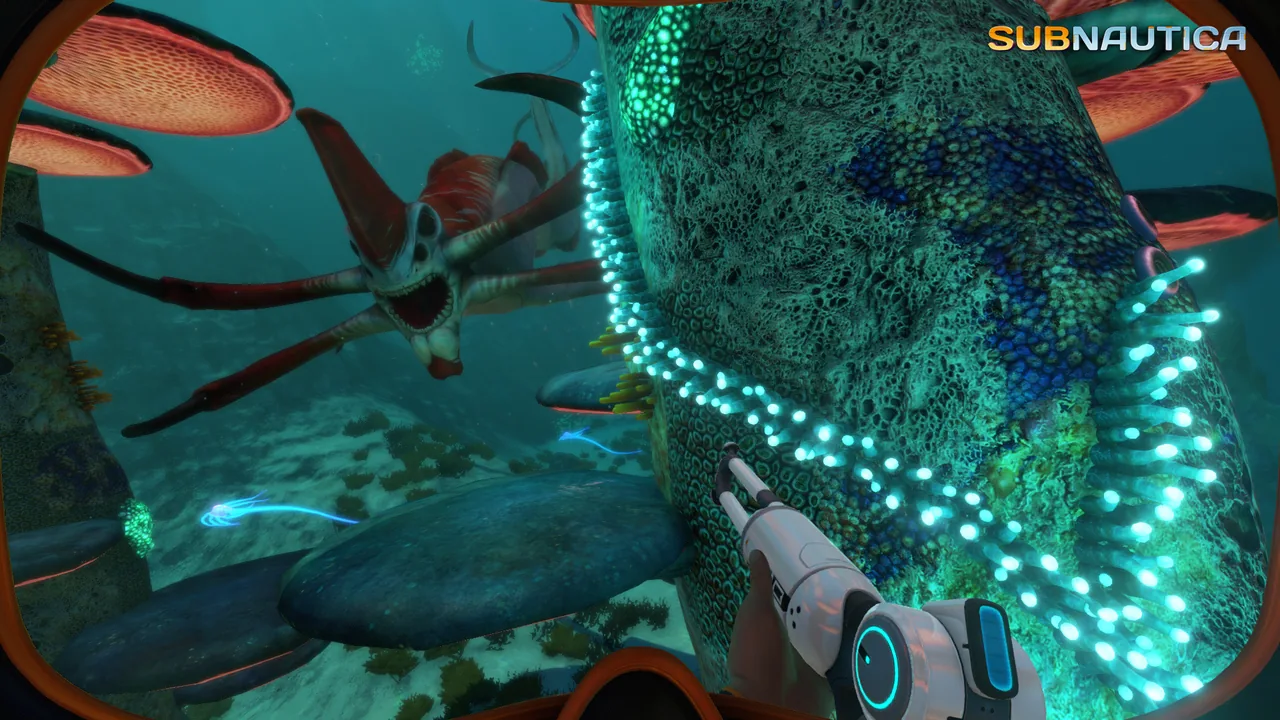
Depth stacks other pressures onto the same gauge. Below certain thresholds your hull starts taking damage without upgrades, visibility drops, and the game leans on sound design rather than jump scares to unsettle you — a distant groan you can't place, echolocation clicks that might be nothing, might be a Ghost Leviathan deciding you're worth investigating. Combat, in the rare cases you attempt it, is almost always a losing proposition against anything that matters. The stinger knife exists mostly to fend off small aggressive fish. Everything above that size class is a navigation problem, not a fight, and once that clicks, the entire genre's usual power curve stops applying. You're not getting stronger than the ocean. You're getting better at reading it.
Progression you find, not progression you unlock
Most survival and crafting games — and this is true of a lot of what Wanderer's own readers grind through — hand you a visible tech tree or a gear ladder with a defined next rung. Subnautica doesn't have one. Blueprints for the Seamoth, the Prawn Suit, better tanks and fabricator upgrades are found: scanned from wreckage, pulled out of data boxes, occasionally handed over by a databank log that points you toward a specific biome. That means the map itself is the tech tree. Knowing where to go next is knowing what to build next, and the two questions are the same question.
It's a structure that rewards exploration far more directly than most open-world survival games manage, because there's no safety net of "grind resources until the number goes up." If you haven't found the fragments, you don't have the upgrade, full stop, and the only way to find them is to go somewhere you currently have a good reason to be afraid of. That's an elegant trap: fear is exactly what's stopping you from getting the tools that would make you less afraid. Compare that to something like Valheim, which our review covers separately — Valheim gates its biomes behind boss kills and a visible material ladder, a more legible structure but a more conventional one. Subnautica trades legibility for genuine discovery, and for a first playthrough that trade mostly pays off. A wiki open in a second window undercuts it badly, and the temptation to use one is real once frustration sets in, but the game was clearly built assuming you wouldn't.
Vehicles as a fear-pacing tool, not just a fear-reduction one
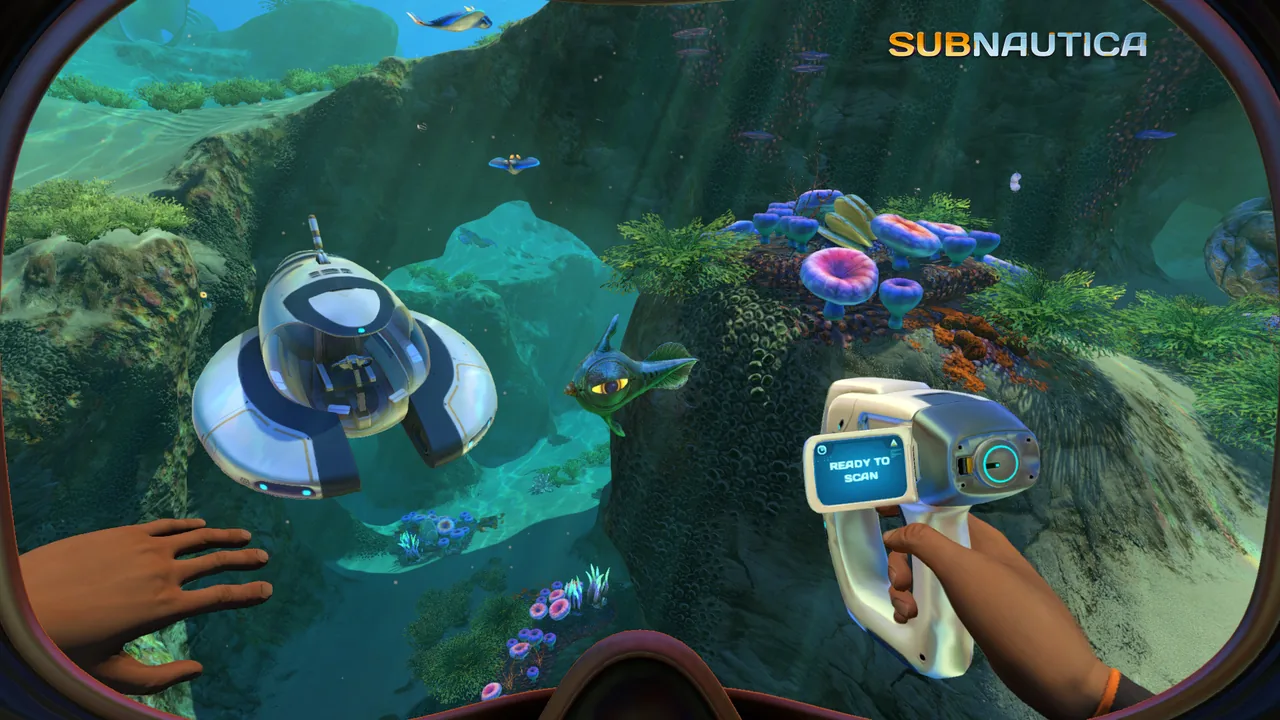
The Seamoth, Prawn Suit and Cyclops don't just let you go faster or carry more. They're the game's main lever for controlling how much dread you're allowed to feel at a given depth, and the pacing around them is genuinely well judged. The Seamoth is fast and fragile — it gets you into mid-depth biomes but a serious Leviathan encounter can total it in seconds, which keeps you cautious even once you technically have a vehicle. The Prawn Suit trades speed for a grapple arm and real durability, turning cave systems and drop-offs from "instant death" into "survivable if you're careful." The Cyclops, meanwhile, functions as a mobile base as much as a submarine — you can retreat into it, repair, and treat the deep ocean as a series of short forays from a safe point rather than one long swim with no way back.
That last part matters more than it sounds. A lot of survival games treat base building as a separate system bolted onto the crafting loop — a home base you decorate, off to the side of the "real" game. Subnautica ties it directly into the fear economy. A base or a parked Cyclops near a dangerous biome is what makes that biome survivable at all; without one, every deep dive is a one-way trip on a timer. Base placement becomes a genuine strategic decision rather than set-dressing, which is more than most of this genre manages, this site's own idle progression loop included.
A story that knows when to shut up
The plot — a crashed alien vessel, a planetary quarantine, a slow reveal of what actually happened to the world you crashed into — is told almost entirely through PDA logs, terminal recordings and the condition of the wrecks you're salvaging. There's no NPC handing you quest markers, because there's almost nobody left alive to do it. That's a deliberate choice and it mostly earns its keep: environmental storytelling is a well-worn technique by now, but Subnautica uses the ocean's own geography to control the order you learn things in, which ties the narrative pacing directly to the exploration pacing instead of running alongside it as a separate track.
Where it wobbles is the same place a lot of environmental narratives wobble: the late game leans harder on withheld information than earned tension, and a handful of major reveals land with less weight than the build-up promised because so much of the delivery has been passive reading rather than anything the game dramatises directly. It's a good story told through a genuinely clever method, not a great story regardless of method.
Where the fear runs out
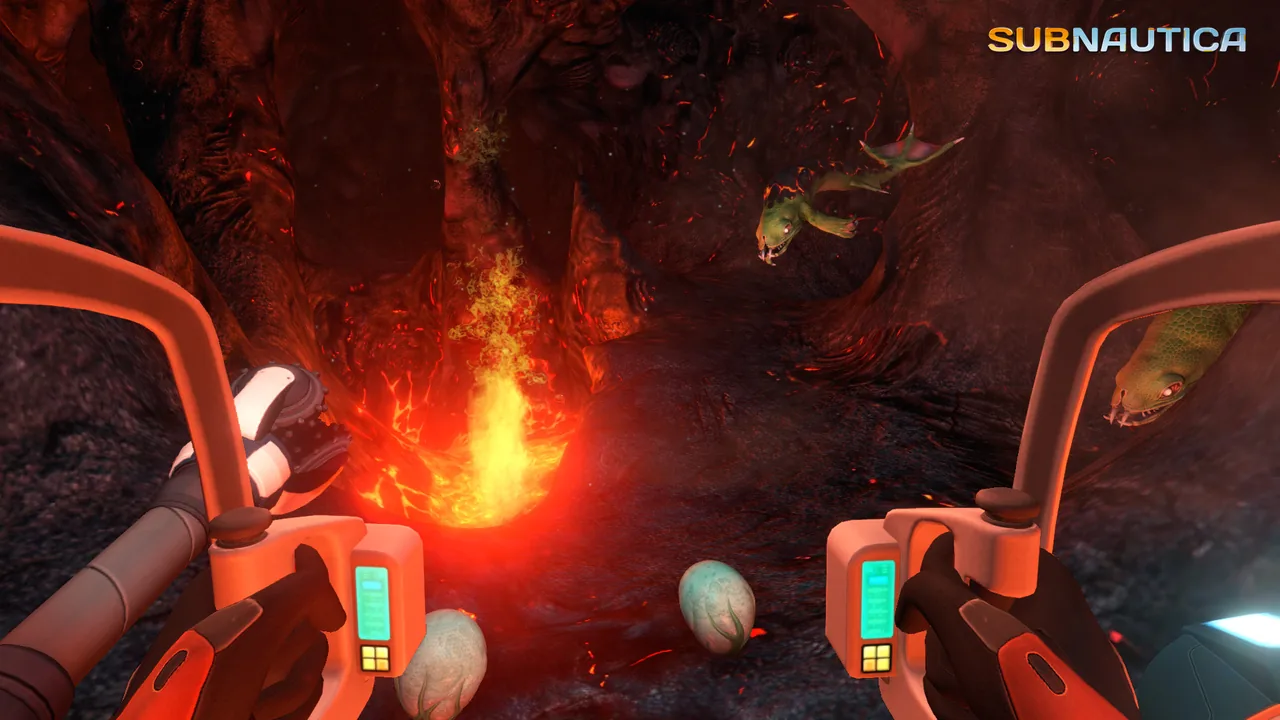
The single biggest structural problem with Subnautica is one that follows directly from its own best idea. Once you've mapped the major biomes, learned which sounds mean which creature, and built a Cyclops that can outrun almost everything that matters, the dread that carried the first twenty hours has nowhere left to come from. The late game becomes a checklist of remaining fragments and a march toward the final area, and the tension that made the early hours so distinctive doesn't have an equivalent late-game replacement. A few genuinely hostile deep biomes try to reintroduce it, and mostly succeed for as long as you're actually in them, but the map as a whole has already given up its secrets by that point.
Inventory management is the other persistent irritant, and it's a bigger deal here than in most survival games because the core gameplay loop is built around long swims back to base with a full hold. Storage upgrades exist but never feel generous, and crafting menus get cluttered by close to half a dozen visually similar ore types that mostly exist to gate specific recipes rather than to offer meaningful choices. It's the kind of friction that's easy to shrug off in a ten-hour game and much harder to shrug off across the thirty-plus hours a full playthrough tends to run.
The technical record, honestly
Subnautica spent close to four years in Early Access before its January 2018 full release, and that period earned it a real reputation for pop-in, stutter and instability — deserved at the time. Years of patches followed, including a substantial free content update in December 2022 that expanded base customisation, and the game has continued receiving maintenance work well past what most premium single-player titles get: a security hotfix landed in October 2025, and another patch shipped in August 2025, seven and a half years after launch. That's an unusually long support tail for a game with no ongoing monetisation to justify it.
The current picture, going by the volume of recent player feedback, is mixed rather than resolved. Most current reports describe a stable experience, and the aggregate Steam rating sits at "Overwhelmingly Positive" across close to 380,000 reviews — a score that number of people couldn't produce if crashes were the norm. But a real minority of recent reviews still describe crash loops, particularly during longer sessions, and it's not something the game has fully put to bed. Buy expecting an occasional crash on a long session, not a broken game.
Value
Subnautica sits at NZ$49.95 on Steam with no discount active at the time of writing, though it turns up in deep sales and free-weekend promotions often enough that patience usually pays off. There's no story or expansion DLC to weigh up — the only add-on is an optional soundtrack — and no live-service layer sitting on top of the base game at all. What you pay for is what you get, permanently, which is worth stating plainly given how rare that's become in this genre. Set against Core Keeper or Dave the Diver, both of which sell for less, Subnautica is the pricier ticket, but it's also the only one of the three built around genuine dread rather than comfortable systems-stacking, and that difference in intent justifies some of the difference in price.
Verdict
Subnautica remains one of the clearest proofs that a survival game doesn't need combat to be tense — it needs stakes, and an oxygen gauge that never stops counting down turns out to generate more of those than most weapon systems manage. The exploration-as-progression structure is genuinely distinctive, the vehicle tiers pace access to fear about as well as any game in the genre has managed, and the sound design does more heavy lifting than the visuals, which is exactly backwards from most competitors and exactly right for this one. It loses ground late, once the map's secrets are spent and inventory friction has had thirty hours to wear you down, and a lingering minority of stability complaints keeps it from a higher performance score. None of that changes what the first two-thirds of the game accomplishes. If you've played Dave the Diver and want the same setting with the danger turned all the way up and the sushi restaurant removed, this is the game. If you've bounced off Valheim or Enshrouded because their biome-gating felt too systemised, Subnautica's find-it-yourself structure is worth the trade.
Players who like their progression to arrive while they're away from the keyboard, rather than earned dive by dive, might find more of that rhythm in something like Wanderer instead — but Subnautica isn't trying to be that kind of game, and it shouldn't be scored as if it were.
Pros and cons
Pros
- The oxygen gauge functions as the game's real antagonist, turning ordinary exploration into a constant risk calculation no weapon can solve
- Blueprints are found in wrecks and data boxes rather than unlocked on a tech tree, so the map's layout doubles as the progression curve
- The Seamoth, Prawn Suit and Cyclops gate access to deeper, more dangerous biomes in a way that paces fear instead of just paces stats
- Environmental storytelling through logs and wreckage gives away just enough plot to keep pulling you toward the next biome without ever stopping to explain itself
- Leviathan-class creatures are used sparingly enough that a single distant roar still changes how you play for the next ten minutes
Cons
- Inventory space is punishingly small for a game built around hauling resources back to base, and it never really gets fixed
- Once the major biomes and their landmarks are memorised, the dread that defines the first half largely evaporates
- A locker-room of near-identical raw materials (six ore types, several fish species) clutters crafting menus without adding real decisions
- No in-game map or waypoint system, which suits the design philosophy but will frustrate anyone used to modern survival-game UX
- A minority of players still report crashes and stability issues on Windows, even this many patches after full release
Screenshots
-
SubnauticaImage: Unknown Worlds Entertainment via Steam -
SubnauticaImage: Unknown Worlds Entertainment via Steam -
SubnauticaImage: Unknown Worlds Entertainment via Steam -
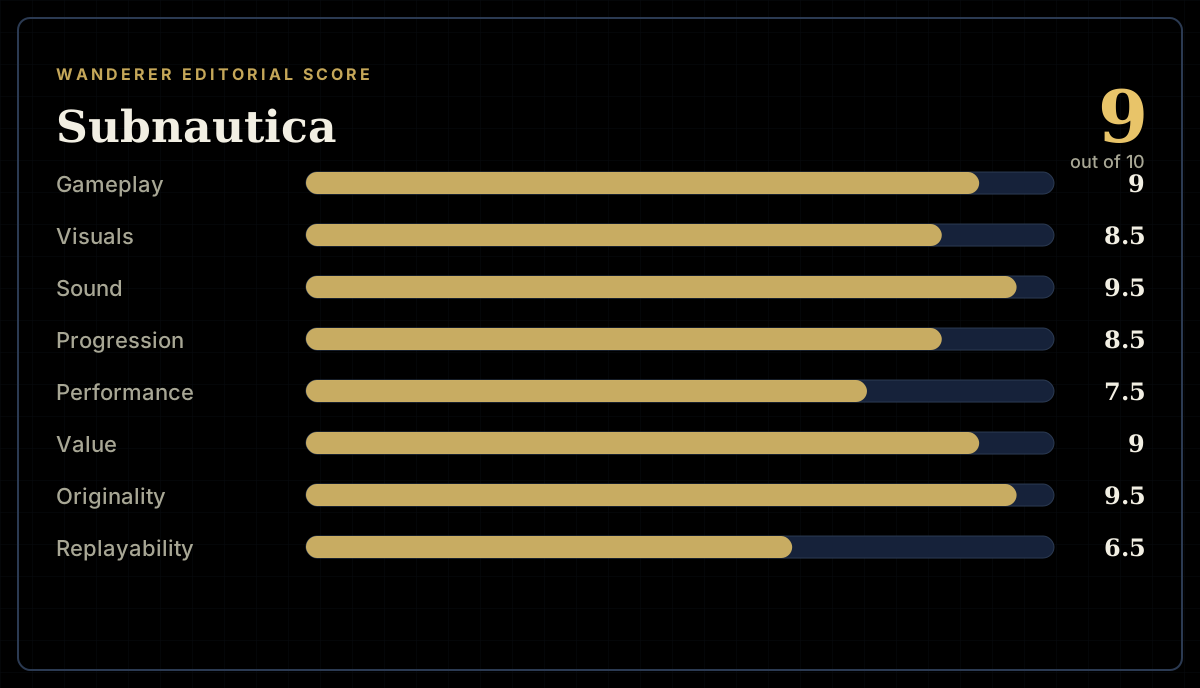
How the review scores each part of the gameWanderer Editorial -
The short versionWanderer Editorial