Game review
Dave the Diver
8 / 10
- Developer
- MINTROCKET
- Publisher
- MINTROCKET
- Released
- 28 June 2023
- Platforms
- Windows, macOS, Nintendo Switch, Nintendo Switch 2, PlayStation 4, PlayStation 5, Xbox One, Xbox Series X|S
- Genre
- Adventure RPG / restaurant sim
- Monetisation
- Premium, one-off purchase. Paid narrative DLC (In the Jungle) and one paid crossover pack (Ichiban's Holiday) are available on top of the base game, alongside two free crossover packs (Godzilla, DREDGE). No in-game currency, ads or gameplay-affecting purchases inside the base game itself.
- Players
- None; single-player only
The short version
Dave the Diver's central idea is genuinely sharp: dive during the day under a hard oxygen and weight-limit clock, then sell what you caught at night through a sushi restaurant that needs specific fish for specific dishes. That loop alone would carry a very good game. Instead MINTROCKET keeps piling farming plots, fish breeding, weapon crafting, card battles and a rotating cast of one-off minigames on top of it, well past the point most designers would call the job done.
The back half suffers for it. Story momentum stalls under fetch quests, new systems arrive faster than any of them can be mastered, and stretches of the map are reused enemies and reused rooms wearing a different coat of paint. None of that erases how good the first fifteen hours are, or how rare it is for a gathering loop and a crafting loop to depend on each other this directly.
Biggest strengths
- The oxygen and weight-limit clock turns every dive into a real risk-reward decision, not a timer for its own sake
- What you catch directly determines what the restaurant can sell that night, so gathering and running the business are the same economy rather than two separate games bolted together
- Hand-animated cutscenes and full voice work give a cast of throwaway-looking NPCs more comic timing than the premise suggests they'd earn
Biggest weaknesses
- New systems (farming, fish breeding, weapon smithing, a full card-battle minigame) keep arriving well past the point the core loop needed the help, and several never get deep enough to justify the interface real estate they take up
- Cutscenes and tutorial prompts frequently interrupt play at moments the player didn't choose, and most can't be skipped
- The story stalls hard in the middle third, padded with fetch quests while the diving areas increasingly reuse enemies and layouts from earlier biomes
Who it's for: Anyone who wants a relaxed, story-driven single-player game with genuine systems depth in its first half, players who liked DREDGE's fishing but wanted a version without the cosmic dread, and anyone burned out on live-service pacing who wants a big single purchase with a defined ending.
Our recommendation: Buy it. Even accounting for the mid-game slump, a $29 game that delivers this much polish, this much genuine mechanical ambition and a real ending is easy to recommend — just expect the second half to ask more patience of you than the first.
8 / 10
Most games that blend two genres pick a primary and a secondary. Dave the Diver refuses to. It spends its mornings and afternoons as a spearfishing roguelite with a hard oxygen clock, and its evenings as a restaurant management sim with staffing, pricing and a dining-room rush. Neither half is a minigame bolted onto the other for flavour — they're both fully worked systems, and for roughly the first third of the campaign that refusal to commit looks like the smartest decision MINTROCKET made. By the middle third, it starts to look like the studio never learned when to stop adding.
The two clocks
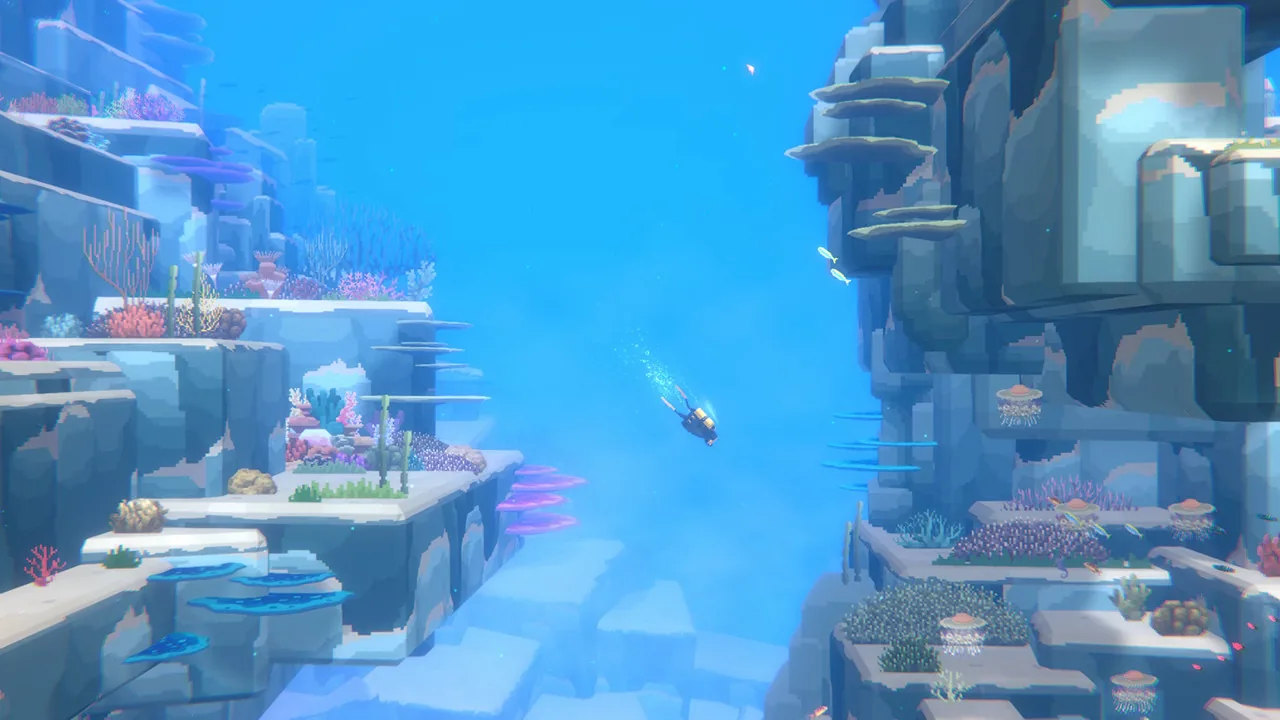
The diving loop works because it never lets you forget you're borrowed time and borrowed inventory space. Dave has a fixed oxygen supply, refillable air canisters found underwater, and a weight limit on how much he can physically carry back to the surface. Every trip becomes a small optimisation problem: chase the rare fish two rooms further down and risk not making it back, or surface early with a safe haul and lower profit. Harpoon a shark badly and it becomes a threat instead of dinner. It's tense in exactly the way a resource-gathering loop should be, and it earns that tension honestly, through a clock and a capacity limit rather than a scripted failure state.
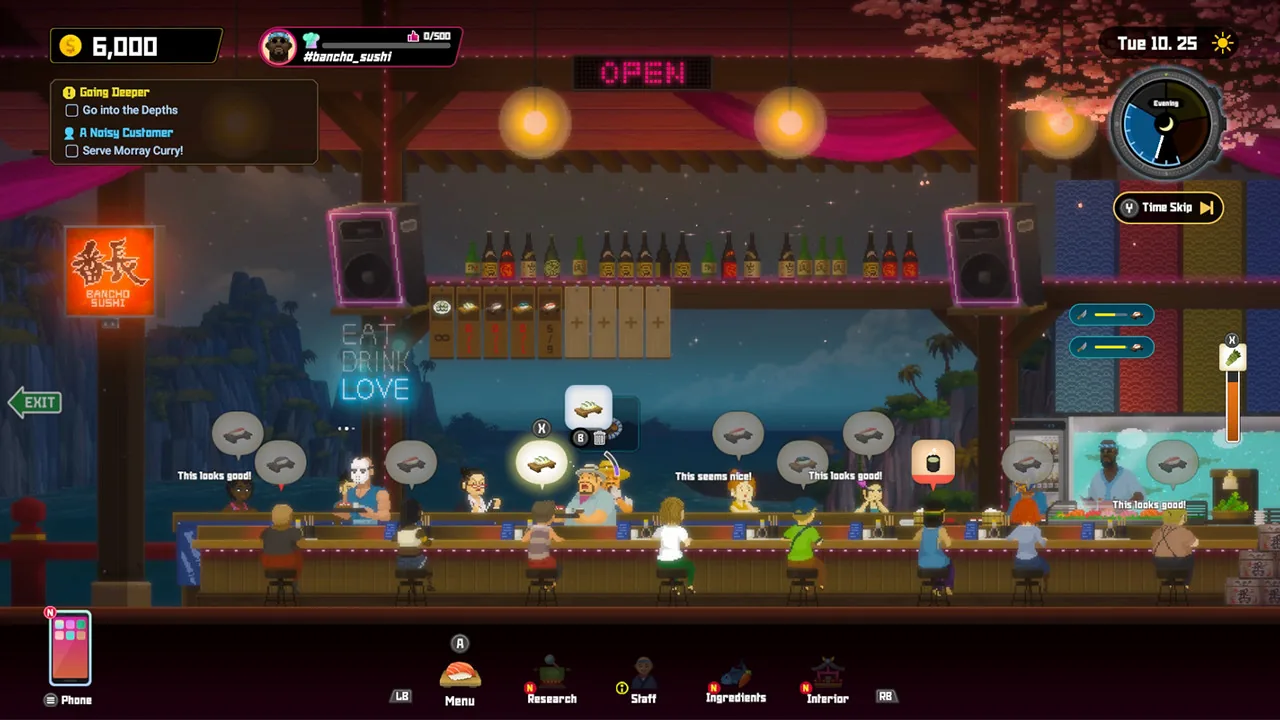
What elevates it above a generic "dive, shoot fish, repeat" structure is that the catch isn't an abstract currency. It's inventory that has to become dishes. The restaurant's menu is built from specific ingredients — a particular fish for sashimi, a particular shellfish for a soup — so a slow night at the Bancho Sushi isn't a separate problem from a bad dive, it's the same problem one day later. Run out of tuna and the tuna dish drops off the menu until the next dive restocks it. That's a tighter link between the gathering half of a game and the "use what you gathered" half than most hybrids manage; a lot of crafting-adjacent games let you stockpile materials until scarcity stops mattering, and Dave the Diver never quite lets that happen, because fish spoil in relevance the moment a new area opens up better ones. The night shift, in turn, gives every individual fish a dollar value and a customer reaction, which turns the morning's dive log into something worth optimising rather than a pile of numbers going up.
The churn problem
Then the game starts adding things. A farming plot for vegetables. A fish-breeding tank. A weapon and gear crafting bench. A card-battling minigame that's a near-direct lift of Balatro, running as its own optional side mode. A rhythm game. A management layer for staff relationships. None of these are badly made — MINTROCKET clearly has the production capacity and the craft to build a competent version of almost anything — but very few of them get the screen time or mechanical depth to become more than a checkbox you tend once and then leave running.
The question worth asking honestly is whether that churn is a feature or a symptom. There's a version of this argument where constant novelty is the point: a roughly 30-to-40-hour campaign that never lets any one system overstay its welcome, always handing you something new before boredom sets in. That's a real and valid design philosophy, and it explains why the opening stretch of the game is so widely loved — every couple of hours genuinely does bring something worth learning. But the churn doesn't stop once the core loop has already proven itself. It keeps going well into the second half, at a point where a player has already invested in getting good at diving and running the restaurant, and instead of deepening either of those two proven systems the game keeps handing over new, shallower ones. The result reads less like restraint and more like a studio that couldn't decide which of its many prototypes to cut, so it shipped all of them. Steam's own user feedback settles on a phrase that's become the game's unofficial tagline among its detractors — wide as an ocean, deep as a puddle — and it's hard to argue with once the farming plot and the fish tank are both just quietly running in the background, adding numbers nobody's optimising around any more.
Pacing, and where it breaks
The day-night structure itself is well judged early on. A day is long enough to get a real dive in and short enough that you're never staring at a clock waiting for something to happen; a night service is brisk, legible, and ends with a clear profit or loss you can act on tomorrow. That rhythm is the game's best piece of pure interface design — it respects a player's time far more than the padding around it does.
The padding is the problem. Story missions increasingly funnel players through fetch quests that exist to gate the next unlock rather than to develop plot, and cutscenes trigger at moments the player didn't choose and frequently can't skip. That's a bigger issue than it sounds: a game built around a tight oxygen clock keeps interrupting itself with sequences that have no clock at all. By the middle third, new diving areas start recycling earlier enemies and room layouts with a new palette, which undercuts the sense of discovery that made the first several biomes so satisfying. None of this breaks the game. It does mean the back half asks for more patience than the front half earns, which is the opposite of how pacing is supposed to work.
Presentation
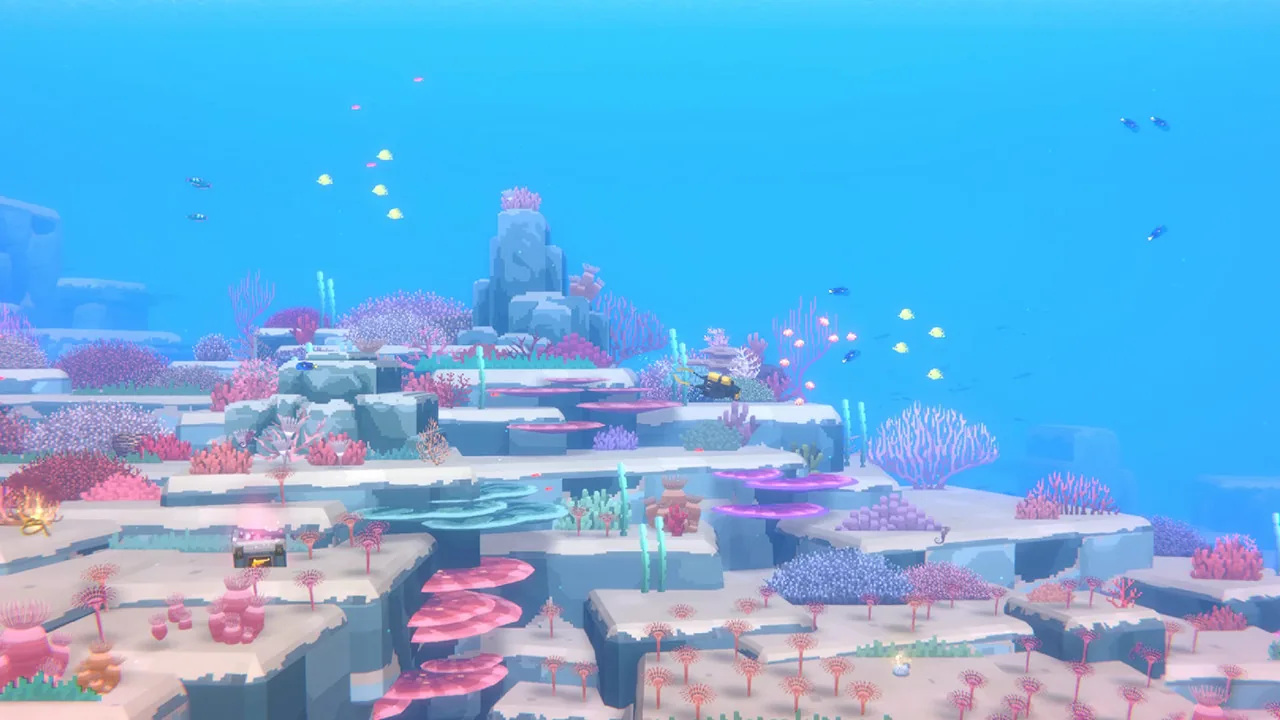
The pixel art and animation are the one part of the production that never wavers. Character sprites carry real comic timing in their idle animations and reaction shots, water and lighting effects give the Blue Hole's biomes a sense of depth well beyond what the resolution should allow, and the fish themselves are drawn distinctly enough that spotting a rare catch from a distance becomes a skill in its own right. The writing leans hard into absurdist humour — a tabloid-editor boss, a chef with an ego the size of the restaurant, increasingly ridiculous mid-game crossover cameos — and it mostly lands because the game commits fully to the bit rather than winking at the player about how silly it's being. It's a game that's very obviously fun to work on, and that shows up on screen more consistently than the mechanical design does.
Value and the DLC question
MINTROCKET is a Nexon-owned studio — Nexon set it up as its own label in 2022, specifically to build smaller, original titles outside the free-to-play MMOs the parent company is best known for — and a premium single-purchase game becoming Nexon's biggest commercial story of the last few years is worth a sentence on its own. It's a genuinely unusual outcome for that publisher, and it hasn't been walked back into a live-service model since.
The base game is one purchase, currently NZ$28.99 on Steam, with a real credits sequence and no currency, energy system or advertising anywhere inside it. On top of that sits a modest and mostly optional DLC slate: two free crossover content packs (a DREDGE-themed event and a Godzilla-themed event), one paid crossover pack (Ichiban's Holiday, a Like a Dragon tie-in, NZ$10.49), a Digital Extra pack of soundtrack and art bonuses from launch, and — as of June 2026 — In the Jungle, a substantial new paid story expansion at NZ$14.49 that adds its own area, mechanics and content pack. None of it is required to finish or enjoy the base campaign, and none of it introduces the kind of monetisation pressure a Nexon game has trained players to expect. That restraint is worth crediting explicitly, not just noting in passing.
Verdict
Dave the Diver earns its reputation in its opening stretch, where the dive-then-sell loop is tight, tense and mutually dependent in a way few hybrid games manage. It loses some of that goodwill in the middle third, where new systems keep arriving faster than any of them can develop real depth, story pacing sags under fetch quests, and diving areas start repeating themselves. It never becomes a bad game — the presentation stays excellent throughout, and the fundamentals never stop working — but the back half is a noticeably lesser experience than the front half sold you on. An 8 out of 10 reflects a genuinely excellent first half pulled down by a design team that never learned to stop adding once the core idea had already proven itself.
Players who want to see the same idea — what you gather determines what you can do with it — built as a persistent world you can dip into instead of a fixed campaign might also want to look at Stardew Valley, which solves the "when does the pressure end" problem differently by keeping its energy-and-season clock running for years of free updates rather than closing the loop after one story. Core Keeper is a closer mechanical cousin on the "digging feeds crafting feeds digging" side of the comparison, without the restaurant half or the mid-game bloat.
Players who like their gathering loop to keep paying off without a credits sequence waiting at the end of it may also want to look at Wanderer — a persistent world where what you mine and forage feeds directly into what you can craft and equip, running whether you're logged in or not.
Pros and cons
Pros
- The oxygen and weight-limit clock turns every dive into a real risk-reward decision, not a timer for its own sake
- What you catch directly determines what the restaurant can sell that night, so gathering and running the business are the same economy rather than two separate games bolted together
- Hand-animated cutscenes and full voice work give a cast of throwaway-looking NPCs more comic timing than the premise suggests they'd earn
- The Blue Hole's biomes are visually distinct and its bosses genuinely change how you have to dive, not just how hard enemies hit
- One $29 purchase covers the whole campaign with a real ending, no currency, no ads, no timers standing between you and playing
Cons
- New systems (farming, fish breeding, weapon smithing, a full card-battle minigame) keep arriving well past the point the core loop needed the help, and several never get deep enough to justify the interface real estate they take up
- Cutscenes and tutorial prompts frequently interrupt play at moments the player didn't choose, and most can't be skipped
- The story stalls hard in the middle third, padded with fetch quests while the diving areas increasingly reuse enemies and layouts from earlier biomes
- Combat against the game's larger bosses is mechanically the weakest part of the moment-to-moment design, relying on pattern memorisation rather than the tactical reads the fishing loop encourages elsewhere
- Once the restaurant is fully staffed and upgraded, its nightly minigame stops asking anything new of the player for the rest of the campaign
Screenshots
-
DAVE THE DIVERImage: MINTROCKET via Steam -
DAVE THE DIVERImage: MINTROCKET via Steam -
DAVE THE DIVERImage: MINTROCKET via Steam -
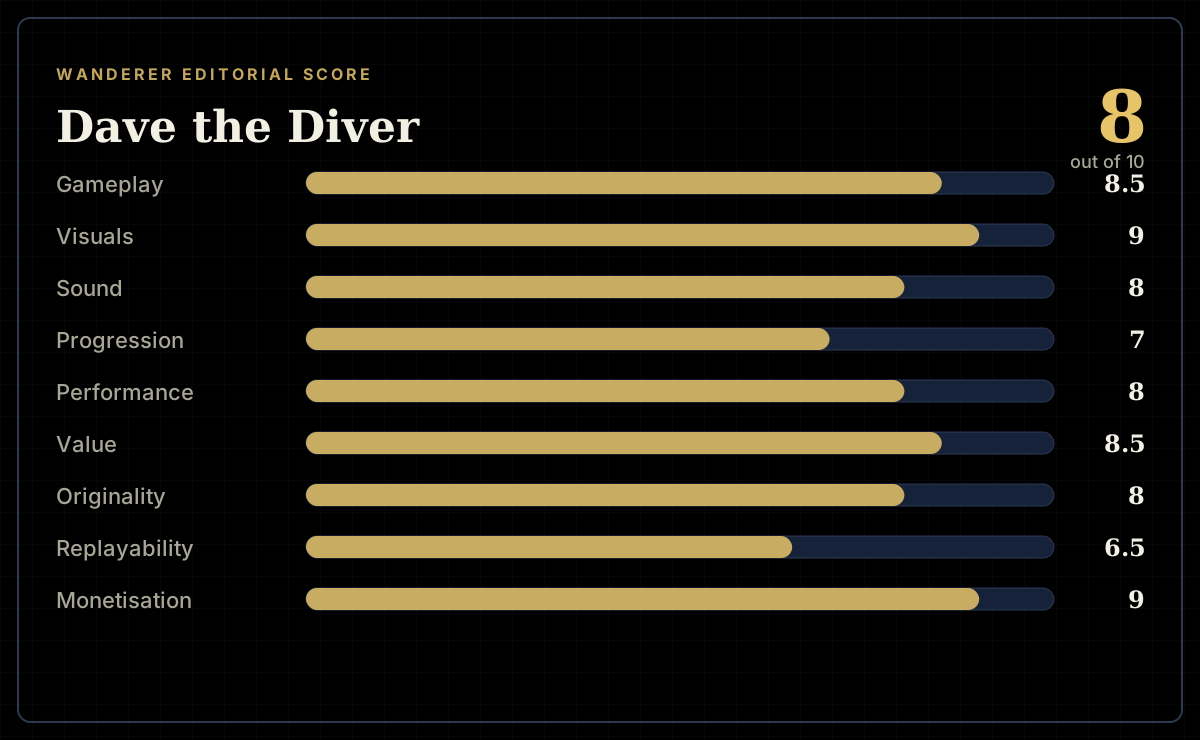
How the review scores each part of the gameWanderer Editorial -
The short versionWanderer Editorial