Game review
Valheim
8.5 / 10
- Developer
- Iron Gate AB
- Publisher
- Coffee Stain Publishing
- Released
- 2 February 2021
- Platforms
- Windows, macOS, Linux, Xbox One, Xbox Series X|S; PlayStation 5 and Nintendo Switch 2 join at 1.0
- Genre
- Survival crafting
- Monetisation
- Premium, one-off purchase — no in-game purchases, no premium currency, no subscription; the only add-on is an optional soundtrack
- Players
- Co-op for up to 10 players in one world; dedicated servers supported; crossplay across PC and Xbox now, extending to PlayStation 5 and Switch 2 at 1.0
The short version
Valheim's central trick still works after five and a half years: every new biome strips away the competence you built in the last one and makes you feel like a beginner again, on purpose. That structure, backed by building and food systems genuinely worth engaging with, is why this is still one of the best survival games on the market rather than just one of the oldest Early Access ones.
The cost is real too — a metal-hauling economy that turns into busywork, a stretch between Mistlands and Ashlands that can feel like waiting, and an Early Access label that has now covered two console generations. September's 1.0 date finally gives that label an ending, which matters more than any single patch has in years.
Biggest strengths
- Each biome genuinely resets the game's sense of safety, turning progression into a series of small, dangerous re-openings rather than one long power climb
- Building uses real structural integrity and piece-snapping, so a longhouse is an engineering decision as much as a decorating one
- The three-slot food system makes cooking and farming a constant, meaningful choice rather than a one-time errand
Biggest weaknesses
- Metal ore can't travel through portals, so mid-game logistics become a repetitive shipping run rather than a puzzle
- The stretch between Mistlands and Ashlands can feel like padding once the initial biome excitement of each has worn off
- Base-heavy worlds and rough seas can still stutter performance on modest hardware
Who it's for: Survival and crafting players who want a world that keeps punishing overconfidence, and co-op groups looking for a shared, long-running project rather than a weekend game.
Our recommendation: Worth buying now rather than waiting for 1.0 — the game you'd play in September is built on the same foundation, just with one more biome and a friendlier front door for PlayStation and Switch owners.
8.5 / 10
Every survival game promises danger. Almost none of them can make a veteran player feel like a beginner again, on demand, more than once. Valheim does it six times over — soon to be seven — and that repeated reset, more than the Viking dressing or the procedural maps, is the reason a game that entered Early Access in February 2021 is still being talked about in the last weeks before it finally leaves it.
The premise hasn't changed since launch: you're a slain warrior resurrected in a purgatory shaped like Norse myth, tasked by a raven-god's agents with killing your way across a chain of biomes until you reach the one that will let you rest. What has changed is how much biome there is. Iron Gate's five-person studio has spent five and a half years adding to that chain one enormous update at a time — Hearth & Home in September 2021, Mistlands in December 2022, Ashlands in May 2024 — and the final piece, Deep North, arrives with the 1.0 release Iron Gate confirmed for 9 September 2026. That date matters. This is, at last, a review of a game with an ending in sight rather than an open-ended promise.
The gate is the game
Strip away the aesthetic and Valheim's structure is simple: six landmasses, later seven, soon eight, each locked behind a boss fight that only becomes winnable once you've properly geared up in the biome before it. Meadows teaches you the verbs. Black Forest adds real threat. Swamp is the first biome that actively wants you dead, with poison and undead in equal measure. Mountains adds a survival stat — cold — on top of everything else trying to kill you. Plains removes your remaining sense of safety entirely, and Mistlands buries navigation itself under fog thick enough that you can't see the thing that just started chasing you.
What makes this work as pacing, rather than as a difficulty slider, is that each biome doesn't just raise numbers — it changes what kind of threat you're managing. Cold in the Mountains is a different problem from poison in the Swamp, which is different again from the Plains' habit of fielding enemies that outrange your bow. You never get to coast on a build that solved the last biome, because the next one is testing something else. That's a harder trick to pull off across a hundred-plus hours than most survival games attempt, and it's the single best argument for why Valheim's Early Access run, however long, produced something worth the wait rather than just more of the same.
The honest crack in the structure is the join between updates. Mistlands to Ashlands was roughly a year and a half apart in real time, and in-game the biomes sit adjacent with nothing new added between them — so a player working through the existing content today experiences that gap as nothing at all, but a player who was there for the wait experienced two years of "the next biome" being the entire conversation around this game. Deep North closes that particular loop, but it's worth naming as the cost of a small team building a game this ambitious in public.
Building that earns its craft mode
Most survival games treat building as decoration bolted onto the real game. Valheim treats it as a system with actual physics: pieces need support within a defined radius or they collapse, wood decays without a roof over it, and a base you build carelessly on a hillside will, at some point, simply fall down. That constraint is what makes building here feel like a genuine skill rather than a creative-mode diversion — you're not just placing pretty walls, you're solving a structural problem with the materials your current biome has given you.
It pays off further through the comfort mechanic. A well-furnished, roofed, fire-lit base grants a "rested" buff that boosts stamina regeneration, and the buff scales with how much decorative effort you've actually put in — chairs, banners, a proper bed — rather than being a flat bonus for having four walls. That's a smart piece of design: it gives the decorating half of the building system a mechanical reason to exist instead of leaving it purely cosmetic, and it means the hours spent making a longhouse look like a longhouse are hours spent on a real stat, not just an aesthetic choice.
Food is the stat sheet nobody explains
The other system doing quiet, constant work is food. You can hold three food buffs at once, each contributing to your maximum health, stamina and regeneration, and the game never tells you this directly — you learn it by dying to something you should have survived and realising your food bar had run dry an hour earlier. Every biome adds new crops, new fish, new monsters worth farming for meat, and a proper build means actively managing which three foods you're carrying rather than eating whatever's cheapest.
It's a good system because it turns farming and cooking from a checkbox into an ongoing decision — do you carry the food that maximises health for a boss fight, or the balanced spread that's safer for general exploration? — and it earns its complexity by mattering in every single fight. Where it strains is onboarding: nothing in the game explains the three-slot logic or the underlying math, so new players spend their first several hours undernourished without understanding why they keep dying to things that shouldn't kill them. A tooltip would have cost nothing and saved a lot of confused Steam reviews.
The unglamorous middle: hauling, sailing, ore
Here is the honest cost of Valheim's structure, and it's worth being direct about it rather than folding it into a paragraph about "pacing." Portals — the game's fast-travel system, unlocked early and cheap to place — refuse to transport ore or raw metal. That single rule, unchanged since launch, is the reason a meaningful chunk of the mid-game consists of building a boat, loading it with tin and copper, and sailing it slowly back to your base while watching the horizon for serpents.
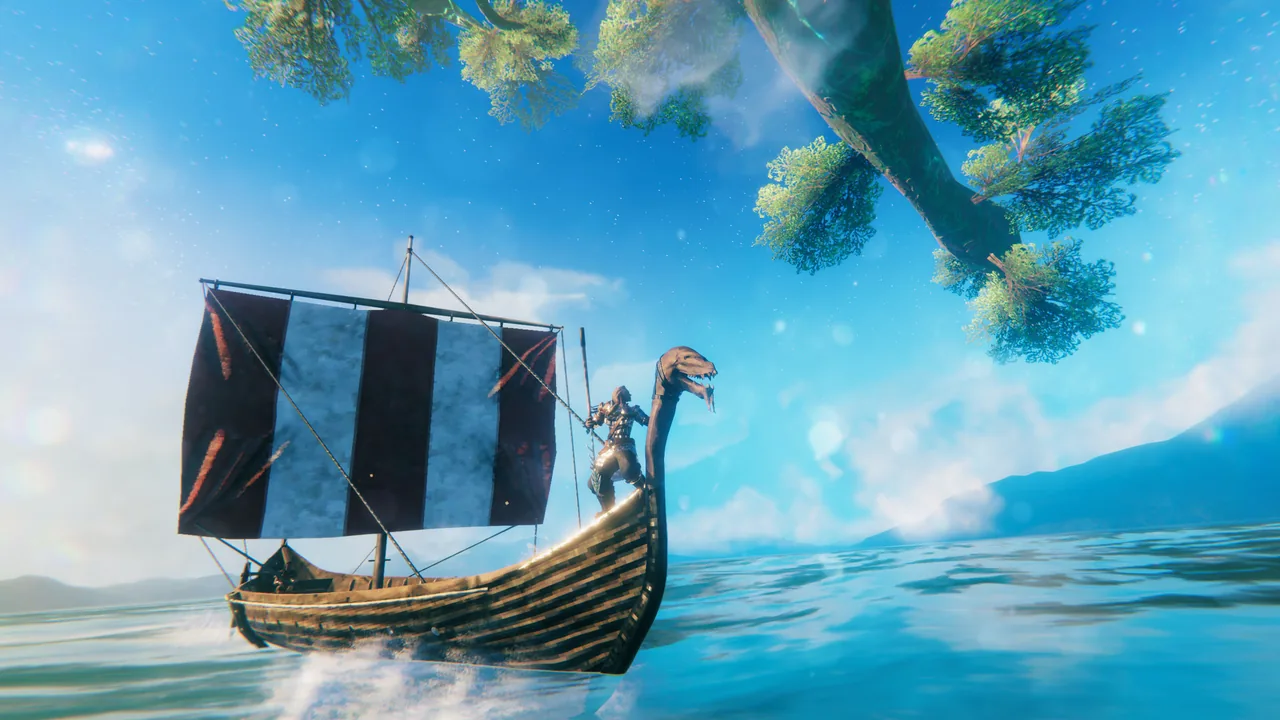
Iron Gate has defended the rule as intentional: it forces you to build ships, engage with the ocean, and feel the weight of what you've mined rather than teleporting resources for free. That argument has merit — sailing is genuinely well made, with wind direction, sail trim and real risk from storms and sea monsters, and the first few ore runs in a new biome are tense in a way the game clearly intends. The trouble is repetition. By your fourth or fifth run hauling the same iron deposit back from the same swamp, the tension has drained out and what's left is a chore with good production values. A survival game is allowed to ask for labour; it's a fair complaint when that labour stops teaching you anything new after the first few trips.
The Plains-to-Mistlands stretch carries a similar tax in a different form — less an obstacle than a waiting room, where the biome itself has been cleared of surprises and the actual goal is stockpiling enough black metal and refined eitr to survive what's coming. Neither of these problems breaks the game. Both of them are the reason "grindy" shows up constantly in player discussion of the mid-game, and both are worth knowing about before you commit sixty hours to a world.
Bosses, combat and the stagger system
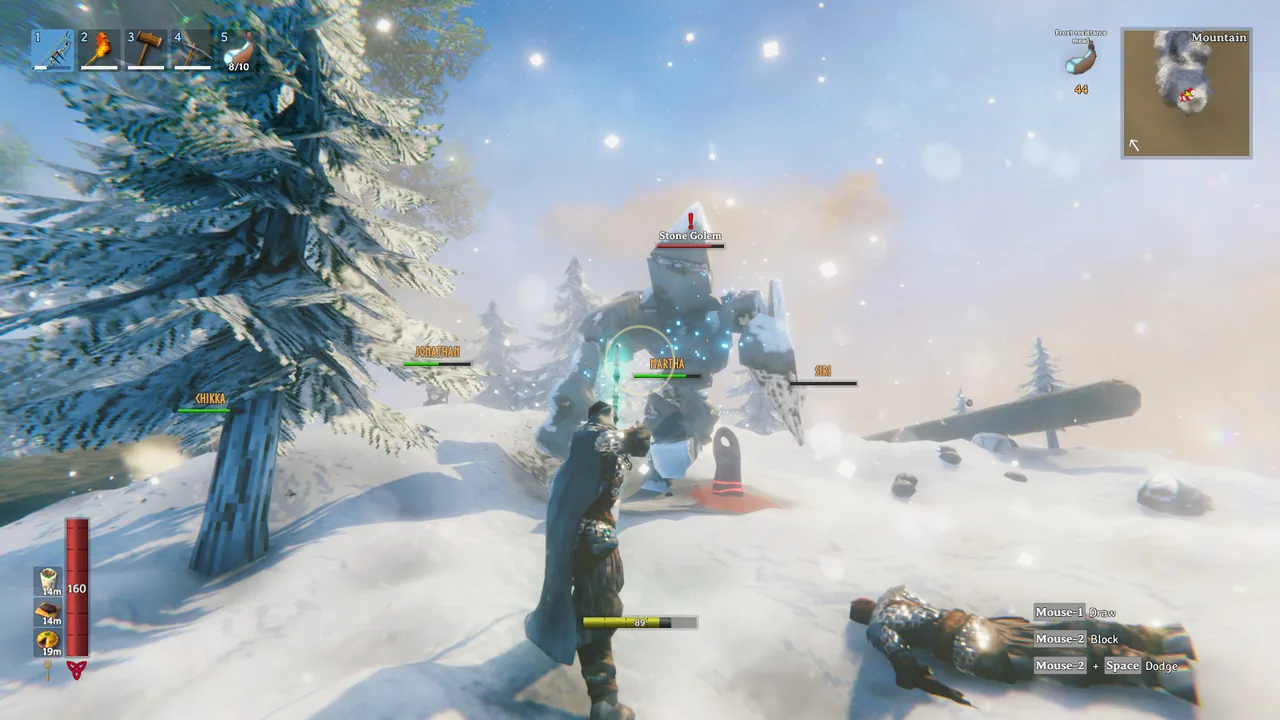
Combat is stamina-governed and deliberately weighty: swings commit you, blocks cost stamina rather than being free, and every weapon carries a stagger value that determines how quickly you can break an enemy's guard and open them up for a heavy hit. That system is what gives Valheim's weapon categories real personality — a two-handed sledge staggers fast and hits like a truck but leaves you exposed mid-swing, while a spear-and-shield build trades damage for the ability to parry a heavy attack at the exact right moment and flip the fight in your favour. It rewards reading an enemy's wind-up rather than memorising a rotation, and the eight boss fights (six live now, a seventh in Ashlands, an eighth expected with Deep North) are built specifically to test that reading under pressure — new attack patterns, new arenas, new reasons your last build's habits will get you killed.
The magic system, added properly in Mistlands and expanded in Ashlands, sits less comfortably next to all this. Staffs and elemental damage are a welcome alternative for players tired of melee, but they arrive late enough in the progression that most players have already built strong habits around stamina-based combat, and the two systems don't always feel like they were designed together. It's good that the option exists. It doesn't yet feel load-bearing the way building and food do.
Multiplayer, servers and the wait to actually cross play
Valheim has always been better with company, and the tools support that properly: dedicated servers you can run yourself, up to ten players sharing a world, and shared risk that makes even a routine ore run feel like it matters because someone else is counting on you to come back with it. Losing your gear on death and having to recover the pile from where you fell is a familiar survival-game mechanic, but it lands harder in co-op, where a friend genuinely might beat you back to your own corpse.
Crossplay has been the sore point. PC and Xbox players have been able to share a world for a while, but PlayStation and Nintendo Switch 2 owners have had nothing to play at all — Valheim simply hasn't existed on those platforms — and Iron Gate has confirmed that full crossplay across every platform arrives specifically with the 1.0 release on 9 September 2026. That's a real gap closing soon rather than a permanent one, but it's fair to note that a meaningful slice of the potential audience has had to wait out the entire Early Access run to get in at all.
Presentation, five years on
The low-poly, painterly art style that made Valheim's first trailers so distinctive has aged well because it was never chasing realism — soft lighting, dense fog and a genuinely excellent score from composer Patrik Jarlestam do more atmospheric work than higher-fidelity survival games manage with ten times the budget. Mistlands and Ashlands both push the art direction further, trading Meadows' gentle green for oppressive fog and volcanic red respectively, and the game is still recognisably the same visual project it was in 2021, just more confident.
Performance is the one place the small-team scale shows. A heavily built base with dozens of structural pieces, animals and stored items can produce real stutter, and rough seas with a lot of physics objects in play aren't much kinder. None of it is close to unplayable, and it's improved over the years, but a base-proud player on modest hardware will notice it more than the marketing screenshots suggest.
Value, and what an Early Access label is worth after five years
At NZ$43.59, unchanged in spirit if not in the exact figure since launch, and with no in-game purchases of any kind attached, Valheim's value case has never really been in doubt — a hundred-plus hours of content for the price of two dinners out is a good trade under any circumstances, and the free content since 2021 (Hearth & Home, Mistlands, Ashlands, and Deep North on the way) has more than doubled what launch buyers originally paid for.
What's fair to interrogate is the Early Access label itself. Five million copies sold in the first month back in 2021, ten million within eighteen months — Valheim was never an unfinished game limping toward relevance; it was a hit that happened to ship with a tag usually reserved for smaller, riskier projects. Five and a half years, two console launches and three major biome updates later, that tag has arguably done more to manage expectations about update pace than to describe the game's actual state of completion. A firm 1.0 date changes that calculus in a way no patch note could — it turns "eventually" into "the 9th of September," and that's worth crediting even before the Deep North content itself is playable.
Players who like the idea of a world that keeps demanding a little more of their attention and rewards patience over twitch reflexes, without the sailing and ore runs attached, might also find something to like in Wanderer's own slower, biome-adjacent progression.
Verdict
Eight and a half. Valheim's biome-gated structure remains one of the smartest pieces of pacing in the survival genre — a game that keeps making you feel unprepared on purpose, backed by a building system and a food system that both genuinely reward the time they ask for. The ore-hauling economy and the flatter middle stretch between Mistlands and Ashlands are real costs, not minor ones, and they're the honest reason this isn't a 9. But they're costs attached to a game that has spent five and a half years adding rather than padding, and that's about to, finally, actually finish.
If you've been waiting for 1.0 to jump in, September gives you a good reason. If you're on the fence today, there's no argument for waiting — the foundation you'd be buying is already excellent, and one more biome won't change what kind of game this is.
Price and platform details checked 30 July 2026.
Pros and cons
Pros
- Each biome genuinely resets the game's sense of safety, turning progression into a series of small, dangerous re-openings rather than one long power climb
- Building uses real structural integrity and piece-snapping, so a longhouse is an engineering decision as much as a decorating one
- The three-slot food system makes cooking and farming a constant, meaningful choice rather than a one-time errand
- Combat's stagger and parry timing give shields and two-handed weapons genuinely different identities in a fight
- One purchase, no in-game shop, no premium currency, and five and a half years of free content updates since launch
- Co-op holds up as the game's best mode — shared bases and shared risk make even routine chores feel worth doing
Cons
- Metal ore can't travel through portals, so mid-game logistics become a repetitive shipping run rather than a puzzle
- The stretch between Mistlands and Ashlands can feel like padding once the initial biome excitement of each has worn off
- Base-heavy worlds and rough seas can still stutter performance on modest hardware
- The Early Access tag has now covered five and a half years and two very long gaps between major biome updates
- Skill-based levelling means death carries a real stat penalty that newer players can find punishing before they understand it
- PlayStation and Switch 2 owners have had nothing to play at all until 1.0 actually ships
Screenshots
-
ValheimImage: Coffee Stain Publishing via Steam -
ValheimImage: Coffee Stain Publishing via Steam -
ValheimImage: Coffee Stain Publishing via Steam -
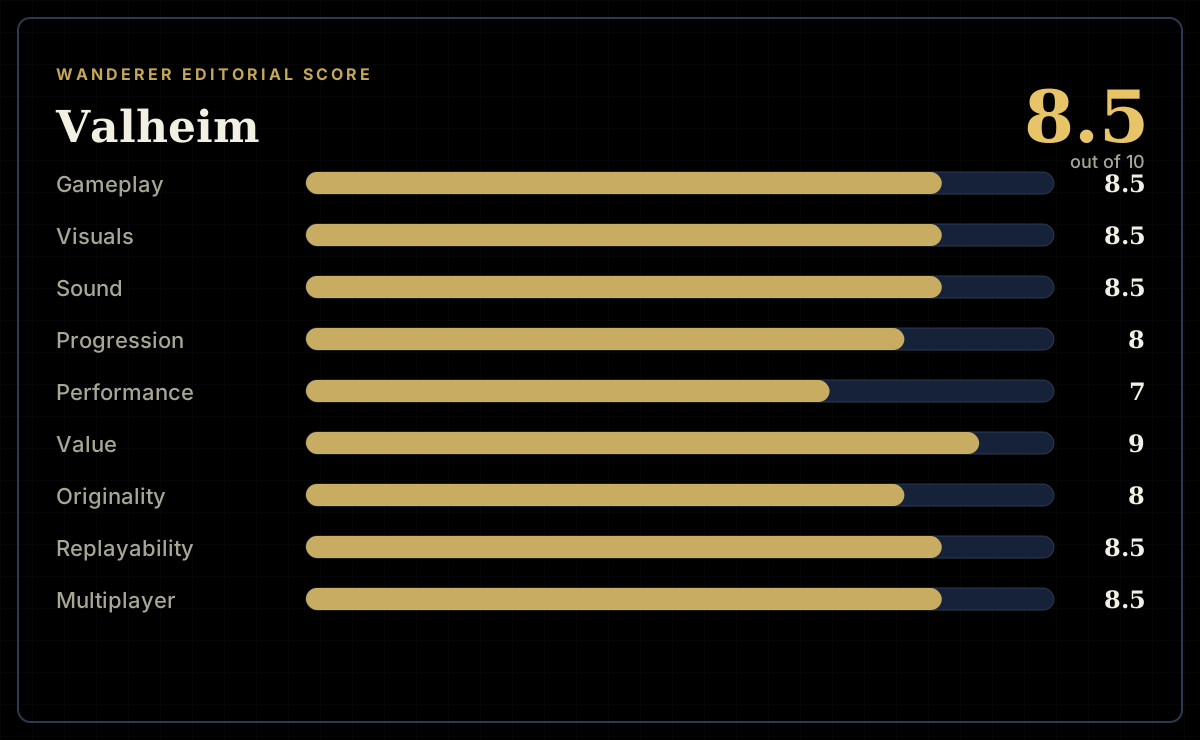
How the review scores each part of the gameWanderer Editorial -
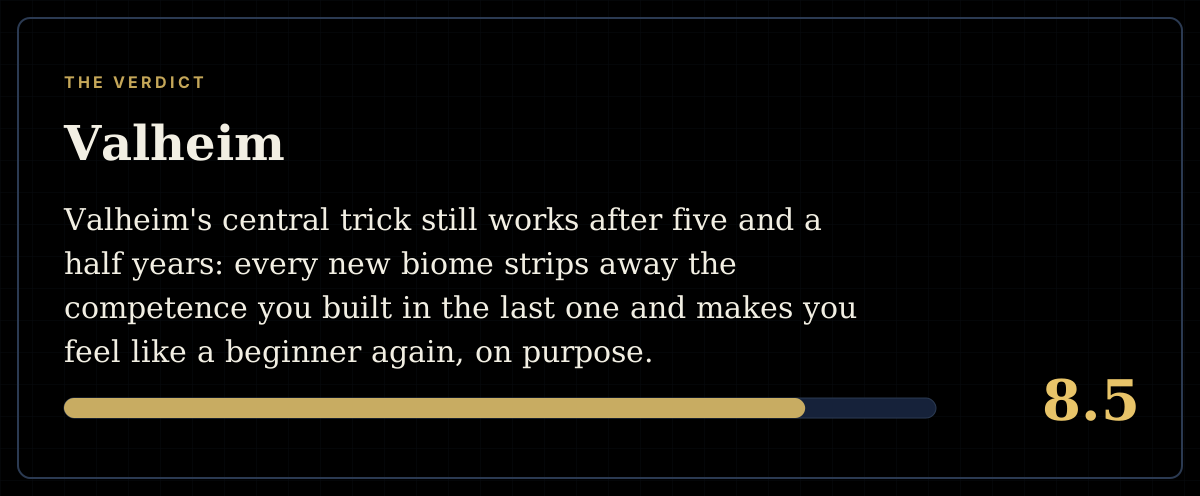
The short versionWanderer Editorial