
Game review
KARMA: The Dark World
6.5 / 10
- Developer
- POLLARD STUDIO LLC
- Publisher
- Wired Productions, Gamirror Games
- Released
- 27 March 2025
- Platforms
- Windows
- Genre
- Psychological Thriller, Walking Simulator
- Monetisation
- One-time purchase, no DLC or in-game currency
- Players
- Single-player
The short version
KARMA: The Dark World casts you as Daniel McGovern, a Roam Agent for the all-powerful Leviathan Corporation's Thought Bureau in an alternate 1984 East Germany, diving into the minds of the accused to investigate crimes that blur into surreal, mind-bending territory. Built on Unreal Engine 5's Lumen and Nanite technology, the game draws consistent, specific praise for its visuals, voice acting and sound design — reviewers across languages independently rate the first three quarters of the story as genuinely gripping. Two problems recur just as consistently across that same admiring audience. First, marketing that leans on horror imagery has, by many reviewers' own account, brought in an audience expecting scares rather than the cinematic, largely non-interactive psychological thriller the game actually is. Second, and more seriously, a story that a large share of reviewers say builds real tension and emotional investment collapses in its final act into confusing, heavily-expository plotting that several say undoes the earlier goodwill.
Biggest strengths
- Visuals draw near-universal, specific praise, with Unreal Engine 5's Lumen and Nanite technology used to render both the dystopian reality and its surreal, mind-bending dream sequences to a standard reviewers repeatedly call cinematic
- Voice acting and sound design are consistently singled out as excellent, with motion-captured performances credited for carrying much of the story's emotional weight during its stronger stretches
- The first three-quarters of the narrative draw genuine, specific investment from reviewers across multiple languages, with several describing being glued to the screen and deliberately pacing their sessions so the experience wouldn't end too soon
Biggest weaknesses
- A large and specific share of reviewers argue the game's marketing, including horror-adjacent trailers and store messaging, misrepresents what's actually a cinematic psychological thriller and walking simulator with very few scares — several explicitly warn other buyers not to purchase expecting a horror game
- An equally large and specific share of reviewers report the story losing its footing badly in the final act, describing a confusing, over-complicated plot dump that several say arrives too suddenly to land the emotional beats it's reaching for
- The gameplay-to-cutscene ratio draws direct, quantified criticism from at least one detailed reviewer, who estimates roughly five of six total hours are cutscenes with only about one hour of actual interactive gameplay
Who it's for: Fans of narrative-first, cinematic "walking simulator" experiences in the vein of Twin Peaks or Nineteen Eighty-Four-adjacent dystopian fiction, who want a visually stunning, largely non-interactive story over any real horror-game tension or gameplay depth. Explicitly not for players expecting a horror game with monsters and scares, despite some of the marketing's framing.
Our recommendation: Worth playing for the atmosphere, performances and a genuinely strong first three-quarters, but temper expectations for both the "horror" label and the ending — go in expecting a short, mostly cutscene-driven cinematic thriller, and be prepared for a conclusion a large share of the game's own fans say doesn't stick the landing.
6.5 / 10
A dystopia worth diving into
KARMA: The Dark World's premise is a strong one: in an alternate 1984, the omnipresent Leviathan Corporation controls East Germany through surveillance, class stratification and the promise of a "Utopia" reserved for the obedient. You play Daniel McGovern, a Roam Agent whose job is literally diving into the minds of the accused to investigate their crimes — a premise that lets the game blend grounded dystopian world-building with genuinely surreal, mind-bending dream sequences. Built on Unreal Engine 5's Lumen and Nanite rendering technology, the results draw close to universal praise: reviewers consistently call the visuals cinematic, the motion-captured performances strong, and the sound design a real contributor to the atmosphere rather than mere backing.
Not the horror game the trailers implied
The most immediately actionable piece of consumer advice running through the review corpus concerns genre expectations. A highly-voted Chinese-language review states the point directly enough to translate cleanly: "this is not a horror game, if you want a horror game please don't buy it" — going on to argue that marketing materials, including preview coverage, have consistently and counterproductively framed KARMA as horror when the store page's own description calls it a "cinematic psychological thriller." English-language reviewers independently reach the identical conclusion, warning other buyers away from horror-genre expectations before they even discuss the story itself. That's a specific, corroborated marketing problem rather than a matter of taste — reviewers aren't disagreeing about whether the game is good, they're agreeing that a meaningful share of its own negative reception likely stems from buyers walking in expecting monsters and jump scares that the actual, largely non-interactive walking-simulator experience was never built to deliver.
Three strong acts, and then a stumble
Where opinion genuinely splits is over the story's back half. A large number of reviewers describe the first three-quarters of KARMA as genuinely gripping — one reviewer specifically paced their own sessions to avoid finishing too quickly, not wanting the experience to end. That same reviewer, alongside many others, then describes the story "nosediving" in its final stretch: a rush of exposition, plot revelations arriving too fast to properly land, and emotional beats several reviewers say feel unearned given how quickly they're delivered. One detailed reviewer frames it precisely: "big exposition dump at the end" following story beats that "do not feel earned at all," while still crediting the overall project as ambitious. Another separately calls the plot "one of the most confusing and over complex stories" they've encountered in a game, arguing the narrative complicates itself past the point of clarity rather than rewarding close attention.
A short, mostly-watched experience
A more structural complaint concerns just how much of KARMA's runtime is spent actually playing versus watching. One detailed reviewer quantifies this precisely: of roughly six hours total, they estimate about five were cutscenes and only around one hour was actual interactive gameplay, with the rest split between light puzzle-solving and railed walking segments. That reviewer specifically questions whether the game qualifies as a walking simulator at all, given how little walking or interaction the runtime actually contains. A separate, more specific criticism targets the protagonist's vocal performance, with at least one reviewer finding Daniel's delivery and pronunciation grating enough to affect their enjoyment of dialogue-heavy stretches — a real liability in a story this dependent on internal narration and conversation to carry its weight.
What playing a Roam Agent actually involves
The moment-to-moment gameplay, thin as its total share of the runtime is, centres on investigating crime scenes and diving into suspects' memories, piecing together clues scattered through increasingly surreal mental landscapes. Reviewers who engage with the puzzle elements describe them as generally solvable but occasionally obtuse — one reviewer specifically needed a guide for a clock puzzle, then felt foolish once the intended logic was explained, a fairly common experience in this kind of light adventure-puzzle design. One detailed comparison places the overall feel closer to Still Wakes the Deep than to a traditional survival-horror walking sim — another cinematic, narrative-forward first-person game with limited combat and heavy scripted sequences — which lines up with the corpus's broader argument that KARMA belongs in a different genre bucket than its marketing suggests.
A B-movie with real ambition
Several reviewers land on a specific, affectionate framing worth noting on its own: describing KARMA as an "arthouse" or "B-movie tier" thriller that overperforms expectations for its budget and scope, rather than judging it against AAA narrative benchmarks. That framing helps explain why so much of the corpus can hold both a genuine, detailed critique of the ending and a positive overall recommendation at the same time — reviewers aren't grading the game against Nineteen Eighty-Four's source-material prestige, they're grading it as an ambitious, mid-budget genre exercise that mostly succeeds at punching above its weight, even where the final stretch doesn't fully deliver on the tension it spent three acts building.
The verdict
KARMA: The Dark World is a visually stunning, well-performed cinematic thriller let down by two specific, well-documented problems: marketing that sets the wrong expectations for a meaningful share of its buyers, and a final act that a large share of even its admirers say squanders the goodwill built up over the preceding three-quarters. Neither problem is subtle or contested within the review corpus — both recur with remarkable consistency across independently-written accounts. For narrative- first players who go in understanding exactly what kind of experience they're buying — short, mostly cinematic, genuinely strong until its closing stretch — this remains a worthwhile few hours in a distinctive, well-realised dystopia.
Pros and cons
Pros
- Visuals draw near-universal, specific praise, with Unreal Engine 5's Lumen and Nanite technology used to render both the dystopian reality and its surreal, mind-bending dream sequences to a standard reviewers repeatedly call cinematic
- Voice acting and sound design are consistently singled out as excellent, with motion-captured performances credited for carrying much of the story's emotional weight during its stronger stretches
- The first three-quarters of the narrative draw genuine, specific investment from reviewers across multiple languages, with several describing being glued to the screen and deliberately pacing their sessions so the experience wouldn't end too soon
- The alternate-1984 East German setting and Leviathan Corporation's surveillance-state premise draw favourable comparisons to Nineteen Eighty-Four and Twin Peaks, with reviewers crediting the game for building a distinctive dystopian atmosphere rather than a generic one
- At a relatively short runtime and mid-range price, several reviewers frame the experience as good value specifically for narrative-focused players who know what they're buying going in
Cons
- A large and specific share of reviewers argue the game's marketing, including horror-adjacent trailers and store messaging, misrepresents what's actually a cinematic psychological thriller and walking simulator with very few scares — several explicitly warn other buyers not to purchase expecting a horror game
- An equally large and specific share of reviewers report the story losing its footing badly in the final act, describing a confusing, over-complicated plot dump that several say arrives too suddenly to land the emotional beats it's reaching for
- The gameplay-to-cutscene ratio draws direct, quantified criticism from at least one detailed reviewer, who estimates roughly five of six total hours are cutscenes with only about one hour of actual interactive gameplay
- The protagonist's vocal performance draws specific, pointed criticism from at least one reviewer over line delivery and pronunciation, a notable complaint given how much of the story rests on dialogue and internal narration
- Steam's own achievement data shows a steep drop from main-story milestones (74-94%) to side-content and collectible achievements (6.5-17.8%), suggesting most players engage with the core story alone rather than exploring the game's more optional content
Screenshots
-

KARMA: The Dark WorldImage: Wired Productions via Steam -

KARMA: The Dark WorldImage: Wired Productions via Steam -

KARMA: The Dark WorldImage: Wired Productions via Steam -
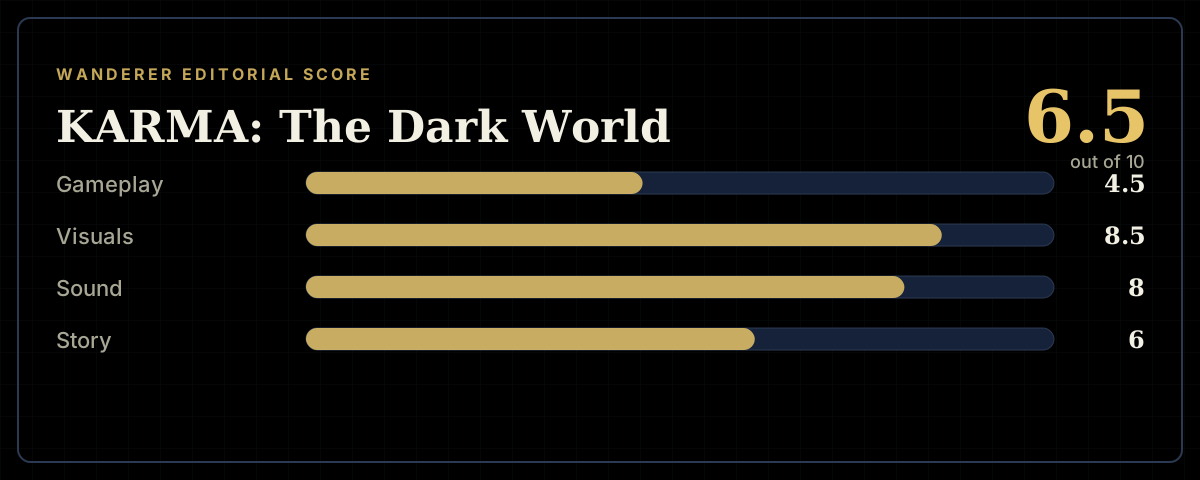
How the review scores each part of the gameWanderer Editorial -
The short versionWanderer Editorial