
Game review
Sixty Four
6 / 10
- Developer
- Oleg Danilov
- Publisher
- Playsaurus
- Released
- 4 March 2024
- Platforms
- Windows, macOS, Linux
- Genre
- Clicker-to-idle factory and resource-management game
- Monetisation
- One-time purchase, no in-game store or additional currency purchases
- Players
- Single-player only
The short version
Sixty Four bills itself as a clicker game that gradually turns idle as you unlock automation, but a remarkably consistent thread through its review sample argues it never fully commits to either identity: clicking never stops mattering the way a pure clicker game demands, and automation never gets complete enough to let a factory truly run itself the way an idle or incremental game promises. That ambiguity is clearly deliberate — the solo developer built a genuinely distinctive, story-driven puzzle-factory hybrid with striking visuals and an unusual refusal to hold your hand — and plenty of reviewers love exactly that refusal to be conventional. But just as many describe real frustration with resource costs that scale far faster than the tools available to keep up with them, and with store-page marketing that oversells the "idle" half of the pitch. A late 2025 offline-progression patch directly answers the most common complaint, but arrived well over a year after launch and doesn't fully settle the deeper argument about whether the loop itself is actually fun to sit with.
Biggest strengths
- The visual presentation and audio, including a score by composer Jake Chudnow, are repeatedly and specifically praised across the review sample as genuinely striking for the price
- The refusal to explain its systems up front is treated by a meaningful share of reviewers as a strength rather than a flaw, with several specifically enjoying the process of puzzling out mechanics through experimentation rather than a tutorial
- The game hides a genuine, unfolding text-based mystery narrative behind its factory-building surface, which several reviewers single out as more compelling than they expected going in
Biggest weaknesses
- The single most repeated complaint in the review sample is that the game doesn't cleanly deliver on either half of its "clicker becoming idle" pitch, with several reviewers independently describing it as failing to satisfy fans of clicker games or idle/automation games specifically
- Resource and upgrade costs are described by multiple reviewers as scaling far more aggressively than the tools available to keep pace, creating stretches where progress requires manual intervention every one to two minutes rather than genuine automation
- At least one detailed reviewer states outright that the Steam store page's presentation is misleading about how automated the game actually becomes, and that buyers specifically drawn in by the "idle" framing should be aware of that gap
Who it's for: Players who enjoy being thrown into an unexplained system and figuring it out through experimentation, and who don't mind a factory game that periodically demands hands-on intervention rather than running unattended. Not a good fit for players specifically seeking a low-effort idle game or a deep, Factorio-style automation sandbox.
Our recommendation: A cheap, genuinely distinctive curiosity worth trying at its low price if the premise of "clicker crossed with factory game crossed with mystery narrative" appeals to you specifically. Go in expecting a demanding, occasionally frustrating hybrid rather than either a relaxing idler or a deep automation sandbox.
6 / 10
Sixty Four's own store-page pitch sets up a clear expectation: a clicker game that gradually becomes more idle as you unlock automation, working toward full hands-off factory production. It's an appealing premise, and the game backing it is genuinely distinctive — striking minimalist visuals, a score from composer Jake Chudnow, and an unusual willingness to let players puzzle out its systems without much guidance. What the review sample argues, at length and with unusual consistency across dozens of otherwise very different reviewers, is that the actual experience of playing Sixty Four never quite delivers on that pitch — not because it fails at being a factory game or a clicker game individually, but because it seems determined not to fully commit to either.
A genre that refuses to settle
The clearest and most repeated complaint in the negative sample isn't about any single mechanic — it's about category confusion. "Not idle game, requires almost constant attention to progress. Not clicker game, when you give it full attention, it doesn't have enough things for you to do... Not a factory game," one reviewer writes, and variations of that exact structure appear independently across the sample. Another puts it more bluntly: "it kinda just ends up failing at both," referring to the clicker and factory genres it's marketed as blending. This isn't a case of a handful of players missing the point — the sheer number of reviewers independently reaching for nearly identical language suggests the game's marketing sets an expectation its actual pacing doesn't meet, at least for a meaningful share of buyers.
Costs that outrun your tools
Layered on top of that identity confusion is a more concrete mechanical complaint: resource and upgrade costs that scale aggressively enough to demand near-constant manual intervention rather than the "set it and forget it" satisfaction the idle-game framing implies. One reviewer notes bluntly that "only 2% of people have 'beaten' the game," attributing this to "the most insane resource requirement scaling I have seen in an idle game yet." Another describes the practical effect directly: needing to manually click something "once every 1-2 minutes, not enough to tap out" and walk away, but also not engaging enough to hold full attention. This is a specific, testable complaint, and the achievement data backs it up in its own way — several of the game's rarest unlocks sit below 5% completion, confirming that a large share of buyers don't push through to the later stages where the promised automation is meant to pay off.
What its fans actually love about it
Set against all of that, the positive review sample makes a genuinely coherent counter-case, and it's worth taking seriously rather than dismissing as simple contrarianism. Several reviewers explicitly frame the ambiguity as the point: "the biggest reason this game has mixed reviews is because it requires you to actually play the game," one writes, arguing that's a feature in a genre saturated with games designed to be ignored. Another compares it favourably to Forager for its blend of exploration-style discovery and resource management rather than treating it as a failed automation game at all. The hidden text-based mystery narrative also draws specific, repeated praise, with more than one reviewer saying they went in for the aesthetic and stayed for a story they didn't expect to care about. None of this contradicts the structural complaints above so much as it reframes them: for a real share of the audience, "doesn't behave like a normal idle game" reads as ambition rather than a bug.
A late fix for the most common complaint
To the developer's credit, this isn't a case of complaints going unanswered. The partner-events feed confirms a dedicated "Offline progress" update landed in February 2025, directly targeting the single most common structural complaint in the review sample, followed by a further content update, "1.2.0 Dark," in June 2025. That's real, responsive post-launch support from what appears to be a small or solo development effort. It's also worth noting plainly that this fix arrived roughly eleven months after the March 2024 launch — meaning a substantial share of the negative reviews quoted here, and likely a substantial share of the game's overall "Mostly Positive" rather than higher rating, were written against a version of the game that genuinely lacked the feature its own marketing implied it had from day one.
Presentation versus reality
A related and more pointed criticism deserves to be named directly: at least one reviewer states outright that the store page's presentation is "misleading" about how automated the game becomes, specifically warning buyers drawn in by the idle framing that they may not get what they expect. Having read the store description directly, the pitch does lean hard on words like "full automation" and "idle" as end-state goals, and while that's technically accurate as a description of where the game eventually heads for players who push through, it undersells just how much sustained manual effort the earlier and middle stretches actually demand to get there.
Final verdict
Sixty Four is a genuinely handsome, genuinely unusual game that earns real, sometimes obsessive devotion from players willing to meet it on its own confusing terms — and earns real, specific frustration from players who took its clicker-to-idle marketing at face value. The February 2025 offline-progression patch closes some of the gap between promise and delivery, but it arrived late enough that it can't retroactively fix the first impression a large share of its audience already had. Worth its low price if the idea of a deliberately unexplained, genre-blending factory puzzle appeals to you specifically — approach with real caution if what you actually want is a relaxing idler you can leave running in the background.
Pros and cons
Pros
- The visual presentation and audio, including a score by composer Jake Chudnow, are repeatedly and specifically praised across the review sample as genuinely striking for the price
- The refusal to explain its systems up front is treated by a meaningful share of reviewers as a strength rather than a flaw, with several specifically enjoying the process of puzzling out mechanics through experimentation rather than a tutorial
- The game hides a genuine, unfolding text-based mystery narrative behind its factory-building surface, which several reviewers single out as more compelling than they expected going in
- The solo developer directly responded to one of the most common complaints, adding proper offline progression roughly eleven months after launch, alongside further content and quality-of-life updates running through mid-2025
- Steam achievement data confirms the game does offer real long-term challenge, with several of its rarest unlocks sitting below 5% completion, indicating meaningful depth for players willing to push through its demanding curve
Cons
- The single most repeated complaint in the review sample is that the game doesn't cleanly deliver on either half of its "clicker becoming idle" pitch, with several reviewers independently describing it as failing to satisfy fans of clicker games or idle/automation games specifically
- Resource and upgrade costs are described by multiple reviewers as scaling far more aggressively than the tools available to keep pace, creating stretches where progress requires manual intervention every one to two minutes rather than genuine automation
- At least one detailed reviewer states outright that the Steam store page's presentation is misleading about how automated the game actually becomes, and that buyers specifically drawn in by the "idle" framing should be aware of that gap
- True offline progression wasn't added until nearly a year after launch, meaning a large share of the game's negative reviews predate a patch that directly addresses their core complaint
- Multiple reviewers report that new mechanics and buildings introduced as the game progresses feel like they work against previous upgrades rather than building on them, creating a sense that progression sometimes gets harder rather than more satisfying
Screenshots
-

Sixty FourImage: Playsaurus via Steam -

Sixty FourImage: Playsaurus via Steam -

Sixty FourImage: Playsaurus via Steam -
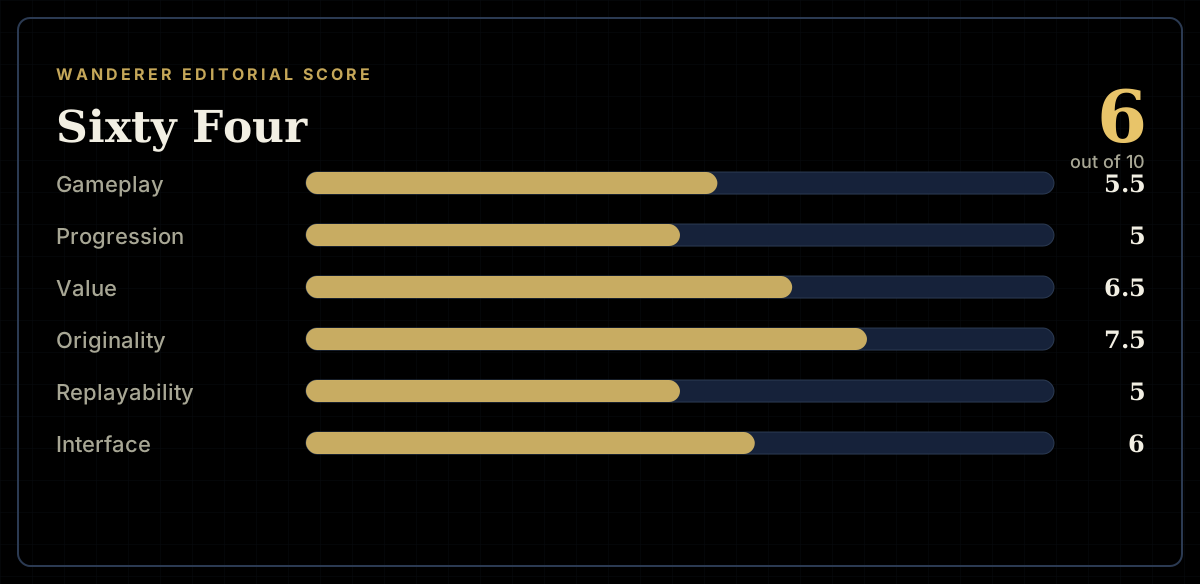
How the review scores each part of the gameWanderer Editorial -
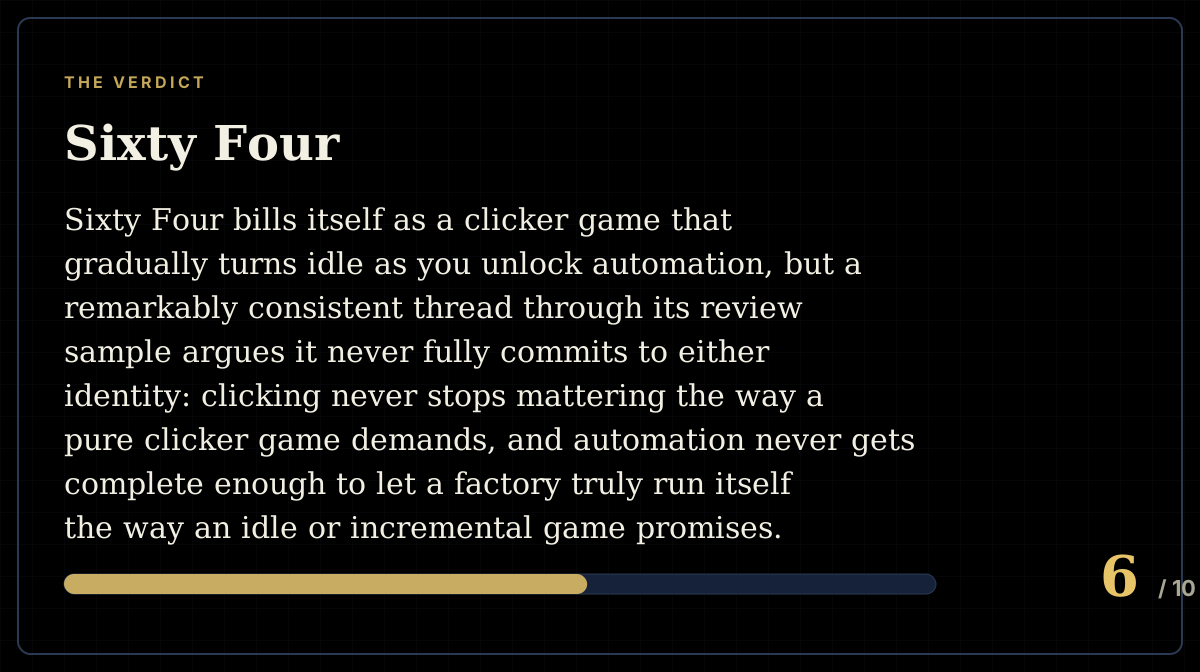
The short versionWanderer Editorial