
Game review
Teeny Tiny Trains
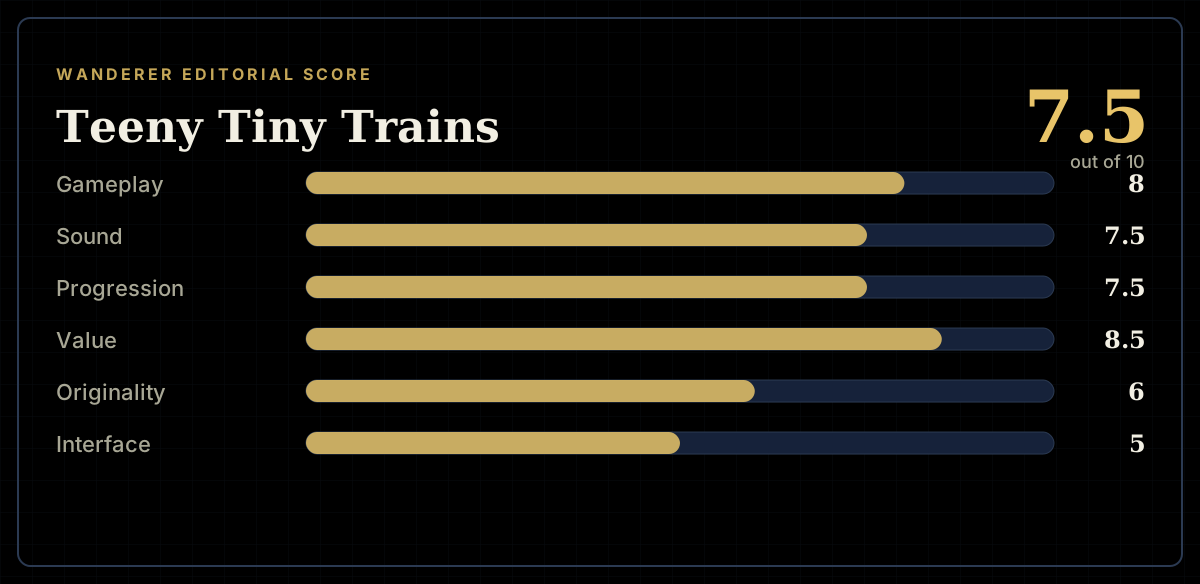
7.5 / 10
- Developer
- Short Circuit Studios
- Publisher
- Short Circuit Studios
- Released
- 28 June 2024
- Platforms
- Windows
- Genre
- Track-routing puzzle game
- Monetisation
- One-time purchase, plus one paid DLC pack ("The Enchanted Attic") released after launch
- Players
- Single-player only
The short version
Teeny Tiny Trains casts you as the conductor of a miniature toy railway, drawing track through cozy dioramas — living rooms, couch forts, attics — to guide trains safely to their stations without crashing into each other. Reviewers repeatedly compare it directly to Trainyard, a beloved mobile puzzle game that's since vanished from availability, and treat this as a worthy, PC-native successor rather than a mere imitation. With roughly 300 levels across seven chapters plus a bonus chapter and paid DLC, the content-to-price ratio draws some of the most enthusiastic value praise covered in this lane this year. The clearest blemish is a specific, reported carryover from the game's mobile origins: at least two reviewers describe an uncloseable, unclickable purchase-nag popup appearing after finishing levels in the paid Steam version, a jarring intrusion in a product buyers have already paid for outright.
Biggest strengths
- The core track-drawing puzzle mechanic is repeatedly described as deceptively deep, starting simple and ramping into genuinely difficult "mastery" levels that reward careful planning around timing, switches, and train crashes rather than trial and error
- With roughly 300 base levels across seven chapters plus a bonus chapter, and additional levels in the paid DLC, reviewers consistently describe the content-to-price ratio as excellent, with one calling it "insane value" for around seven euros
- A level editor with community-shared puzzles extends the game well past its built-in content, giving dedicated players an effectively unlimited additional supply of puzzles to solve
Biggest weaknesses
- At least two reviewers report an uncloseable, unclickable popup appearing after finishing levels from Chapter 1 onward, prompting a purchase or ad view despite the game already being paid for outright, describing it as a mobile-port carryover that shouldn't exist in the premium Steam release
- The camera cannot be freely rotated, panned, or zoomed beyond fixed top-down and side views, which multiple reviewers say causes parts of the track or play space to become obscured on more complex levels
- Track-drawing input is described by at least one reviewer as occasionally unresponsive, a real friction point in a game where precise routing is the entire point
Who it's for: Fans of logic and routing puzzles who want a large amount of content for a modest price, and who appreciate a genuinely cozy, nostalgic presentation without needing deep narrative or complex systems layered on top of the core puzzle-solving.
Our recommendation: A strong pick for puzzle fans given the sheer amount of content on offer, though prospective buyers bothered by the reported post-Chapter-1 popup issue should check the most recent reviews first to see whether it has been addressed since this review's research was conducted.
7.5 / 10
Teeny Tiny Trains asks a simple question in every level — draw the track that gets these toy trains where they need to go without crashing — and the review sample is remarkably consistent that the answer gets a lot more interesting than that setup implies. One reviewer places the comparison plainly: "another pretty blatant copy, this time of Trainyard, but to be fair, it's very well done, and properly addictive... if anything these guys are filling a hole that needed filling," referring to a beloved mobile puzzle game that's since become unavailable. That's the frame most reviewers use to judge the game, and on that frame, it largely succeeds.
Puzzles that earn their difficulty honestly
The core mechanic — drawing track through switches, splitters, and bridges to route multiple trains to their correct stations — starts simple and escalates into what several reviewers call genuinely demanding territory. "Don't be confused by the cute art style or the calming music," one writes, "the frustration with figuring out the logic of these levels is real. I've lost hours on some of the harder ones, arranging and rearranging." The game's optional "mastery" levels draw specific praise for their difficulty spike, with one reviewer admitting they "tested my patience and I failed" before promising to return once "I stop dreaming about railways and trains." That kind of good-natured defeat, rather than frustration, shows up often enough to suggest the difficulty curve is landing as intended: hard, but fair enough to keep players coming back rather than bouncing off.
An enormous amount of content for the price
Value is the second constant theme, and reviewers back it with specifics rather than vague enthusiasm. One breaks down the numbers directly: "seven chapters and a bonus chapter. Each have 30 normal levels along with 5 master levels... you can also create and play community levels," concluding it represents "insane value considering the normal price of around €7." Another, who expected "a short puzzle game of 3-5 hours," reports the game actually contains "about 300 levels (plus over a hundred with DLC)" and took several weeks of regular play to work through. Combined with a level editor supporting community-made puzzles, the effective content ceiling here is well beyond what a game at this price typically offers.
A specific problem that shouldn't exist in a paid release
The most serious complaint in the sample is narrow but pointed, and worth reporting in full because of how specific it is. Two separate reviewers describe an unclickable, uncloseable popup appearing after completing levels from the end of Chapter 1 onward, prompting either a purchase or an ad view — despite the reviewer having already paid for the game outright. "No game that I own a legitimate license for should ever nag me to buy the game in order to play," one writes, explicitly confirming they checked and it wasn't a DLC prompt. Another calls it "an obvious rush job of a mobile port doing a disservice to an otherwise" good game — visibly frustrated at behaviour that reads as monetisation logic carried over from the game's existence as a free mobile title, where several reviewers say they played it long before its PC release. This review could not confirm from the public patch history whether this specific issue has since been resolved, and flags it here as a reported, specific concern rather than a settled fact about the current build — prospective buyers bothered by it should check the most recent reviews before purchasing.
Camera and input friction
A second, more conventional complaint concerns the camera, which cannot be freely rotated, panned, or zoomed beyond fixed top-down and side perspectives. Multiple reviewers say this causes parts of the play space to become obscured on more visually complex levels, a real usability issue in a genre where seeing the full board clearly matters. A smaller number of reviewers separately describe track-drawing input as occasionally unresponsive, though this is raised as a minor annoyance rather than a significant barrier by the reviewers who mention it.
A developer that kept building, including exactly what players asked for
This review can confirm directly that Short Circuit Studios has supported the game substantially since its June 2024 launch. A free Chapter 7 arrived in September 2024, followed by the paid "Enchanted Attic" DLC that November. Most notably, a January 2025 update titled "Hint System & Valentine's Patch" added exactly the feature at least one reviewer had requested — a direct, dated response to specific player feedback rather than a coincidence. Steam Deck verification followed in December 2024, and the events feed shows continued seasonal content and sales participation well into 2026, a genuinely sustained commitment for a puzzle game well past its first year.
A minority view worth weighing
Not every review is purely enthusiastic about the sheer volume of content. One detailed critique argues directly that "there are far too many puzzles. Too much repetition and redundancy. Could have easily retained its flow and balance with half the number of levels," going on to call some of the more complicated levels "an absolute chore" to untangle. This is a minority position in the sample, but a reasonable one — a buyer who values a tightly curated puzzle experience over maximum content volume may find the same 300-level count that other reviewers praise as generous instead reads as excessive.
Final verdict
Teeny Tiny Trains succeeds at what it sets out to do: a cozy, nostalgic track-routing puzzler with real depth once its mastery levels kick in, backed by an amount of content that makes its modest price feel like an easy decision, and a developer that's kept adding to it — including a hint system built specifically from player feedback — for well over a year after launch. The reported purchase-nag popup is a real, specific concern this review couldn't independently confirm as resolved, and the fixed camera and occasional level bloat are genuine, if smaller, friction points. None of that erases what's otherwise a generous, well-supported puzzle game filling a real gap left by an older favourite that's no longer available to play.
Pros and cons
Pros
- The core track-drawing puzzle mechanic is repeatedly described as deceptively deep, starting simple and ramping into genuinely difficult "mastery" levels that reward careful planning around timing, switches, and train crashes rather than trial and error
- With roughly 300 base levels across seven chapters plus a bonus chapter, and additional levels in the paid DLC, reviewers consistently describe the content-to-price ratio as excellent, with one calling it "insane value" for around seven euros
- A level editor with community-shared puzzles extends the game well past its built-in content, giving dedicated players an effectively unlimited additional supply of puzzles to solve
- The developer has maintained a genuinely active, multi-year support cadence, including a free Chapter 7 content update, a hint system added specifically in response to player requests, Steam Deck verification, and seasonal free content well into 2026
- The cozy diorama presentation and toy-train aesthetic draw consistent, specific nostalgic praise, with multiple reviewers directly comparing the feeling to childhood wooden train sets rather than treating the art style as a generic coat of charm
Cons
- At least two reviewers report an uncloseable, unclickable popup appearing after finishing levels from Chapter 1 onward, prompting a purchase or ad view despite the game already being paid for outright, describing it as a mobile-port carryover that shouldn't exist in the premium Steam release
- The camera cannot be freely rotated, panned, or zoomed beyond fixed top-down and side views, which multiple reviewers say causes parts of the track or play space to become obscured on more complex levels
- Track-drawing input is described by at least one reviewer as occasionally unresponsive, a real friction point in a game where precise routing is the entire point
- At least one detailed reviewer argues the game has too many levels for its own good, describing meaningful repetition and redundancy that could have been trimmed without losing the game's overall flow or balance
- A separate reviewer specifically criticises the theming as generic, arguing the trains themselves lack strong enough identity compared to other games in the routing-puzzle space, leaving the experience feeling "rather wooden" despite otherwise complete execution
Screenshots
-

Teeny Tiny TrainsImage: Short Circuit Studios via Steam -

Teeny Tiny TrainsImage: Short Circuit Studios via Steam -

Teeny Tiny TrainsImage: Short Circuit Studios via Steam -
How the review scores each part of the gameWanderer Editorial -
The short versionWanderer Editorial