
Game review
Islands of Insight
6 / 10
- Developer
- Lunarch Studios
- Publisher
- Behaviour Interactive Inc.
- Released
- 13 February 2024
- Platforms
- Windows
- Genre
- Puzzle
- Monetisation
- One-time purchase, no DLC or in-game currency
- Players
- Formerly online shared-world (servers closed 30 October 2024); offline-only since
The short version
Islands of Insight offers more than 10,000 individually crafted puzzles across 24 distinct types, spread through a gorgeous, explorable island world, and on the puzzle design alone it's genuinely one of the strongest entries the genre produced in 2024 — critics called it a modern reinvention of puzzle design, and the sheer scale and variety on offer backs that up. Steam's own audience is far more divided than that praise suggests, sitting at Mostly Positive, 75.5% across roughly 1,600 reviews, a meaningfully lower figure than most well-regarded 2024 releases. The reason isn't the puzzles: it's a forced always-online requirement for what is, in practice, an entirely single-player experience, marketed with an "Online Co-op" Steam tag that turned out to mean seeing other players' avatars and emoting at them rather than solving anything together. The single most-upvoted review on the entire page, at over 1,800 votes, is a privacy-policy complaint citing specific clauses about data shared with advertisers. And in October 2024, eight months after launch, the developers shut the servers down entirely, converting the game to offline-only after sales fell short of expectations — with a real, if partially mitigated, cost in lost player progress for anyone who missed the migration window.
Biggest strengths
- More than 10,000 individually designed puzzles spread across 24 distinct types give the game a scale and variety critics single out as genre-leading, with enough range that players can focus on the puzzle types they personally enjoy
- Visual design of the island world draws consistent praise, described by critics and players alike as one of the more beautiful settings a puzzle game has been built around
- The core logic-grid and pattern-completion puzzles are repeatedly credited as genuinely excellent, even by reviewers who can't recommend the game overall for other reasons
Biggest weaknesses
- The single most-upvoted review on the entire Steam page, at over 1,800 votes, is a privacy-policy complaint citing specific clauses about personal data (age, gender, location) being shared with advertisers — a serious claim worth reading in the reviewer's own words before buying
- The game originally shipped with an "Online Co-op" Steam tag and marketing describing "solving puzzles together," but the actual online functionality amounted to seeing other players' avatars, emoting and pinging locations — no shared puzzle-solving of any kind, which multiple detailed reviews call actively misleading
- Prior to the October 2024 shutdown, the game forced an always-online connection for what is, in every meaningful sense, single-player content, causing real disconnection issues, lost puzzle progress mid-session, and sluggish performance multiple reviewers attribute directly to unnecessary server dependency
Who it's for: Puzzle genre enthusiasts who want genuine variety and craft, and who are buying today rather than during the game's original online period, are the best audience — the current offline-only version sidesteps most of the historical online complaints entirely. Buyers should still be aware of the game's rocky history before assuming the current Mostly Positive score reflects a typical game's typical growing pains, since a meaningful share of it traces back to decisions the developers have since reversed rather than ongoing issues with the puzzles themselves.
Our recommendation: Recommended for the puzzle content specifically, especially now that it's offline-only and the historical connectivity and shared-world complaints no longer apply to a new purchase. Go in aware of the game's commercial and reputational history — the forced-online era, the misleading co-op marketing, and the server shutdown — since understanding what changed and why is the fairest way to judge what you're actually buying today.
6 / 10
A puzzle box big enough to get lost in, in more ways than one
Islands of Insight's core pitch is straightforward and, on its own terms, genuinely delivered: an open island world seeded with more than 10,000 individually crafted puzzles across 24 distinct categories, from logic grids to pattern completion to environmental observation challenges, all explorable at the player's own pace. Critics who reviewed it on those terms were enthusiastic, calling it a modern reinvention of the puzzle genre and praising both the sheer scale of content and the flexibility to focus on whichever puzzle types a given player finds most engaging while skipping the rest. The visual design of the island world backs up that reputation — it's a genuinely beautiful place to wander, and multiple reviewers who are otherwise critical of the game's other decisions still credit the puzzle design and presentation without reservation.
A "co-op" game that never let you actually co-op
Where the reputation splinters is everything built around those puzzles rather than the puzzles themselves. Islands of Insight launched carrying an "Online Co-op" tag on Steam and marketing language describing players solving puzzles together in a shared world. What that turned out to mean, according to multiple detailed reviews from the game's original online period, was considerably thinner: players could see each other's avatars wandering the same island, emote at one another, ping locations, and invite people into loose groups — but the puzzles themselves remained entirely single-player, with no mechanism for two people to actually work on one together. Reviewers who'd bought the game specifically expecting the collaborative puzzle-solving the marketing implied describe this gap as actively misleading rather than a minor feature omission, and it's a specific, verifiable claim about what the online mode did and didn't include rather than a matter of taste.
Compounding that disappointment, the game required a persistent internet connection to play at all during this period, despite the actual content being functionally single-player. Reviewers describe exactly the problems you'd expect from forcing an unnecessary server dependency onto offline-shaped content: disconnections mid-puzzle that cost progress, sluggish performance multiple reviewers specifically attribute to server load rather than local hardware, and puzzle-completion tracking tied to server-side systems that some reviewers say never worked reliably. One reviewer's dry summary — calling it "the first MSOG," a Massively Singleplayer Online Game — captures the specific absurdity of the arrangement about as well as any critique could.
The single loudest voice on the page
Sitting above all of that, at more than 1,800 votes — a genuinely enormous number for a Steam review, on a title with only around 1,600 reviews total — is a complaint that isn't about gameplay at all. It cites specific clauses in the game's own privacy policy, by number, describing data including age, gender and location being shared with advertisers, and asks plainly why a puzzle game needs that level of data collection at all. This review's own author states they hadn't played the game and were reviewing the privacy policy alone — worth knowing as context for how to weigh it, since it's explicitly not a gameplay assessment. But its vote count reflects how many other players read those same policy clauses and found the concern legitimate enough to amplify rather than dismiss, and it's the kind of specific, checkable claim — citing clause numbers rather than vague suspicion — that's worth reading in full before buying, regardless of how the puzzles themselves hold up.
The shutdown, and what it actually cost
The most consequential event in the game's history came in October 2024, eight months after launch: Lunarch Studios announced that sales had fallen short of expectations, and rather than continuing to run servers for a shared-world feature most players weren't meaningfully using anyway, they converted the game permanently to an offline-only experience. To their credit, this wasn't handled as callously as many server shutdowns — players were given advance notice and an explicit option to download their online progress into an offline save before the cutoff, and outlets covering the transition at the time noted it as a comparatively responsible way to wind down an online component. In practice, though, several detailed reviews posted well after the cutoff describe a real, painful gap between that good-faith effort and what actually happened to less-attentive players: reviewers report discovering the transition only after taking a break from the game, missing the migration window entirely, and losing genuinely substantial amounts of progress — 90-plus hours in one case, nearly 250 hours in another, with the second reviewer specifically noting they were saved just outside the game's final area when the cutoff hit. A responsible shutdown process still produces real casualties among players who don't happen to be actively checking in during the exact window it's open, and that's a fair, documented cost to weigh against the credit the developers otherwise deserve for trying to do this the right way.
Verdict
The puzzles at the heart of Islands of Insight are genuinely excellent, and buying the game today — offline-only, heavily discounted, with the always-online and misleading co-op marketing both now moot — sidesteps most of what made its first eight months so contentious. What's left is a fair, honest accounting of how a genuinely strong puzzle game got dragged down by decisions that had nothing to do with puzzle design: an online mode that oversold what it actually offered, a data-sharing concern serious enough to become the single most-discussed thing on the game's entire review page, and a server shutdown that, however well-intentioned, still cost real players real progress. Buy it today for the puzzles. Go in knowing the history is part of what you're buying into as well.
Pros and cons
Pros
- More than 10,000 individually designed puzzles spread across 24 distinct types give the game a scale and variety critics single out as genre-leading, with enough range that players can focus on the puzzle types they personally enjoy
- Visual design of the island world draws consistent praise, described by critics and players alike as one of the more beautiful settings a puzzle game has been built around
- The core logic-grid and pattern-completion puzzles are repeatedly credited as genuinely excellent, even by reviewers who can't recommend the game overall for other reasons
- The game is now offline-only following the October 2024 server shutdown, which removes the connectivity, lag and forced-online complaints that dominated its first eight months entirely
- Currently available at a steep discount, which meaningfully changes the value calculation for buyers coming to it now rather than at its original asking price
Cons
- The single most-upvoted review on the entire Steam page, at over 1,800 votes, is a privacy-policy complaint citing specific clauses about personal data (age, gender, location) being shared with advertisers — a serious claim worth reading in the reviewer's own words before buying
- The game originally shipped with an "Online Co-op" Steam tag and marketing describing "solving puzzles together," but the actual online functionality amounted to seeing other players' avatars, emoting and pinging locations — no shared puzzle-solving of any kind, which multiple detailed reviews call actively misleading
- Prior to the October 2024 shutdown, the game forced an always-online connection for what is, in every meaningful sense, single-player content, causing real disconnection issues, lost puzzle progress mid-session, and sluggish performance multiple reviewers attribute directly to unnecessary server dependency
- Servers closed permanently on 30 October 2024, eight months after launch, following weaker-than-expected sales; despite an advance-notice migration window to transfer progress to an offline save, multiple detailed reviews report losing 90-plus and in one case nearly 250 hours of progress after missing that window, often because they'd simply taken a break from the game
- Several detailed reviews describe a meaningful portion of the 10,000-plus puzzles as repetitive filler variations on the same handful of mechanics, compounded by no way to track which specific puzzles have already been solved
Screenshots
-

Islands of InsightImage: Behaviour Interactive Inc. via Steam -

Islands of InsightImage: Behaviour Interactive Inc. via Steam -

Islands of InsightImage: Behaviour Interactive Inc. via Steam -
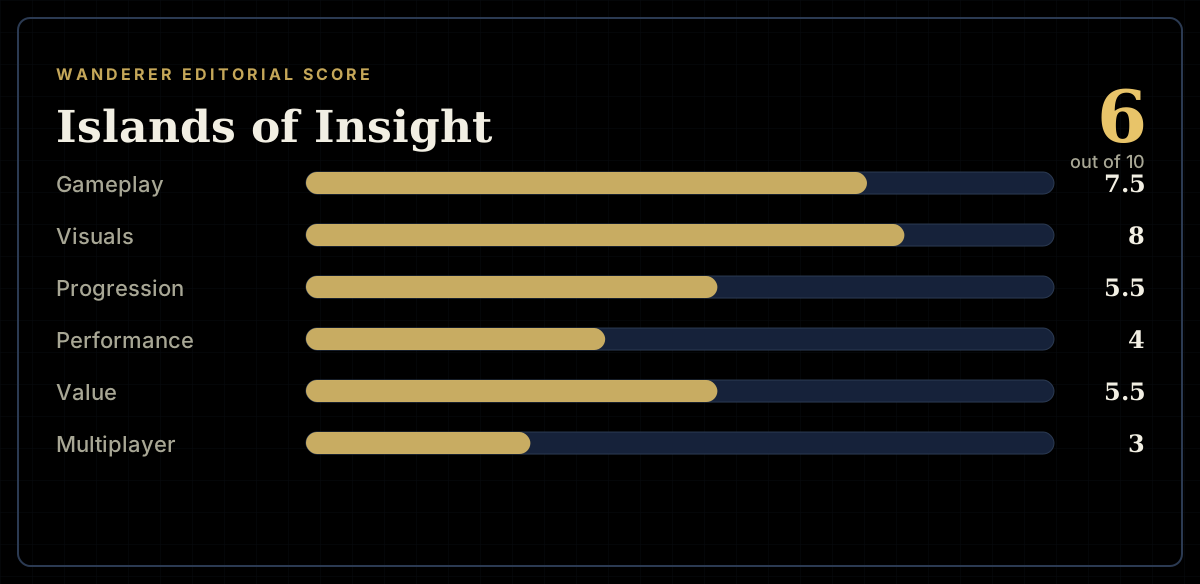
How the review scores each part of the gameWanderer Editorial -
The short versionWanderer Editorial