
Game review
Bugtopia
7 / 10
- Developer
- Nocturnal Games
- Publisher
- GCORES PUBLISHING
- Released
- 21 May 2025
- Platforms
- Windows
- Genre
- Idle, Collector
- Monetisation
- One-time purchase, no DLC or in-game currency
- Players
- Single-player
The short version
Bugtopia asks you to collect, breed and grow more than 300 bug species, each modelled on a real-world counterpart and given, in the three-person developer team's own words, "an adorable artistic makeover while preserving their real-world charm." You place two bugs in a breeding box and wait for new, sometimes rare offspring to emerge, then decorate an increasingly elaborate terrarium with hundreds of landscaping items across shifting times of day and weather. It landed Very Positive across 998 reviews, and reviewers consistently praise its complete absence of microtransactions in a genre notorious for them, alongside a genuinely soothing, patience-rewarding design. The most serious complaint, raised independently by multiple reviewers, is specific and checkable: income stops accruing after 24 hours away from the game, a bug reported since launch that directly undercuts the AFK-friendly pitch the whole concept is built around.
Biggest strengths
- No monetisation of any kind beyond the purchase price — reviewers specifically and repeatedly credit this as rare and valuable in a genre where microtransactions are the norm rather than the exception
- The bug designs draw consistent, specific praise for balancing real-world accuracy with charm, and the developers' own stated inclusion of endangered and extinct species alongside built-in encyclopedia entries gives the collection layer an educational angle beyond pure cuteness
- A deep, genuinely varied customisation system — 20-plus terrarium types, 300-plus landscaping items, 700-plus evolving decoration states, five time periods and four weather conditions — gives long-term players real creative range once the collecting slows down
Biggest weaknesses
- The single most serious and specific complaint, raised independently by more than one reviewer, is that the game stops crediting income after roughly 24 hours away from it — a reviewer with over 9,400 minutes logged reports this has been broken since release and unaddressed by the developers, directly undercutting the "AFK-friendly" framing the whole design leans on
- A separate, independently-reported bug describes terrarium plants failing to grow once touched with the in-game broom tool even a single time, again reported as present since launch with no developer response noted in the reviews
- Multiple reviewers describe incubation periods lengthening substantially as you progress, to the point that "the majority of the time you're playing is waiting" — a deliberate anti-grind design choice according to some reviewers, but one that at least one reviewer calls "slow enough to be pathetic" even accounting for the genre's normal pacing
Who it's for: Players who want a genuinely relaxing, patience-based collector game to check in on daily rather than actively grind, particularly anyone with an existing fondness for insects and a tolerance for slow, incubation-gated progression. Less of a fit for anyone wanting to actively play for long stretches, since multiple reviewers say mid-to-late-game bugs simply take a long time to mature regardless of attention paid.
Our recommendation: A strong, low-risk buy at NZ$8.99 for cozy-collector fans specifically, given the complete absence of monetisation tricks — just go in aware of the 24-hour AFK income cap reported by long-term players, since it means checking in daily gets you more than leaving the game running for a week would.
7 / 10
Digital bugs for digital nomads
Bugtopia's origin story, told directly on its own store page, sets the tone for the whole game: "a small indie team of three from China... as digital nomads, we can't keep real insects long-term—so we turned our screens into virtual terrariums." That personal, slightly wistful premise carries through into the design. You collect and breed more than 300 bug species, each based on a real insect and redrawn with what the developers call "an adorable artistic makeover while preserving their real-world charm," including species that are endangered or extinct in reality, each with its own encyclopedia entry. Breeding is simple in mechanism — place two bugs in a box and wait — but genuinely uncertain in outcome, with rare offspring possible from any pairing, which reviewers consistently cite as the game's most quietly compelling hook.
Around that collecting core sits an unusually deep customisation system for a game this size: more than 20 terrarium types, over 300 landscaping items, 700-plus evolving decoration states, five times of day and four weather conditions. Reviewers who've stuck with the game for the long haul — several explicitly call it one of their "forever games" — describe returning daily less for new bugs and more for the ongoing pleasure of rearranging and expanding their terrarium's look, which speaks to real design depth beneath the cute presentation.
What sets it apart from the genre's worst habits
The single most repeated praise across the corpus isn't about bugs at all — it's about what's absent. Idle and collector games are, as a category, closely associated with aggressive monetisation, and reviewers here are specific and grateful that Bugtopia has none: no microtransactions, no premium currency, nothing beyond the upfront NZ$8.99. That absence is treated as a real selling point rather than a baseline expectation, which says something uncomfortable about how low the genre's bar usually sits — and something genuinely good about this particular team's choices.
A specific, unresolved bug worth knowing about
Set against that goodwill is one serious, concrete technical complaint raised independently by more than one reviewer: income stops accruing roughly 24 hours after you last touch the game. A reviewer with over 9,400 minutes logged — clearly invested enough to notice a pattern rather than a one-off glitch — reports this has been broken since release with no developer response addressing it. That's a meaningful problem specifically because Bugtopia markets itself as AFK-friendly; a hard cap on how long your absence is rewarded directly contradicts that pitch, and it means the optimal way to play is checking in daily rather than genuinely leaving the game to run. A second, separate bug report describes terrarium plants failing to grow once touched by the broom tool even once — again reported as present since launch. Neither bug appears to be universal based on the sample available, but both are specific enough, and corroborated by enough playtime, to trust as real rather than user error.
Waiting as the point, sometimes to a fault
Several reviewers separately describe incubation periods lengthening substantially as you progress, turning much of the mid-to-late game into waiting rather than active play. Some frame this charitably, as a deliberate anti-grind pacing choice appropriate to a cozy idle game; at least one reviewer, though, calls the wait "slow enough to be pathetic" even accounting for genre norms, citing over an hour of feeding, selling and repurchasing just to afford a single new bug, upgrades included. Steam's own achievement data supports a real, if not extreme, drop-off: early milestones clear above 75%, while the deepest collection achievements fall to under 15%, suggesting most players settle into a smaller, comfortable rotation rather than chasing full completion.
Not quite a screensaver, and reviewers notice
One specific missed opportunity comes up in the corpus that's worth dwelling on: unlike some genre peers that let a idle collection game shrink down to a small widget sitting at the bottom of the screen while you work, Bugtopia doesn't offer that option. Given how much of the game's stated appeal — both in its own marketing and in reviewer testimony — is simply watching the terrarium exist in the background, that's a real gap rather than a nitpick. The game does include a desktop wallpaper mode and a built-in pomodoro timer, suggesting the developers are thinking in that direction, but reviewers who specifically wanted the "glance over occasionally while working" experience note that Bugtopia currently asks for more direct window focus than that use case ideally wants. It's a fixable, additive request rather than a structural flaw, and one that would meaningfully extend the game's appeal to exactly the audience already inclined to love it.
The verdict
Bugtopia earns its Very Positive reception honestly: a genuinely original collecting hook, real educational and conservation-minded touches, deep customisation, and a refreshing, complete refusal to monetise beyond the purchase price. The 24-hour AFK income cap is a real, specific flaw worth knowing before buying — it undercuts the exact pitch that makes an idle game worth owning in the first place — but it doesn't erase what a clear majority of reviewers describe as a small, lovingly made game worth checking in on for months. At NZ$8.99, that's a fair trade even with the rough edges still unpatched — and given the size of the team behind it, a reasonable one to extend some patience toward, provided the AFK income cap eventually gets the fix its own core pitch depends on.
Pros and cons
Pros
- No monetisation of any kind beyond the purchase price — reviewers specifically and repeatedly credit this as rare and valuable in a genre where microtransactions are the norm rather than the exception
- The bug designs draw consistent, specific praise for balancing real-world accuracy with charm, and the developers' own stated inclusion of endangered and extinct species alongside built-in encyclopedia entries gives the collection layer an educational angle beyond pure cuteness
- A deep, genuinely varied customisation system — 20-plus terrarium types, 300-plus landscaping items, 700-plus evolving decoration states, five time periods and four weather conditions — gives long-term players real creative range once the collecting slows down
- Multiple reviewers describe the game as one of their "forever games," checking in daily with sustained affection well past their initial hours, which is a meaningfully stronger signal than the more common "cute for a few hours" praise this genre usually earns
- The breeding system's real rarity and randomness give even experienced players an ongoing reason to keep two bugs in the box, with reviewers specifically citing the anticipation of "exciting new (and sometimes rare!) species" as a genuine hook rather than a shallow gimmick
Cons
- The single most serious and specific complaint, raised independently by more than one reviewer, is that the game stops crediting income after roughly 24 hours away from it — a reviewer with over 9,400 minutes logged reports this has been broken since release and unaddressed by the developers, directly undercutting the "AFK-friendly" framing the whole design leans on
- A separate, independently-reported bug describes terrarium plants failing to grow once touched with the in-game broom tool even a single time, again reported as present since launch with no developer response noted in the reviews
- Multiple reviewers describe incubation periods lengthening substantially as you progress, to the point that "the majority of the time you're playing is waiting" — a deliberate anti-grind design choice according to some reviewers, but one that at least one reviewer calls "slow enough to be pathetic" even accounting for the genre's normal pacing
- There's no way to run the terrarium as a genuine background widget at the bottom of the screen the way some genre peers allow, which one reviewer specifically flags as a missed opportunity given how much of the appeal is simply watching the bugs
- Steam's own achievement data shows a familiar but fairly steep idle-genre drop-off: most early milestones sit above 75%, while several of the deepest collection achievements fall to 9.5-13.7%, suggesting the full 300-species collection goal is a minority pursuit even among engaged players
Screenshots
-

BugtopiaImage: GCORES PUBLISHING via Steam -

BugtopiaImage: GCORES PUBLISHING via Steam -

BugtopiaImage: GCORES PUBLISHING via Steam -
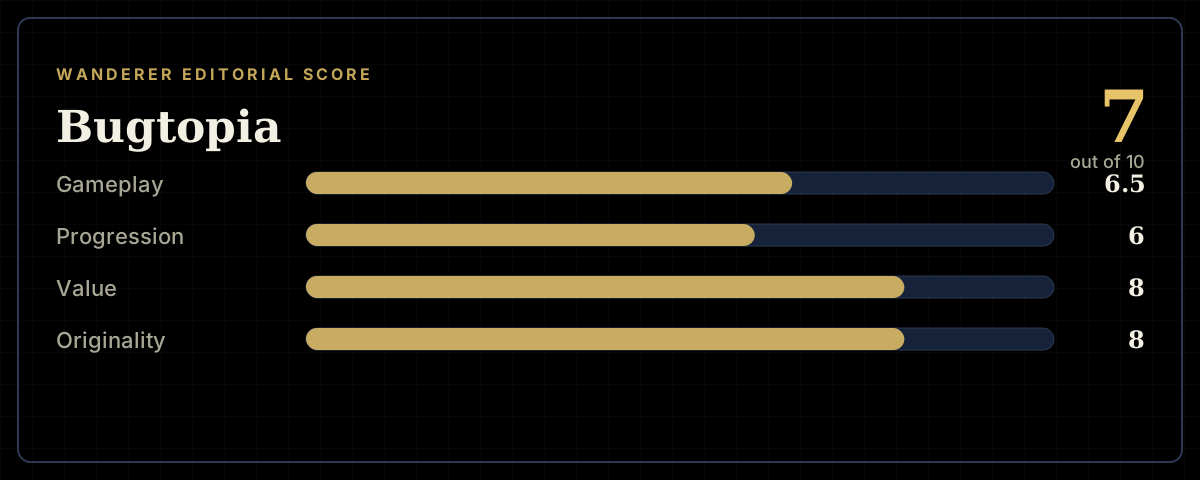
How the review scores each part of the gameWanderer Editorial -
The short versionWanderer Editorial