
Game review
Idle Critter Adventure
6.5 / 10
- Developer
- Fuzz Force
- Publisher
- Fuzz Force
- Released
- 7 September 2025
- Platforms
- Windows
- Genre
- Idle RPG, Creature Collector
- Monetisation
- One-time purchase, no DLC or in-game currency
- Players
- Single-player
The short version
Idle Critter Adventure asks you to pick a starter Critter, send your avatar Alfa off into a region full of trainers and wild creatures, and then leave it running — battles resolve automatically, captures happen on their own, and the whole point is that you can walk away from your PC and come back to real progress. What separates it from the crowded field of idle creature-collectors, according to its small but consistent review corpus, is the art: reviewers specifically and repeatedly praise the 80-plus Critter designs for looking genuinely original rather than reskinned Pokemon, a complaint that dogs much of this sub-genre. Set against that is a handful of rougher notes, including one reviewer who reports the game simply not progressing past the very first trainer battle.
Biggest strengths
- The single most consistent praise in the review corpus is for the Critter designs themselves — reviewers specifically call out that the 80-plus creatures avoid looking like "reskinned Pokemon," a direct and recognised failure mode of the wider creature-collector-idle sub-genre, and highlight that even the game's "shiny" variants carry different elemental types rather than just a palette swap
- Multiple reviewers describe genuinely using it as intended: running on a second screen throughout a workday, checking in periodically, and finding that light ambient engagement adds real enjoyment rather than feeling like a chore
- The core loop supports both hands-off and hands-on play without forcing either — you can leave a region to run unattended, or actively mash the Run button and cheer during battles to speed things along, and reviewers who tried both note it's "fiddly if you want it to be, not if you don't"
Biggest weaknesses
- One reviewer reports the game simply would not progress past the very first trainer battle, marking it not recommended despite finding the premise appealing at the price — whether that's a genuine bug or an unclear UI prompt isn't resolved in the review itself, but it's a concrete, checkable failure report rather than vague dissatisfaction
- A separate reviewer specifically flags parts of the UI as "finicky to work with" and says the gameplay isn't compelling once the first Adventure area is cleared, a direct contrast with reviewers who found the loop sustained their interest much longer
- Steam's own achievement data shows a familiar idle-genre drop-off, but a fairly steep one for a NZ$5.99 game: 92.2% of players capture a single Common Critter, yet only 40.5% reach the first Champion title and just 11.1% catalogue 100 Critters or reach the fifth Champion tier
Who it's for: Players who want a genuinely hands-off, run-it-in-the-background companion game — several reviewers specifically describe it running on a second monitor during a workday — with enough creature-collecting flavour to reward the occasional active check-in. Less of a fit for anyone wanting deep, hands-on combat systems, since the entire design intent is to let the game play itself.
Our recommendation: A safe, cheap pick at NZ$5.99 for idle-genre fans who specifically want a creature collector with its own visual identity rather than a Pokemon clone — just be aware of the one reported case of a hard progression stop, and don't expect much beyond background company and passive number-watching.
6.5 / 10
Left running, on purpose
Idle Critter Adventure is built around a promise that most idle games make but not all of them keep convincingly: you pick a starter Critter, send Alfa off into the Dorma region, and the game plays itself. Trainers get battled, Critters get captured, and time spent away from your PC — not just time spent staring at it — is where the real progress happens. If you are around, mashing the Run button speeds up traversal and cheering on your Critters in battle makes them attack faster, but neither is required. Longer stretches in a given area raise your odds of finding Uncommon and Rare Critters, and Champion-defeating unlocks a prestige loop that boosts experience, money and rare and shiny encounter rates on subsequent runs.
Original creatures, not reskinned Pokemon
The clearest, most repeated praise across the small review corpus is about the Critters themselves. Idle creature-collectors are a crowded, often derivative sub-genre, and more than one reviewer specifically calls out that Idle Critter Adventure avoids the most common failure mode — creature designs that are functionally reskinned Pokemon. One reviewer frames this directly as "a big problem with some creature collector games," and credits Fuzz Force with visible design effort across the 80-plus roster, extending even to the shiny variants, which carry different elemental typing rather than just a different palette. For a budget release at NZ$5.99, that level of specific, informed praise for the art is a genuinely strong signal — it's the kind of detail a reviewer only notices and calls out when the alternative, lazier approach is common enough to be worth contrasting against.
Reviewers who describe their actual play habits back up the game's central pitch just as directly. More than one specifically mentions running it on a second monitor throughout a workday, periodically glancing over to check progress and make small upgrade decisions — exactly the ambient, low-commitment engagement the game is designed around, and something reviewers say genuinely made their day more enjoyable rather than feeling like an obligation.
Where it gets rougher
Not every account is this smooth. One reviewer reports the game simply refusing to continue past the very first trainer battle, and downgrades an otherwise appealing impression to a thumbs-down over it — a specific, checkable failure rather than a vague complaint, though the review itself doesn't establish whether it's a bug or a missed UI prompt. A separate reviewer independently criticises parts of the interface as "finicky" and says the core gameplay loop stops being compelling once the first Adventure area is cleared, a direct contrast to reviewers who describe sustained, multi-thousand-hour engagement. Steam's own achievement data adds useful, if unsurprising, context: 92.2% of players manage to capture a single Common Critter, but only 40.5% reach the first Champion title, and just 11.1% either catalogue 100 Critters or reach the fifth Champion tier — a real but not unusual drop-off for the idle genre, consistent with a game whose early hook is stronger than its long-term pull for at least some of its audience.
The systems underneath the idling
Idle Critter Adventure doesn't stop at "leave it running and watch numbers go up." Captured Critters who aren't part of your active battling cohort can be sent on Expeditions, passively earning experience and money while you focus elsewhere, with a bonus for matching a Critter's type to the Expedition's theme — a small but real decision layer on top of the core idling. A training room lets you convert Punching Bags, earned from catching duplicates of Critters you already own, into instant level gains for whichever Critter needs them most, giving your excess captures a use beyond simply padding a collection screen. Progression through the region culminates in Club battles, tougher gauntlets of trainers guarding a Club Leader whose defeat earns a Club Pin — a structure clearly modelled on the genre conventions long-time creature-collector fans will recognise instantly, even filtered through an idle-first lens. Clearing the full circuit and claiming the Champion title opens a prestige system, trading your current run for permanent boosts to experience, money, and — notably — your odds of encountering Uncommon, Rare and Shiny Critters on the next attempt, giving repeat playthroughs a clearer purpose than just starting over from scratch.
None of these systems are deep in isolation, and the review corpus doesn't claim otherwise — nobody describes Idle Critter Adventure as a mechanically rich game. What reviewers credit it for is fitting these systems together into something coherent at a genuinely low price point, rather than shipping the idle loop alone and calling it a day. Whether that's enough content to justify checking back in over weeks or months, rather than the several-thousand-hour totals a couple of enthusiastic reviewers report, is the one question the small review sample can't yet answer with confidence.
The verdict
At its price, Idle Critter Adventure delivers exactly what it promises for most of the players who have reviewed it: a genuinely hands-off idle companion with more visual identity than the sub-genre usually bothers with, layered with just enough active-play options — Expeditions, a training room, prestige — to reward checking in without demanding it. The corpus is small enough that both the strongest praise and the one reported hard stop deserve to be read as early signal rather than a final word, but for genre fans specifically tired of Pokemon-shaped reskins, the art alone makes this a reasonable, low-risk pick.
Pros and cons
Pros
- The single most consistent praise in the review corpus is for the Critter designs themselves — reviewers specifically call out that the 80-plus creatures avoid looking like "reskinned Pokemon," a direct and recognised failure mode of the wider creature-collector-idle sub-genre, and highlight that even the game's "shiny" variants carry different elemental types rather than just a palette swap
- Multiple reviewers describe genuinely using it as intended: running on a second screen throughout a workday, checking in periodically, and finding that light ambient engagement adds real enjoyment rather than feeling like a chore
- The core loop supports both hands-off and hands-on play without forcing either — you can leave a region to run unattended, or actively mash the Run button and cheer during battles to speed things along, and reviewers who tried both note it's "fiddly if you want it to be, not if you don't"
- A layered structure beyond the core capture loop — Expeditions for off-team Critters to earn passive rewards, a training room for direct levelling, and a prestige system tied to Champion titles — gives reviewers a reason to describe "a lot of things to do" despite the low price point
- Accessibility touches like mouse-only play and Steam Cloud saves suit the game's own stated pitch of being playable in short, interrupted sessions
Cons
- One reviewer reports the game simply would not progress past the very first trainer battle, marking it not recommended despite finding the premise appealing at the price — whether that's a genuine bug or an unclear UI prompt isn't resolved in the review itself, but it's a concrete, checkable failure report rather than vague dissatisfaction
- A separate reviewer specifically flags parts of the UI as "finicky to work with" and says the gameplay isn't compelling once the first Adventure area is cleared, a direct contrast with reviewers who found the loop sustained their interest much longer
- Steam's own achievement data shows a familiar idle-genre drop-off, but a fairly steep one for a NZ$5.99 game: 92.2% of players capture a single Common Critter, yet only 40.5% reach the first Champion title and just 11.1% catalogue 100 Critters or reach the fifth Champion tier
- The review corpus is small — 15 reviews total at time of writing — so both the strong praise for the art and the isolated bug report should be weighted as early, limited signal rather than a settled verdict
- As an explicitly idle-first design, there's little here for players who want hands-on creature-collector combat depth; the game is upfront that its core selling point is working while you're not looking, which some potential buyers may find thin as a full-price-adjacent purchase even at this budget price
Screenshots
-

Idle Critter AdventureImage: Fuzz Force via Steam -

Idle Critter AdventureImage: Fuzz Force via Steam -

Idle Critter AdventureImage: Fuzz Force via Steam -
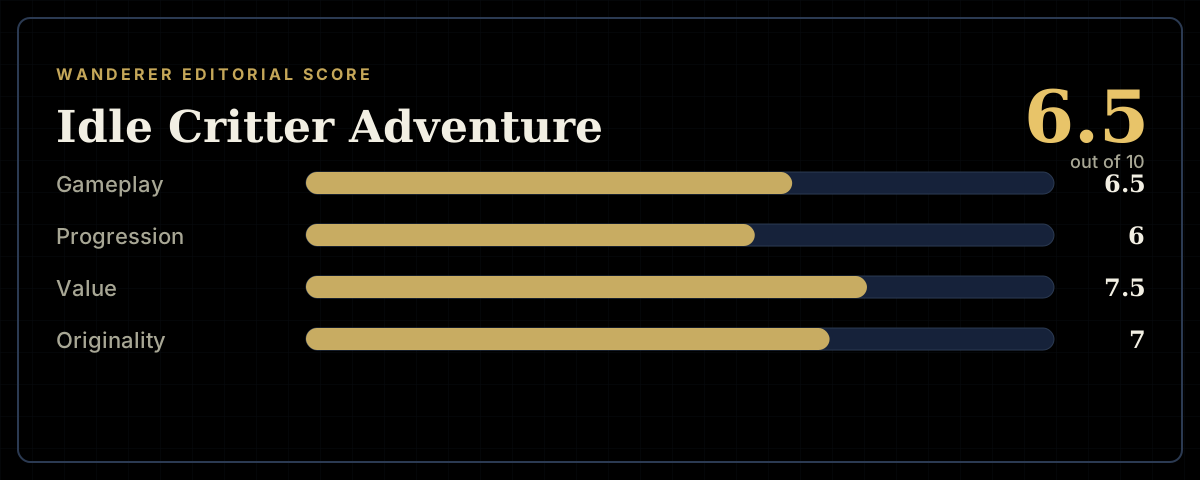
How the review scores each part of the gameWanderer Editorial -
The short versionWanderer Editorial