
Game review
Progress Racer RPG
7 / 10
- Developer
- Cameron Ladjevardi, David Elliot
- Publisher
- David Elliot
- Released
- 17 June 2025
- Platforms
- Windows
- Genre
- Incremental, Idle
- Monetisation
- One-time purchase, optional soundtrack DLC
- Players
- Single-player
The short version
Progress Racer RPG's whole currency is kilometres: your car drives forward automatically, you spend the distance it racks up on upgrades, and the faster you get the further you go. That's a familiar incremental shape, but the game does something most of the genre never bothers with — it ends. A defined ~45-minute-per-run structure, a prestige loop that actually resets toward a stated finish line, and a meta-narrative wrapped around the whole thing have won over the large majority of its 131-review corpus, several of whom specifically call out "an incremental that has an actual goal" as the thing they wish more of the genre attempted. A detailed dissenting review argues the opposite on every front: that the game can't idle because it keeps pausing itself, that the incremental systems are too thin to stand alongside its peers, and that the story built around a troubled protagonist and the girlfriend he keeps endangering is more uncomfortable than compelling.
Biggest strengths
- A defined ending is the game's whole pitch, and it delivers on it — Steam's own achievement data shows 67.1% of players reach ACH_END and 41.8% reach the "true" ending, remarkably high completion for an incremental genre where most games are designed to be played forever and few players ever see a credits screen
- Multiple detailed positive reviews specifically praise the prestige loop for giving repeated playthroughs a reason to exist beyond bigger numbers, citing the game's own design goal — an actual end goal, an in-game reason to reach it, and a length calibrated so you get there before boredom sets in
- Reviewers who came in skeptical of "yet another incremental" credit it with genuinely new ideas for the genre, particularly wrapping upgrade progression in a narrative frame instead of leaving numbers to speak for themselves
Biggest weaknesses
- A long, detailed critical review argues the game fails to earn any of its three labels: you can't meaningfully idle because the game pauses itself every few minutes for upgrade menus and story beats, the incremental systems are "basic and bare bones" next to genre peers, and the RPG narrative framing doesn't hold up dramatically
- That same review's most serious complaint is about the story itself: a VRChat-obsessed, emotionally absent protagonist whose neglected real-world girlfriend is repeatedly hurt in the process of "saving" him, which the reviewer reads as underwritten rather than earning the emotional weight it reaches for
- Two independent reviewers state plainly that Progress Racer RPG isn't a true idle game — one notes you have to actively steer around obstacles to avoid falling, the other says the game "stops when you get upgrades" — a direct contradiction of the genre label it's filed under
Who it's for: Incremental-genre regulars who are tired of games explicitly designed to never end, and who want a short, cheap, upgrade-driven session with an actual narrative wrapped around it. Less of a fit for players who want a true set-and-forget idler, or anyone put off by a story that leans into abusive- relationship beats without, in some reviewers' reading, handling them with much care.
Our recommendation: A confident yes for its price if a several-hour, story-flavoured incremental with a real ending sounds appealing — just go in knowing it asks for more active attention than "idle" promises, and that its central relationship plot draws real, specific discomfort from at least part of its audience.
7 / 10
A currency measured in kilometres
Progress Racer RPG hands you a car that drives itself forward, winding along tracks strewn with obstacles, and asks you to spend the distance it covers on upgrades that make it drive further and faster still. That's the entire loop stated plainly, and it's a shape any incremental-game player will recognise instantly. What sets it apart, according to the large majority of its review corpus, is what it does with that shape: rather than the endless, ever-escalating numbers most of the genre runs on, Progress Racer RPG is built around a stated goal, a roughly 45-minute per-run pace, and a prestige system that resets your stats in service of actually reaching a "true" ending rather than just resetting for its own sake.
Two build paths — Handling, for maneuvering around obstacles, and Armor, for brute-forcing through them — sit alongside a stock market subsystem and a "buff wheel" for combining temporary boosts. Several reviewers who tried both playstyles specifically credit that choice with making repeat playthroughs feel distinct rather than identical, which is a real design achievement in a genre where "just do the same run again, but faster" is often the whole of what a prestige system offers.
The ending is the point, and the data backs it up
The single most interesting fact about Progress Racer RPG isn't in its review text at all — it's in Steam's own achievement data. Across incremental and idle games generally, the genre's own defining trait — most are explicitly designed to be played indefinitely — means completion-style achievements routinely sit in the single digits or low teens. Here, ACH_END sits at 67.1% and ACH_TRUE_END, the harder finish gated behind repeat prestige runs, still sits at 41.8%. That's an extraordinary completion rate for the genre, and it's exactly the design claim several of the game's most detailed positive reviews make in their own words: that having "an actual end goal" and "an in-game story reason to get there" changes how a game like this is actually played, not just how it's marketed. One reviewer who bought in on a whim after a YouTuber "rage baited" them into it reports 9.5 hours in and a deliberate New Game Plus run just to see how far the systems go — the kind of engagement that a genre built around infinite grinding rarely earns from a skeptical buyer.
Whether it's actually an "idle" game at all
Set against that praise is a persistent, specific counter-argument running through several reviews, both positive and negative: this isn't really an idler. One reviewer notes you have to actively steer to avoid falling on the winding tracks; another says outright that the game "stops when you get upgrades," pausing every few minutes to show menus and advance the story, so it never lets you set it down the way the genre's name implies. The single longest and most critical review in the corpus goes furthest, arguing Progress Racer RPG fails simultaneously as an idler (because you can't actually idle), as an incremental (because the underlying systems — four stats, only three of them meaningfully useful — are thin next to genre peers), and as an RPG (because the story it wraps around all of this doesn't hold up on its own terms).
That story is worth addressing directly rather than glossing over, because it's the sharpest point of disagreement in the whole corpus. The premise centres on a protagonist who spends more time with AI companions than with his real girlfriend, who is repeatedly hurt over the course of the plot in what the game frames as an attempt to save him. Several positive reviewers call this framing "super cool" and specifically praise the narrative choices around it; the detailed critical review reads the same material as underwritten and uncomfortable, arguing the protagonist isn't written sympathetically enough to justify what happens to the people around him. Both readings are represented independently in the review corpus rather than one being a fringe outlier, and a prospective buyer sensitive to that kind of subject matter should weigh the dissenting account before buying rather than assuming the 94.7% positive score means universal comfort with the writing. A high aggregate score describes how many people recommend a game, not how comfortable every one of them was with everything in it, and this is one of those cases where the gap between those two things actually matters.
The verdict
Progress Racer RPG earns its strong overall reception by doing something genuinely uncommon for an incremental game: giving players a reason to reach the end rather than just bigger numbers to chase forever, and the achievement data confirms that the design works as intended for most buyers. Where it's more contested is exactly how "idle" it really is, whether its systems have enough depth to stand alongside genre veterans on their own terms, and whether its central relationship plot earns the weight it reaches for. None of those are fringe complaints — they're raised independently by multiple reviewers, including some who otherwise enjoyed their time with it — but they're also not enough, on the evidence, to outweigh what a clear majority of its audience considers a smart, cheap, several-hour experiment that most of its genre never even attempts.
Wanderer's own progression systems are built to keep going indefinitely rather than toward a finish line, which is exactly the trade-off that makes Progress Racer RPG's approach stand out by comparison — sometimes the more interesting design decision is knowing when to let players see the end.
Pros and cons
Pros
- A defined ending is the game's whole pitch, and it delivers on it — Steam's own achievement data shows 67.1% of players reach ACH_END and 41.8% reach the "true" ending, remarkably high completion for an incremental genre where most games are designed to be played forever and few players ever see a credits screen
- Multiple detailed positive reviews specifically praise the prestige loop for giving repeated playthroughs a reason to exist beyond bigger numbers, citing the game's own design goal — an actual end goal, an in-game reason to reach it, and a length calibrated so you get there before boredom sets in
- Reviewers who came in skeptical of "yet another incremental" credit it with genuinely new ideas for the genre, particularly wrapping upgrade progression in a narrative frame instead of leaving numbers to speak for themselves
- Choice between Handling and Armor builds, plus optional automation of Boost combos, means the same core loop supports both an active playstyle and a closer-to-idle one, which several reviewers highlight as the reason repeat runs don't feel identical
- Cheap and short enough — most completions land in the 6-to-9-hour range across a full run to New Game Plus — that reviewers who otherwise found parts of it thin still don't call it poor value at NZ$7.39
Cons
- A long, detailed critical review argues the game fails to earn any of its three labels: you can't meaningfully idle because the game pauses itself every few minutes for upgrade menus and story beats, the incremental systems are "basic and bare bones" next to genre peers, and the RPG narrative framing doesn't hold up dramatically
- That same review's most serious complaint is about the story itself: a VRChat-obsessed, emotionally absent protagonist whose neglected real-world girlfriend is repeatedly hurt in the process of "saving" him, which the reviewer reads as underwritten rather than earning the emotional weight it reaches for
- Two independent reviewers state plainly that Progress Racer RPG isn't a true idle game — one notes you have to actively steer around obstacles to avoid falling, the other says the game "stops when you get upgrades" — a direct contradiction of the genre label it's filed under
- One reviewer reports frequent crashes; it's an isolated data point in this corpus rather than a broad pattern, but worth flagging since a crash-prone save could cost hours in a game this progression-dependent
- Several reviewers who otherwise liked it say the back half — particularly repeat prestige runs required to reach the true ending — turns tedious, with one specifically noting the prestige system "doesn't add anything to the gameplay except saving stats"
Screenshots
-

Progress Racer RPGImage: David Elliot via Steam -

Progress Racer RPGImage: David Elliot via Steam -

Progress Racer RPGImage: David Elliot via Steam -
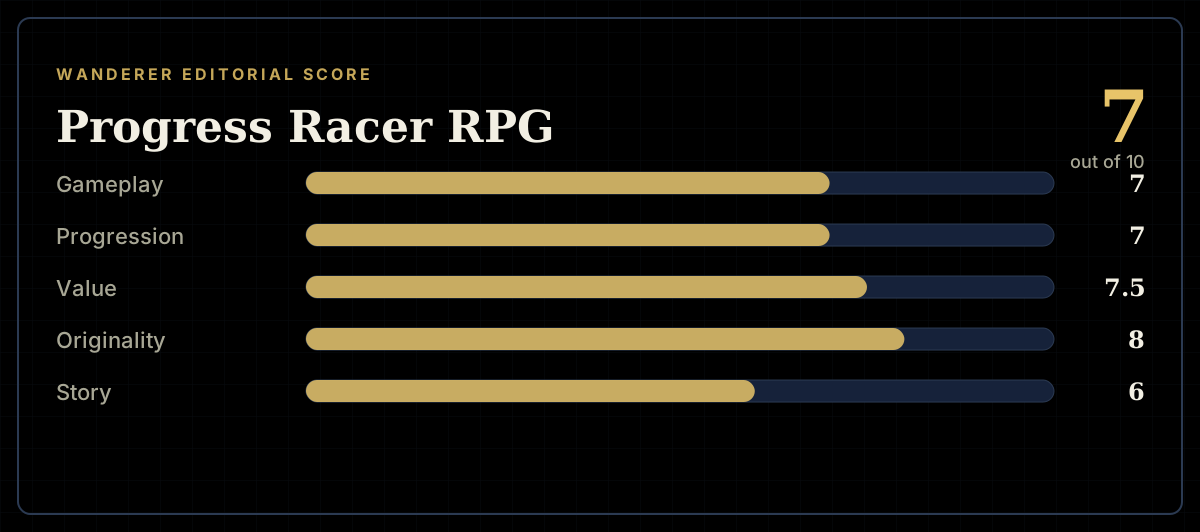
How the review scores each part of the gameWanderer Editorial -
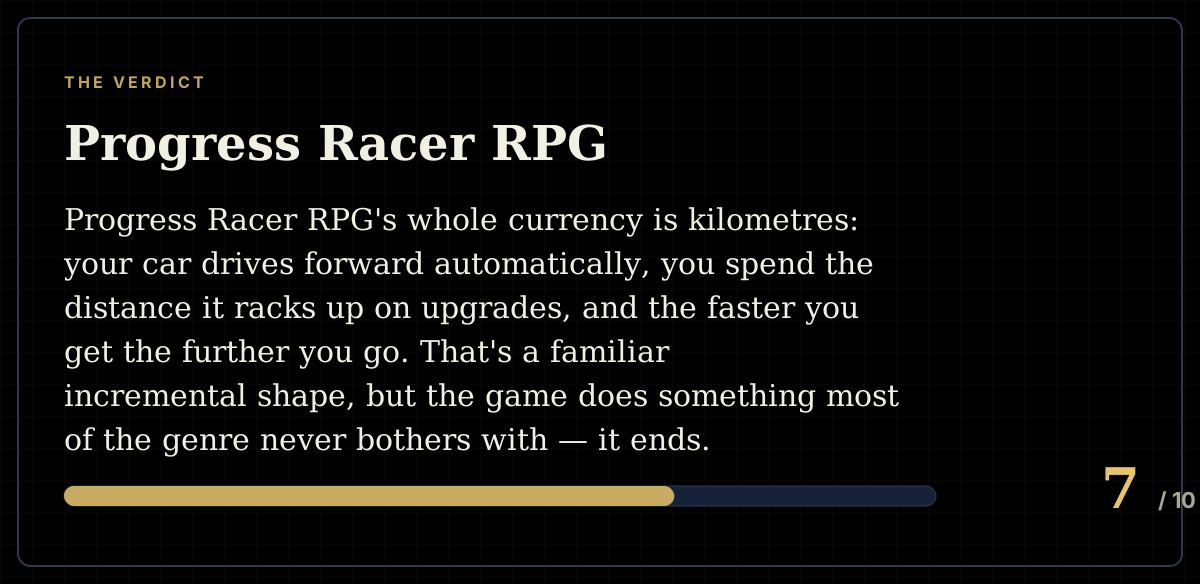
The short versionWanderer Editorial