
Game review
Remaya Idle
4 / 10
- Developer
- Wurrad
- Publisher
- Wurrad
- Released
- 20 November 2017
- Platforms
- Windows, macOS
- Genre
- Idle RPG
- Monetisation
- One-time purchase, no DLC or in-game currency
- Players
- Single-player
The short version
Remaya Idle is a small, click-and-idle hybrid RPG — destroy targets manually or let an Archer do it while you're away, farm potions and gear, "reborn" into a fresh cycle with permanent bonuses — priced fairly at NZ$4.49 with absolutely no monetisation pressure attached. Its own Steam news feed has never carried a single post in nearly nine years, and reviewers writing in 2018, 2021, 2024 and 2025 independently arrive at the same number: the full talent tree, achievements and available worlds are exhausted somewhere between twelve and sixty-five hours, after which there is nothing more the game was ever going to give you.
Biggest strengths
- No monetisation of any kind beyond the one-time purchase price — no premium currency, no ads, no paywalled convenience, a point multiple reviewers raise unprompted as a relief next to typical mobile-style idle games
- The core loop of manual clicking backed by an automated Archer, combined with a "Reborn" prestige cycle and a genuine crafting/book system for modifying gear, gives it more moving parts than a bare-bones clicker
- Achievement design is friendly rather than punishing — the completion curve declines gently across 48 achievements rather than walling off the last few behind an artificial grind, matching reviewer reports of clearing everything in well under a week
Biggest weaknesses
- The developer's Steam news feed carries zero posts in almost nine years on sale — not a slowdown, a complete absence of any patch, announcement or acknowledgement since launch
- Reviewers spanning 2017 through 2025 converge on the same finding independently — full content, including the endgame "legendary dungeons," is exhausted in roughly twelve to sixty-five hours, after which the game has nothing further to offer
- One reviewer explicitly disputes the "idle" framing itself, pointing out that gold generation is capped, meaning leaving the game running unattended stops paying off well before a genuinely idle game would let it
Who it's for: Idle-genre completionists after a cheap, achievement-friendly few hours with zero microtransaction pressure will find exactly that here, and several long-time reviewers say as much plainly. Anyone looking for a game to sink real hours into, or expecting ongoing support of any kind, should look elsewhere — the developer has never posted a single update, patch note or acknowledgement in the game's entire history on the store.
Our recommendation: Reasonable only as a short, disposable idle diversion at its low price, bought with the explicit understanding that what exists today is everything that will ever exist. Not recommended to anyone hoping the "reborn" loop or additional worlds will deepen with time — eight years of silence is as strong a signal as a developer can give without saying so directly.
4 / 10
A modest idea, delivered once and never revisited
Remaya Idle's pitch sits in familiar territory for the genre circa 2017: click to attack directly, or step away and let an automated Archer do the same work slower; loot potions and gear; "reborn" into a fresh run carrying permanent bonuses forward; eventually push into tougher "legendary dungeons" once the early tiers are cleared. None of that is a new idea even by the standards of when it launched, and reviewers are broadly upfront about that — several describe the mechanics as "far below the current standard for idle games" even at launch, while still finding a couple of enjoyable hours in the execution.
What the game does have going for it, and what a genuine number of reviewers volunteer without being asked, is restraint. There's no premium currency, no advertisement, no artificial wall engineered to sell a convenience purchase past it — just a single low price and a game that, for as long as it lasts, plays by the rules it states up front. One reviewer frames this directly against the rest of the genre: most idle games "use microtransactions" and "create a wall you hit while playing to buy stuff," while Remaya Idle just doesn't. On a scoring axis that exists specifically because idle and mobile-adjacent games so often pressure players toward spending, that's a real, creditable point in its favour, and it's the strongest part of this review.
Where the content actually ends
The complaint that dominates the review corpus isn't about mechanics so much as duration. A representative sample: one reviewer clears the full talent tree in about twelve hours and calls the game "basically out of content" at that point; another logs 36 hours to unlock every achievement; a third, writing the most detailed technical breakdown in the corpus after 65 hours, rates the animation quality as comparable to "free flash games" and the sound design as one 90-second ambience loop with no music at all. These aren't outlier accounts from players who bounced early — several are from people who stuck with the game specifically to reach its stated endgame, and all of them land on the same conclusion: there isn't enough here to justify treating it as more than a short diversion.
One negative review goes further and challenges the core premise directly, pointing out that gold generation in Remaya Idle is capped — meaning the central promise of an idle game, that leaving it running keeps paying off, stops being true well before it would in a genuinely idle-first design. Whether or not every reviewer who's tried it agrees with that framing, it's a specific, checkable mechanical claim rather than a vague complaint about difficulty, and it goes to the heart of what the "Idle" in the title is supposed to mean.
The systems that were actually built
It's worth being specific about what does exist, because the review corpus doesn't describe a bare-bones tech demo — the "Reborn" prestige cycle carries permanent bonuses into a fresh run, gear can be found in multiple rarity tiers, and a book-based modification system lets players reshape an item's stats rather than simply replacing it with a bigger number. One reviewer calls the crafting layer "pretty deep... for this kind of game," and it's a fair assessment relative to genre peers from the same era — Remaya Idle isn't a single-currency clicker with a coat of paint, it has a real, if compact, itemisation loop underneath the click-and-idle surface. The interface itself draws no serious complaints in either direction; reviewers on both sides describe it as clean and easy to parse, which matters more than it might sound for a game whose main selling point is leaving it running unattended.
The problem the corpus keeps returning to isn't that these systems don't work — it's that there's exactly one pass of them, sized for the twelve-to-sixty-five-hour window reviewers report and never expanded afterward. A prestige loop that resets you into the same content with the same worlds and the same legendary dungeons stops feeling like a system and starts feeling like the only lever left to pull once everything else is exhausted, and several reviewers describe exactly that shift happening to them personally, usually within the first two or three "reborns."
Nine years of silence
The single fact that reframes everything else here is what isn't on the store page: Remaya Idle's Steam news feed has never carried a single post. Not a launch-week bug fix, not an acknowledgement of the reviews asking for more content, nothing, across almost nine years on sale. Reviews dated 2018 already describe the developer as having "dropped it halfway through" and reviews as recent as 2024 and 2025 are still discovering the same thing for the first time, several explicitly warning newcomers before they buy. That total absence of communication — not even a "thanks for playing, moving on to something else" note of the kind other abandoned idle games in this library have at least left behind — is unusual even among the genre's frequent Early-Access-forever pattern, since this game was never in Early Access at all; it launched as a finished 1.0 product and simply stopped there.
Verdict
Remaya Idle does one thing well: it charges a fair price once and never asks for another cent, which is worth real credit in a genre built around exactly the opposite instinct. But a short, mechanically ordinary idle RPG that both its critics and its defenders agree runs out of content within a couple of days, built by a developer who has posted literally nothing about it in nearly nine years, doesn't clear the bar for a broader recommendation. Buy it, if at all, as a disposable few hours at a low price and nothing more — the reviewers who went in expecting anything beyond that, across eight years of trying, have all reached the same disappointed conclusion.
Pros and cons
Pros
- No monetisation of any kind beyond the one-time purchase price — no premium currency, no ads, no paywalled convenience, a point multiple reviewers raise unprompted as a relief next to typical mobile-style idle games
- The core loop of manual clicking backed by an automated Archer, combined with a "Reborn" prestige cycle and a genuine crafting/book system for modifying gear, gives it more moving parts than a bare-bones clicker
- Achievement design is friendly rather than punishing — the completion curve declines gently across 48 achievements rather than walling off the last few behind an artificial grind, matching reviewer reports of clearing everything in well under a week
- The asking price is consistently described as fair for what's there, even by reviewers recommending against a purchase on other grounds
Cons
- The developer's Steam news feed carries zero posts in almost nine years on sale — not a slowdown, a complete absence of any patch, announcement or acknowledgement since launch
- Reviewers spanning 2017 through 2025 converge on the same finding independently — full content, including the endgame "legendary dungeons," is exhausted in roughly twelve to sixty-five hours, after which the game has nothing further to offer
- One reviewer explicitly disputes the "idle" framing itself, pointing out that gold generation is capped, meaning leaving the game running unattended stops paying off well before a genuinely idle game would let it
- A detailed 65-hour review describes several systems — animation quality, sound design limited to a 90-second ambience loop, and itemisation — as reaching only "a bit beyond a proof of concept level" rather than a finished game
- At least one recent reviewer raises the question of whether some assets were sourced rather than originated, without reaching a firm conclusion either way
Screenshots
-

Remaya IdleImage: Wurrad via Steam -

Remaya IdleImage: Wurrad via Steam -

Remaya IdleImage: Wurrad via Steam -
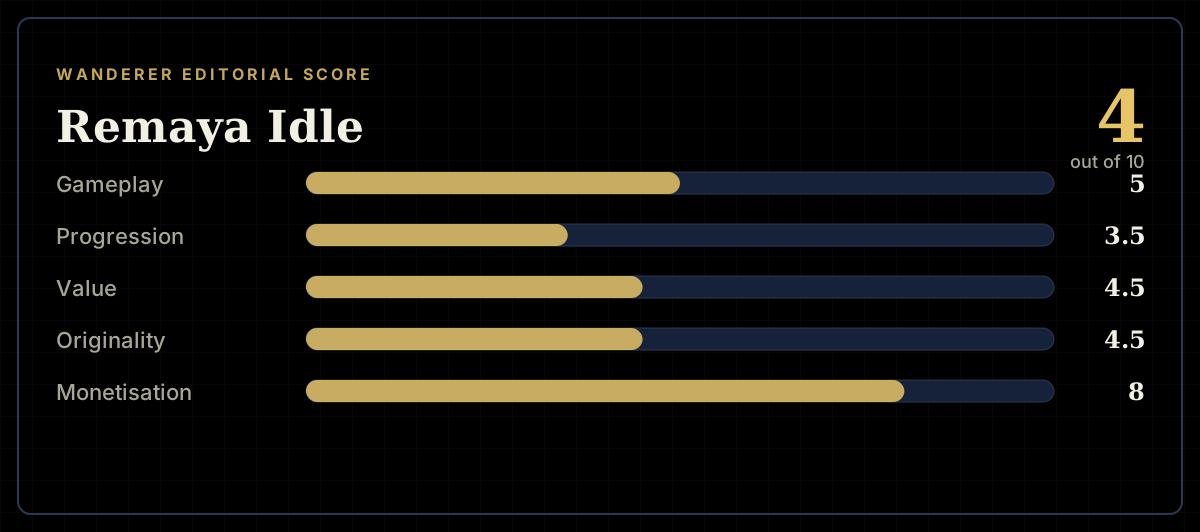
How the review scores each part of the gameWanderer Editorial -
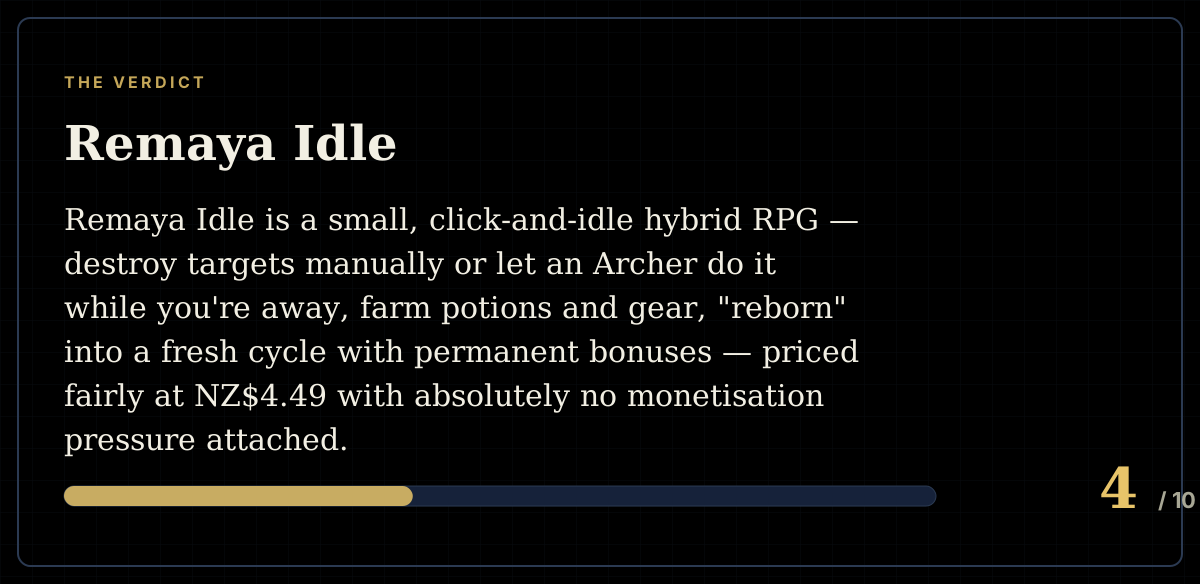
The short versionWanderer Editorial