
Game review
Idle Hunter
5.5 / 10
- Developer
- SaFiKiK
- Publisher
- SaFiKiK
- Released
- 23 August 2018
- Platforms
- Windows, Linux
- Genre
- Idle Clicker
- Monetisation
- One-time purchase, no DLC or in-game currency
- Players
- Single-player
The short version
Idle Hunter is exactly what its NZ$1.29 price tag promises and nothing more: click a monster, buy upgrades, watch numbers climb while you're away, with no rebirth-adjacent flourish beyond a genuine but under-rewarding prestige loop. What separates it from this session's other small idle finds is that its developer actually showed up — ten patches between September 2018 and May 2019, including an explicit public post after players started reporting corrupted saves — before going quiet. The reviews that remain Mixed rather than clearly positive mostly concern what happens after that early support window: a late game several reviewers describe as a hard stop with nowhere left to go.
Biggest strengths
- Ten patches shipped between September 2018 and May 2019, including a specifically titled "IF YOU LOST YOUR SAVE" post addressing player-reported save corruption directly rather than staying silent about it
- At NZ$1.29, reviewers on both sides of the Mixed rating consistently describe the price as fair or better than fair for what's delivered
- A clean, legible interface and an in-game guide explaining damage calculations and stat effects go further than many idle games at this price bracket bother to
Biggest weaknesses
- Multiple reviewers independently report losing all progress to save corruption, and while the developer's October 2018 patch addressed the issue publicly, at least one review describes the same failure recurring years later
- The most detailed negative reviews argue the reset/prestige mechanic barely accelerates a subsequent run, leaving committed players stuck at the same soft ceiling reset after reset rather than genuinely restarting stronger
- Core stats like Agility go under-explained in the base game according to more than one reviewer, despite the in-game guide covering other mechanics reasonably well
Who it's for: Anyone who wants forty or fifty completely unpretentious hours of number-watching for the price of a coffee, and doesn't mind a simple presentation with almost no explanation of its own systems, will get real value here. Players who specifically want their idle game's reset mechanic to meaningfully re-accelerate progress, rather than mostly reset the clock, will hit the same wall several detailed reviewers describe.
Our recommendation: A fair, low-risk purchase at its price point — the core loop works, the worst of its early bugs were patched rather than ignored, and nobody claims it under-delivers on cost. Go in expecting a short, simple experience with a soft ceiling rather than the deep multi-prestige systems bigger idle games build around, and the Mixed score on its store page will make more sense.
5.5 / 10
What a dollar-thirty actually buys
Idle Hunter doesn't pretend to be anything beyond its price point. Click on a monster to fight it directly, or leave the game running and let passive damage do the same job slower; spend gold on stat upgrades across attack, strength, agility and a handful of building-style investments; unlock deeper mine shafts and item tiers as numbers climb. There's a Prestige system in there too — confirmed less by the marketing than by two dedicated achievement tiers tracking how often players actually use it — giving the loop a second axis beyond straight-line number growth. None of this reinvents the idle clicker template, and reviewers on both sides of the game's Mixed rating say so plainly, several explicitly labelling it "basic" or "simplistic" before going on to recommend it anyway for exactly what it is.
What that "exactly what it is" framing earns the game is real, specific credit most disposable idle clickers at this price don't bother collecting. The interface is clean and legible, there's an actual in-game guide walking through how damage is calculated, and several long-playtime reviews — one logging over 30,000 minutes, another past 28,000 — describe genuinely sticking with it far past a first-hour impression, which is a real signal for a game this unadorned.
A bug the developer actually fixed
The most interesting fact in Idle Hunter's history isn't in the reviews at all — it's on the game's own Steam news feed. Between its August 2018 launch and May 2019, ten separate updates shipped, and one of them is titled, without euphemism, "[IMPORTANT] IF YOU LOST YOUR SAVE." That's a direct response to exactly the complaint that recurs across the review corpus: players losing hours, sometimes tens of hours, of accumulated progress to what several describe as save corruption or an outright crash-on-load. Compared to the silent, unsupported small idle games this library has also found this year, a developer publicly addressing a serious bug by name, in the game's own announcement feed, is a meaningfully better outcome — even though at least one more recent review reports the same category of failure returning years later, suggesting the original fix didn't close every case.
That the last patch is dated May 2019 means whatever imperfections remain today are the final state of the game rather than a snapshot of an active project. It's fair to read that either as "the developer finished polishing it and stopped, reasonably" or as "the same open complaints have sat unaddressed for seven years" — the review corpus supports both readings, and this review isn't in a position to say which is truer without a claim it can't verify.
Where the design itself falls short
Set the bug history aside and a more structural criticism remains, made by some of the corpus's most detailed reviews: the Prestige loop exists, but doesn't do the one job a reset mechanic in this genre is supposed to do. One reviewer states it directly — "you get stuck in a few days... reseting hardly gives you anything" — arguing that the entire appeal of an idle game's reset structure, meaningfully re-accelerating a subsequent run, doesn't really land here. That's a different, more specific complaint than "the game is too simple," and it's the one that separates the players who call this "the perfect cheap timewaster" from the ones who feel every session eventually hits the same soft ceiling with no further lever to pull.
Value against the rest of the genre
At NZ$1.29, Idle Hunter sits well below even the budget end of the idle-RPG shelf this library has covered this year, and the value case reviewers make for it is consistent rather than exaggerated: nobody in the corpus argues it's a rip-off, and several go out of their way to say it's a fair or generous trade specifically because there's no monetisation attached beyond the initial purchase. That matters more in this genre than most, since idle games are exactly where energy timers, paywalled prestige resets and pay-to-skip currencies show up most often elsewhere in Wanderer's coverage — Idle Hunter simply doesn't have any of that machinery, for better or worse. The "for worse" side of that trade is that without a live-service model funding it, there's no obvious business reason for the developer to have kept updating past May 2019, which likely explains the patch history stopping where it does rather than continuing indefinitely the way a monetised idle game's updates typically do.
The other side of the value equation is time rather than money. Reviewers logging tens of thousands of minutes — several past the 15,000-to-30,000-minute mark, which is 250 to 500 hours — suggest the core loop holds up as background entertainment far longer than its bare-bones presentation implies on a first look. That's a real point in its favour distinct from the specific prestige-design complaint above: even players frustrated by the reset mechanic's limits are, by their own playtime figures, still choosing to leave the game running.
Verdict
Idle Hunter is a small, honest product: an unpretentious idle clicker that costs less than a coffee, mostly does what it says, and — unlike several other small idle games surfaced this session — had a developer who responded in writing when a serious bug surfaced. Its Mixed rating isn't a mystery once you read past the star count: the base loop earns real goodwill, and the late-game prestige gap and lingering save-reliability reports are specific enough, and repeated by enough independent reviewers, to justify the players who came away disappointed. At its price, that's a fair trade for the audience it's actually aimed at, and a clear pass for anyone expecting more.
Pros and cons
Pros
- Ten patches shipped between September 2018 and May 2019, including a specifically titled "IF YOU LOST YOUR SAVE" post addressing player-reported save corruption directly rather than staying silent about it
- At NZ$1.29, reviewers on both sides of the Mixed rating consistently describe the price as fair or better than fair for what's delivered
- A clean, legible interface and an in-game guide explaining damage calculations and stat effects go further than many idle games at this price bracket bother to
- A genuine Prestige system exists (two dedicated achievement tiers track its use), giving the loop more structure than a pure single-currency clicker
Cons
- Multiple reviewers independently report losing all progress to save corruption, and while the developer's October 2018 patch addressed the issue publicly, at least one review describes the same failure recurring years later
- The most detailed negative reviews argue the reset/prestige mechanic barely accelerates a subsequent run, leaving committed players stuck at the same soft ceiling reset after reset rather than genuinely restarting stronger
- Core stats like Agility go under-explained in the base game according to more than one reviewer, despite the in-game guide covering other mechanics reasonably well
- No update has shipped since May 2019, so any of the above stands exactly as reported with no indication of further fixes
- One reviewer reports the game driving their CPU to 105°C, a resource-usage complaint unusual for a game this visually simple
Screenshots
-

Idle HunterImage: SaFiKiK via Steam -

Idle HunterImage: SaFiKiK via Steam -

Idle HunterImage: SaFiKiK via Steam -
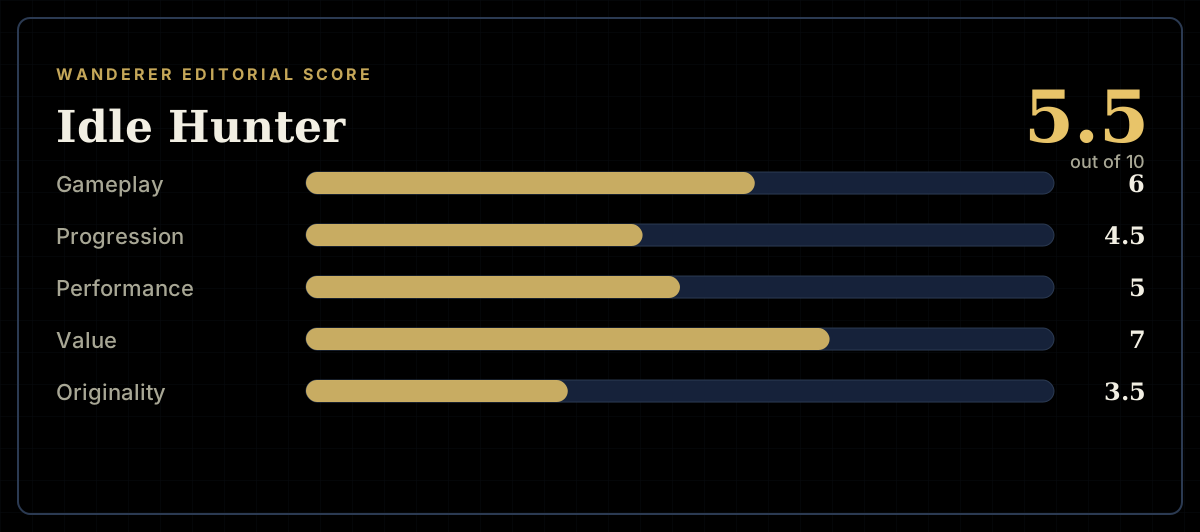
How the review scores each part of the gameWanderer Editorial -
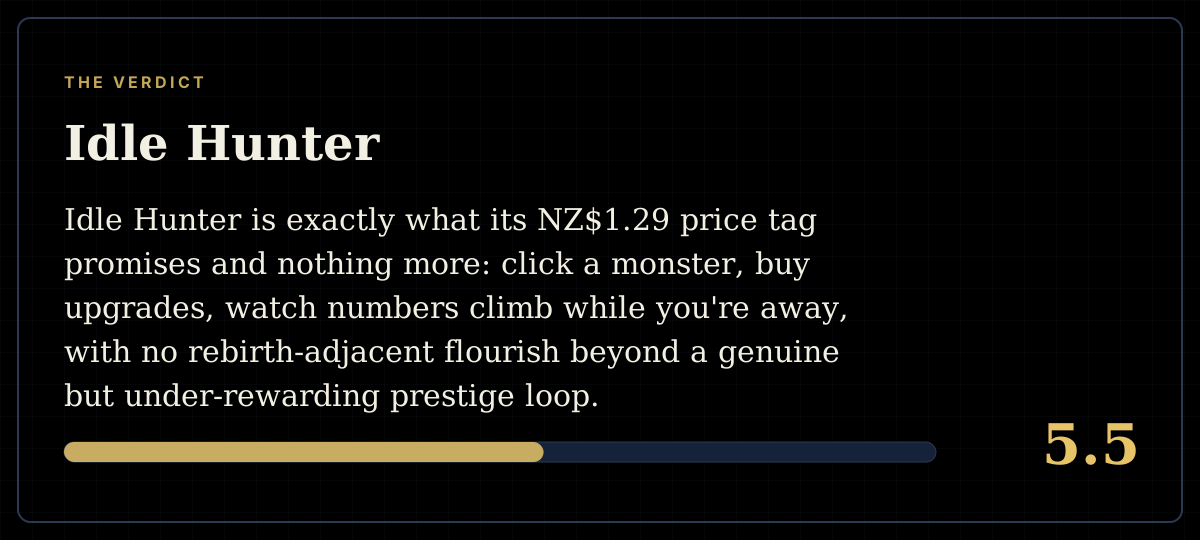
The short versionWanderer Editorial