
Game review
Creature Card Idle
5.5 / 10
- Developer
- Playsaurus, Fordesoft
- Publisher
- Playsaurus
- Released
- 22 December 2019
- Platforms
- Windows, Linux
- Genre
- Idle Strategy
- Monetisation
- Free to play, no in-game purchases or advertisements
- Players
- Single-player
The short version
Creature Card Idle's idea is small but genuinely its own: instead of buying stat upgrades, you place cards on a grid, and adjacency between cards is what generates income — a spatial-puzzle layer bolted onto an idle economy that reviewers on both sides of its Mixed rating credit as something they hadn't seen elsewhere. Playsaurus launched it for $1.19 in December 2019, patched it through April 2020, dropped the price to free, and then — in a September 2021 post on the game's own Steam news feed — announced their next game instead. Nothing has shipped for Creature Card Idle since.
Biggest strengths
- Card placement on a grid, not just card ownership, determines income — a genuinely different structural hook from the buy-a-multiplier loop most idle games use
- Fully free with literally no monetisation of any kind: no ads, no premium currency, no cosmetic store, confirmed by both the store page and the review corpus
- Individually resettable boards let you replay and optimise a layout without restarting the whole game's progress, a quality-of-life idea sharper than many bigger idle titles bother with
Biggest weaknesses
- The developer's own Steam news feed carries a September 2021 post announcing an entirely different game, Eternal Exodus, with nothing about Creature Card Idle posted before or since — about as direct a confirmation of abandonment as a review corpus gets
- The final promised zone, "Cityescape," was never released; multiple reviewers who stuck around specifically for it say so directly
- Progression scaling draws a specific technical complaint — costs rising exponentially while income grows closer to linear, which several reviewers say turns the back half of the existing content into pure waiting rather than active optimisation
Who it's for: Idle-genre players who want two or three real hours of a distinctive spatial-placement puzzle, for free, with no monetisation whatsoever to complain about, will get exactly that. Anyone hoping for the multi-hundred-hour depth Playsaurus's other idle games (Clicker Heroes 2, Idle Skilling) are known for should adjust expectations before installing — this one stops short of its own promised final zone and stays stopped.
Our recommendation: Worth downloading precisely because it costs nothing and the core placement mechanic really is interesting for the few hours it lasts. Go in expecting an unfinished tech demo rather than a complete idle RPG, and the disappointment several long-time players describe won't apply to you.
5.5 / 10
A puzzle bolted onto an idle economy
Most idle games separate what you own from where you put it — buy the upgrade, and it applies globally. Creature Card Idle's one real innovation is refusing that separation: cards generate income based on which other cards sit next to them on a grid, so the interesting decision isn't "which card should I buy next" but "where do these five cards go relative to each other." Reviewers on both sides of its verdict single this out. One calls it "a spark of brilliance in this unassuming little idle game... it brings brand new ideas to a genre that's in desperate need of them," and even reviewers who end up recommending against it tend to credit the placement puzzle specifically before explaining why the rest of the package falls short.
The execution backs that praise up for as long as there's content to apply it to. Boards reset individually, so refining a layout for one zone doesn't cost you progress in another — a genuinely thoughtful piece of design that plenty of bigger, better-funded idle games still don't bother implementing. Card packs introduce randomness into which pieces you have to work with, giving the placement puzzle new constraints each time rather than converging on one solved layout and staying there.
Where the promise runs out
The specific complaint that recurs across the review corpus isn't that the placement idea fails — it's that the economy built around it scales badly once the early puzzle novelty wears off. Costs rise exponentially while income growth stays closer to linear, which reviewers translate plainly: "to get further you need more and more time," turning what was an active optimisation problem into pure waiting. The achievement data is consistent with a game that's short by construction rather than artificially padded — completion falls from 92% to 15.6% across fourteen achievements, a real but gentle curve next to idle games built for hundred-plus-hour engagement, and several of the most detailed positive reviews describe reaching an "end goal" of sorts within a few hundred hours and finding nothing left to reach for afterward.
That ceiling would be a fair, ordinary criticism of a short game on its own. What turns it into the review's central story is that the game was never supposed to stop there. Playsaurus's own December 2019 launch messaging framed Creature Card Idle as an evolving game with expansions still to come, patched it twice in April 2020, and multiple 2020-and-later reviews specifically call out a promised final zone — "Cityescape" — that never arrived. One reviewer, writing in 2021, states it outright: "the last announced expansion is delaying a year to be released." It was never released at all. The clearest confirmation sits on the game's own Steam news feed: after April 2020, the only post is from September 2021, and it isn't a patch note — it's Playsaurus announcing their next project, Eternal Exodus, to this game's own audience. Nothing else has been posted since.
Reading it against Playsaurus's later games
Playsaurus is not a studio that vanished after this — that's part of what makes the abandonment here easier to state plainly rather than speculate about. The same developer went on to Clicker Heroes 2 and the long-running Idle Skilling, both built for exactly the hundred-plus-hour engagement Creature Card Idle stops well short of. Read next to those, Creature Card Idle looks less like a failed idle RPG and more like a smaller, experimental side project whose one good idea — spatial card placement — never got the additional zones, balance passes and content cadence a Playsaurus game usually receives once it finds an audience. That's a useful, fairer frame than judging it purely against a bigger, fully supported title, but it doesn't change what a player installing it today actually gets: a free, interesting, unmistakably unfinished couple of hours.
The interface itself holds up reasonably well for what it is — dragging cards onto a grid is intuitive from the first minute, and the individually resettable boards mean experimenting with a new layout never risks the rest of your progress. Where it shows its age is pacing: several reviewers describe the early zones as generous and the later ones as a wait-timer with no engagement, which is the scaling-imbalance complaint above showing up in how the game actually feels to sit through rather than just in the raw numbers.
Free, and worth exactly what that implies
Creature Card Idle's monetisation is the easiest section of this review to write: there isn't any. It launched paid at $1.19, was later made free, and carries no advertisements, premium currency or cosmetic storefront at any point in its history — several reviewers explicitly credit this restraint even while giving the game a mixed or negative recommendation on other grounds. For a genre where energy timers and paywalled resets are common enough to be one of Wanderer's standing concerns, that's worth stating plainly rather than taking for granted.
It doesn't rescue the experience from feeling incomplete, though. A free game that stops exactly where its own developer said more was coming is still a game that stops early, and "at least it didn't try to charge you for the unfinished part" is a low bar to clear rather than a real recommendation.
Verdict
Creature Card Idle is a small, free, genuinely original idle experiment — a grid-placement puzzle wearing an idle game's economy — that gets two or three good hours out of an idea most of the genre hasn't tried, and then simply stops, mid-plan, with its own developer's next game already being promoted on its news feed. That's enough for a fair, moderate score rather than a low one: nobody was charged for the unfinished parts, and what does exist works roughly as designed. But "worth trying because it's free and interesting for an afternoon" is a different, smaller claim than "worth playing," and this review can only honestly make the first one.
Pros and cons
Pros
- Card placement on a grid, not just card ownership, determines income — a genuinely different structural hook from the buy-a-multiplier loop most idle games use
- Fully free with literally no monetisation of any kind: no ads, no premium currency, no cosmetic store, confirmed by both the store page and the review corpus
- Individually resettable boards let you replay and optimise a layout without restarting the whole game's progress, a quality-of-life idea sharper than many bigger idle titles bother with
- Achievement data shows a gentle, completable curve (92% down to 15.6% across fourteen achievements) rather than an artificial grind wall — this is a short game by design, not a padded one
Cons
- The developer's own Steam news feed carries a September 2021 post announcing an entirely different game, Eternal Exodus, with nothing about Creature Card Idle posted before or since — about as direct a confirmation of abandonment as a review corpus gets
- The final promised zone, "Cityescape," was never released; multiple reviewers who stuck around specifically for it say so directly
- Progression scaling draws a specific technical complaint — costs rising exponentially while income grows closer to linear, which several reviewers say turns the back half of the existing content into pure waiting rather than active optimisation
- At least one 2020 review reports offline-mode instability serious enough to make unattended play, the entire point of an idle game, unreliable for them
- Most positive reviews describe finishing the available content in well under a few hundred hours and having nothing left to do afterward, which is a real ceiling next to genre peers built for much longer engagement
Screenshots
-

Creature Card IdleImage: Playsaurus via Steam -

Creature Card IdleImage: Playsaurus via Steam -

Creature Card IdleImage: Playsaurus via Steam -
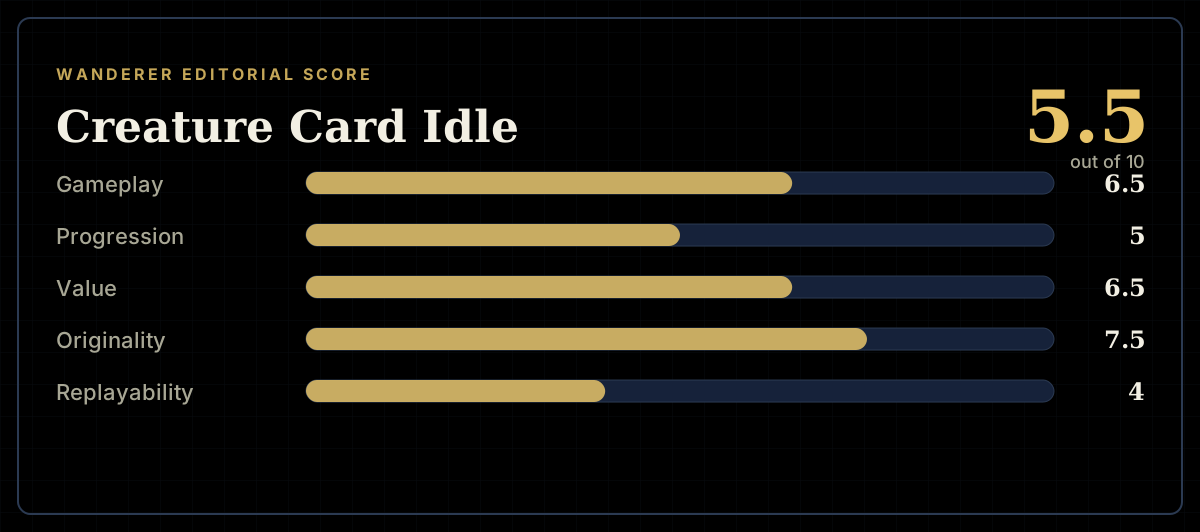
How the review scores each part of the gameWanderer Editorial -
The short versionWanderer Editorial