
Game review
Perfume Atelier
6.5 / 10
- Developer
- Keep The Engine Games
- Publisher
- Rogue Duck Interactive, Gamersky Games
- Released
- 7 February 2026
- Platforms
- ["Windows", "Mac", "Linux"]
- Genre
- Simulation
- Monetisation
- Paid
- Players
- Single-player
The short version
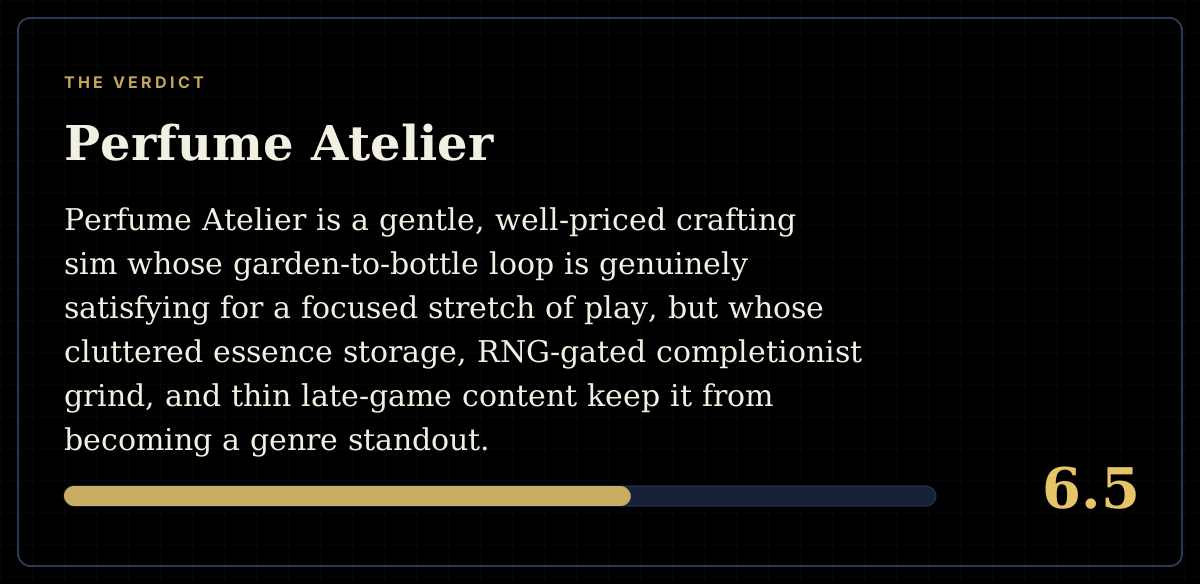
Perfume Atelier is a gentle, well-priced crafting sim whose garden-to-bottle loop is genuinely satisfying for a focused stretch of play, but whose cluttered essence storage, RNG-gated completionist grind, and thin late-game content keep it from becoming a genre standout.
Biggest strengths
- A genuinely satisfying core loop of growing ingredients, distilling essences, and hand-mixing them into perfumes and candles, with no time pressure forcing the pace
- Cheap and content-rich for a short sim, with most reviewers reporting 9 to 20 hours to see everything, plus extensive bottle and label customization
- A well-realised garden system that lets players grow their own scent ingredients rather than buying everything, something several reviewers say other games in the genre skip entirely
Biggest weaknesses
- Essence storage quickly clutters the workbench, since vials cannot easily be merged or organised, a problem multiple reviewers raised as the game's biggest usability flaw
- A short in-game selling window and finicky customer patience timers make the shop segment feel rushed compared to the relaxed pace of the crafting itself
- The last stretch of full completion leans on a random NPC handing out arbitrary, RNG-gated quests, which several reviewers found tedious and unnecessarily grindy
Who it's for: Fans of low-pressure, no-fail crafting sims like Potion Craft or Ship Inc who want a short, cheap, screen-time-friendly loop rather than a deep management challenge.
Our recommendation: Worth picking up on sale for anyone who enjoys the make-and-sell genre, especially at its usual price point, but go in expecting a handful of relaxing hours rather than a long-term time sink.
6.5 / 10
Growing, Distilling, Bottling
Perfume Atelier, developed by Keep The Engine Games and published by Rogue Duck Interactive and Gamersky Games, released fully on February 7, 2026 after a demo run during the previous autumn's Steam Next Fest. It's the studio's follow-up to Ship Inc, and it carries over the same basic pitch: take a real-world trade, strip it down to a calm, no-fail crafting loop, and let players work through it at their own pace. Here, that trade is perfumery. Players tend a small garden to grow flowers and herbs, harvest and distil them into scent essences, then combine those essences by hand in a mortar-and-stovetop process that determines how many quality stars a finished perfume earns. The same essences can also be poured into candles, giving the crafting side two parallel outputs rather than one.
What reviewers consistently praise is how unhurried all of this feels. There's no game-ending failure state and no ticking clock forcing decisions during the crafting phase, so players can take as long as they like mixing a batch, and the game rewards patience rather than speed. One reviewer, comparing it favourably to other games in the genre, specifically calls out the garden as "well implemented here" in a way "many other games fall short" of, since growing ingredients rather than simply buying them gives the loop an extra, satisfying layer most competitors skip.
A Shop That Moves Faster Than the Workshop
Once perfumes and candles are made, they go on sale to a rotating cast of customers who wander into the shop with specific requests, sniff samples, and buy or walk away depending on whether their preferences are met. This half of the game runs at a noticeably different tempo than the unhurried crafting side: each in-game day gives players a limited window to serve customers before it ends, and reviewers describe customer patience as draining quickly, sometimes forcing sales to be abandoned or carried over to the next day. One detailed review argues the short sales window actively slows the whole game down, since it caps how much money and quest progress can be earned per day, indirectly stretching out later objectives that require large sums or many sales. A separate customization layer softens this a little: players can name and visually design their own bottles, something several reviewers list among their favourite parts of the game, giving even a rushed sale a personal touch.
Progression is steady and well-paced through the early and mid game, unlocking new recipes, ingredients, and shop upgrades at a rate reviewers describe as satisfying without being padded. Automation options appear at the higher tiers, letting some of the repetitive steps run themselves once unlocked, and one long-time player specifically credits post-launch quality-of-life patches, including the ability to combine essence jars, with meaningfully improving the experience since release.
Ducks, RNG, and a Cluttered Bench
The clearest recurring complaint across the review sample is inventory management on the crafting bench itself. Essences are collected in individual vials that cannot easily be merged into larger, more efficient containers, and as the recipe list grows, players end up juggling a rapidly cluttering workspace of near-identical bottles. One reviewer frames it plainly: the essence box "is small and can't even be upgraded," forcing constant back-and-forth trips that break the otherwise relaxed flow, while another calls the vial system the single change they most want to see improved.
The other sore point shows up specifically around full completion. A recurring NPC, referred to by multiple reviewers simply as "the duck guy," hands out randomized quests tied to achievement progress, and getting the full set of rewards depends on that NPC appearing with the right request rather than any skill or planning on the player's part. More than one reviewer describes spending their final hours of play almost entirely on this RNG-gated duck-hunting rather than on the crafting the game is actually built around, with one calling it a pure "gamble" and another noting they burned roughly four hours chasing the last few unlocks. A smaller handful of players also reported bugs affecting core tools, including at least one case where a crafting implement stopped responding regardless of settings changes, effectively blocking further progress until reinstalled or patched around.
Where the Charm Runs Thin
Beyond those specific friction points, the game's overall shallowness is its biggest limitation. There's no real narrative or character writing to speak of, customers are functional rather than memorable, and recipes are handed to players outright instead of being discovered through experimentation, which flattens some of the crafting fantasy the genre usually leans on. Reviewers are largely at peace with this trade-off given the low price, but it does mean the game's replay value depends almost entirely on how much its central loop appeals on its own merits, without a story or cast to pull players back in once the mechanical novelty fades. Several reviewers explicitly frame the experience as best enjoyed in short, regular sessions rather than long sittings, treating it more like a wind-down ritual than a game to be consumed in one push.
Verdict
Perfume Atelier delivers exactly what it promises: a calm, pleasant crafting loop built around growing and blending scents, sold at a price that matches its modest scope. The garden and distillation systems are its strongest ideas, giving the make-and-sell formula a layer of hands-on cultivation that similar games often skip, and the customization options give even a rushed shop day some personality. But a cluttered, unmergeable essence inventory, a completion path that leans on random NPC quests rather than mastery, and a shop segment that moves faster than the crafting side it's paired with all chip away at the experience the longer it goes on. Buy it expecting a short, cozy handful of hours rather than a deep management sim, ideally on sale, and it's easy to enjoy for what it is.
Pros and cons
Pros
- A genuinely satisfying core loop of growing ingredients, distilling essences, and hand-mixing them into perfumes and candles, with no time pressure forcing the pace
- Cheap and content-rich for a short sim, with most reviewers reporting 9 to 20 hours to see everything, plus extensive bottle and label customization
- A well-realised garden system that lets players grow their own scent ingredients rather than buying everything, something several reviewers say other games in the genre skip entirely
Cons
- Essence storage quickly clutters the workbench, since vials cannot easily be merged or organised, a problem multiple reviewers raised as the game's biggest usability flaw
- A short in-game selling window and finicky customer patience timers make the shop segment feel rushed compared to the relaxed pace of the crafting itself
- The last stretch of full completion leans on a random NPC handing out arbitrary, RNG-gated quests, which several reviewers found tedious and unnecessarily grindy
Screenshots
-
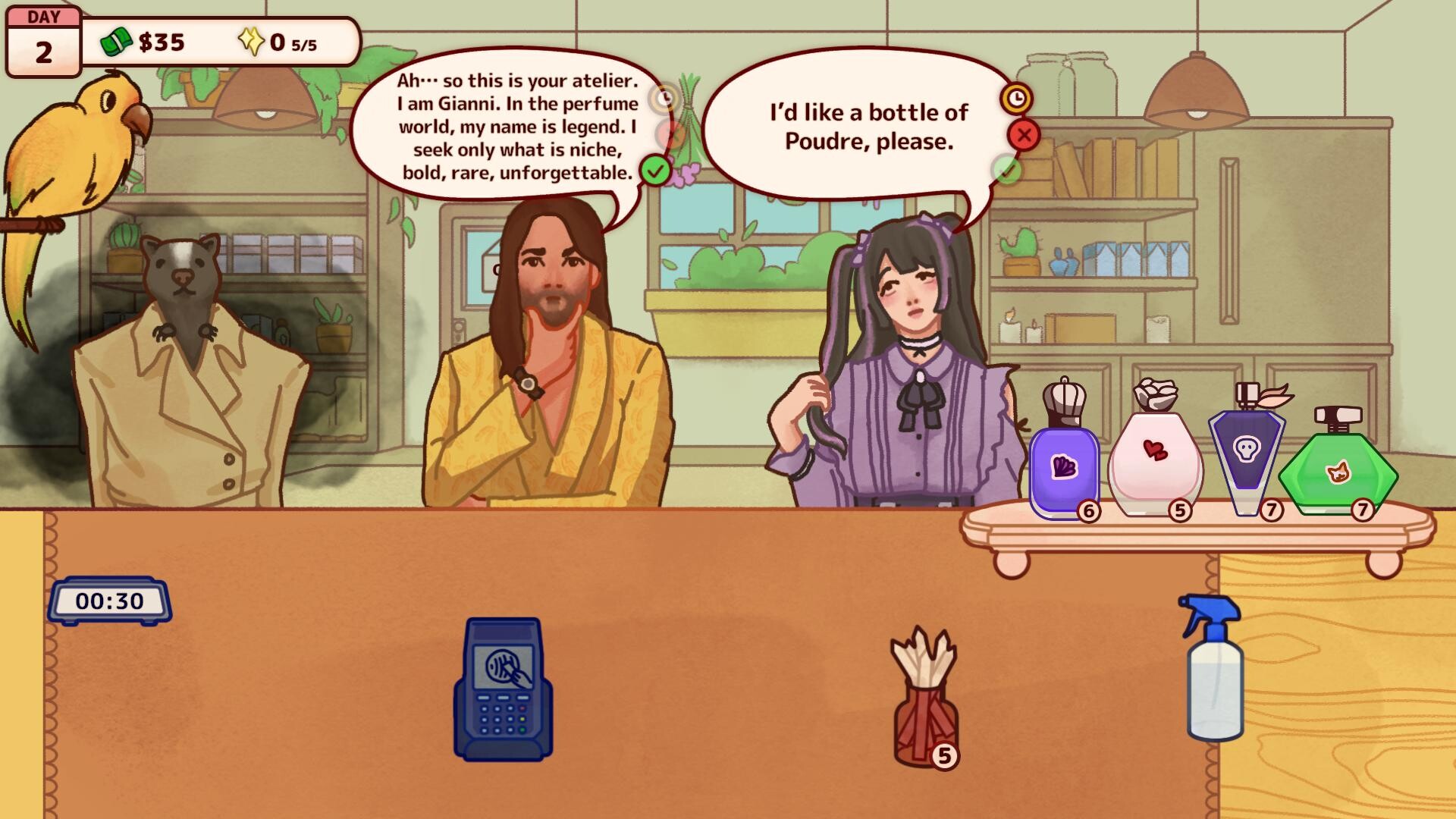
Customers browse a tray of finished perfumes while placing their orders at the counterKeep The Engine Games -
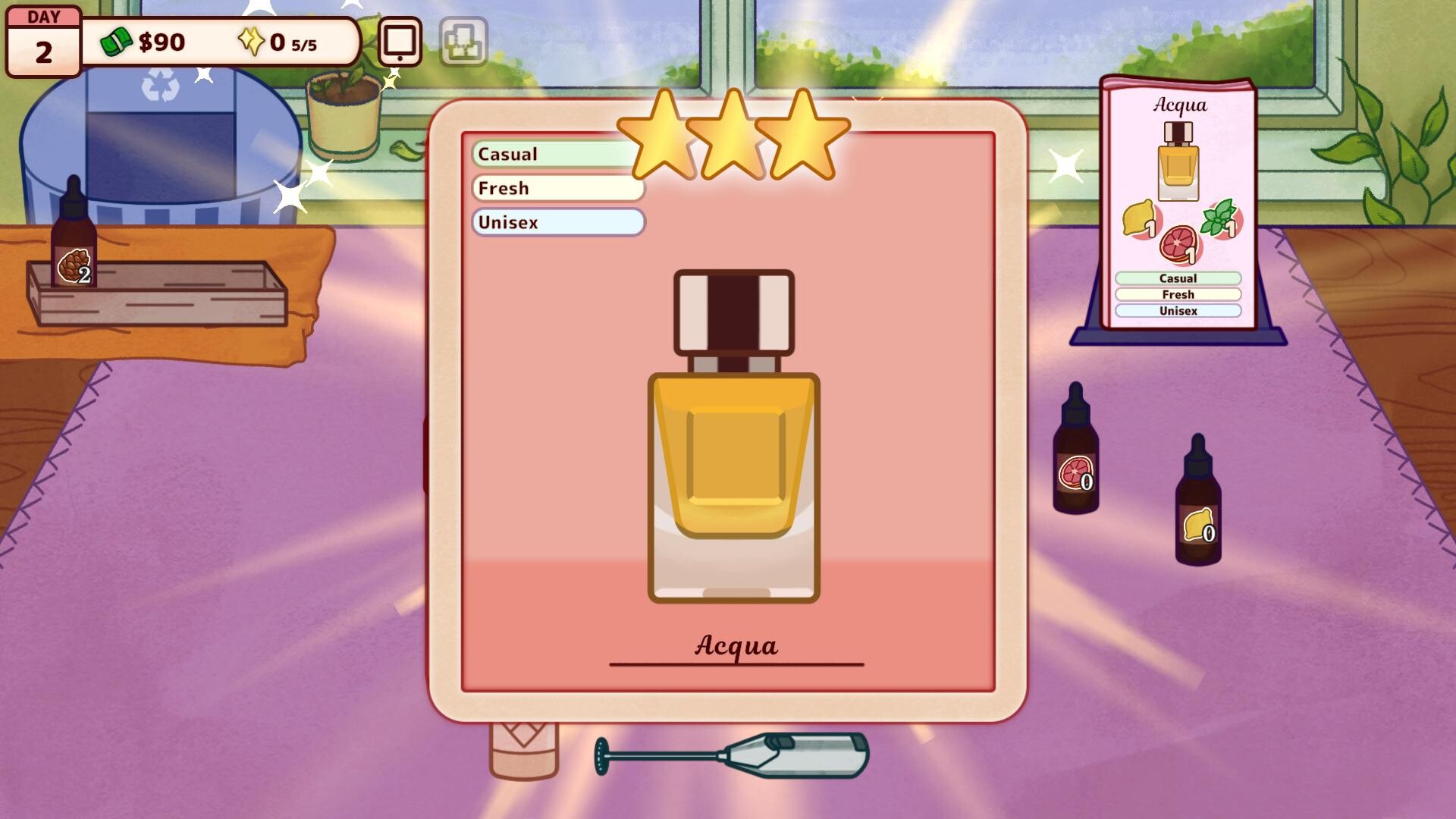
A completed perfume earns a star rating based on how closely it matches its recipe cardKeep The Engine Games -
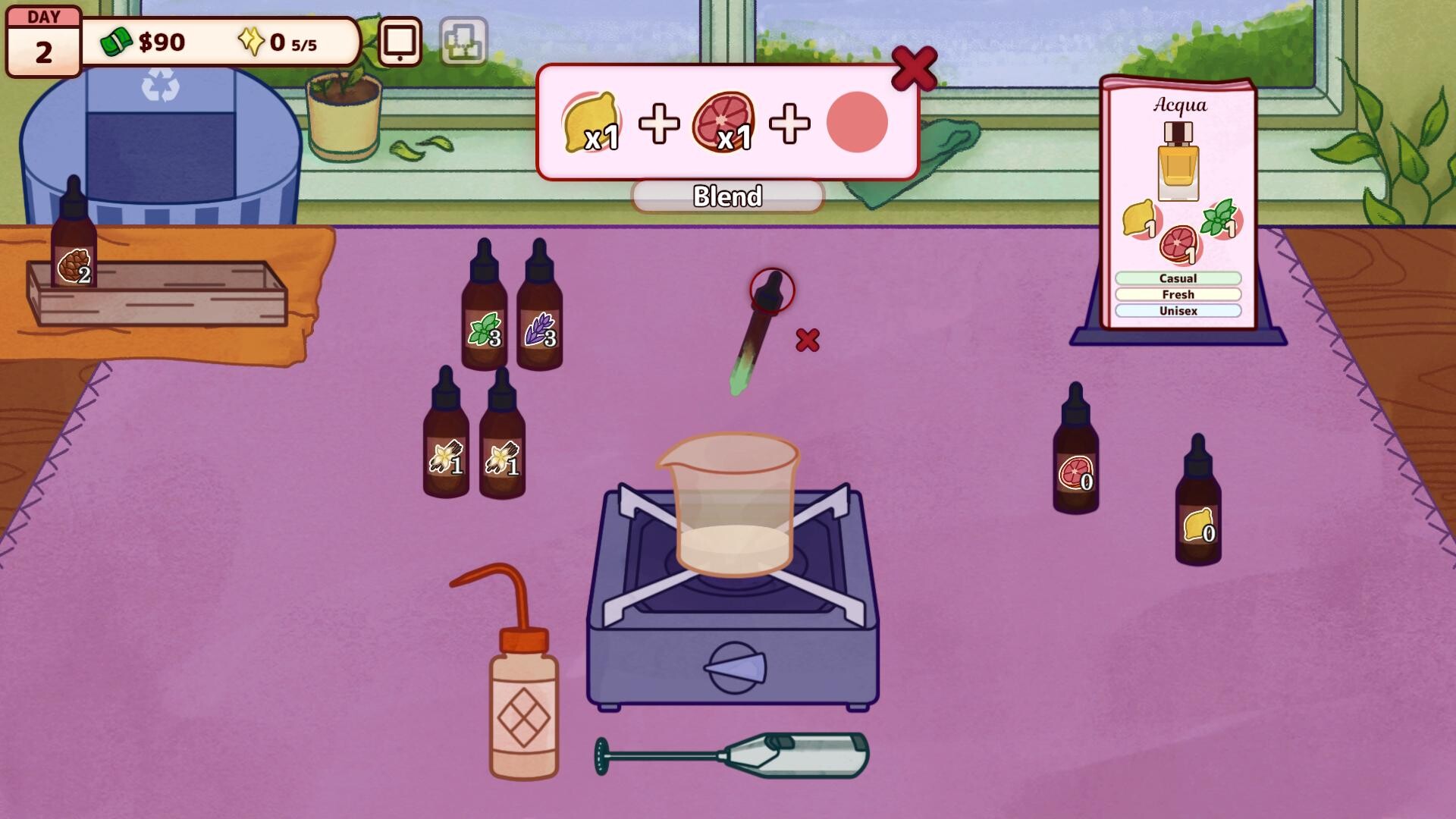
Blending essences on the stovetop, one dropper at a time, to build a new perfumeKeep The Engine Games -
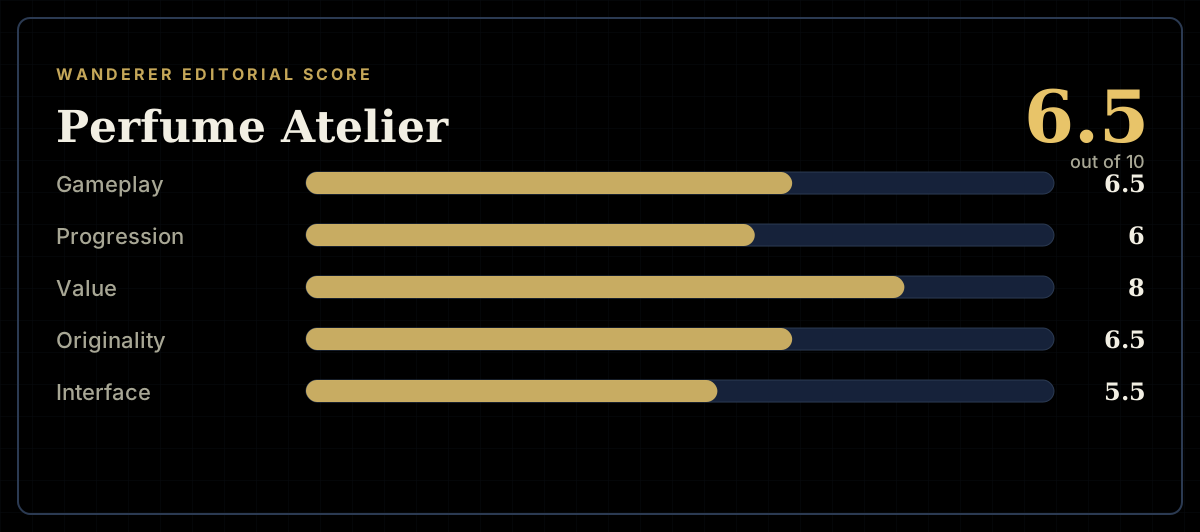
How the review scores each part of the gameWanderer Editorial -
The short versionWanderer Editorial