
Game review
Space Control
6.7 / 10
- Developer
- MoonMonster Studios
- Publisher
- MoonMonster Studios
- Released
- 1 April 2026
- Platforms
- ["Windows"]
- Genre
- Simulation
- Monetisation
- Paid
- Players
- Single-player
The short version
Space Control is a short, sharply written VR job simulator whose comedic voice cast and tactile world carry it well past the simplicity of its underlying mini-games, though its brevity and occasional pacing lulls will leave some players wanting more.
Biggest strengths
- Full, widely praised voice acting and comedic writing that draws frequent, favorable comparisons to Rick and Morty, Futurama, and High on Life
- A tactile, reactive VR world where most objects can be grabbed, squeezed, or thrown, and characters respond to being touched or interacted with
- Solid hand-tracking and VR comfort for most players, with reports of a clean, largely bug-free experience after post-launch patching
Biggest weaknesses
- A short runtime of roughly three hours across its episodes, with no announced additional content despite frequent player requests for more
- The underlying job-simulator tasks are simple and repetitive rather than mechanically deep, leaning almost entirely on writing and presentation to hold interest
- At least one reviewer reported severe motion sickness and sluggish pacing in the full release compared to the earlier demo, a discomfort risk worth flagging for sensitive players
Who it's for: VR owners who enjoy comedic job-simulator games like Job Simulator, Vacation Simulator, or Accounting+, and anyone who wants an irreverent sci-fi comedy told through a headset.
Our recommendation: Recommended for VR owners looking for a short, funny, well-acted comedy experience, though those expecting deep or varied gameplay systems should look elsewhere.
6.7 / 10
Abducted, Indebted, and Put to Work
Space Control, developed and published by MoonMonster Studios, opens with a premise that doubles as its whole pitch: you've been abducted by the intergalactic megacorporation Glorpo Inc, and rather than being probed and released, you've been conscripted into working off your debt alongside a crew of alien coworkers. It's a VR job simulator in the vein of Job Simulator and Vacation Simulator, structured as a handful of episodes that string together small workplace tasks with a heavy dose of narrative comedy. Of the 53 English-language Steam reviews at the time of writing, 52 recommend it, a Very Positive showing for a small, comedy-first VR title.
The premise is deliberately silly, and reviewers consistently describe the tone as somewhere between Rick and Morty, Futurama, and the alien-workplace absurdity of High on Life, with one reviewer specifically namechecking Trover Saves the Universe as a comparison point for the humor's cadence. Rather than building an elaborate simulation with deep systemic interactions, Space Control leans on scripted set pieces and character-driven banter to carry each episode, betting that its jokes land often enough that players won't mind the mechanical simplicity underneath. Based on the review set, that bet mostly pays off.
A Tactile World Built for Comedy, Not Depth
Mechanically, Space Control sits squarely in the job-simulator tradition established by Owlchemy Labs and refined by titles like Accounting+ and Border Bots VR: you're handed a series of small, physical tasks, stamping forms, processing alien recruits, preparing questionable space snacks, tending to alien babies, and the game trusts your hands and the room-scale space around you to do the rest. Reviewers repeatedly praise how tactile the world feels, nearly every object can be grabbed, squeezed, thrown, or fiddled with, and coworker characters visibly react when poked, prodded, or handed things, which several reviewers single out as the small detail that sells the whole experience. Hand tracking is described as solid across both Valve Index and Meta Quest 3 setups, with players managing precise actions like flipping and catching a coin without difficulty, though a few reviewers mention their virtual hands occasionally snagging on environment geometry.
Where the game is more honest about its limits is in the actual task design. The mini-games and interactions that make up each episode's workload are, by multiple accounts, simple and not especially varied, closer to a light rhythm of busywork than to a mechanically rich simulation. One reviewer put it plainly: the work itself "isn't particularly complex," and the game is "packed with crude charm" instead of systemic depth. That's a deliberate trade-off rather than an oversight, but it does mean players hoping for the kind of escalating complexity found in stricter simulation games will find Space Control's loop thin if they look past the jokes wrapped around it.
Comedy, Voice Acting, and a Crew Worth Meeting
The strongest and most consistent praise across the review set is reserved for the writing and voice performances. Reviewers describe the full cast as "phenomenal," the dialogue as laugh-out-loud funny, and the crewmates, your fellow abducted, indentured aliens, as genuinely likeable despite the game's short runtime giving them limited screen time to develop. The humor skews crude and irreverent, gross-out jokes, bodily-fluid gags, and a general willingness to be juvenile in service of a laugh, and reviewers who click with that register describe episodes as consistently escalating in quality, with the third episode singled out more than once as a high point players wanted to replay immediately. One reviewer who came in skeptical, expecting a generic job-simulator wrapped around Rick and Morty-flavored marketing, described being pleasantly surprised by how much they enjoyed the experience once they gave it a chance.
Not every reviewer connects with the humor equally; the review set's single explicit critic of the comedy found it derivative and unfunny by comparison to the shows it evokes, even while still rating the game positively overall. But that view is a clear outlier against a broader consensus that the writing, timing, and vocal performances are the game's standout asset, doing most of the heavy lifting that the simpler mechanical layer can't carry on its own.
A Short Shift, Fair Pay, and One Rough Landing
Most reviewers finish Space Control in two to four hours, and treat that length as appropriate for its roughly thirty-dollar asking price rather than a shortfall, several explicitly frame the experience as "short but fair," and multiple reviewers say they'd happily pay for additional episodes or DLC if MoonMonster Studios made more. That goodwill extends to the game's technical state: several reviewers who purchased after launch, once early patches had shipped, report a clean, bug-free experience, and Steam's own update history shows a steady run of hotfixes in the weeks following release followed by a customization update adding new options for players.
That said, the review set isn't unanimous on comfort and pacing. One detailed negative review reports the full release felt noticeably slower and more boring than the pre-launch demo, and describes severe motion sickness setting in almost immediately, a discomfort the reviewer didn't experience in the demo build and attributes to movement or optimization changes made before launch. That account is the clear outlier among an otherwise strongly positive set, but it's a legitimate risk worth flagging for VR players who are sensitive to locomotion discomfort, since most of the positive reviews don't discuss comfort settings in any detail. A separate, more minor piece of feedback from content creators asks for a centered, stabilized camera view as an alternative to the default right-shifted perspective, useful context for anyone planning to stream or record their playthrough.
Verdict
Space Control knows exactly what it is: a short, funny, well-acted VR comedy dressed up as a job simulator, not a deep or systemically ambitious one. Its mini-games won't challenge anyone, and its runtime is measured in hours rather than days, but the writing and voice cast carry it comfortably past those limitations for the vast majority of the people who've played it. Anyone drawn to alien-workplace absurdity in the vein of Rick and Morty or High on Life, and comfortable with VR locomotion, should find it an easy, entertaining few hours; players chasing mechanical depth, or unusually sensitive to VR motion discomfort, are the ones most likely to come away wanting more.
Pros and cons
Pros
- Full, widely praised voice acting and comedic writing that draws frequent, favorable comparisons to Rick and Morty, Futurama, and High on Life
- A tactile, reactive VR world where most objects can be grabbed, squeezed, or thrown, and characters respond to being touched or interacted with
- Solid hand-tracking and VR comfort for most players, with reports of a clean, largely bug-free experience after post-launch patching
Cons
- A short runtime of roughly three hours across its episodes, with no announced additional content despite frequent player requests for more
- The underlying job-simulator tasks are simple and repetitive rather than mechanically deep, leaning almost entirely on writing and presentation to hold interest
- At least one reviewer reported severe motion sickness and sluggish pacing in the full release compared to the earlier demo, a discomfort risk worth flagging for sensitive players
Screenshots
-
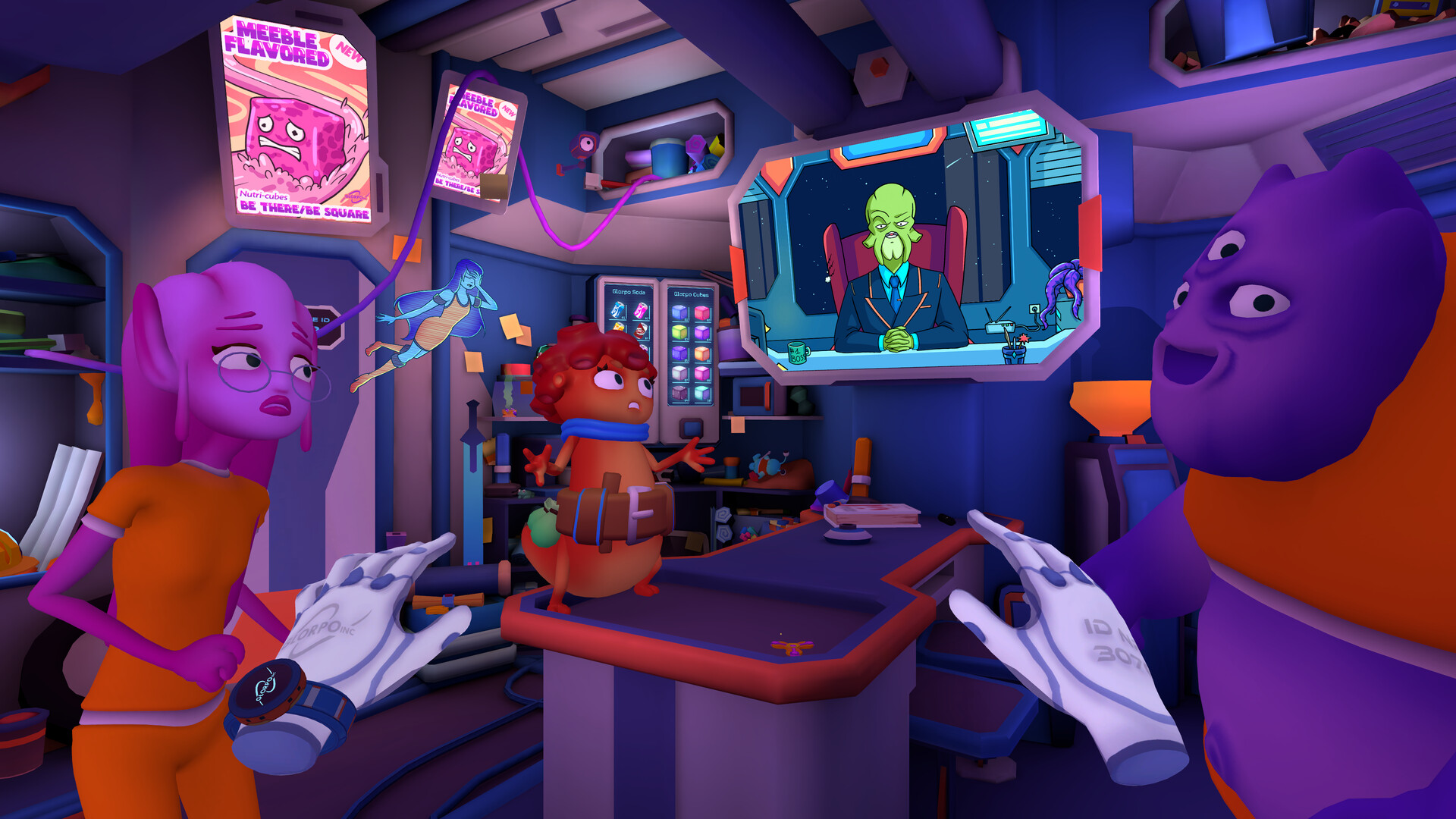
The player's crewmates and the ever-watchful Glorpo Inc leadership set the comedic toneMoonMonster Studios -
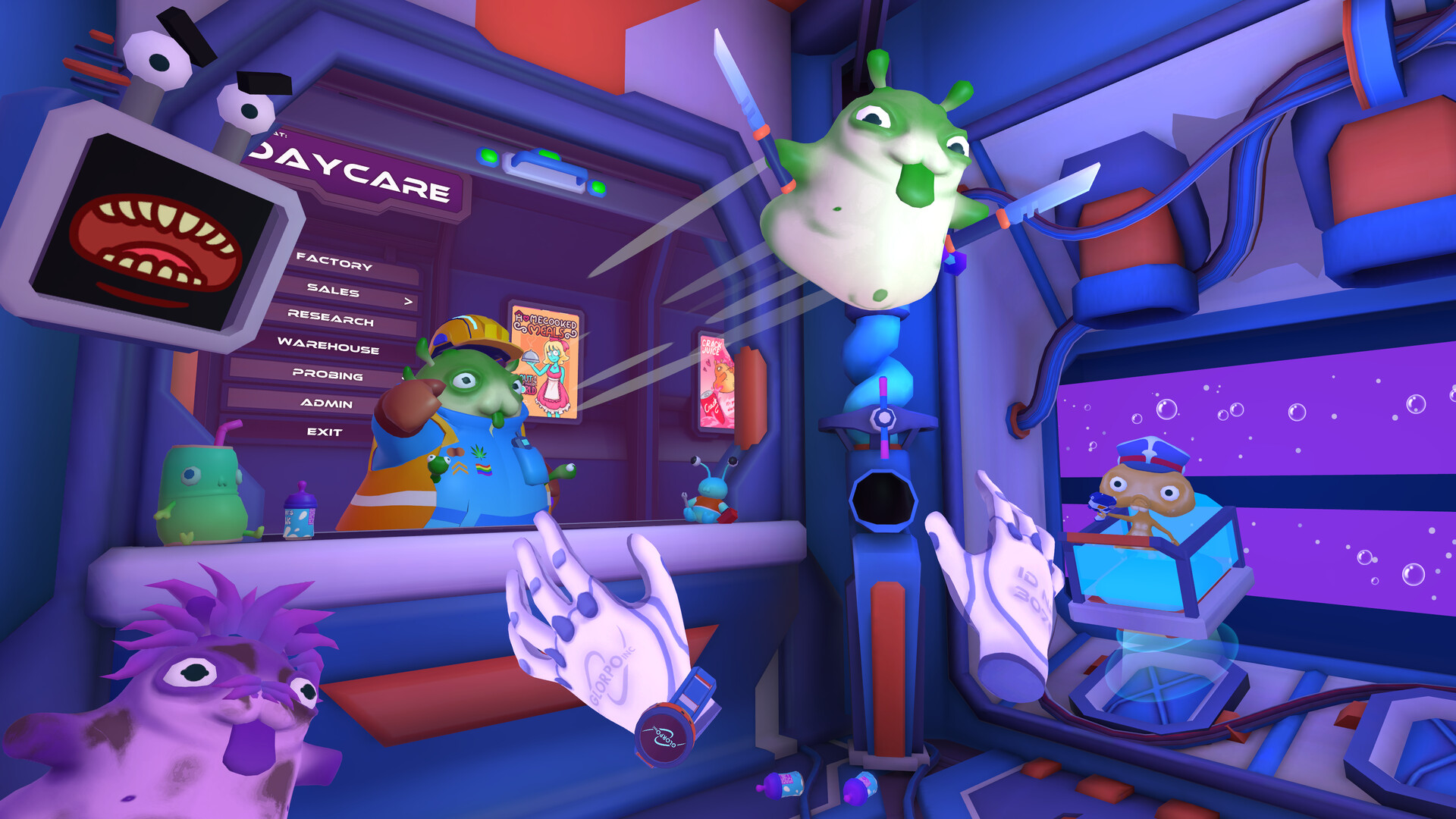
Job simulator-style menus and tasks sit alongside the game's comedic set dressingMoonMonster Studios -
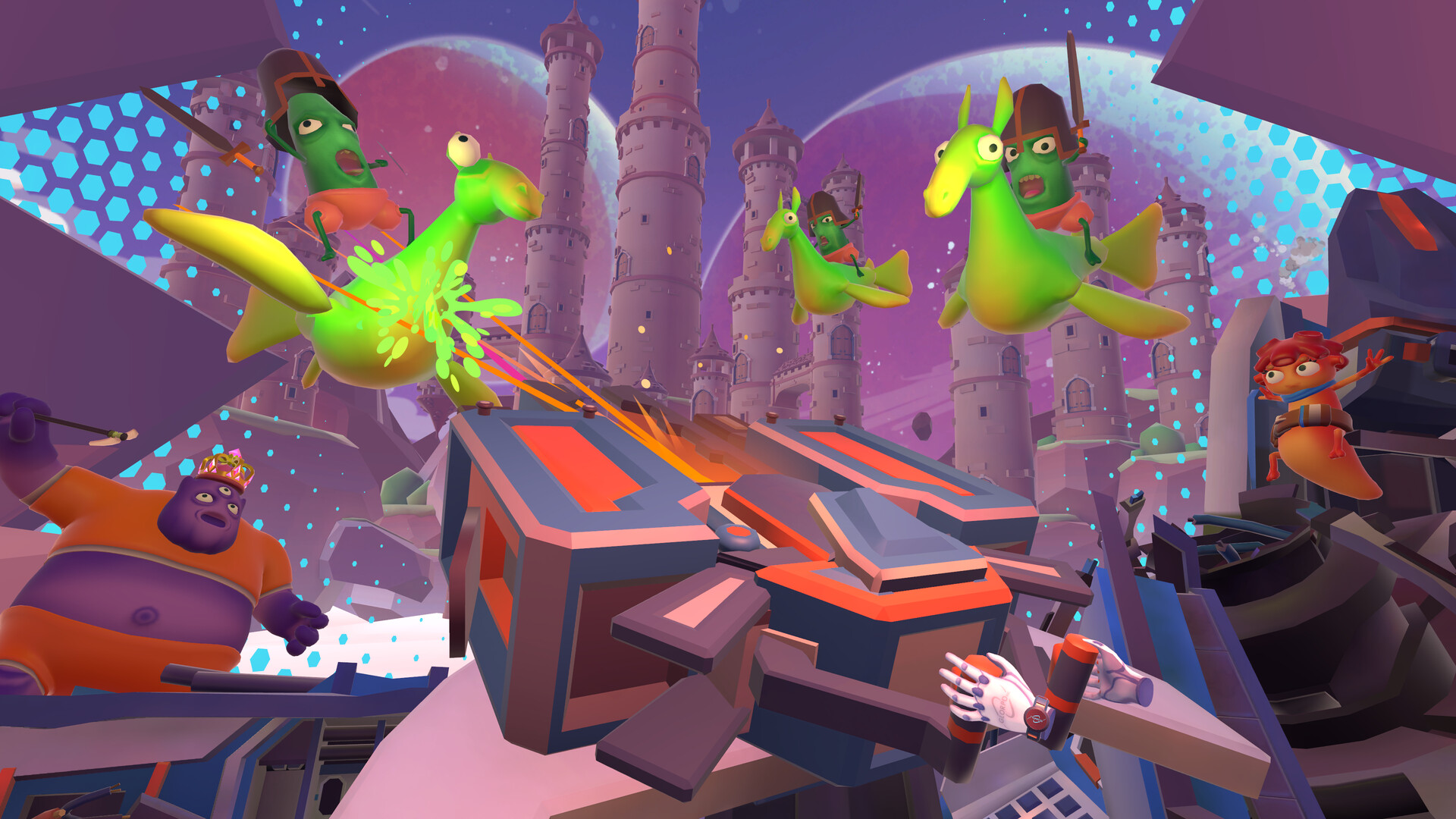
Later sequences push past the office setting into more chaotic, action-driven set piecesMoonMonster Studios -
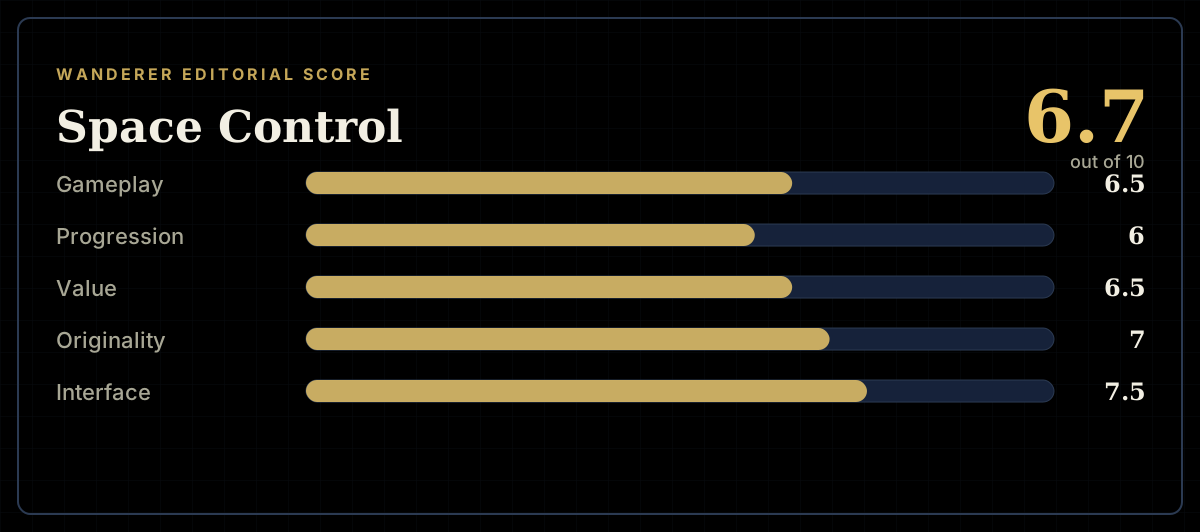
How the review scores each part of the gameWanderer Editorial -
The short versionWanderer Editorial