Game review
Caves of Qud
8.8 / 10
- Developer
- Freehold Games
- Publisher
- Kitfox Games
- Released
- 5 December 2024
- Platforms
- Windows, macOS, Linux, Nintendo Switch
- Genre
- Science fantasy roguelike RPG
- Monetisation
- Premium, one-time purchase. Two optional DLCs exist — a soundtrack and Pets of Harvest Dawn, a small pack of thirteen starting companion pets that were Patreon-exclusive rewards during Early Access — and neither touches core systems, balance or content gated behind play. No ads, no premium currency, no subscription, no battle pass
- Players
- Single-player only; there is no co-op, competitive mode or any shared-world feature
The short version
Caves of Qud's real subject isn't its caves. It's the character you decide to build before you ever step into one — a fork between an unmutated True Kin running on cybernetics and a Mutant running on randomly rolled physical and mental powers that doesn't just change your numbers, it changes what kind of game you're playing. Everything downstream of that choice — the gas and liquid physics, the limb-by-limb damage model, the reputation math across dozens of factions — is simulated honestly enough that it keeps producing situations nobody at Freehold Games sat down and wrote.
None of that comes free. The interface is dense even with the tile renderer turned on, a wiki tab is close to mandatory, and the middle stretch of a run can sag once the early tutorial areas are behind you and the named endgame set-pieces aren't yet in view. It's a harder sell than its Hugo Award would suggest. It's also one of the only games on PC where two players' characters can be built from genuinely different rules rather than the same rules at different power levels.
Biggest strengths
- The True Kin versus Mutant fork at character creation changes which systems you're even playing with, not just how hard the game hits back
- Gases, liquids, temperature and a limb-by-limb damage model interact as real simulated systems, so a cryo grenade thrown into standing water or a phosphorus cloud near an open flame produces outcomes the designers never scripted
- A persistent, hand-authored world with named factions, landmarks and quests sits underneath the procedural generation, so exploring feels like uncovering a place rather than generating one
Biggest weaknesses
- The keybind-dense interface still assumes a wiki tab open in a second window, even with the tile renderer switched on over raw ASCII
- The sheer number of interacting systems produces well-documented exploits, like repeatable trade and reputation farms, that let players bypass the exact difficulty the rest of the design is built around
- The stretch between the early tutorial areas and the endgame's authored set-pieces can turn into repetitive exploration with little new to learn
Who it's for: Players who want character creation itself to be the puzzle, roguelike veterans who already know what a spreadsheet-shaped game looks like and want theirs seasoned with real prose, and anyone who finished Dwarf Fortress or RimWorld wanting a simulation that runs at the level of a single body instead of a whole colony. A poor fit for anyone who wants a game to explain its own systems as it goes, or who needs permadeath to be optional rather than merely softened.
Our recommendation: Buy it if the idea of forty hours spent partly reading a wiki sounds like a feature rather than a cost — the depth on offer easily justifies NZ$46.49, and Freehold is still patching it monthly more than a year after 1.0. Start in Wander or Roleplay mode rather than Classic; the simulation is the same either way, and there's no reason to learn it while also relearning how to lose everything to a gas cloud you didn't see.
8.8 / 10
Every roguelike promises that its systems will surprise you. Almost none of them mean it the way Caves of Qud does. Freehold Games spent nine years in Steam Early Access — and seventeen counting the freeware build the studio's two founders released back in 2007 — building a science-fantasy world where the physics underneath the ASCII actually run rather than get faked, and where the character you decide to build at the very start doesn't just set your difficulty, it changes what game you're playing for the next forty hours. That's the real reason this game's reputation splits down the middle into "impenetrable" and "the deepest thing on PC." Both halves are describing the same design decision from opposite sides.
Two forks, not two difficulty settings
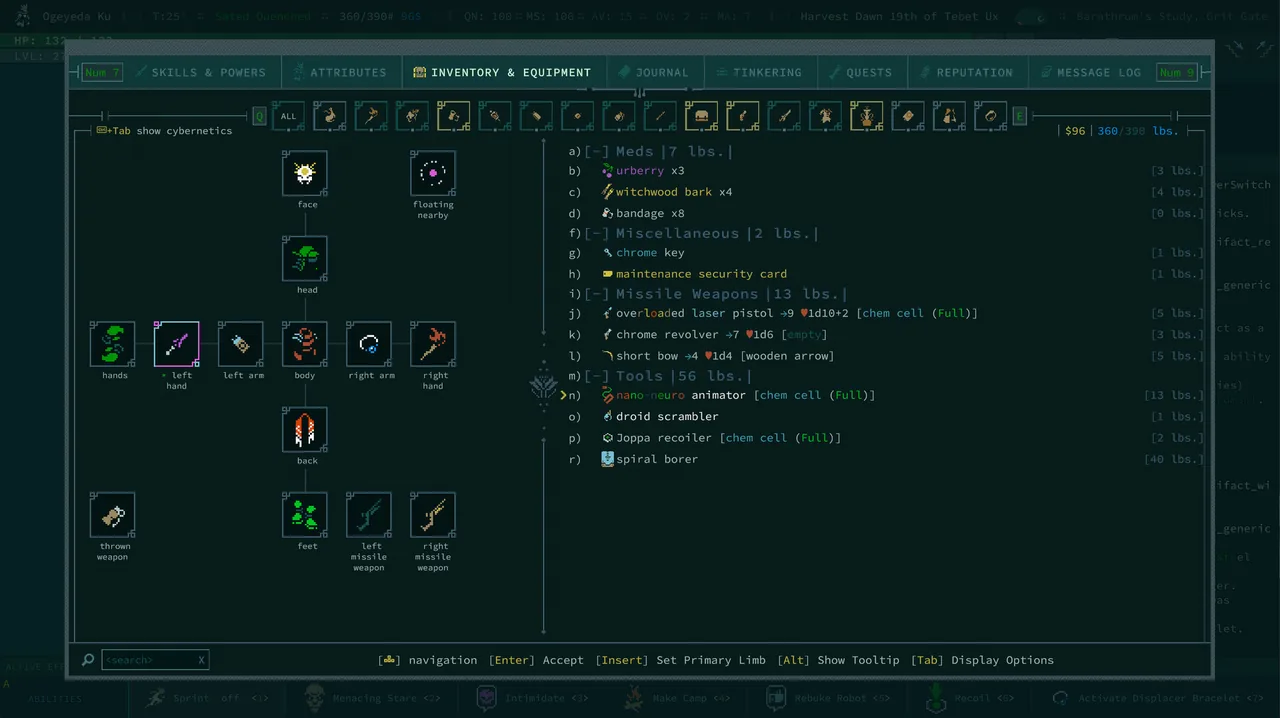
Character creation starts with a single question that most roguelikes would treat as flavour: are you True Kin, an unmutated human who augments themselves with cybernetic implants, or a Mutant, born with randomly rolled physical and mental powers layered onto a base body? It reads like a class-select screen. It isn't one. True Kin builds are built around gear you find, buy or salvage — limb-replacement cybernetics that trade a body part's normal function for a mechanical one, energy cells to keep them running, and a playstyle that rewards planning your loadout the way an immersive-sim player plans theirs. Mutant builds are built around what you rolled — telekinesis, elongated limbs, corrosive gas glands, mental domination — stacked and levelled with points you spend rather than a class tree you climb, so two Mutant characters with the same starting stats can end up doing almost nothing alike by the midgame.
Skills work the same way underneath either choice: bought with points rather than unlocked by hitting a level threshold, which means a character's identity is a series of deliberate purchases rather than a curve everyone climbs in the same order. Combined with the True Kin/Mutant fork and a set of preset "callings" for players who'd rather not build entirely from scratch, the result is a chargen screen that produces genuinely different games, not just genuinely different numbers. A cybernetic True Kin sniper picking enemies off through walls with a scanner implant and a Mutant with a corrosive gas gland who wins fights by not touching anything are not the same difficulty level of the same game — they're closer to two different games that happen to share a map.
The simulation doesn't know it's supposed to surprise you
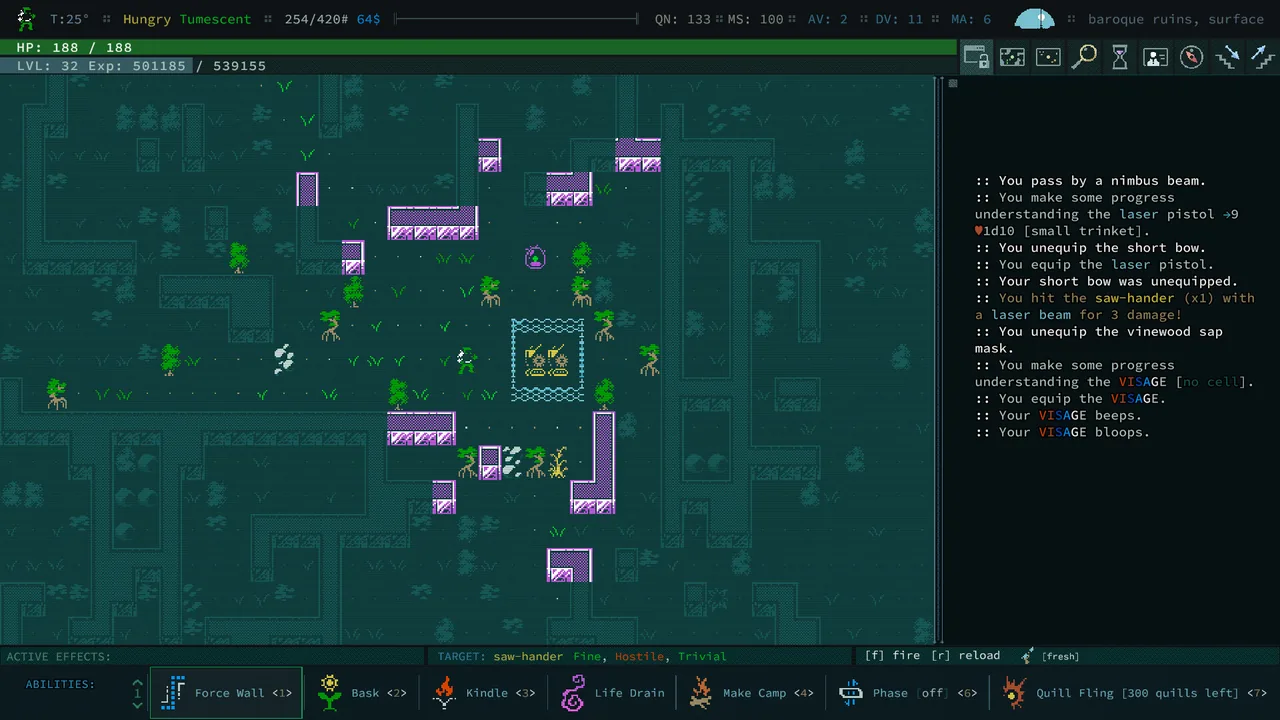
What makes that character system worth building around is that the world it drops you into is simulated with the same honesty. Qud tracks gases as spreading, mixing clouds rather than area-of-effect circles — a cryogenic grenade thrown into standing water freezes the water solid, and that ice sheet will crack under enough weight or melt back into a hazard if something sets it on fire later. Electrical damage conducts through water and other liquids rather than stopping at the tile it was cast on, so fighting near a flooded room changes the maths for everyone standing in it, attacker included. Limbs are modelled individually enough that losing an arm to acid or corrosion has a real mechanical consequence rather than just draining a shared health bar, and a body part replaced with cybernetics behaves differently under damage than the flesh it replaced.
None of that would matter if the game only ever used it the way its designers anticipated, and the reason Qud gets talked about the way Dwarf Fortress does is that it doesn't. Cooking a meal from creatures and plants you've killed or harvested can grant temporary mutations matching whatever you ate, which means the ingredient list for dinner is also a build decision. A gas cloud drifting toward an open flame is a bomb you can set off on purpose or wander into by accident. None of these are scripted set-pieces — they're the predictable consequence of systems that were built to run their own rules consistently rather than to stage a moment, and that's precisely the trade-off Dwarf Fortress makes at colony scale. Qud runs the same commitment at the scale of one body moving through one room, which is a genuinely different kind of ambition rather than a smaller one — the fluid and gas physics are arguably more legible here because you're watching them happen to a single character instead of inferring them from a hundred dwarves at once.
A world that remembers itself
Most roguelikes solve the "how do I have infinite content" problem by regenerating the entire map every run. Qud solves it differently: the overworld is a large, mostly persistent space seeded once per game, with named settlements, authored factions and real questlines sitting on top of procedurally detailed terrain. Grit Gate, the Six Day Stilt and the game's dozens of other landmarks aren't randomly assembled from a kit each time you visit — they're built by hand, populated by named NPCs with actual dialogue, and layered with reputation tracked across more than seventy factions that remember whether you've helped or robbed them. Die and start a fresh character, and you're not generating a new world from scratch; you're arriving in a version of the same one, seeded differently, with its own history already written.
That history is where Qud's stranger ambitions live. The game procedurally generates centuries of world lore — legendary Sultans, their reigns, their obsessions and their downfalls — and weaves that generated history into item flavour text, ruin descriptions and dialogue that reads like it was hand-authored even when large parts of it weren't. It's a genuinely unusual middle ground between RimWorld's fully procedural narrative, generated fresh from your colony's own events, and a game like Darkest Dungeon's fixed, hand-written horror — Qud generates its deep history algorithmically but plants real, static landmarks and real writers' prose on top of it, so a player exploring the world isn't discovering a random dungeon, they're discovering a place with a past that happens to have been computed rather than written entirely by hand.
What fifteen-plus years of Early Access actually bought
It's worth being precise about the timeline, because "fifteen years in development" undersells how gradual this was. Grinblat and Bucklew started building the game in 2007, released a free public version in 2010, formally founded Freehold Games in 2012, and didn't reach Steam Early Access until July 2015 — where the game then stayed for close to nine years before 1.0 shipped on 5 December 2024. That's not a studio that rushed a rough build onto Steam and iterated in public under pressure. It's closer to two developers treating Early Access as the working method rather than a marketing phase, adding systems (cybernetics, the current cooking mechanics, the reworked faction and reputation math) as finished features rather than patch-note promises.
1.0 itself didn't reset that pace. Freehold has kept shipping — a performance-focused maintenance patch in July 2026 targeting pathfinding and rendering, a localization framework in testing, and the Nintendo Switch port that launched on 17 February 2026 after a short delay from its original end-of-2025 target. The studio has also publicly committed to at least three further expansion packs, each paired with a free update to the base game. Whatever else is true about this game's difficulty or opacity, "abandoned after 1.0" isn't one of the complaints that holds up.
The writing earned the project an honour almost no game gets to claim: the 2025 Hugo Award for Best Game or Interactive Work, a category the World Science Fiction Society only added in 2021 and that Qud is the first roguelike to win. It also picked up an IGF award for Excellence in Narrative years earlier, during Early Access. Neither award is a substitute for playing the game, but they're a genuine, independently judged confirmation of the thing this review would otherwise be asking you to take on faith: the procedurally generated lore isn't filler text between mechanics. It's good enough to be judged against actual science fiction writing and hold up.
Permadeath, softened on purpose
1.0 shipped four distinct ways to play, and they're worth understanding as different products rather than difficulty sliders. Classic is the roguelike purists expect — full permadeath, one save, a dead character gone for good. Roleplay plays identically but checkpoints your progress every time you leave a settlement, so a death costs you the ground since your last town rather than the entire run; it's the mode 1.0 was largely built to make possible, aimed at players who want the story and the build variety without the game punishing forty hours of investment for one bad turn against a gas cloud. Wander strips out strict permadeath entirely for players who bounce off combat pressure specifically but still want to explore the simulation, and Daily runs a shared seed with its own leaderboard, permadeath intact, for players who want the classic roguelike-of-the-day format.
That's the right call, and it doesn't undermine the design the way a softer mode sometimes does elsewhere. Qud's difficulty was never really located in its combat math — it's located in how much of the simulation you understand well enough to use. Roleplay and Wander remove the penalty for learning that the hard way without removing the learning itself, which is a more honest accessibility pass than simply turning enemy damage down. Classic remains exactly as unforgiving as it always was for players who want it that way, the same balance Darkest Dungeon strikes by making its own permadeath a deliberate, opt-in kind of pain rather than a tax on everyone.
Getting through the first hour
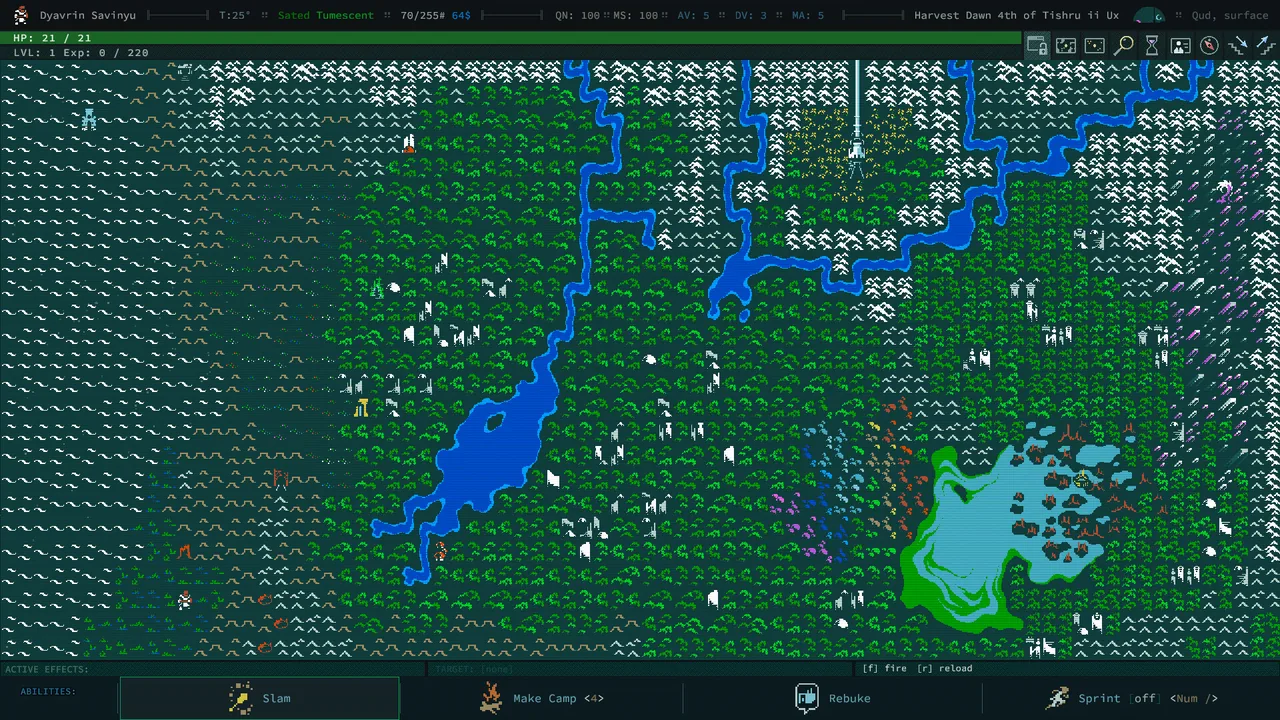
Here's where the reputation for impenetrability is earned rather than exaggerated. Qud offers both a classic ASCII display and a tile-based renderer, togglable at will, and the tiles genuinely help — a corrosive gas cloud reads faster as a green haze than as a wall of "g" characters. What the renderer doesn't fix is the keybind density underneath it: examining an item, checking a faction's disposition, comparing two nearly identical mutations, or figuring out why a fight went badly all live behind menu layers the game explains once, briefly, and then expects you to remember. New players consistently report needing the community wiki open in a second window within the first hour, not because the game is unfair, but because it communicates through implication rather than tooltips. That's a real, measurable cost, and it's the most common complaint in the game's own negative Steam reviews, alongside balance disputes between True Kin and Mutant builds and the well-documented trade and reputation exploits that let some players skip the difficulty entirely.
Where the depth stops paying off
The honest criticism isn't that Qud is hard. It's that a meaningful share of its systems are more thorough than any single playthrough needs, and the game rarely signals which ones matter now versus which are quietly available three characters from now. The stretch between the early tutorial areas and the authored endgame locations can sag — exploration without a clear next landmark, the same handful of creature types with diminishing novelty, waiting for the next named place to give the simulation a reason to matter again. A player who never touches cooking, never experiments with gas-and-liquid interactions on purpose, and never digs into faction reputation can still finish a run using a fraction of what's actually simulated underneath them — a strange position for a game this proud of its own depth to leave a normal player in.
Value and verdict
At NZ$46.49 for a complete, still-actively-patched game with no gameplay-relevant DLC and years of free updates ahead on the studio's own roadmap, the price is easy to justify next to genre peers like RimWorld at NZ$46.99 — and unlike RimWorld's five-expansion ladder, there's no growing bill on the other side of the purchase. The two optional DLCs, a soundtrack and a pack of starting companion pets, are exactly as inessential as they sound.
8.8 out of 10. Caves of Qud earns that score for doing something almost nothing else in the genre attempts: making the character you build, not just the world you explore, the site of its simulation's depth. The gas physics, the limb model, the reputation math and the generated history all matter because the True Kin/Mutant fork means two players' characters were never running the same rules to begin with. It loses ground for an interface that hasn't caught up to what it's asking players to track, for a mid-game that can go slack between authored landmarks, and for balance and exploit issues that a fifteen-plus-year development cycle hasn't fully closed out. None of that changes what's underneath it. This is one of the very few roguelikes where "build a character" is the whole pitch, and it delivers on that pitch more completely than its ASCII reputation gives it credit for.
Players who like a persistent world that keeps a memory of what they've done in it, rather than resetting to a fresh seed every attempt, will recognise a slower, gentler cousin of that idea in Wanderer's own world state.
Pricing, platform and release details checked 1 August 2026.
Pros and cons
Pros
- The True Kin versus Mutant fork at character creation changes which systems you're even playing with, not just how hard the game hits back
- Gases, liquids, temperature and a limb-by-limb damage model interact as real simulated systems, so a cryo grenade thrown into standing water or a phosphorus cloud near an open flame produces outcomes the designers never scripted
- A persistent, hand-authored world with named factions, landmarks and quests sits underneath the procedural generation, so exploring feels like uncovering a place rather than generating one
- Procedurally generated Sultan histories woven into hand-written dialogue and item lore earned the game a 2025 Hugo Award for Best Game or Interactive Work, a rare honour for any game's writing
- Roleplay mode checkpoints progress at settlements, letting story-focused players opt out of full permadeath without turning the run into easy mode
- Freehold Games is still shipping monthly content and performance patches, a Switch port and at least three planned expansions more than a year after 1.0 shipped
Cons
- The keybind-dense interface still assumes a wiki tab open in a second window, even with the tile renderer switched on over raw ASCII
- The sheer number of interacting systems produces well-documented exploits, like repeatable trade and reputation farms, that let players bypass the exact difficulty the rest of the design is built around
- The stretch between the early tutorial areas and the endgame's authored set-pieces can turn into repetitive exploration with little new to learn
- True Kin and Mutant builds aren't cleanly balanced against each other, and which path has the higher ceiling is a recurring argument in the game's own community
- English is the only fully supported language, a real barrier for a game that already asks a lot of new players before it asks anything of a translator
- A first character's death to a mechanic the game never explained on-screen is still the most common way new players actually meet Classic mode
Screenshots
-
Caves of QudImage: Kitfox Games via Steam -
Caves of QudImage: Kitfox Games via Steam -
Caves of QudImage: Kitfox Games via Steam -
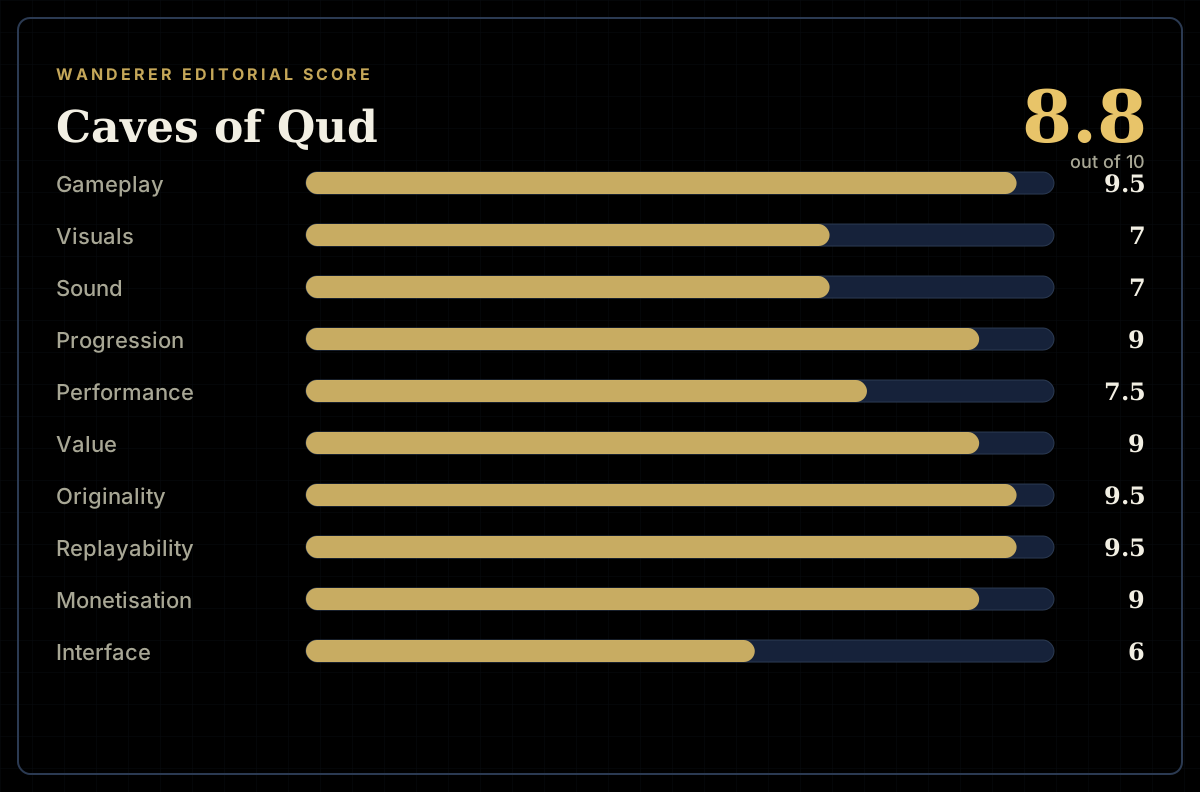
How the review scores each part of the gameWanderer Editorial -
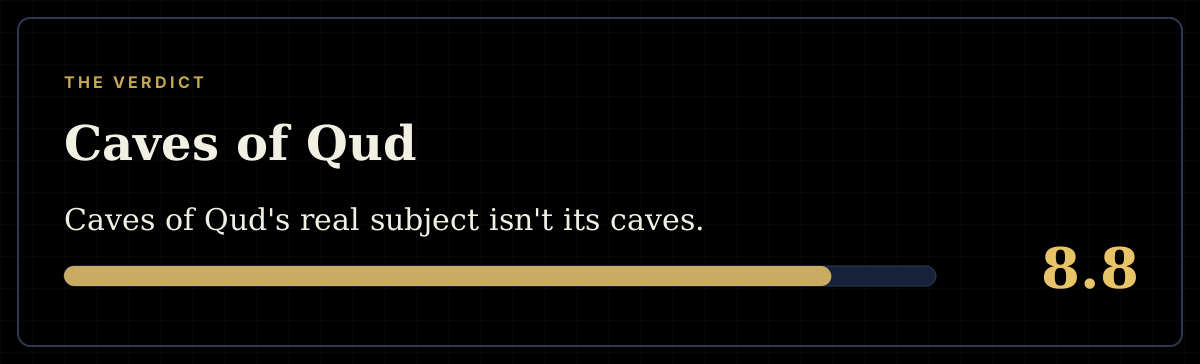
The short versionWanderer Editorial