Game review
Darkest Dungeon
8.5 / 10
- Developer
- Red Hook Studios
- Publisher
- Red Hook Studios (self-published)
- Released
- 19 January 2016
- Platforms
- Windows, macOS, Linux, PlayStation 4, PlayStation Vita, Nintendo Switch, Xbox One, iOS
- Genre
- Turn-Based Roguelike RPG
- Monetisation
- Premium, one-off purchase — three paid content DLCs (Crimson Court, Shieldbreaker, Color of Madness) plus two free DLCs (the Musketeer hero class and the Butcher's Circus PvP mode) and an optional soundtrack; no microtransactions, energy systems or loot boxes, though the base game does surface Butcher's Circus and other DLC through in-game prompts
- Players
- Single-player campaign; the free Butcher's Circus DLC adds online 4-hero PvP
The short version
Darkest Dungeon isn't really about winning fights. It's about deciding which losses you can live with. Every hero drags a stress meter alongside their health bar, and once it fills they don't just get weaker — they get afraid, paranoid, abusive to the people standing next to them. The game's real subject is a roster, not a hero, and its real skill test is knowing when to retreat, when to bench someone before they break, and when a run simply isn't coming home.
That premise is executed about as well as this genre has ever managed, with art direction and narration doing as much heavy lifting as the systems themselves. It's let down by a difficulty curve that sometimes reads as arbitrary rather than earned, a Crimson Court expansion whose central mechanic actively fights the base game's pacing, and an interface that still shows its Early Access joints nearly a decade on.
Biggest strengths
- The stress and affliction system makes psychological collapse a mechanic instead of a flavour text, giving virtue and madness real tactical consequences
- Four-rank positioning turns party formation into a puzzle that most other tactical RPGs treat as an afterthought
- Wayne June's narration and the hand-painted, animated-etching art style do more to sell the horror than any single system does
Biggest weaknesses
- Hit and dodge percentages routinely feel worse than their displayed numbers, and the game does nothing to show a player the difference between bad luck and a bad build
- The Crimson Court expansion's blood-curse mechanic forces courtyard detours on a timer, actively punishing players who'd rather ignore it
- Levelling a replacement hero from zero after losing a veteran is repetitive enough that many players lean on mods or house rules to soften it
Who it's for: Players who want their tactical RPGs to punish attachment, anyone who found XCOM's permadeath thrilling rather than annoying, and gothic-horror fans who'll tolerate a genuinely difficult game for a genuinely committed aesthetic. A poor fit for anyone who needs every loss to feel like their own mistake rather than the dice's.
Our recommendation: Buy the base game without hesitation — nine years on it remains one of the sharper ideas the roguelike genre has produced, and the asking price is fair for the hours it holds. Add Shieldbreaker and Color of Madness whenever they're convenient. Go into Crimson Court with eyes open about the timer it puts on your other business.
8.5 / 10
The moment that defines Darkest Dungeon isn't a boss fight. It's the walk back from one, when a hero who took a critical hit from an eldritch abomination starts talking to themselves, refuses to be healed, and then — on the next fight — steals a bandage meant for a dying ally because a new phobia has convinced them the ally is cursed. Nothing about that was scripted. It emerged from a stress meter crossing a threshold, a random affliction roll, and a game that had already decided your party's psychology mattered as much as its hit points. Most dungeon crawlers ask whether your heroes can survive. Darkest Dungeon asks whether they can survive each other.
Red Hook Studios built a striking pitch around that idea back in 2015 and never really softened it. Funded through a Kickstarter that blew past its US$75,000 goal within two days and eventually raised over $313,000, the game spent almost a year in Early Access before its full release on 19 January 2016, and it arrived already fully formed in its thesis: this would be a turn-based dungeon crawler where the real enemy wasn't the monster roster, it was attrition — of health, of sanity, and of a player's willingness to keep sending the same faces into the dark.
The roster is the hero
Strip away the atmosphere and Darkest Dungeon is a management game wearing a combat system. You run a rotating stable of a dozen-plus adventurers out of a crumbling hamlet, sending four at a time into procedurally arranged dungeons while the rest rest, heal, get treated for diseases at the Sanitarium, or drink themselves stupid at the Tavern to shed stress. No single hero is the protagonist. The protagonist is the roster itself — its depth, its readiness, its ability to absorb a bad week without collapsing entirely.
This is the design decision everything else serves, and it's the reason permadeath here lands differently than it does in most roguelikes. Losing a level-one recruit costs nothing. Losing a Vestal you've spent a dozen expeditions levelling, who's finally unlocked the trinket slots and camping skills that made her genuinely good, is a real loss — not because the game tells you to feel it, but because you did the actual work of making her useful and now that work is gone. Most RPGs write companion deaths as scripted beats. Darkest Dungeon just lets the math do it, and the math is more convincing.
The trade-off is the grind on the other side of that loss. Rebuilding a fifth-tier roster slot after a wipe means running a fresh recruit through the same early dungeons at reduced difficulty until they're viable again, and there's no way around that treadmill except stacking up a deep enough bench in advance that no single death forces it. Veteran players manage this by never running short rosters in the first place. New players lose their first real team and discover the tax the hard way, which is a legitimate design choice but not always a fun one to learn firsthand.
Stress is the actual health bar
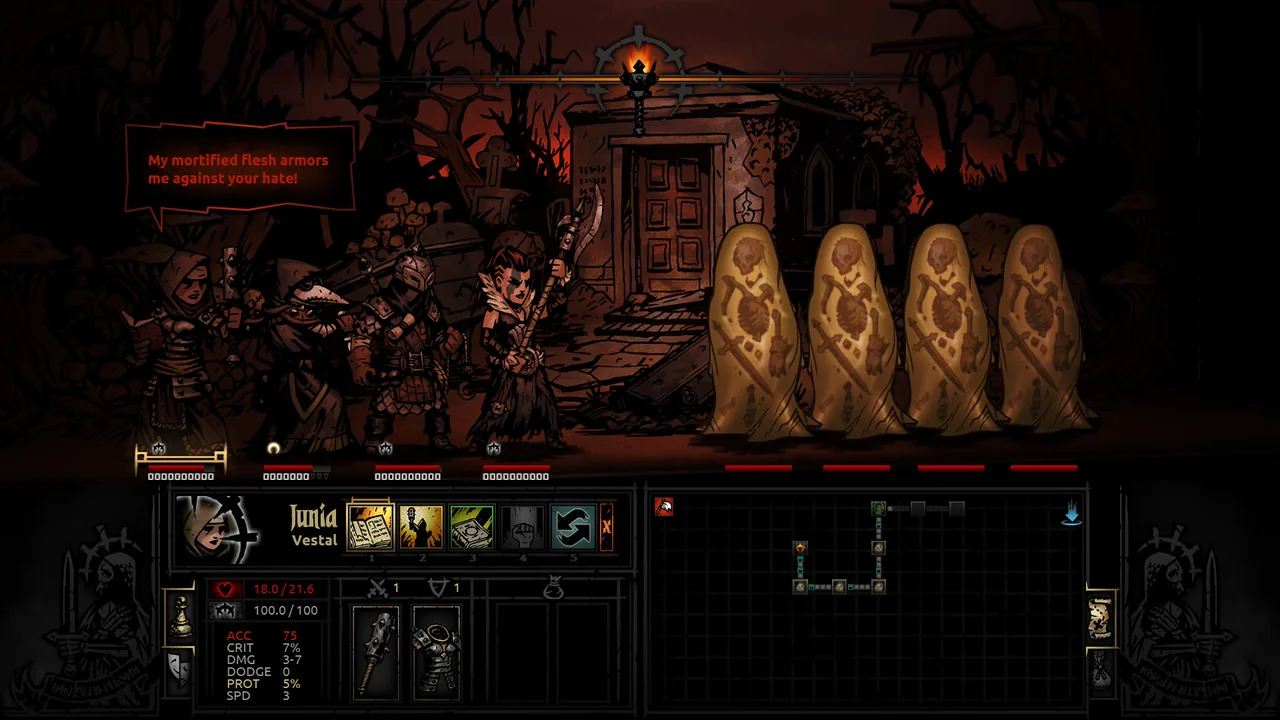
The affliction system is the thing that separates Darkest Dungeon from every other dungeon crawler attempting similar difficulty, and it's worth being specific about why it works. Every hero has a stress meter running alongside their HP, filled by combat, by darkness, by seeing an ally die, by specific enemy attacks designed to torment rather than damage. When it fills, the hero rolls against it: succeed, and they gain a Virtue — a burst of selfless heroism that can turn a fight around. Fail, and they gain an Affliction — irrational, paranoid, abusive, masochistic, fearful — each with its own behavioural quirk that actively works against the party's plan. An abusive hero might refuse orders and insult a teammate mid-turn, tanking that ally's own stress in the process. A paranoid one might simply flee.
What makes this more than a debuff system is that it's contagious in the way real panic is contagious. One hero breaking increases the stress of everyone standing near them, so a single bad roll on a stress check can cascade into two or three heroes cracking in the same fight, at which point the run isn't a tactical problem anymore — it's a triage problem. Managing stress proactively, through camping skills, trinkets, and simply not overstaying a dungeon's welcome, becomes as important as managing health, and that reframing is Darkest Dungeon's single best idea. It converts a tactical RPG into a psychological attrition sim without ever changing the combat math that underpins it.
Rank matters more than raw stats
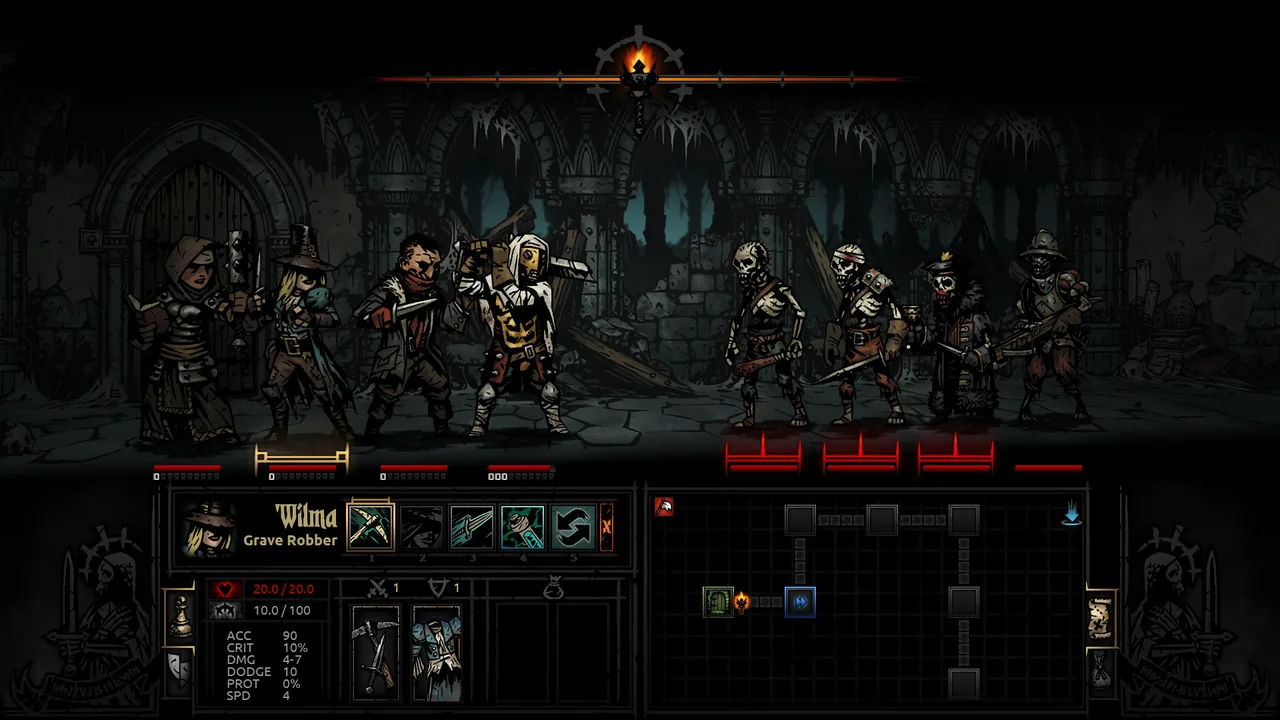
The combat itself is turn-based and four-versus-four, fought across a strict rank order that most tactical RPGs treat as a minor wrinkle and Darkest Dungeon treats as the whole game. A hero's rank in the marching order determines what they can do — a Hellion's strongest attacks only work from the front two ranks, a Plague Doctor's blight abilities work best further back, and getting the wrong hero shuffled to the wrong rank mid-fight by a knockback attack can neuter half your party's kit for a turn. Building a viable party means thinking about formation before a single die is rolled, and losing that formation partway through a fight is often more dangerous than the damage output of whatever caused it.
It's a genuinely smart layer, and it rewards the kind of party-composition thinking that a lot of turn-based RPGs only pretend to ask for. The friction is that positioning math sits on top of hit and dodge percentages that consistently feel worse than advertised — a well-documented and long-running source of player frustration that isn't really a bug so much as a design choice the game never explains clearly. A 90% hit chance failing twice in a row reads as bad luck the first time and a broken promise the fifth. The system is defensible on paper: stacking accuracy and dodge modifiers is itself a real strategic layer, and a player who ignores it will run a consistently worse hit rate than the numbers suggest. But the game gives a new player almost no way to learn that distinction, which is exactly why "the RNG feels rigged" is one of the most consistent threads in negative player feedback nearly a decade after launch. Some of that complaint is a skill gap in disguise. Not all of it is. A boss with a genuinely high dodge stat paired with a full-team stun combo can end a well-played run through no real fault of the player's decisions, and pretending that's always a fair outcome oversells the design.
The narrator and the art are doing the heaviest lifting
Wayne June's narration is one of the more effective uses of voice work in the genre — a baritone that treats every stubbed toe and every catastrophic wipe with the same Lovecraftian gravity, and it's precisely that consistency that makes it funny in exactly the moments it needs to be and genuinely unsettling in the ones that count. Chris Bourassa's hand-drawn, animated-etching art direction pairs with it perfectly: character portraits look like woodcuts brought half to life, and the hamlet itself, rendered in the same style, feels less like a hub screen and more like a place actively rotting while you're not looking at it. Very little of the horror here comes from jump scares or gore. Almost all of it comes from tone, sustained relentlessly across hundreds of hours, and that's a harder trick to pull off than the shock-value alternative.
Crimson Court's clock you can't turn off
Red Hook's first paid expansion, The Crimson Court, released in June 2017 and adds a new region, a new hero class in the Bloodletter-adjacent Houndmaster line, and a blood-craving curse that infected heroes carry indefinitely. The idea is sound on paper — a second stress-adjacent resource to manage — but the execution is the most consistently cited weak point in the whole catalogue. Curing the curse means farming courtyard bosses for blood vials on a schedule the game sets, not the player, and if you'd rather spend your expeditions elsewhere, the curse escalates until a roaming boss shows up specifically to punish you for ignoring it. It's not that the Crimson Court content is bad in isolation. It's that it imposes a pacing obligation on a base game whose whole appeal was letting you manage your own risk on your own schedule, and a meaningful share of the playerbase experiences it as the DLC taking away a freedom the core game promised them. The Shieldbreaker (October 2017) and The Color of Madness (June 2018) are both cleaner additions — a new hero and a horde-mode region respectively — and neither carries the same structural complaint.
Console, handheld and the phone in your pocket
The PlayStation 4 and Vita ports arrived in September 2016, Switch in January 2018 and Xbox One a month later, and all of them are faithful translations of the same turn-based structure rather than compromises — this was never a game that needed twitch reflexes, so a controller and a smaller screen cost it very little. The iOS port, out since August 2017, is the more interesting case: it's a full, premium conversion rather than a stripped-down mobile spin-off, and it earns real credit for resisting the free-to-play conventions this kind of turn-based RPG so often gets squeezed into on phones. There's no energy system gating dungeon runs, no gacha layer sitting on top of trinket drops, no ads. It's simply the same unforgiving game on a touchscreen, which is rarer than it should be and worth calling out on its own terms.
Value, nearly a decade in
At NZ$36.99 for a base game that comfortably runs past the hundred-hour mark for anyone chasing every hero to endgame viability, Darkest Dungeon clears the bar for premium pricing without much argument. The paid DLC ladder is modest by current standards — Crimson Court, Shieldbreaker and Color of Madness together add roughly another NZ$28 on top of the base price, with the Musketeer hero class and the Butcher's Circus PvP mode both free rather than paywalled. None of it is necessary to call the base game complete; all three add real, if uneven, extra hours for players who've exhausted what's in the box. The one genuine friction point in the shop experience is that the base game does promote Butcher's Circus and other add-ons through its own menus, which a number of current player reviews call out specifically as an unwelcome intrusion into what's otherwise a single-player, no-nonsense purchase.
Red Hook followed this game with Darkest Dungeon II in 2023, a substantially redesigned road-trip sequel built around a different structure entirely — it's worth knowing it exists if the original hooks you, but it's a different game solving a different problem, not a replacement for this one.
Where it actually falls short
The interface is the part that hasn't aged as gracefully as the art. Comparing trinkets across a roster of a dozen heroes, checking resistances against an unfamiliar enemy mid-run, or simply figuring out why a quirk is suddenly active all take more menu digging than a game this systems- dense should ask for, and little of that friction has been smoothed out since Early Access. New players get almost no onboarding into why a run collapsed — the game is content to let the narrator intone something ominous and move on, leaving the actual lesson (overextended without enough camping supplies, ignored a building stress cascade, brought the wrong formation into a fight with a shuffle-heavy boss) for the player to reconstruct entirely on their own. That's a defensible philosophy for a game this committed to difficulty. It's also the single biggest reason "unfair" shows up as often as "hard" in critical feedback, and the two words aren't the same complaint.
Verdict
Darkest Dungeon earns its reputation by taking an idea most RPGs treat as backstory — that adventuring should break people — and building an entire game out of actually modelling it. The stress and affliction system is genuinely inventive, the rank-based combat rewards real planning, and the art direction and narration create an atmosphere that's held up for nearly a decade without a visual refresh. It loses ground for a hit-rate system that obscures the line between skill and bad luck more than it needs to, for a first expansion whose central mechanic fights the base game's pacing instead of extending it, and for an interface that still asks too much of a player trying to manage a large roster.
None of that is enough to undercut what the design gets right. This is still one of the more distinctive tactical roguelikes on the market, built for players who find "which of my heroes can I afford to lose" a more interesting question than "how do I keep everyone alive." Players who like Wanderer's own approach to progression that keeps moving whether or not you're staring at it will find Darkest Dungeon asks for the opposite kind of attention — every expedition is a deliberate risk, not a passive tick — but the two games share a real respect for the idea that resource management can be the whole point, not the chore between the fun parts.
Price, DLC lineup and the Steam review summary checked 30 July 2026.
Pros and cons
Pros
- The stress and affliction system makes psychological collapse a mechanic instead of a flavour text, giving virtue and madness real tactical consequences
- Four-rank positioning turns party formation into a puzzle that most other tactical RPGs treat as an afterthought
- Wayne June's narration and the hand-painted, animated-etching art style do more to sell the horror than any single system does
- Losing a hero you've spent hours training stings in a way scripted companion deaths in other RPGs rarely manage
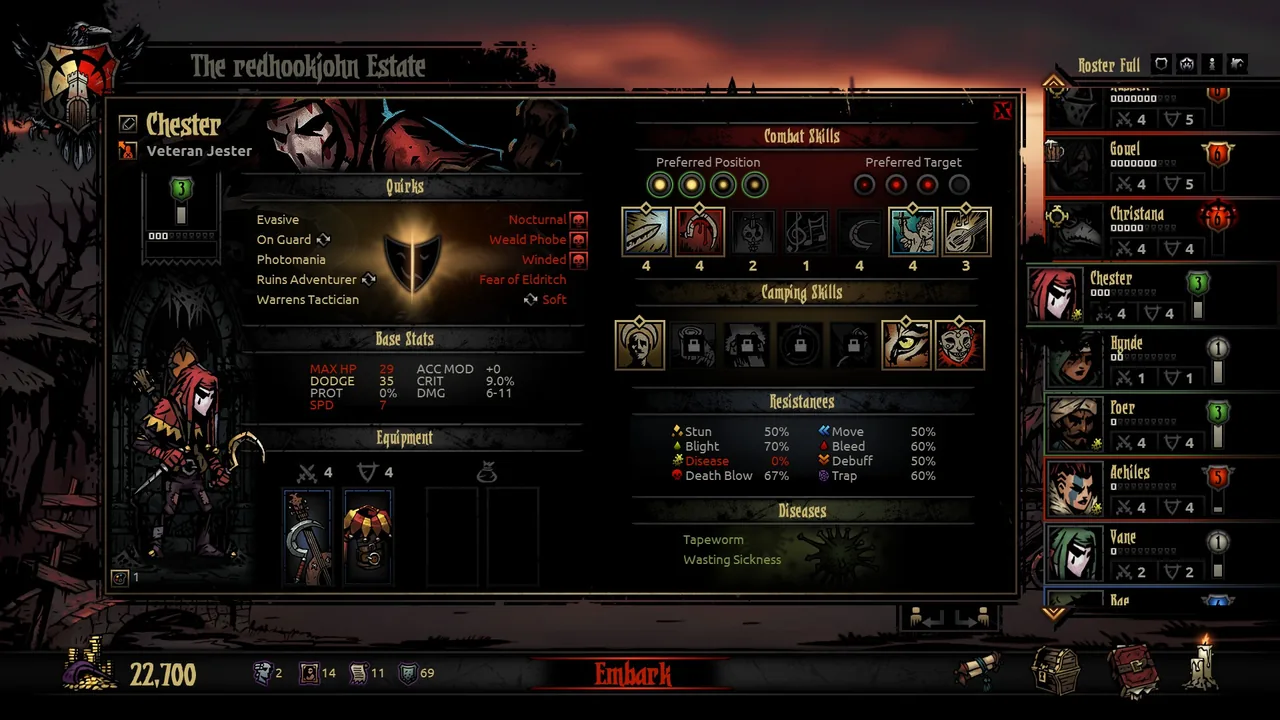
- Quirks, diseases and camping skills give the town-and-roster management layer as much depth as the dungeon runs themselves
- The soundtrack understands restraint, letting silence and the narrator carry tension instead of a constant score
Cons
- Hit and dodge percentages routinely feel worse than their displayed numbers, and the game does nothing to show a player the difference between bad luck and a bad build
- The Crimson Court expansion's blood-curse mechanic forces courtyard detours on a timer, actively punishing players who'd rather ignore it
- Levelling a replacement hero from zero after losing a veteran is repetitive enough that many players lean on mods or house rules to soften it
- The interface still asks for more clicks than it should when comparing trinkets, checking resistances or managing a large roster
- Early hours give almost no guidance on why a run failed, which reads as unfair rather than hard to a first-time player
- Positive Steam reviews skew toward players who bounced off the back half, according to players who note that the harshest true tests — level 5 and 6 content — arrive well after most reviews get written
Screenshots
-
Darkest Dungeon®Image: Red Hook Studios via Steam -
Darkest Dungeon®Image: Red Hook Studios via Steam -
Darkest Dungeon®Image: Red Hook Studios via Steam -
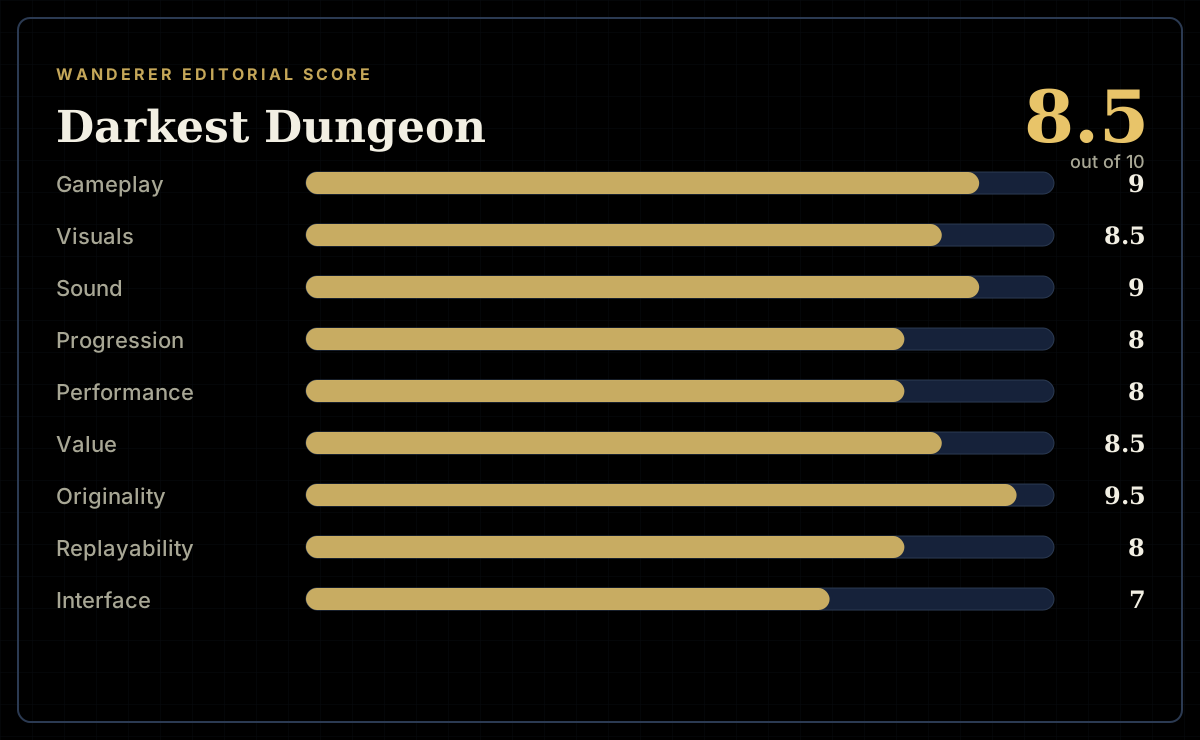
How the review scores each part of the gameWanderer Editorial -
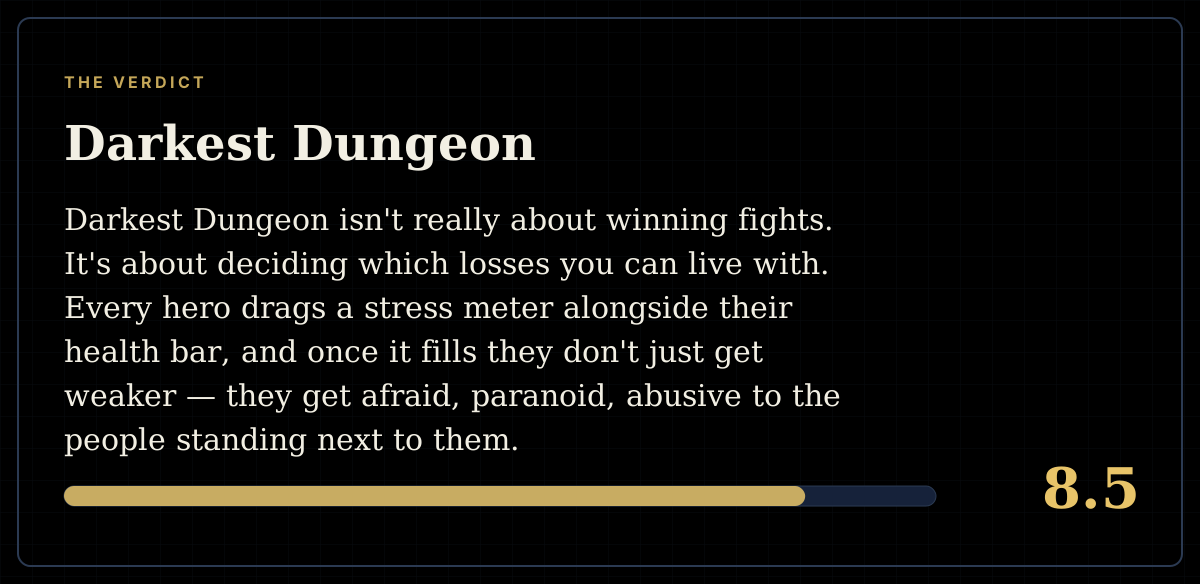
The short versionWanderer Editorial