
Game review
Streets of Rogue
6 / 10
- Developer
- Matt Dabrowski
- Publisher
- tinyBuild
- Released
- 12 July 2019
- Platforms
- Windows, macOS, Linux
- Genre
- Roguelite Immersive Sim RPG
- Monetisation
- Paid, one-time purchase. No in-app purchases or DLC beyond the base game.
- Players
- Local and online co-op for up to four players.
The short version
Streets of Rogue's pitch is genuinely ambitious: a procedurally generated city where nearly every character class, weapon and gadget offers a different way to complete the same objective, framed by the store page itself as "Nuclear Throne meets Deus Ex, mixed with the anarchy of GTA." The writing, class variety and co-op chaos back that ambition up well enough to explain an Overwhelmingly Positive rating across more than 17,000 reviews. What a remarkably consistent thread of criticism spanning 2017 through 2025 also documents, often from reviewers who otherwise like the game, is that the actual mission structure repeats far more than the "immersive sim" framing implies — a handful of objective types recurring floor after floor, with escalating enemies rather than escalating variety.
Biggest strengths
- A large, genuinely varied roster of playable classes, each with distinct abilities that change how the same level can be approached.
- Sharp, self-aware comedic writing that lands consistently well even among reviewers otherwise critical of the gameplay loop.
- Local and online four-player co-op turns the sandbox chaos into a genuinely strong social experience, independent of any single-player pacing concerns.
Biggest weaknesses
- A remarkably consistent complaint across 2017 through 2025 describes actual mission variety as shallow, with roughly five recurring objective types across procedurally generated floors rather than meaningfully different scenarios.
- Multiple reviewers independently describe later floors as reskinned versions of earlier ones, with tougher enemies rather than new mission design.
- Combat is repeatedly described as feeling "janky" or lacking impact, undercutting the tactical framing the tutorial and marketing suggest.
Who it's for: Fans of chaotic, systems-driven roguelites who want genuine build variety and enjoy co-op mayhem, with realistic expectations that the mission structure itself is repetitive rather than endlessly fresh.
Our recommendation: A strong pick for the class variety and co-op chaos, especially with friends; go in expecting the underlying objectives to repeat well before the class roster does.
6 / 10
An ambitious pitch, delivered through variety of approach
Streets of Rogue's premise is a genuinely distinctive combination for the genre: a top-down, procedurally generated city sandbox where nearly every objective can be tackled through violence, stealth, hacking, social manipulation or outright chaos, depending on the class a player has chosen. The store page's own comparison is a fair one — "it's like Nuclear Throne meets Deus Ex, mixed with the anarchy of GTA. Rogue-lite meets immersive sim, and goes completely insane" — and the official screenshot backs up the tone: a lively bar interior with arcade cabinets, distinct NPC characters and a bartender waiting on an order, the kind of dense, systemic environment that invites the multiple approaches the pitch promises. A large roster of unlockable characters, each with genuinely different abilities rather than cosmetic reskins, gives real mechanical reason to keep experimenting even after the base loop has been seen once. Co-op, both local and online for up to four players, is where reviewers most consistently and enthusiastically praise the game without qualification — the social chaos of multiple players attempting a mission through wildly different methods simultaneously is frequently cited as the game at its best.
The repetition complaint that's aged remarkably consistently
What tempers that praise, across a striking span of years, is a specific and detailed criticism of what's actually inside each procedurally generated level. "Every run of this game is basically the same few quests every single floor. It's almost shockingly generic and repetitive, with literally like 5 types of missions in total," reads a review from launch week in 2019. A 2020 review makes the same point from a slightly different angle: "there is only so much fun you can have with randomly generated levels and the same 5 missions." A 2022 review is specific about how that repetition compounds over a single run: "each level plays out in more or less the exact same way... citizens on later floors are usually just upgraded versions of those seen on earlier floors," rather than new scenarios. A 2025 review, going in with high expectations built on the announcement of a sequel, reports the same disappointment: "this game did not deliver for me... the core g[ameplay loop]" fell short of what the premise promised. Checking a broad sample of negative reviews, this exact complaint — not vague dissatisfaction, but the specific claim that mission variety is thin relative to the marketing — appears in roughly half, spanning nearly the entire lifespan of the Steam release rather than clustering around one bad patch or update.
A tactical framing the combat doesn't always support
A second, related thread concerns combat feel specifically. "The game tries to present itself as tactical, but the actual gameplay feels like the exact opposite," reads a 2017 review, a complaint echoed by a 2021 review describing the combat as "janky, awful-feeling" and unable to support the depth the tutorial implies. This matters because it compounds the mission-repetition issue rather than existing separately from it: if the core moment-to-moment combat lacks the weight or precision several reviewers describe wanting, then repeating a small set of mission types becomes a sharper problem than it would be in a game whose combat alone was strong enough to carry repeated encounters. Several reviewers explicitly frame their disappointment this way — liking the writing and class concepts while finding the actual play, mission to mission, thinner than the premise suggested.
Where the ambition genuinely lands
It's worth being fair to what the class and systems design does achieve, since the repetition complaint could otherwise read as a wholesale dismissal it doesn't deserve. A 2022 review that's otherwise lukewarm on the game still credits "plenty of characters to unlock who all have slightly differing stats, traits" as a real strength, and several reviewers who ultimately criticise the mission variety are explicit that they don't regret their purchase, framing the disappointment as a ceiling on a genuinely good foundation rather than a a flaw that undermines the whole game. A 2018 review captures this balance directly: "the basic elements of Streets of Rogue seem interesting and offer seeming innovation in a lot of ways. I do not regret supporting this developer," while still recommending prospective buyers wait for more content before purchasing at the time. That's a more generous reading than a simple thumbs-down implies, and it matches the game's overall Overwhelmingly Positive standing — most players clearly get real value out of the class variety and co-op chaos even where the underlying mission design falls short of the premise's most ambitious claims.
Final verdict
For a game whose class roster and writing draw this much consistent goodwill, the honest final question is simply how much a given player values variety of approach over variety of objective. If the appeal of trying the same mission as a hacker, then a brute, then a con artist is enough on its own, this game delivers that specific pleasure extremely well and the repetition complaint will matter less. If the expectation, set by the "immersive sim" framing, is that the missions themselves would feel as varied as the classes attempting them, the review sample suggests that expectation is likely to go unmet well before the character roster does.
Streets of Rogue succeeds at what a large and genuinely diverse character roster, sharp writing and strong co-op chaos can deliver, and those elements justify its high aggregate score on their own terms. Where this review lands more cautiously is in taking seriously a specific, well-corroborated and unusually long-running complaint: that the actual mission content underneath all that class variety is thinner than the "immersive sim" framing implies, repeating a small handful of objective types with escalating enemies rather than escalating scenario design. That's a real, structural limitation reported consistently by players who otherwise like the game, not a fringe complaint, and it's worth knowing before assuming the class roster's variety extends all the way down to the missions themselves.
Pros and cons
Pros
- A large, genuinely varied roster of playable classes, each with distinct abilities that change how the same level can be approached.
- Sharp, self-aware comedic writing that lands consistently well even among reviewers otherwise critical of the gameplay loop.
- Local and online four-player co-op turns the sandbox chaos into a genuinely strong social experience, independent of any single-player pacing concerns.
- A distinctive visual style and setting that stands out from more generic roguelite dungeon crawlers.
Cons
- A remarkably consistent complaint across 2017 through 2025 describes actual mission variety as shallow, with roughly five recurring objective types across procedurally generated floors rather than meaningfully different scenarios.
- Multiple reviewers independently describe later floors as reskinned versions of earlier ones, with tougher enemies rather than new mission design.
- Combat is repeatedly described as feeling "janky" or lacking impact, undercutting the tactical framing the tutorial and marketing suggest.
- Several long-time players report losing interest specifically once the class roster is exhausted, since the underlying mission loop doesn't offer enough on its own to sustain further runs.
Screenshots
-

Streets of RogueImage: tinyBuild via Steam -

Streets of RogueImage: tinyBuild via Steam -

Streets of RogueImage: tinyBuild via Steam -
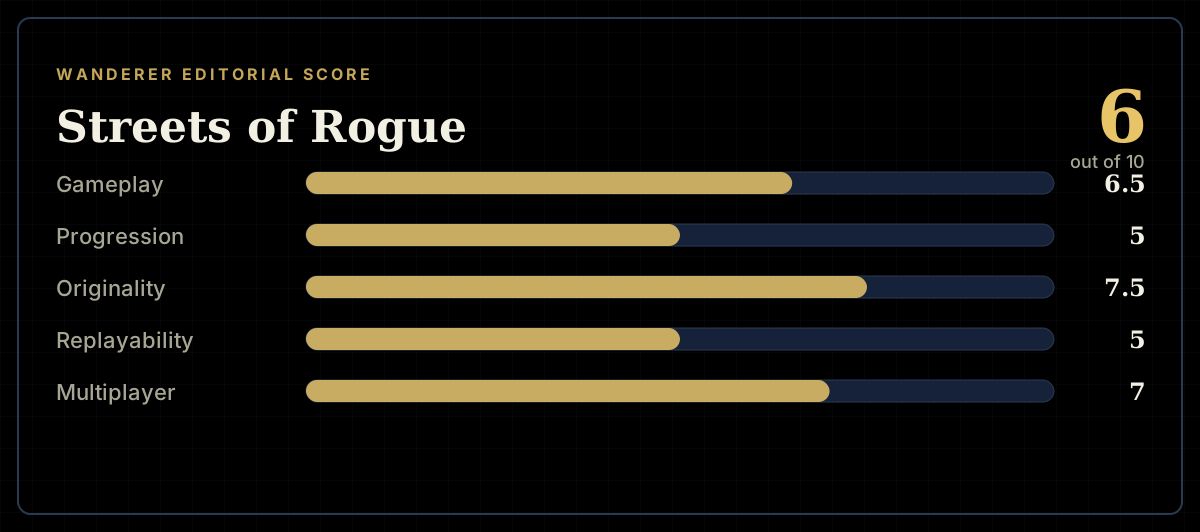
How the review scores each part of the gameWanderer Editorial -
The short versionWanderer Editorial