
Game review
Asterika: Phantom Rose Refrain Review
6.8 / 10
- Developer
- makaroll
- Publisher
- Studio Maka
- Released
- 2 September 2026
- Platforms
- ["Windows", "Mac"]
- Genre
- Rhythm
A Rhythm Game With No Lanes
Most rhythm games ask you to hit notes as they scroll toward a fixed line. Asterika: Phantom Rose Refrain throws that structure out entirely. Instead of lanes, you're dropped onto a 6x6 grid and asked to dodge geometric bullet patterns that spawn on the beat, moving your character in real time to survive each measure while staying locked to the music's rhythm. It's rhythm game and bullet-hell shoot-em-up fused into something that genuinely doesn't map cleanly onto either genre, and reviewers reach for the same comparison over and over to describe it: Crypt of the Necrodancer. One reviewer calls it exactly that, "reminds me a lot of Crypt of the Necrodancer, which is my favorite game of all time," and praises the "really solid gameplay that makes me always want to try just one more time." Another goes further, noting the game "can give even good reaction times" trouble because the grid's traps often can't be reliably dodged on a first attempt — success comes from memorizing a track's layout as much as reacting to it in the moment, which is an unusual, deliberate design choice for the genre.
That unusual approach is clearly the game's biggest draw. Solo developer makaroll, working under Studio Maka, built a scoring system — both solo practice runs and competitive Rank mode — that reviewers single out repeatedly as a standout feature. "The scoring system, both solo and ranked, is also unique and gives the game a nice flair," one review notes, while another calls out the detailed post-song statistical breakdowns as "AMAZING" and adds that they'd "have bought it for $60." Rank mode lets players see exactly how their run compares to the person ranked directly above them on a given track, turning the climb toward the "Top 1% of Engineers" leaderboard into something with real, visible incremental progress rather than an opaque number.
Story, Art, and a Cast Worth Caring About
Between songs, Asterika slows down for an illustrated, page-by-page prose story mode following Klare, a Soul Rose Engineer caught between Iris, a Phantom Hunter, and Vignette, a mysterious thief — connective tissue to the broader Phantom Rose series that reviewers familiar with the earlier games specifically call out as "a fun little change of pace whilst adding onto the Phantom Rose story." The art throughout draws consistent, specific praise; several reviewers single out makaroll's character designs by name, and it's clear the visual identity is doing real work to sell the game's tone alongside its music.
The writing itself is a more divisive point. One detailed review appreciates the story's concept but takes issue with its execution, criticizing how "it's written in about a million short paragraphs" and noting that "the art in the story doesn't stay on screen nearly long enough" — illustrations flash past before players can fully register them, leaving blank backgrounds where relevant artwork should linger. Another reviewer draws a comparison to a different rhythm game's prose style, noting Asterika's writing takes a similar tone to Arcaea's, which will read as either a selling point or a warning sign depending on how a given player felt about that game's story delivery.
Performance Problems Overshadowed a Strong Launch
The most consistent and serious criticism across the review pool has nothing to do with design and everything to do with technical polish. Multiple reviewers report significant frame drops on the game's harder, more visually dense tracks — a genuinely severe problem for a genre where split-second timing is the entire point. One reviewer attempting the game's Nightmare-difficulty stages describes the frame drops going "from irritating to run-ending," and flags that "for a rhythm game, stability is about the worst problem one can have." A memory leak compounded the issue at launch.
To makaroll's credit, the response has been fast and substantive. Patch 1.0.1 arrived within two days of the September 2 launch addressing Day 1 bugs, followed by 1.0.2 on September 7 with a major memory leak fix and new quality-of-life options, and 1.0.3 on September 13 adding dedicated frame rate settings alongside further stability work. Reviewers posted after those patches landed reflect the improvement directly — one who initially experienced FPS drops bad enough to make "certain songs practically unplayable" updated their review to say the game "runs noticeably smoother" and that they could "finally recommend this without the big 'wait for a hotfix' warning." It's a genuinely reassuring pattern of a solo developer treating stability as the top post-launch priority rather than chasing new content first, though it also means early buyers ran into real, review-shaping problems that shouldn't have shipped at 1.0.
A Small Soundtrack With Room to Grow
Asterika launched with a modest track list, and it's the other recurring, lower-stakes complaint in the review pool. "Since the game only came out a few days ago there aren't that many tracks," one reviewer notes, while another calls the limited soundtrack selection the "only downside" of what they otherwise consider "the perfect rhythm game." The curated mix of piano and electronic pieces that is present draws consistently positive marks for quality — catchy, varied in difficulty, and well-suited to the grid-dodging gameplay — but there's an acknowledged gap between how good the existing songs are and how few of them there currently are.
The built-in beatmap editor is the clearest sign of how makaroll intends to close that gap over time, letting players build and share their own custom stages rather than waiting solely on official content drops. One reviewer explicitly frames this as a reason for optimism: "looking forward to what the modding community has in store!" Given the demonstrated post-launch patch cadence, a community-driven expansion of the track list seems like a realistic path forward rather than an idle promise.
Verdict
Asterika: Phantom Rose Refrain is a genuinely novel rhythm game wrapped in a shaky launch. The lane-free, grid-based bullet-hell hybrid at its core is exactly the kind of idea that could feel gimmicky and instead feels inspired, backed by a scoring and ranking system with real depth and a visual style that consistently earns its praise. Performance issues at launch were serious enough to actively hurt the experience on harder tracks, and while makaroll's rapid patch cadence has visibly closed much of that gap within two weeks, it's a rough first impression for a genre that lives or dies on split-second precision. Combined with a currently thin track list, Asterika reads as a strong, distinctive foundation rather than a fully realized package — worth the $14.99 for rhythm fans willing to ride out the early rough patches, with real reason to expect it only gets better from here.
Screenshots
-
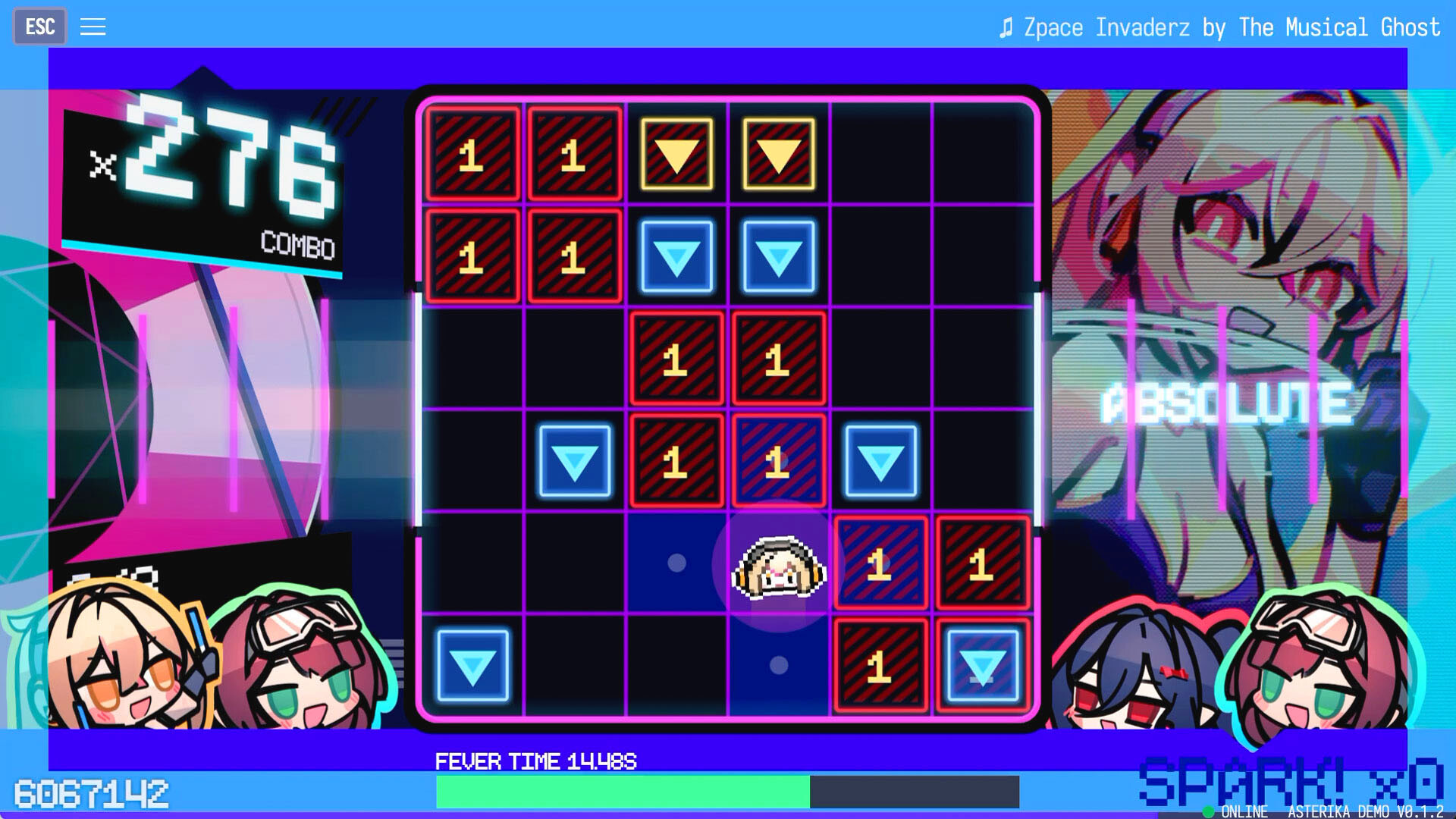
There are no lanes or falling notes here — you plot your own path across a 6x6 grid in time with the music.Image: makaroll via Steam -
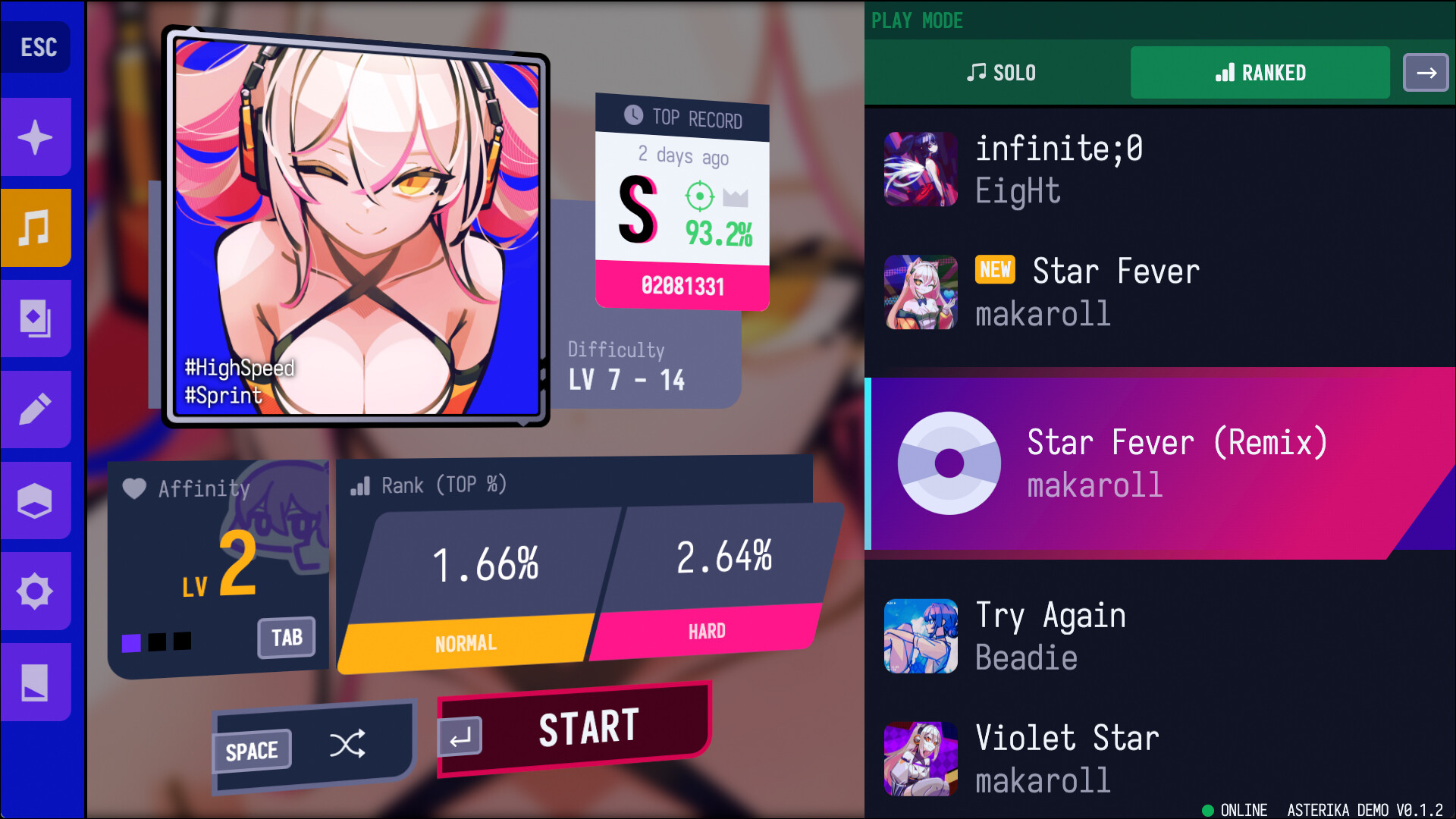
Ranked mode tracks a top-percentile leaderboard per song, with detailed accuracy stats attached to every run.Image: makaroll via Steam -
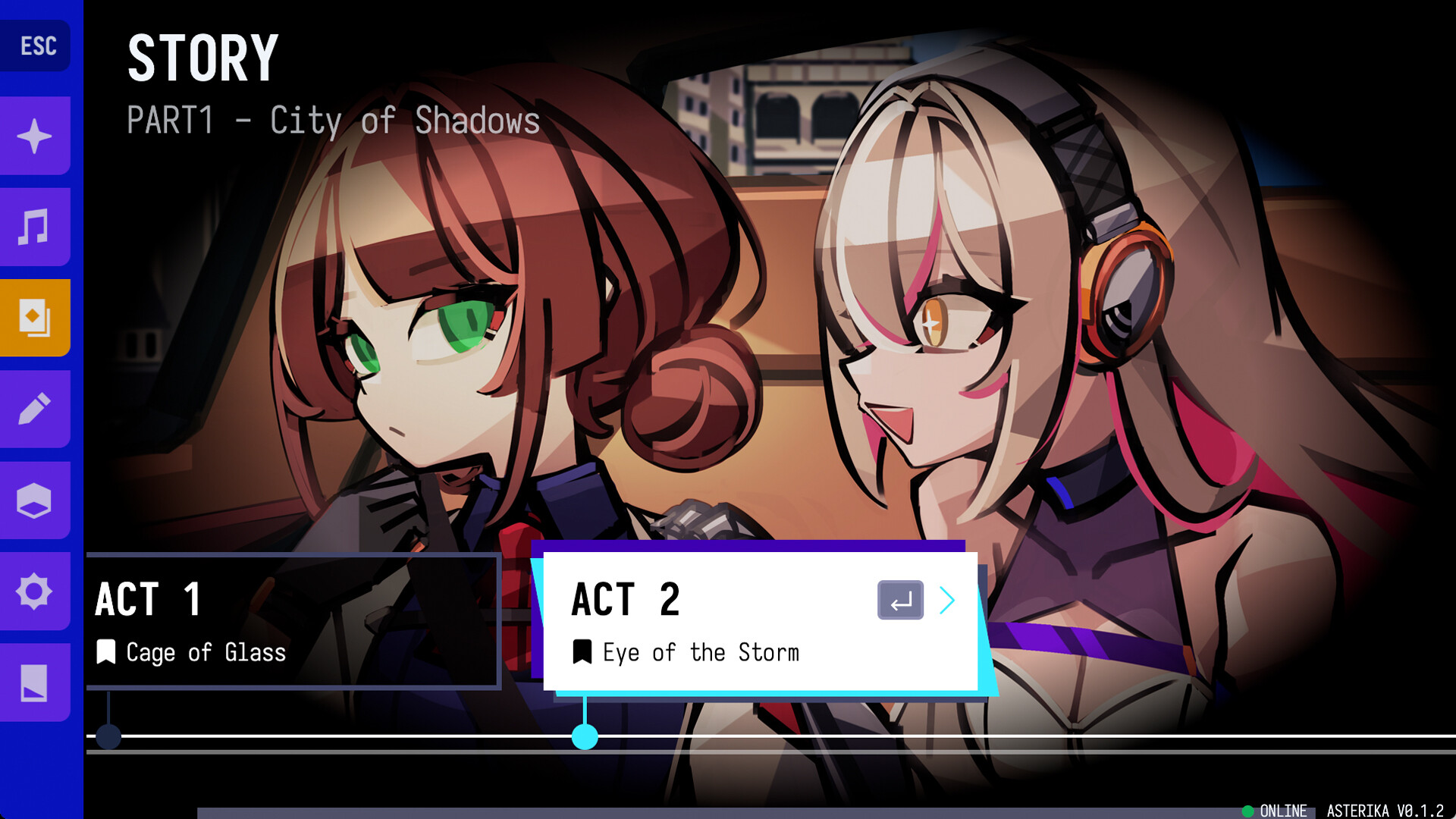
The story mode is organized into chapters players unlock between songs, following Klare, Iris, and Vignette.Image: makaroll via Steam