
Game review
Dragon Tiles Review
7.2 / 10
- Developer
- hf_game_studio
- Publisher
- hf_game_studio
- Released
- 7 September 2026
- Platforms
- ["Windows"]
- Genre
- Action
A Snake Wearing a Chess Set Into Battle
Dragon Tiles is a lightweight top-down bullet-hell survival roguelite built around a single, distinctive visual idea: a dragon's head leads a chain of trailing tiles into battle, each one a turret firing automatically as the whole formation slithers around the arena clearing waves of enemies. Where the game earns its name is in what those trailing tiles actually are, dice, dominoes, mahjong tiles, playing cards, Chinese chess pieces, and international chess pieces, each functioning as a turret with its own attack pattern, and each carrying two overlapping trait tags: a tile-type category and an elemental affinity drawn from physical, fire, poison, ice, and electric damage. Matching tiles by tile type or element unlocks synergy bonuses that transform a scattered assortment of turrets into a coordinated, screen-clearing formation, and the core loop revolves entirely around building that formation rather than manually aiming or dodging. Rounds alternate between short bursts of automatic, countdown-timed combat and a shop phase where limited gold gets spent purchasing new tiles, rerolling the shop, combining duplicates into star-upgraded turrets, or investing further into whatever synergy is already working. Developed and published solo by hf_game_studio, Dragon Tiles moved from a pre-launch demo into a full release on Steam on September 7, 2026, priced at $3.99.
A Tiny But Perfectly Positive Debut
Dragon Tiles has drawn just three reviews so far, all three positive, giving it a 100% approval rating on a genuinely small sample. All three are written in Simplified Chinese, and two of them go into real detail about the game's mechanics and design philosophy rather than offering a quick thumbs-up, suggesting the early audience found here is engaged enough to actually explain what the game is doing rather than just rating it and moving on.
Reviewers Praise the Clarity, the Tile Gimmick, and How Fast It Gets Going
The most detailed review opens by noting the game clears up its own premise well: the dragon-and-tiles metaphor refers specifically to the snake-like formation styled after a Chinese dragon, paired with turret types represented as different classes of game pieces, dice, dominoes, mahjong, playing cards, Chinese chess, and international chess, each dressed up further with elemental traits. That reviewer specifically praises the accessible difficulty curve, noting players start fighting immediately with no tutorial and don't need one, since the core loop reveals itself within seconds of picking it up, and calls out the streamlined three-in-one star-upgrade system as a smart, effort-saving twist on a familiar roguelite mechanic, upgrading to a three-star turret only requires one two-star piece plus two one-star pieces rather than a full set of three two-star pieces. A second reviewer describes going in expecting a Snake-style roguelike and instead finding something more specific: a dragon head trailing an increasing chain of cards, mahjong tiles, chess pieces, and dice, each with its own attack behavior and able to be combined into upgraded forms, alongside item-driven buffs that form a full combat build. That same reviewer specifically calls the game "light and fun" and well suited to a quick session when there's time to kill, while flagging that the actual combat plays out on an automatic countdown, meaning the real decisions all happen during the shop phase between rounds rather than in the heat of battle. A third, shorter review simply confirms the basics that matter to a Chinese-speaking audience evaluating an indie pickup: Chinese-language support, Steam Achievements, and cloud save are all present and accounted for.
A Thin Review Pool and an Auto-Battler's Built-In Ceiling on Player Skill
With only three reviews on record, Dragon Tiles hasn't accumulated the kind of broad critical pushback that would surface real structural problems, but the praise itself hints at where the limits sit. More than one reviewer frames the game's appeal explicitly in terms of its lightness, "light and fun," a review whose "content is short and concentrated," and a design whose entire experience compresses down into two growth systems, relic items and turret weapons, rather than anything more expansive. That's a deliberate design choice rather than an oversight, but it does mean Dragon Tiles is more likely to satisfy players looking for a fast, disposable roguelite session than anyone hoping for the kind of deep, hours-long build variety that genre heavyweights offer. The automatic, countdown-driven combat is also worth flagging plainly: since the dragon formation fights on its own once a round starts, all of the actual skill expression happens in the shop between rounds deciding what to buy, reroll, or combine, which will appeal to players who enjoy build theorycrafting but will read as a lack of agency to anyone expecting to personally aim, dodge, or otherwise directly control combat. No reviewer has yet weighed in on how the game's content holds up across dozens of runs, how many distinct viable synergy builds actually exist beyond the tile-type and elemental combinations advertised, or whether the pacing stays snappy once a run's formation grows unwieldy.
Verdict
Dragon Tiles takes a genuinely clever visual hook, a dragon-shaped chain of chess pieces, mahjong tiles, and playing cards functioning as an auto-battling turret army, and builds a clean, accessible roguelite around it that every early reviewer describes as easy to pick up and satisfying to build with. The three-review sample is far too small to call this launch a runaway success, but its unanimous positivity and the thoughtful detail in what reviews do exist suggest a well-executed, if intentionally lightweight, idea rather than a shallow cash-in. At $3.99, with no tutorial friction and a shop-driven build system that rewards experimenting with tile-type and elemental synergies, it's a low-cost, low-commitment pickup for roguelite fans who want a quick, snackable session rather than a sprawling one. Just know going in that the actual combat runs on autopilot, the real game happens in the shop, and go in expecting a tight, novel curiosity rather than a systems-deep epic.
Screenshots
-

The card-turret chain auto-fires at waves of enemies while the dragon head weaves through incoming fireImage: hf_game_studio via Steam -
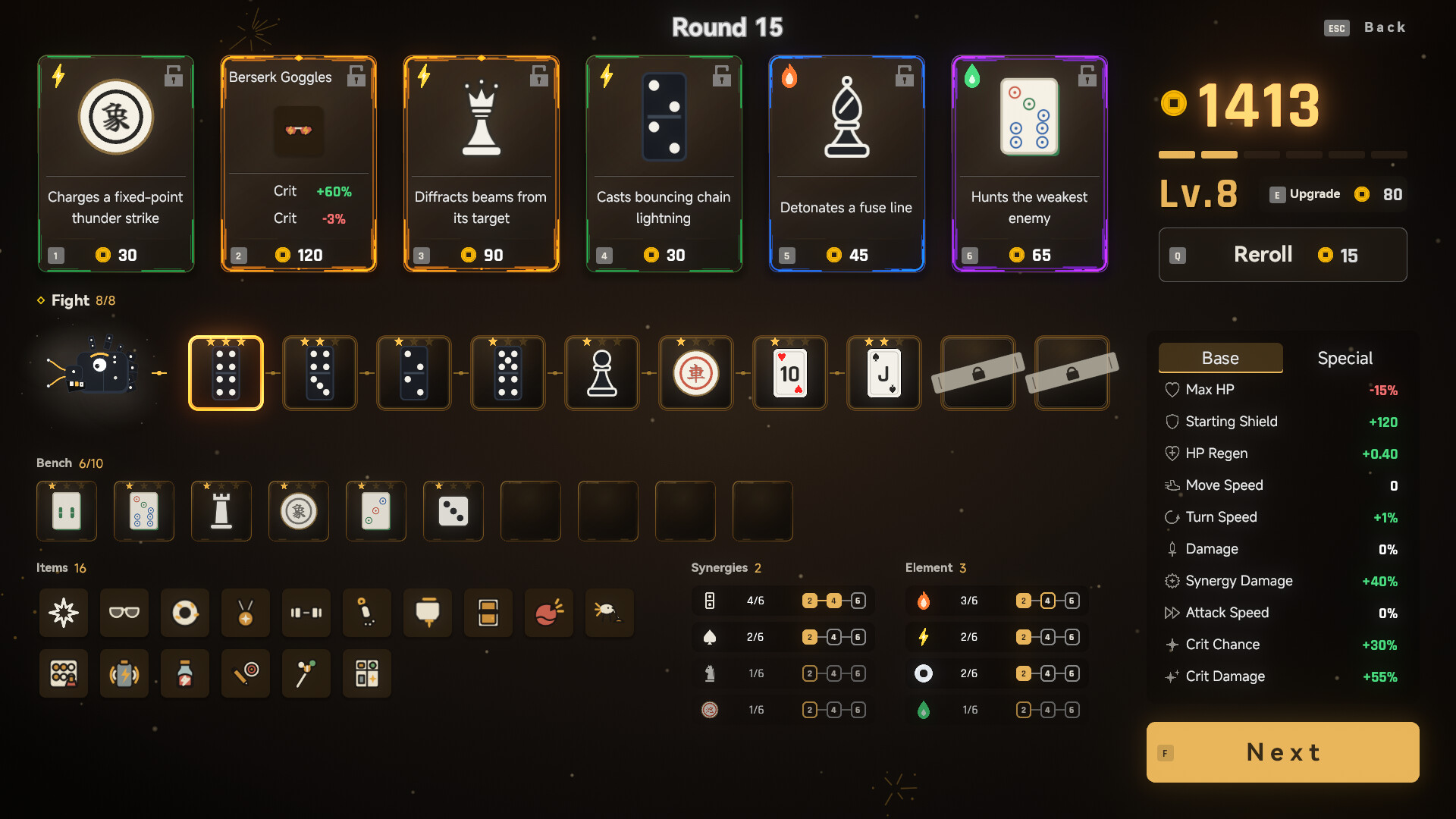
Between rounds, the shop is where the real decisions happen: buying, rerolling, and combining tiles into synergiesImage: hf_game_studio via Steam -
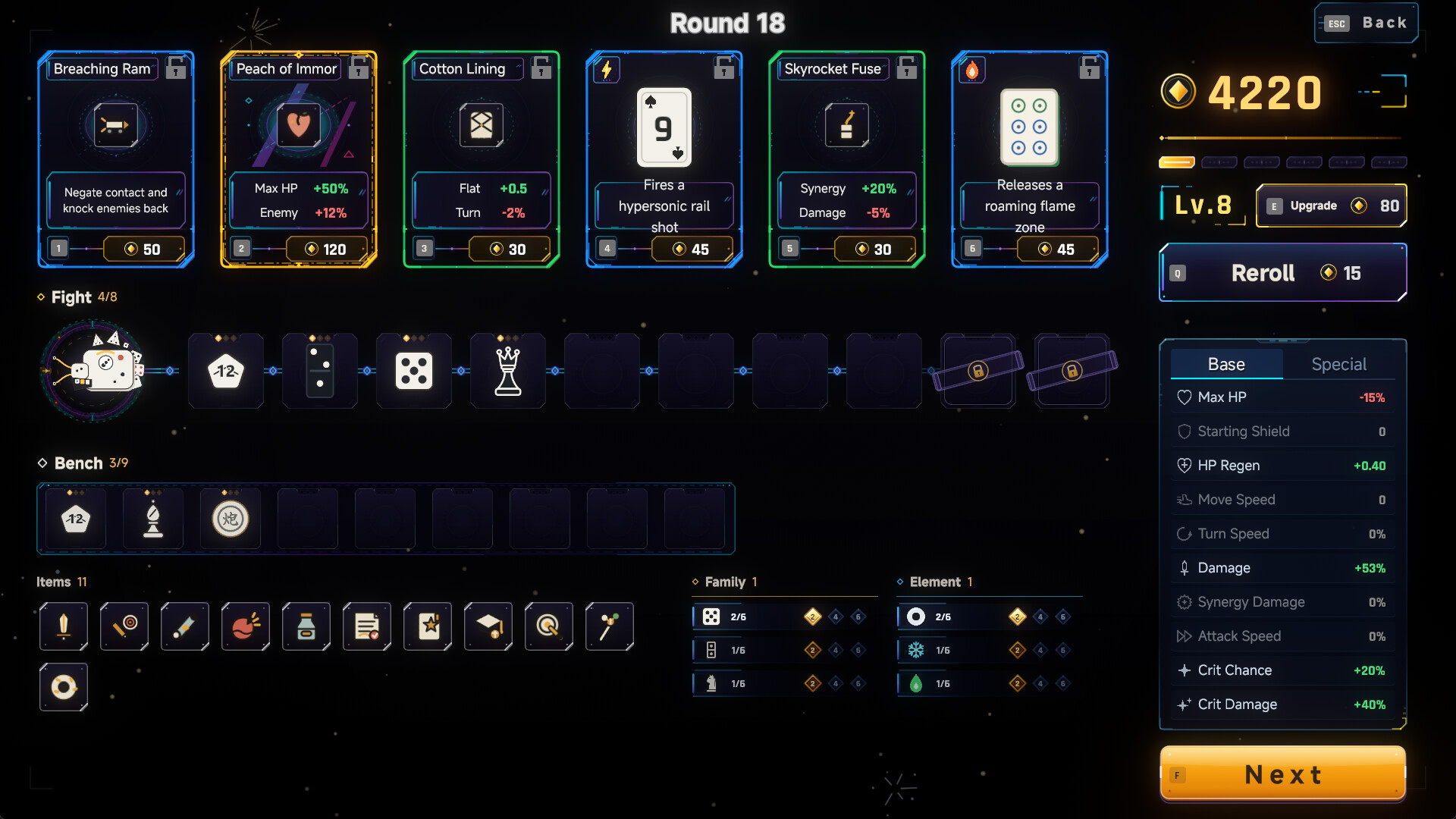
By round 18 a run's formation and stat bonuses have grown considerably from a handful of starting tilesImage: hf_game_studio via Steam