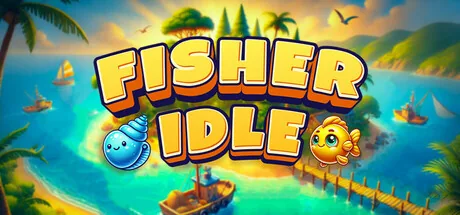
Game review
Fisher Idle
4.5 / 10
- Developer
- Bahamut Games
- Publisher
- Bahamut Games
- Released
- 31 July 2026
- Platforms
- Windows
- Genre
- Idle tycoon / Incremental
- Monetisation
- One-time purchase, no in-app purchases, no ads, no subscription
- Players
- Single-player only
The short version
Fisher Idle drops you on a boat with nothing, and the pitch — catch fish, sell them at auction, buy bigger ships, build an empire — is a perfectly sound idle premise. The problem is that almost everything the game has to offer is visible and finished within about two hours, after which buying more upgrades stops meaningfully mattering and the game becomes something to leave running rather than something to play. There's no prestige system, no alternate build, no second layer once the fifteen ships and the fishermen roster are maxed out.
That specific complaint dominates the game's negative reviews, and nearly all of those reviews are seventeen months old, written during the long Early Access period that only just ended on 31 July 2026. Public achievement-completion data shows the same shape those reviewers described: most unlocks clear at a healthy 44–76%, then the rate collapses to 18% and 10% for the last two, exactly where players say the game demands weeks, months or over a year of just leaving it open.
Biggest strengths
- At NZ$2.69 the asking price is low enough that even reviewers who don't recommend the game describe it as tolerable for the money, which is a different complaint from feeling ripped off
- Monetisation is completely clean — a single flat purchase with no in-app purchases, ads, premium currency or timer standing between the auction house and your fleet
- A free demo (a separate Steam listing) has been public since the game's Early Access days, so anyone unsure about the loop can try it before spending anything
Biggest weaknesses
- Multiple reviewers independently describe clearing every ship, upgrade and system available to them in under two hours, and the 1.0 release doesn't appear to have changed that ceiling
- There is no prestige loop, reset mechanic or alternate build path — once ships and hired fishermen are maxed, active clicking stops adding anything the idle rate wasn't already doing
- Public achievement-completion data shows a sharp cliff from the mid-40s/70s percent range down to 18% and then 10% for the final two unlocks, matching reviewer accounts of a real-time wall that can run past a year in fully offline play
Who it's for: Anyone who wants a NZ$2.69 cozy toy to glance at for an afternoon, not players looking for an idle game with a long-term save file or a reason to keep coming back after week one.
Our recommendation: Reasonable as an impulse-priced curiosity if the fishing-boat setting appeals, but go in expecting an hour or two of real decision-making followed by a very long, largely decision-free wait for the last couple of achievements.
4.5 / 10
Every idle tycoon makes the same implicit promise: there's always another tier to reach for, even if the climb gets slower the higher you go. Fisher Idle sells that promise with a pleasant, cozy setup — you start with nothing in the middle of the ocean, catch and sell fish, and work your way through more than fifteen ships toward something the store page calls a "fishing empire." What the game's own reviewers have been saying, consistently, for a year and a half, is that the climb ends almost immediately, and nothing is built to replace it once it does.
A short game wearing a long-term game's marketing
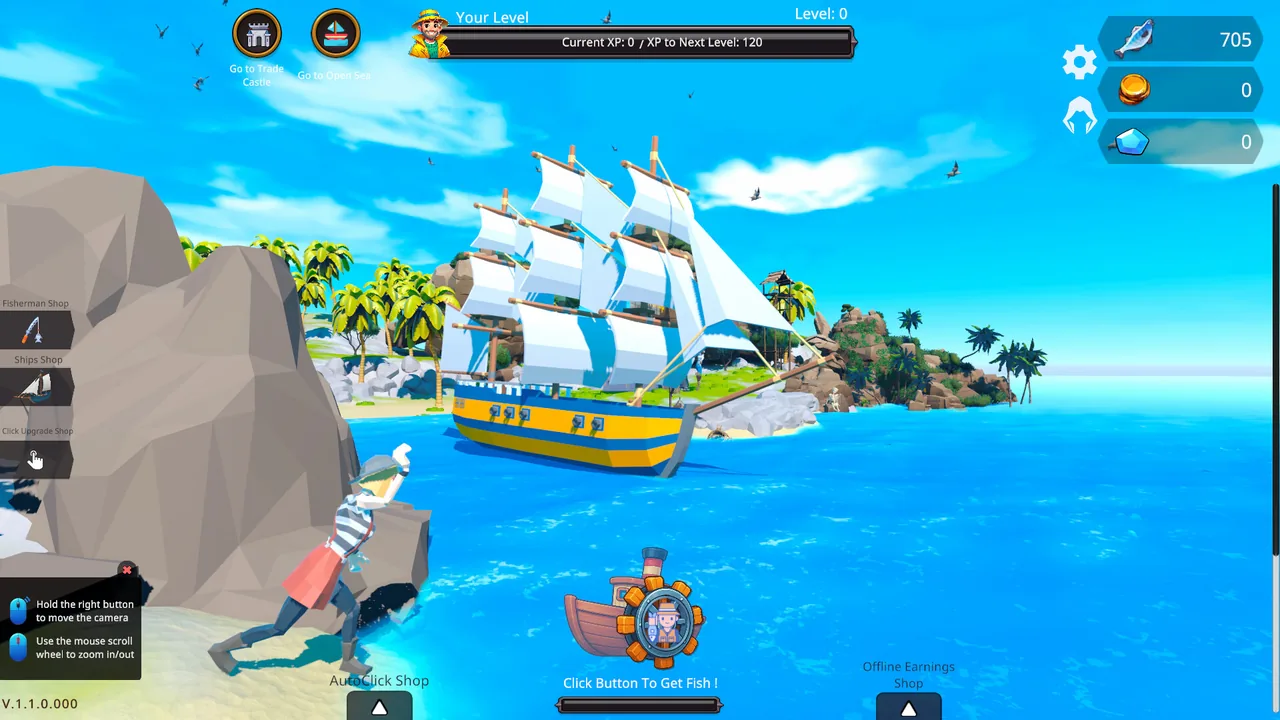
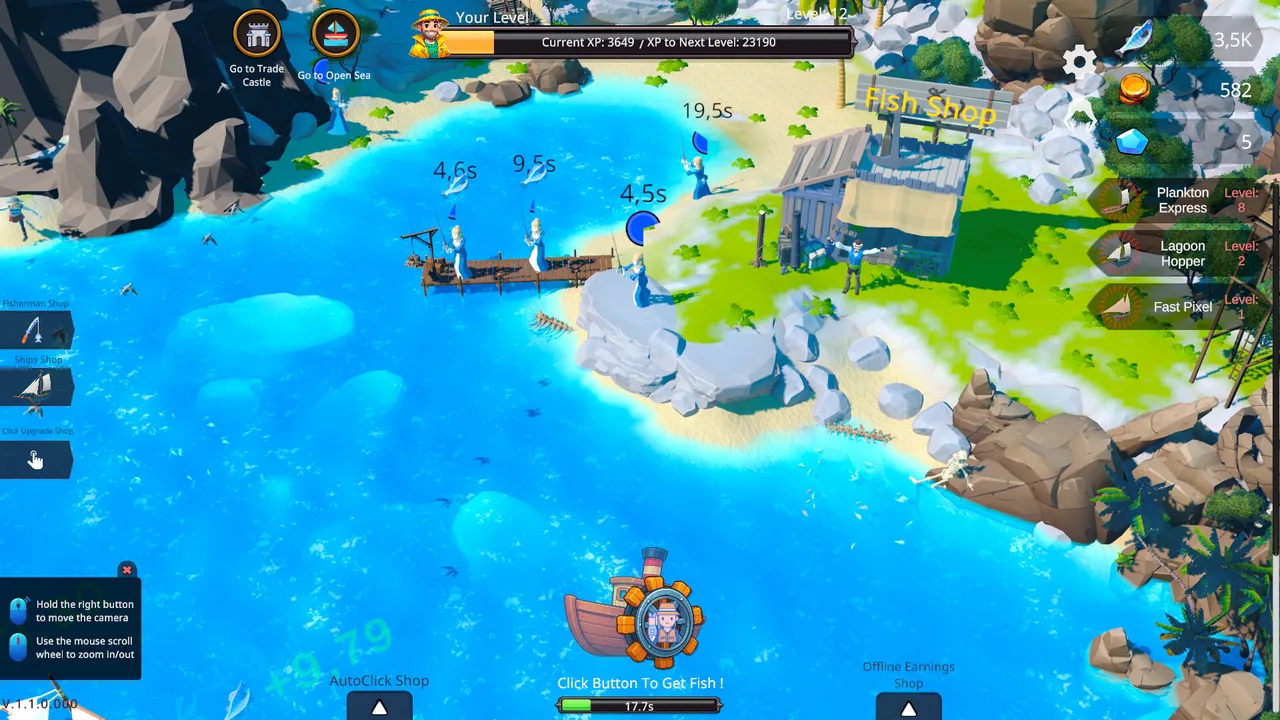
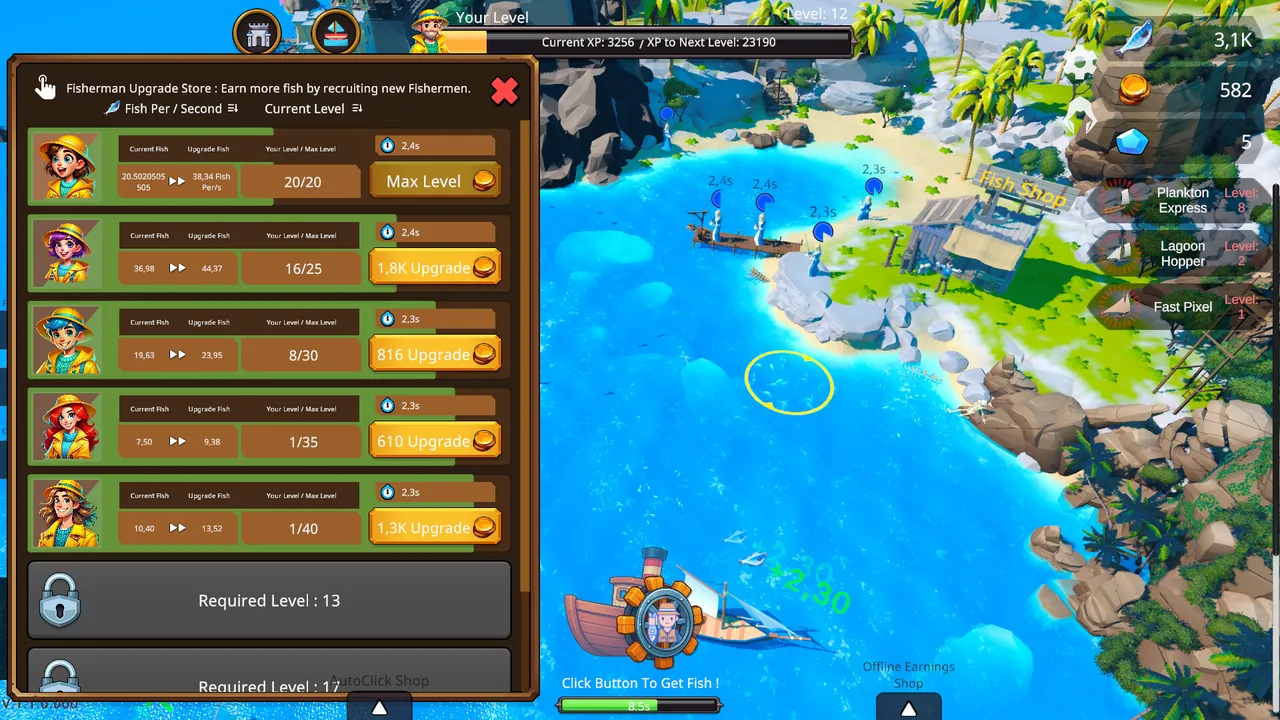
The core loop is straightforward and, in its opening stretch, genuinely pleasant: sail out, catch fish, sell them through an auction system that tracks market prices, and reinvest in a bigger boat or a hired fisherman who automates part of the process. It's a familiar idle shape, and for the first hour or so it works the way idle tycoons are supposed to — every purchase visibly speeds up the next one. The trouble, according to reviewer after reviewer since the game's Early Access debut, is that the whole system tops out fast. More than one player describes reaching every ship and maxing every available upgrade inside two hours, at which point the fifteen-ship roster and the hired-fishermen system stop being goals and start being a checklist you've already cleared. Hired fishermen in particular have a hard upgrade ceiling — once they're maxed, there's nothing left to spend gold on that changes anything.
That's a survivable problem for a short, cheap toy. It's a much bigger one for a game whose own pitch is "build your fishing empire," because an empire implies a horizon, and Fisher Idle doesn't currently have one. There's no prestige system, no reset-and-rebuild loop, no alternate ship composition to chase on a second attempt — the upgrade order is fixed and singular, and once you've walked it, several reviewers say active play stops mattering entirely. Clicking to fish faster becomes pointless once idle income outpaces anything your attention can add, which inverts the usual selling point of an idle game: instead of respecting your time by making both active and away-from-keyboard play worthwhile, it makes engaging with the game actively feel like the wrong choice.
What the achievement numbers actually confirm
It's easy to write off "I beat it in two hours" as one player's impatience, so it's worth checking against harder data. Steam's public achievement-completion statistics for Fisher Idle show thirteen of its fifteen achievements clearing between 44% and 76% of the player base — consistent with a game most owners genuinely do finish quickly. Then the numbers fall off a cliff: the second-to-last achievement sits at 18.2% completion, and the final one at 10.4%. That gap lines up exactly with what several negative reviews describe — a last unlock gated behind a real-time wait measured in weeks or months if the game idles in the background, and potentially over a year if you're relying on its offline catch-up instead of leaving the process running live. That's not a difficulty curve, it's a patience tax, and it's the single design decision most responsible for the game's mixed reception: padding out an otherwise two-hour game by making its last achievement cost real-world time rather than anything resembling a decision.
Two release dates, and a review base that barely covers the newer one
Here's the detail that matters most for anyone reading the "Mixed" badge on Fisher Idle's store page today: this isn't a fresh verdict. The game entered Steam Early Access on 5 March 2025, and almost the entire review history — 11 of its 12 negative reviews and 21 of its 23 positive ones — was written during that Early Access window, most of it clustered in the first few months. Fisher Idle only exited Early Access into its current 1.0 release on 31 July 2026, seventeen months later. Since that full release there have been exactly two English-language reviews: one positive, from a player with roughly ninety hours logged who evidently found enough here to stick with it long-term, and one negative, posted with barely twenty minutes of playtime. What that means practically is that the "Mixed" rating a shopper sees today is overwhelmingly a snapshot of a much earlier, much less finished build, not a considered judgment on the game as it currently ships — and the reviews that do exist give no strong signal either way about whether the two-hour ceiling moved during those seventeen months. The store page's own description still lists a "Trade Castle" feature as "in development," which at least suggests the project hasn't been abandoned, but it also suggests the game the 1.0 tag describes as finished still has acknowledged gaps.
The AI-art disclosure, and the review it drew
Fisher Idle carries an official Steam AI Generated Content Disclosure: the developer states that "some of the visuals in the game (fishermen photos) were created using artificial intelligence." That's a narrow, specific admission — one asset category, not the whole game — but it's clearly become a flashpoint on its own. The most recent negative review in the game's history, posted the day after the 1.0 launch, objects to the purchase entirely on the grounds that it's "AI generated" and argues a game built that way shouldn't be sold for money at all, independent of how the gameplay actually holds up; the reviewer spent about twenty-four minutes with it. An earlier, Early-Access-era review makes a related but more specific complaint, describing "mostly AI generated content or open source assets that don't fit with each other," pointing at a lack of consistent art direction rather than objecting to AI use as a category. Both are worth separating from the game's core design problem — they're about what the assets are, not about whether the progression loop holds up — but a shopper weighing the "Mixed" badge should know that a slice of it isn't about gameplay at all.
Price and what NZ$2.69 actually buys
On the business side, Fisher Idle is close to unimpeachable: a single NZ$2.69 purchase, no premium currency, no advertising, no timer nudging you toward a store you'd otherwise have no reason to open. That's the right way to sell a small idle game, and it's a large part of why even its harsher reviews stop short of calling it a rip-off — the complaint is almost always about thinness, not about being charged twice for the same content. Whether that's enough depends entirely on what you want from the genre. As a five-dollar impulse buy for an afternoon on a cozy little boat, the price matches the content on offer reasonably well. As the "fishing empire" builder its own marketing promises, it runs dry long before the empire part arrives, and no amount of low pricing changes that the core loop currently has a ceiling most players hit before their first sitting is over.
Final verdict
Fisher Idle isn't broken, and it isn't a scam — it's a small, cheap, pleasant-looking boat game that happens to run out of things to decide about an hour or two after it hooks you. The clean monetisation and low price are genuine credits, and the achievement design gives casual players a real finish line rather than an endless grind. But an idle tycoon lives or dies on what happens after the opening rush, and here that's a fixed, un-resettable path with no prestige system, followed by a final stretch that asks for weeks or months of just leaving the window open. The game's Mixed rating is mostly an Early Access artifact rather than a verdict on the finished 1.0 release, but nothing in the handful of reviews written since 31 July 2026 suggests the underlying shape has changed. Buy it for what it is — a few dollars of cozy fishing-boat scenery — not for the long-term empire the store page describes.
Anyone who likes this idea better with a longer runway should look at Idle Startup or Garbage Growth, two other cheap incrementals wrestling with the same "what happens after the opening hour" problem in different ways. Players who'd rather their progress kept compounding in a world that keeps growing around them, instead of a fixed path with a hard ceiling, might also enjoy Wanderer.
Pros and cons
Pros
- At NZ$2.69 the asking price is low enough that even reviewers who don't recommend the game describe it as tolerable for the money, which is a different complaint from feeling ripped off
- Monetisation is completely clean — a single flat purchase with no in-app purchases, ads, premium currency or timer standing between the auction house and your fleet
- A free demo (a separate Steam listing) has been public since the game's Early Access days, so anyone unsure about the loop can try it before spending anything
- 13 of the game's 15 Steam achievements are earned through ordinary play, giving casual buyers a real "I finished it" moment without needing to chase a completionist grind
- The developer has continued supporting the project past its Early Access tag — a "Trade Castle" feature is still listed as in development on the current store page
Cons
- Multiple reviewers independently describe clearing every ship, upgrade and system available to them in under two hours, and the 1.0 release doesn't appear to have changed that ceiling
- There is no prestige loop, reset mechanic or alternate build path — once ships and hired fishermen are maxed, active clicking stops adding anything the idle rate wasn't already doing
- Public achievement-completion data shows a sharp cliff from the mid-40s/70s percent range down to 18% and then 10% for the final two unlocks, matching reviewer accounts of a real-time wall that can run past a year in fully offline play
- The developer's own disclosure that some fisherman artwork was AI-generated has become a lightning rod on its own, drawing at least one post-launch review that scores the purchase on principle rather than on time spent with it
- Only a handful of reviews have been written since the 31 July 2026 exit from Early Access, so today's buyer is mostly judging a "finished" game against 17-month-old first-impression feedback
Screenshots
-
Fisher IdleImage: Bahamut Games via Steam -
Fisher IdleImage: Bahamut Games via Steam -
Fisher IdleImage: Bahamut Games via Steam -
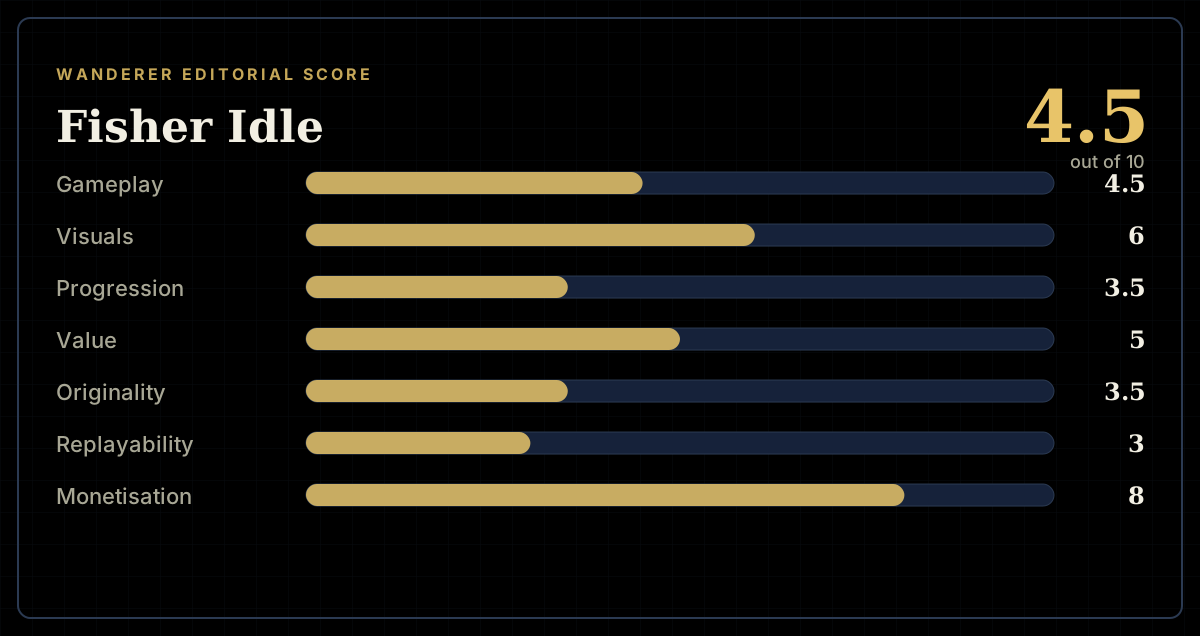
How the review scores each part of the gameWanderer Editorial -
The short versionWanderer Editorial