
Game review
Idle Startup
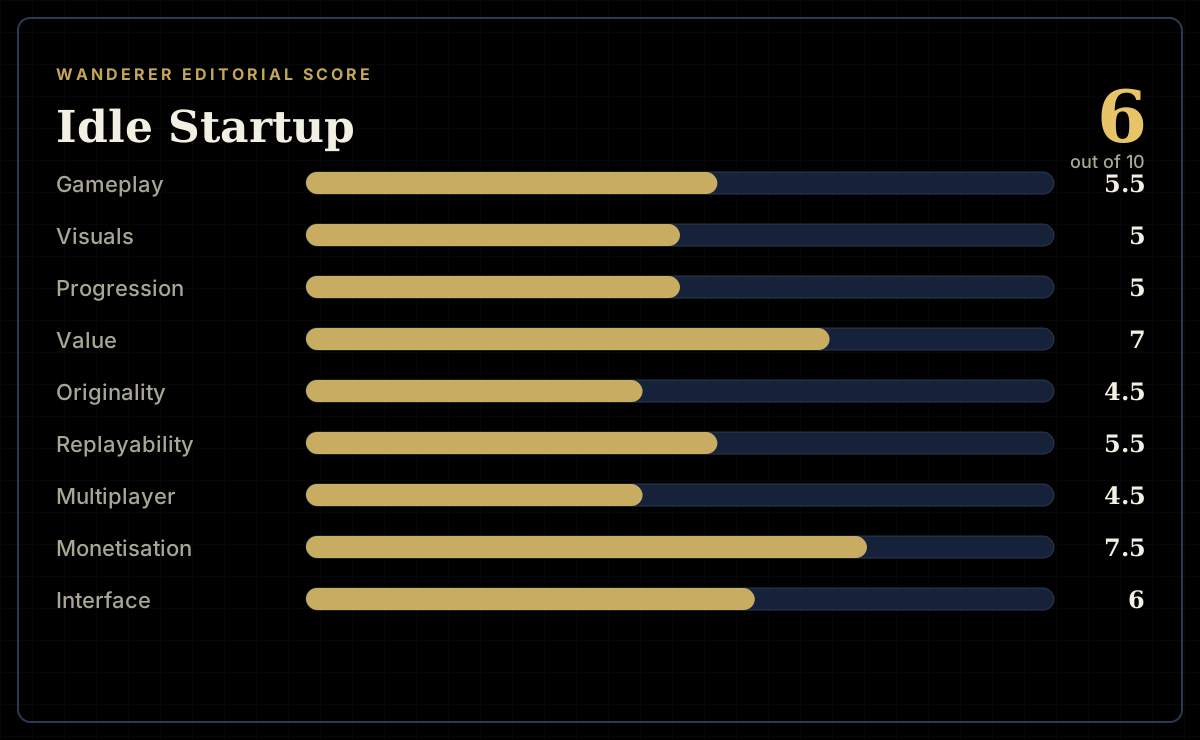
6 / 10
- Developer
- Merrill Lines
- Publisher
- Merrill Lines
- Released
- 21 June 2026
- Platforms
- Windows, macOS
- Genre
- Idle / Incremental
- Monetisation
- Free-to-play with optional in-app purchases (timed and permanent speed boosts, uncapped offline earnings); no advertisements
- Players
- Single-player, with online leaderboards
The short version
Idle Startup wraps a completely conventional incremental loop in a "garage to global tech empire" theme, and for the first several hours that framing does real work — training skills, automating tasks and cashing out for Founder Points feels like a clean, honest idle game with nothing hidden behind a paywall. The trouble starts once the numbers stop cooperating: a midgame economy that several players describe as mathematically broken, a well of content that runs out long before the promised "endlessly-scaling" loop does, and a leaderboard with no anti-cheat protecting it.
Biggest strengths
- Genuinely completable without spending a cent, and nothing in the shop gates content — the optional Energy Drink, Coffee Pot and Productivity Suite purchases only speed up a loop you can otherwise finish for free
- No advertisements anywhere in the game, which is unusual for a free idle release and worth crediting on its own
- Automation unlocks early enough that the game genuinely runs itself in the background, matching its own pitch of progress continuing while you're away
Biggest weaknesses
- Several players describe the mid-to-late economy as mathematically broken, with upgrade costs climbing into the octillions while income plateaus far below what's needed to keep pace
- The six skill trees behave almost identically to one another, so there's little sense of specialising in a playstyle rather than just clicking through parallel checklists
- Automation arrives quickly enough that meaningful decisions dry up within the first couple of hours, leaving a long stretch of the game as pure waiting
Who it's for: Idle-game regulars who want something free to leave running in a browser tab or on a second monitor for a few weeks, and players who specifically value a monetisation model with no ads and nothing locked behind a hard paywall.
Our recommendation: Worth installing since it costs nothing and never demands payment to finish — just go in expecting the loop to run out of ideas well before it runs out of zeroes, and don't chase the endgame achievements expecting the pacing to hold up.
6 / 10
Idle games live or die on a single promise: the numbers should always feel like they're going somewhere, even when nobody's watching. Idle Startup borrows the visual language of a business sim — a one-person garage venture, hired staff, quarterly-sounding milestones — to dress up that promise, and for a while it delivers on it cleanly. Then the spreadsheet underneath starts showing its seams, and the game that's left is a fairly ordinary incremental asking you to wait out costs its own income can't keep up with.
Garage to empire, one skill bar at a time
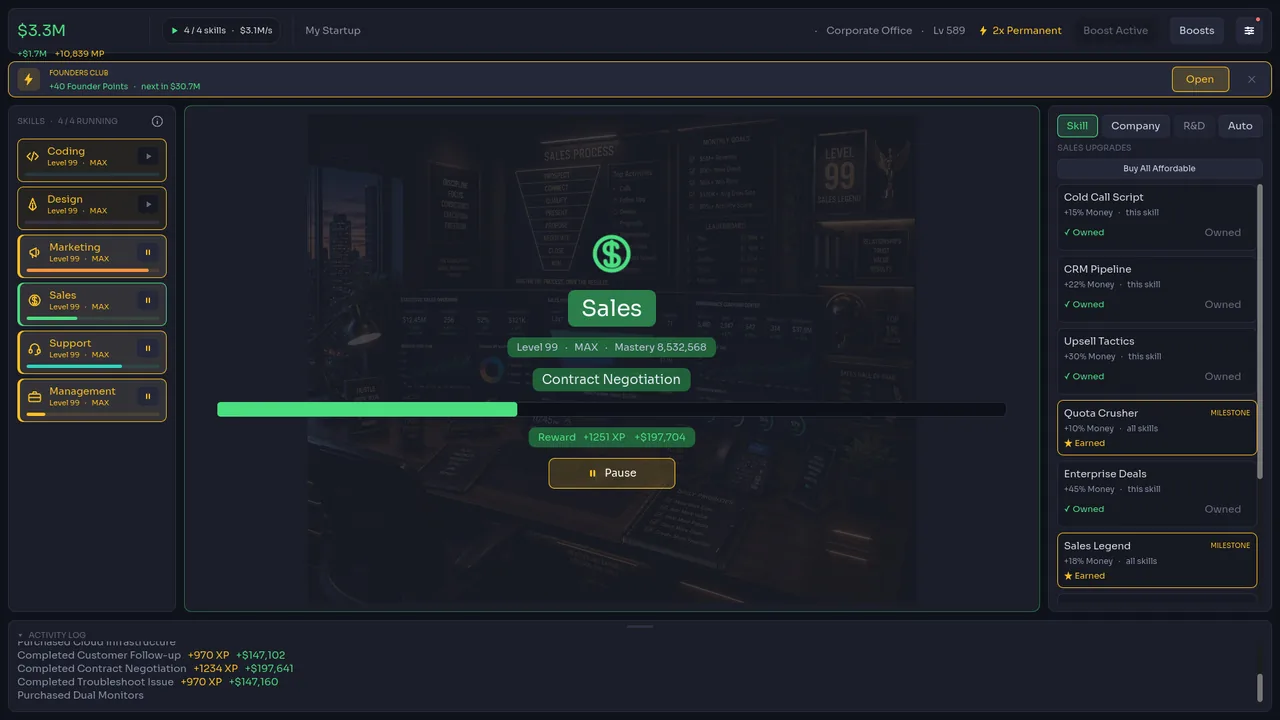
The pitch is straightforward: train six skills, automate the ones you've outgrown, and watch a single founder's side project turn into a company with departments, milestones and a growing income stream. Early on, that structure works exactly as an idle game should. There's a steady supply of small unlocks, each skill bar fills at a pace that rewards checking back in, and the game telegraphs its own automation options clearly enough that handing off a task never feels like giving something up.
The problem is that the six skills don't stay distinct for long. They're built on the same underlying shape — train a stat, automate it, watch its number climb — and nothing about the "tech company" theming gives them a mechanically different identity from each other. A marketing skill and an engineering skill end up being the same interaction with a different coat of paint, which is a real missed opportunity in a genre where the best entries (whether they're about mining, cooking or running a company) usually find at least one skill that plays by different rules.
Founder Points and the reason to reset
Idle Startup's prestige system, Founder Points, is one of its better ideas. Cashing out your company converts your progress into points spent in a permanent Founder Store, so restarting isn't just a bigger-numbers treadmill — it's an actual decision with lasting consequences, which is the part of prestige design that separates a good incremental from a game that just resets your save for the sake of it. Combined with a "Welcome Back" recap that spells out what happened while the game was closed, the loop is legible in a way plenty of idle games never bother to be.
Where that goodwill runs out is in what the loop actually asks you to do between resets. Automation kicks in early enough that there's rarely a meaningful choice left to make once the early skill trees are filled in — you're mostly watching a company you already finished optimising get slightly bigger. For a genre built around the tension between active decisions and passive growth, Idle Startup leans hard toward the passive side well before it's earned that trust.
Where the math stops adding up
The most consistent complaint in player feedback isn't about pacing philosophy — it's about arithmetic. Several long-time players describe hitting a wall where upgrade costs balloon into the octillions while income has plateaued far below what's needed to close that gap in any reasonable timeframe, turning what's meant to be a background idle game into something closer to a multi-day wait with nothing new to look at while it happens. One specific achievement asks for 100 hours of accumulated playtime, and by the time players reach it, the consensus is that there's been little meaningful content to unlock for a long stretch beforehand.
That's a design failure specific to incremental games: the entire genre lives or dies on its curve, and a curve that outpaces its own economy turns "idle" into "abandoned." A handful of strong early hours don't offset a mid-game wall that several players independently flag as the point where they stopped opening the game.
Presentation and the AI question
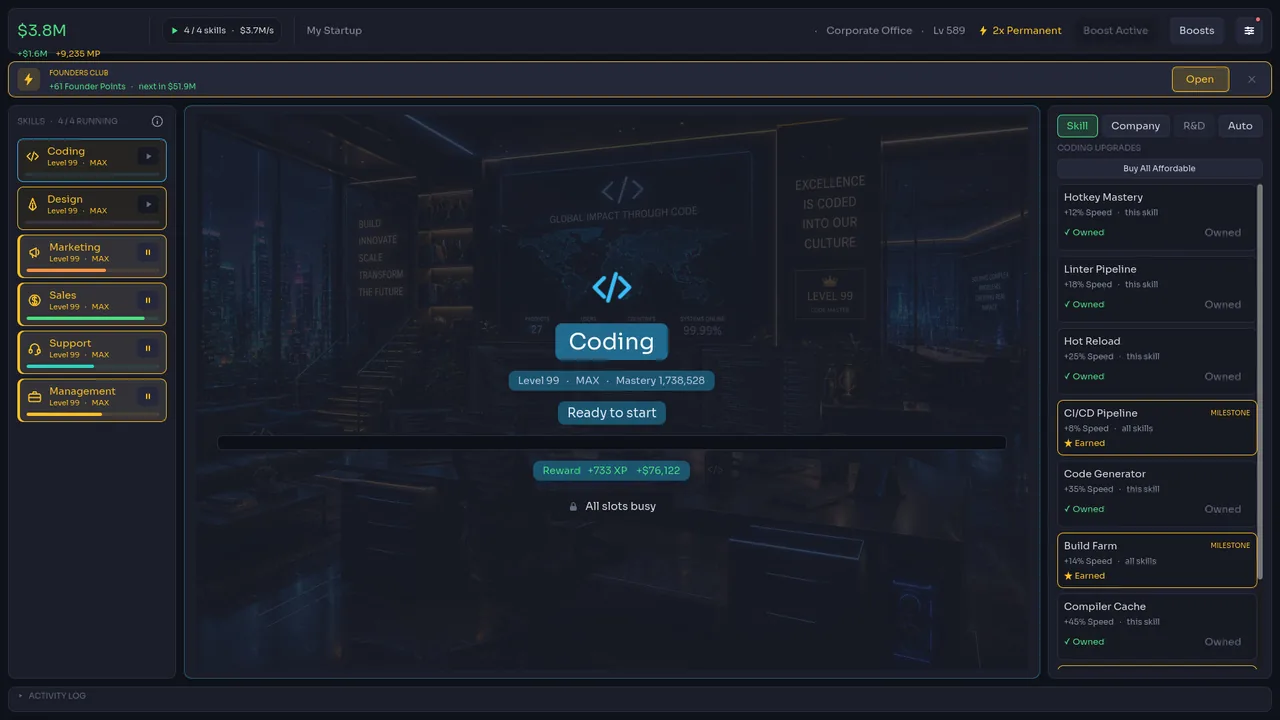
Visually, Idle Startup is clean rather than distinctive — flat interface panels, simple icon work, nothing that clashes but nothing that leaves much of an impression either. That would be a minor note on its own, but a recurring thread in player feedback claims the art and possibly some of the code were AI-generated without disclosure on the store page. Whether or not every instance of that complaint is accurate, it's landed as a real credibility problem for a lot of reviewers, and it compounds a presentation that was already coasting on genre convention rather than doing anything to stand out.
Leaderboards without a lock on the door
The game layers in online leaderboards and 50-plus Steam achievements as reasons to keep playing past the core loop, and the achievement list is a reasonable hook for completionists. The leaderboards are a weaker addition: with no anti-cheat protection in place, save-edited scores reportedly sit at the top uncontested, which turns a feature meant to add a competitive layer into a list most honest players have no realistic reason to check.
Monetisation and value
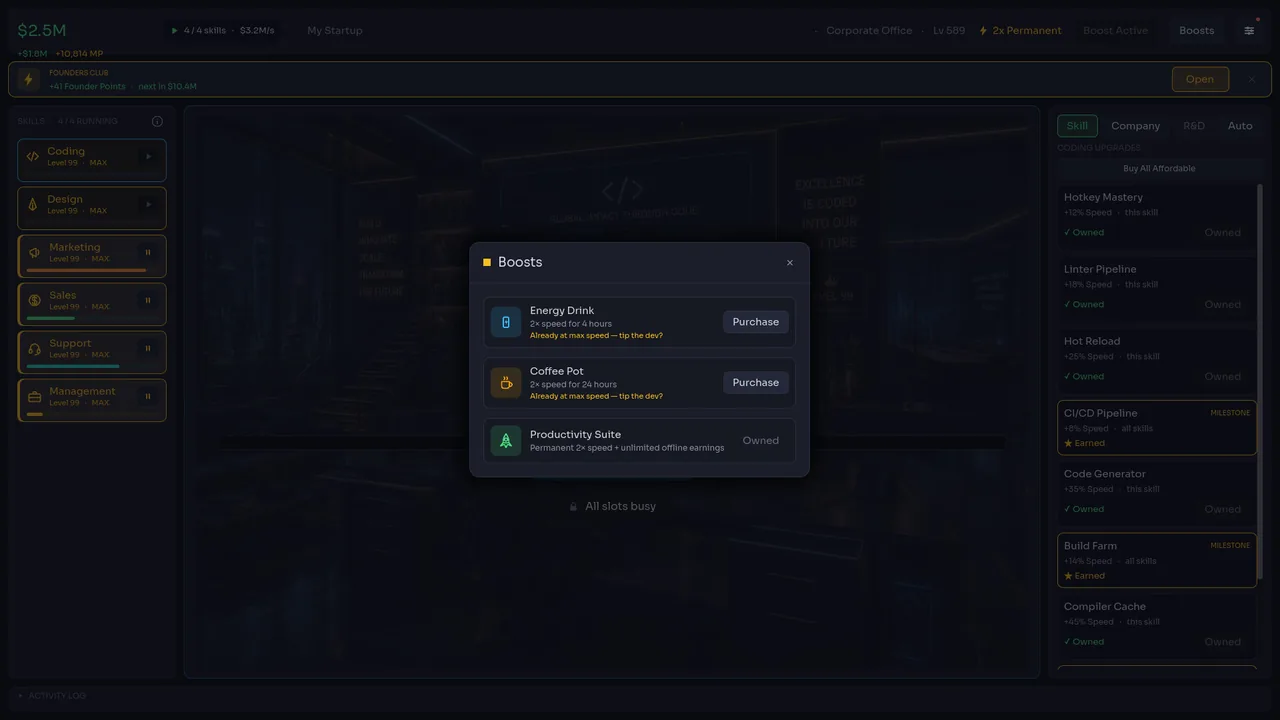
This is where Idle Startup earns real credit. It's free, playable start to finish without spending anything, and carries no advertising of any kind — a genuinely unusual combination for a free idle release in 2026, where ad breaks are practically the genre default. The shop is built around convenience rather than access: a timed speed boost (Energy Drink, four hours), a longer timed boost (Coffee Pot, 24 hours) and a one-time Productivity Suite that grants a permanent speed doubler along with uncapped offline earnings, since the free version caps how much progress accumulates while the game is closed. Player reports put the timed boosts around a dollar or two and the permanent Productivity Suite closer to ten, though Idle Startup's own store page doesn't list exact prices for the microtransactions, only that none of them are required to finish the game.
None of that is predatory in the way loot boxes or hard paywalls are — every purchase saves time rather than unlocking something otherwise inaccessible. But "no ads, nothing gated" is a low bar that plenty of far worse-behaved free games also technically clear, and the honesty of the monetisation model doesn't fix the fact that the content it's protecting runs thin well before the hundred-hour achievements imply it should.
Final verdict
Idle Startup gets the opening hours of an idle game right: a legible loop, a prestige system that actually means something, and a monetisation model that never once demands money to keep playing. What keeps it out of "recommended without hesitation" territory is everything that happens after that opening stretch — a midgame economy several players describe as broken, six skills that never differentiate themselves, presentation dogged by AI-content criticism, and a leaderboard nobody can trust. It's a fair way to spend a free download's worth of attention, not a game worth chasing to its stated 100-hour finish line.
Players who want a persistent world with actual choices behind its progression, rather than a company that mostly plays itself once the automation unlocks, might also want to look at Wanderer.
Pros and cons
Pros
- Genuinely completable without spending a cent, and nothing in the shop gates content — the optional Energy Drink, Coffee Pot and Productivity Suite purchases only speed up a loop you can otherwise finish for free
- No advertisements anywhere in the game, which is unusual for a free idle release and worth crediting on its own
- Automation unlocks early enough that the game genuinely runs itself in the background, matching its own pitch of progress continuing while you're away
- The Founder Points prestige system gives resetting a real purpose, since points convert into permanent Founder Store upgrades that carry into the next run
- A "Welcome Back" recap on return makes offline progress legible rather than just a silent number jump
Cons
- Several players describe the mid-to-late economy as mathematically broken, with upgrade costs climbing into the octillions while income plateaus far below what's needed to keep pace
- The six skill trees behave almost identically to one another, so there's little sense of specialising in a playstyle rather than just clicking through parallel checklists
- Automation arrives quickly enough that meaningful decisions dry up within the first couple of hours, leaving a long stretch of the game as pure waiting
- Multiple reviewers flag apparently undisclosed AI-generated art and code, a criticism that lands harder given how little the presentation otherwise distinguishes itself
- The online leaderboards have no anti-cheat protection, so save-edited scores sit uncontested at the top and undercut the one competitive hook on offer
Screenshots
-
Idle StartupImage: Merrill Lines via Steam -
Idle StartupImage: Merrill Lines via Steam -
Idle StartupImage: Merrill Lines via Steam -
How the review scores each part of the gameWanderer Editorial -
The short versionWanderer Editorial