
Game review
Factory Town Idle
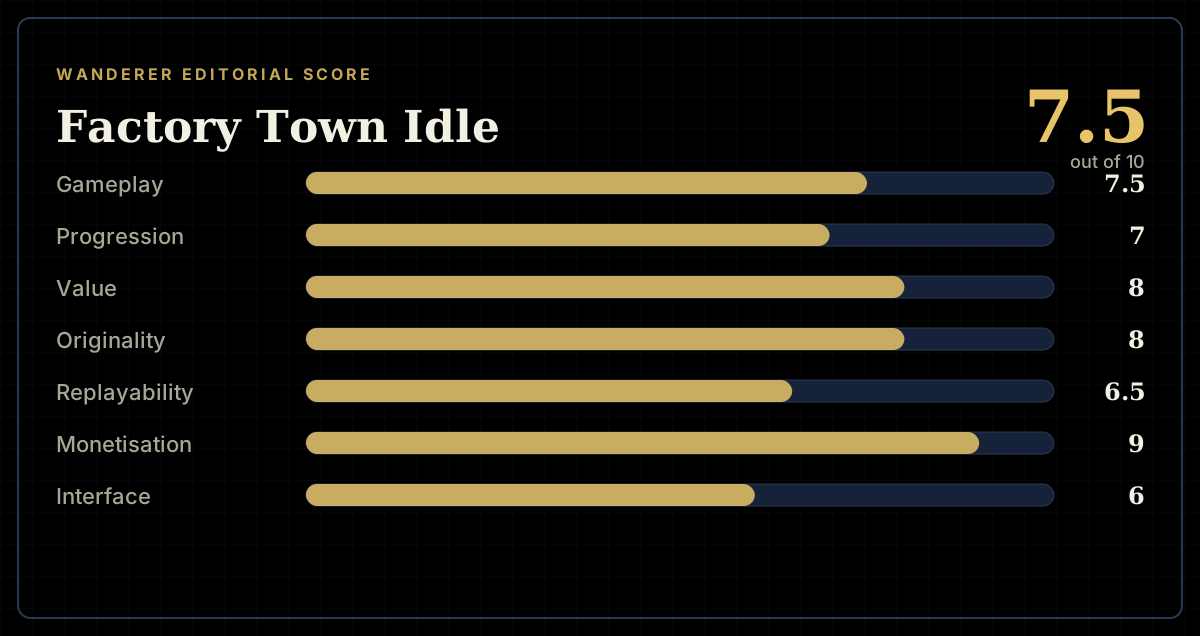
7.5 / 10
- Developer
- Erik Asmussen
- Publisher
- Erik Asmussen
- Released
- 8 January 2024
- Platforms
- Windows, macOS
- Genre
- Idle Simulation
- Monetisation
- One-time purchase, no in-app purchases, no ads, no DLC
- Players
- Single-player
The short version
Factory Town Idle takes the belts, pipes and trains out of Erik Asmussen's original Factory Town and rebuilds the same underlying economy as a set of menus you click through instead of a factory floor you route by hand. It's a genuinely distinct idea, not a lazy re-skin, and the offline Time Token system is one of the more thoughtful ways an idle game has handled time away from the screen.
The trade-off is legibility. The game hands you a wall of production stats and bottleneck counters without ever properly explaining what they mean, and a single missing resource can quietly stall an entire town's supply chain until you go hunting for the cause. For seven and a half dollars, with a free demo to test the waters, it's an easy recommendation for idle-genre regulars. Newcomers expecting a gentler on-ramp should try the demo first.
Biggest strengths
- Reworking Factory Town's spatial logistics into a menu-driven "spreadsheet" produces a genuinely different kind of idle satisfaction rather than a reskinned clicker
- Offline Time Tokens convert time away into a currency you spend deliberately when you return, instead of just ticking a background timer
- Eight biomes each lock certain resources behind their own borders, so trading between towns becomes a real logistics decision rather than a formality
Biggest weaknesses
- Bottleneck stats and production metrics are surfaced everywhere but rarely explained, and working out what a number actually means costs more time than fixing the problem it points to
- Production chains are fragile enough that one missing resource can cascade into a stalled town within seconds, and untangling the cause afterward can eat a full session
- Recipe and biome unlocks arrive faster than the early tutorial can contextualise them, turning the opening hour into a stream of notifications rather than a guided ramp-up
Who it's for: Idle and incremental game regulars who like resource-chain puzzles, and existing Factory Town players curious what the same economy looks like without the logistics layer. Less suited to players who want their idle games to explain themselves as they go, or who are looking for a game that lasts for months rather than weeks.
Our recommendation: Worth buying at its asking price, especially on sale, and the free demo removes any risk in finding out whether its dense information style works for you before you commit.
7.5 / 10
Erik Asmussen already built a factory-automation game. Factory Town, his 2018-launched, 2021 full-release title, is a spatial logistics puzzle: you lay conveyor belts across 3D terrain, route pipes and airships between villages, and watch goods physically travel from a mine to a market. Factory Town Idle throws almost all of that away. There are no belts to route and no terrain to build across. Instead you assign workers to buildings from a menu, watch production numbers tick over, and decide which goods to sell and which to refine into something more valuable. The developer's own pitch line calls it "an entire town builder experience packed into a living spreadsheet," and that's a more literal description than most Steam taglines manage. It's the right idea, and it mostly works — right up until the game asks you to understand its own numbers without ever teaching you how.
The same universe, a completely different kind of game
It's worth being precise about what Factory Town Idle actually is, because the naming invites confusion. It isn't a sequel, a remaster, or a mobile port of the original Factory Town — that distinction now belongs to Factory Town 2: Paradise, a separate, more recent release from the same developer that continues the original's belt-and-terrain formula. Factory Town Idle sits alongside both as a third, distinct product: the same recipes, resources and town-levelling logic reimagined for a genre with completely different expectations. Where the original rewards patient spatial planning, the idle version rewards fast decision-making across menus, then lets the simulation run while you're away. Calling it a spin-off undersells how much of the game has actually been rebuilt around that premise rather than simply reused.
Assign, craft, sell, repeat
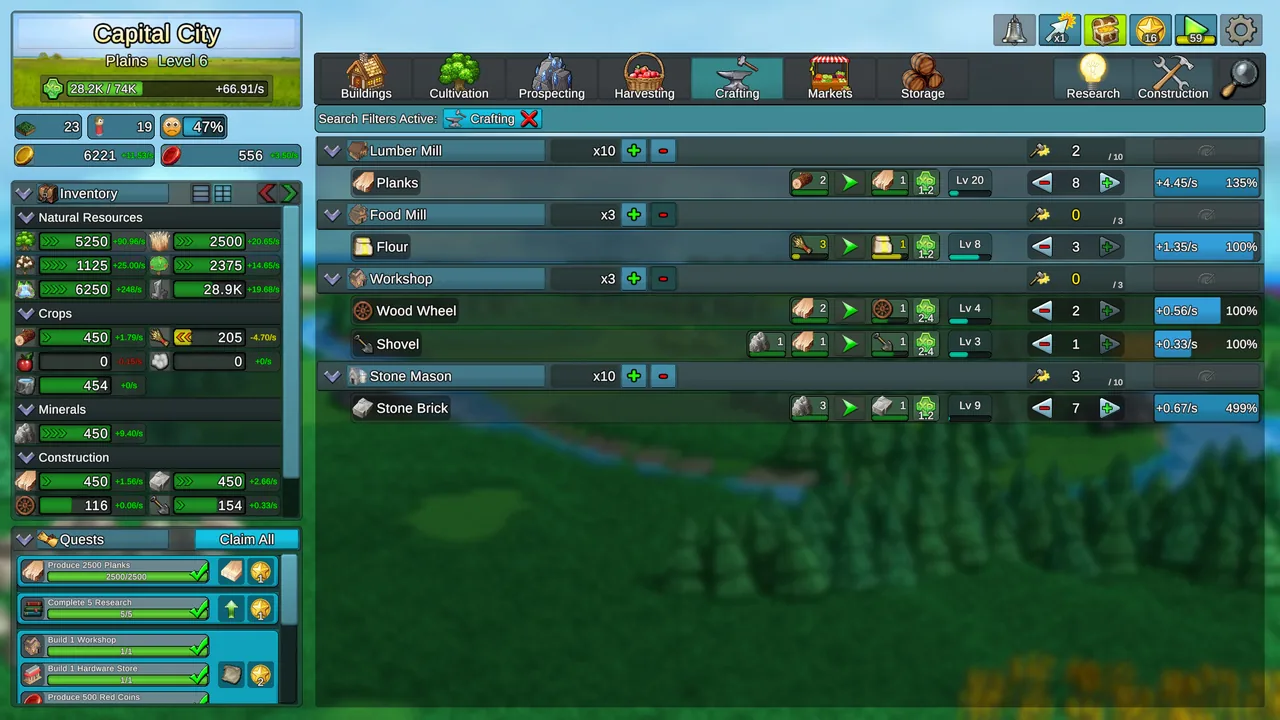
The core loop starts small: click to harvest raw resources, build housing and production buildings, and assign workers to turn ore and crops into goods worth selling at market. As your town levels up, you unlock automation tools that take over the repetitive parts of that loop, which is necessary rather than optional — the game's later stages throw enough resource types and production buildings at you that manually managing all of it stops being fun long before it stops being possible. Research and upgrades feed back into that automation, and completing the game's substantial quest list unlocks perks that meaningfully change how a town runs rather than just nudging a multiplier.
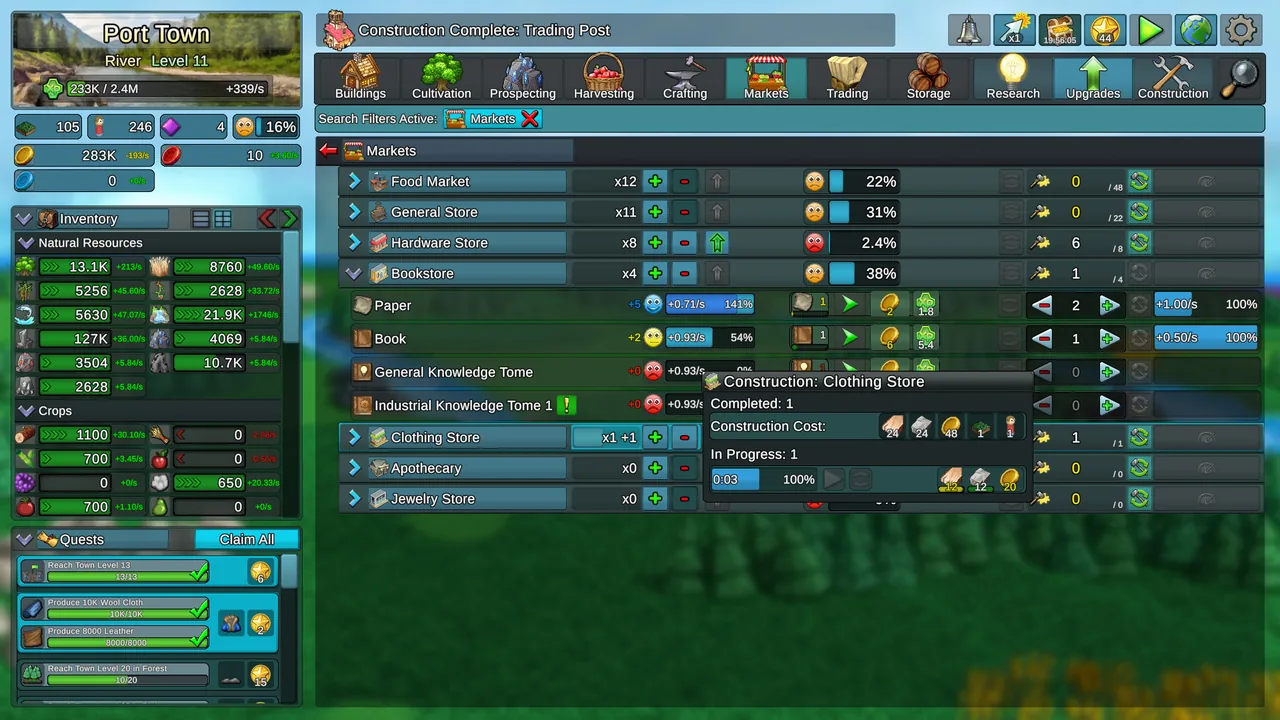
Eight biomes eventually come into play, each gating unique resources and recipes behind its own regional quirks. That forces a genuine logistics decision once a second or third town is up and running: what do you export, what do you keep, and which town's specialty is worth routing goods toward. It's the strongest surviving trace of the original Factory Town's spatial-trade thinking, translated into a system built entirely around menus and priority settings rather than physical routes.
Offline progression that actually respects your time
The Time Token system is the game's best idea. Rather than simply running the simulation in the background at a fixed rate while you're away, Factory Town Idle banks your absence as tokens you spend deliberately when you come back, fast-forwarding the simulation on your terms rather than handing you a flat passive trickle. It rewards checking in once a day without punishing players who want to leave the game running and returning progress feels like the result of a choice rather than a formality you have to sit through. For an idle game, that's exactly the balance between "away" and "active" that the genre is supposed to nail, and here it actually does.
An interface that never quite explains itself
The recurring complaint in player feedback isn't about pacing or content volume — it's about legibility. The game surfaces detailed production stats specifically so players can diagnose bottlenecks, but it rarely explains what those numbers mean in practice, leaving players to reverse-engineer the underlying math through trial and error. That wouldn't be fatal on its own, except the production chains it's asking you to diagnose are fragile: a single missing resource upstream can stall an entire town within seconds, and untangling which of a dozen interdependent chains actually broke can burn far more time than the mistake that caused it. Several players have made essentially the same point independently — the game's core mechanic is supply management, but the tools for actually managing that supply assume knowledge the game never provides.
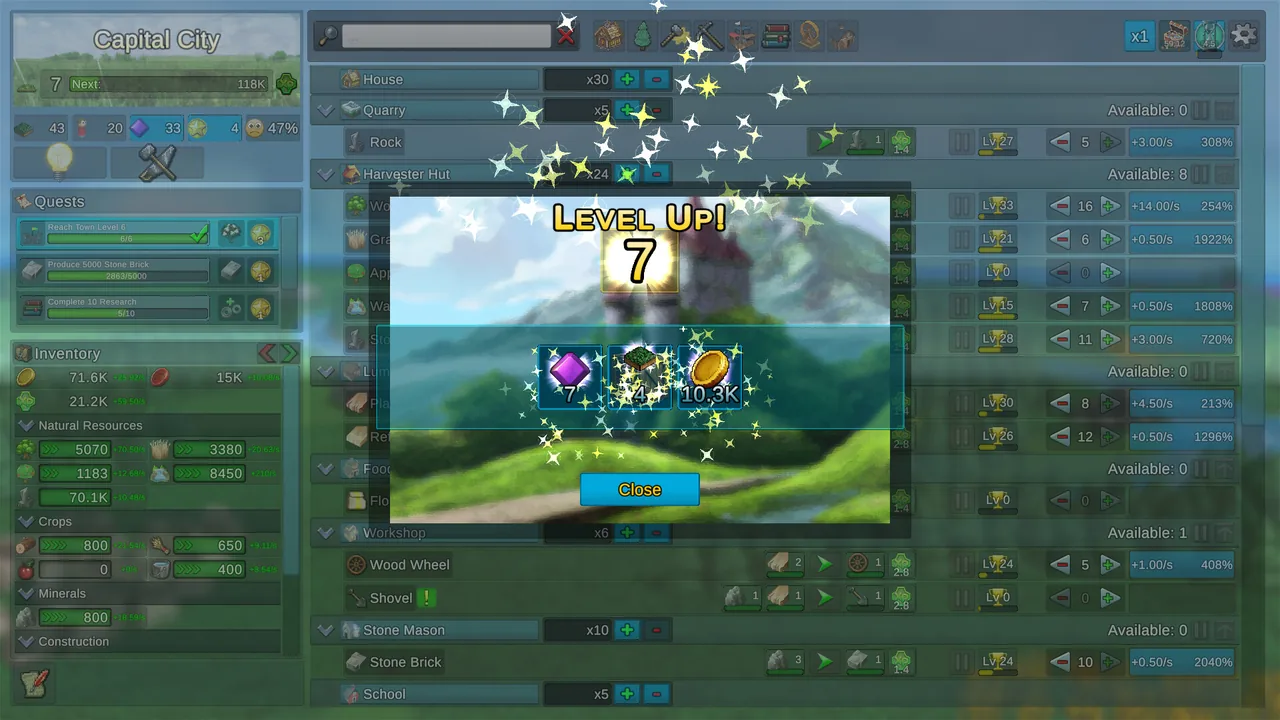
The opening hour has a related problem. New recipes, buildings and biome mechanics unlock in rapid succession, each announced with its own notification, and the tutorial doesn't slow down enough to let any one system land before the next arrives. Players coming in expecting a gentle idle-game ramp-up can find the first twenty minutes closer to information overload than onboarding. It settles down once the early unlocks are behind you, but that's a rough first impression for a genre where first impressions usually decide whether someone gives a game a second sitting.
Value, monetisation and how long it actually lasts
At NZ$7.39 with no in-app purchases, no ads, no subscription and no DLC, Factory Town Idle is about as honest as premium idle games get — you pay once and own everything the game has to offer, and a free demo lets you test whether the interface's density works for you before spending anything at all. That's worth calling out explicitly in a genre where energy systems and premium currencies have become close to standard.
Where the value proposition gets more complicated is longevity. Player reports on total playtime vary enormously, from a handful of hours to several hundred, which says more about how players choose to engage than about a single fixed length — some treat it as a background app to check daily for weeks, others push through the meaningful content in a couple of sittings and stop once the eight biomes are unlocked and the loop stops introducing anything new. Compared with genre staples that stretch progression across months through drip-fed content, Factory Town Idle is built to be finished, not maintained indefinitely. That's a legitimate design choice rather than a flaw, but it's worth knowing going in if you're shopping for something to sink a year into.
Final verdict
Factory Town Idle succeeds at the thing it set out to do: take an existing factory-automation economy and prove it can work as a menu-driven idle game without losing what made the original interesting. The Time Token system in particular is a smarter answer to offline progression than most idle games bother building. What holds it back from a stronger score is the same interface that's meant to be the whole point — a game built around understanding your production numbers needs to actually explain them, and right now it asks players to learn that through failure instead. Idle-genre regulars and existing Factory Town fans curious about the reimagining should buy in without much hesitation, ideally after trying the demo first. Players who want their idle games to hold their hand through the early hours, or who measure value in months rather than weeks, should adjust their expectations accordingly.
Players who like progression systems that keep working while they're away from the keyboard, but want more of an RPG built around that idea, may also find something to like in Wanderer.
Pros and cons
Pros
- Reworking Factory Town's spatial logistics into a menu-driven "spreadsheet" produces a genuinely different kind of idle satisfaction rather than a reskinned clicker
- Offline Time Tokens convert time away into a currency you spend deliberately when you return, instead of just ticking a background timer
- Eight biomes each lock certain resources behind their own borders, so trading between towns becomes a real logistics decision rather than a formality
- A one-time NZ$7.39 price with no in-app purchases, ads or DLC is refreshingly honest for a genre that increasingly leans on energy meters and premium currencies
- A free Steam demo lets players test the interface's density before buying, which this particular game benefits from more than most idle titles do
Cons
- Bottleneck stats and production metrics are surfaced everywhere but rarely explained, and working out what a number actually means costs more time than fixing the problem it points to
- Production chains are fragile enough that one missing resource can cascade into a stalled town within seconds, and untangling the cause afterward can eat a full session
- Recipe and biome unlocks arrive faster than the early tutorial can contextualise them, turning the opening hour into a stream of notifications rather than a guided ramp-up
- Several long-time players report clearing the meaningful content in a handful of hours to a couple of weeks, which is short for a genre whose fans often measure games in months
Screenshots
-
Factory Town IdleImage: Erik Asmussen via Steam -
Factory Town IdleImage: Erik Asmussen via Steam -
Factory Town IdleImage: Erik Asmussen via Steam -
How the review scores each part of the gameWanderer Editorial -
The short versionWanderer Editorial