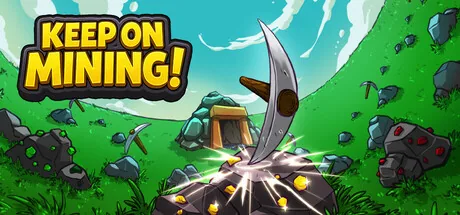
Game review
Keep on Mining!
7 / 10
- Developer
- EagleEye Games
- Publisher
- EagleEye Games
- Released
- 30 July 2025
- Platforms
- Windows, iOS, Android
- Genre
- Incremental
- Monetisation
- One-time purchase. No ads, no in-app purchases. One optional cosmetic DLC (26 pickaxe skins) at NZ$4.49. The iOS and Android versions are paid, with no ads or IAP.
- Players
- Single-player
The short version
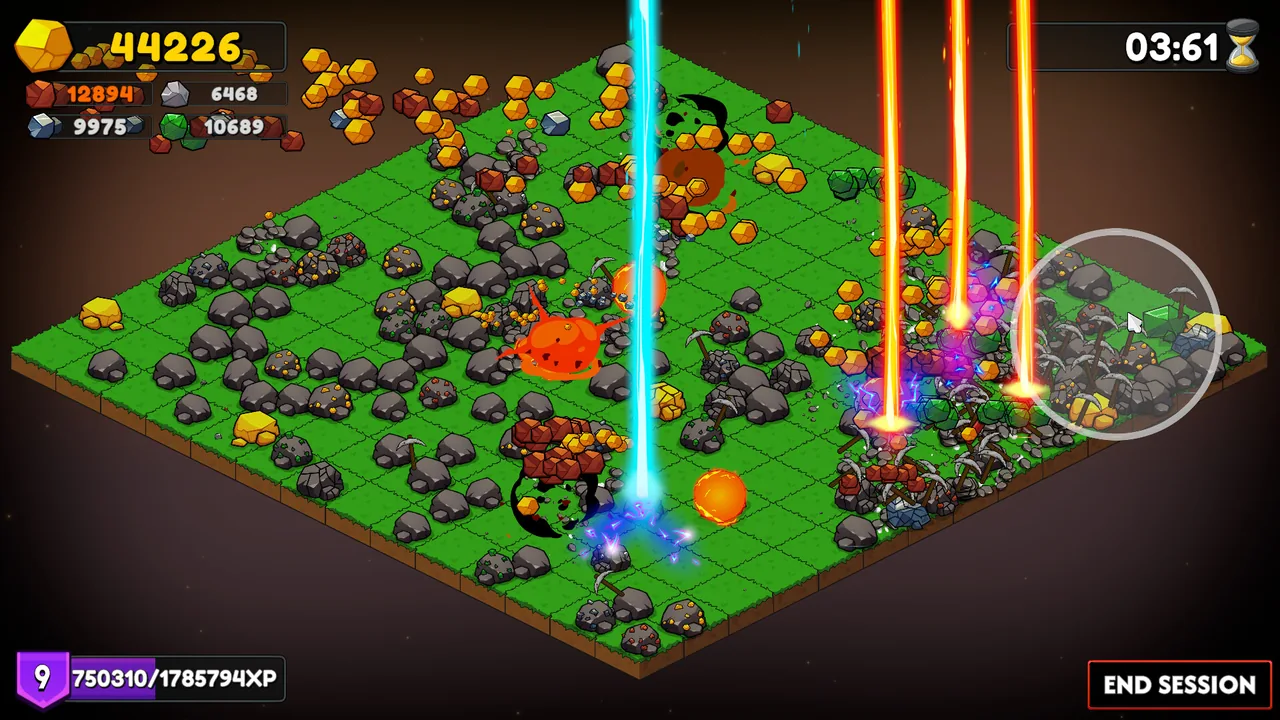
The first hour of Keep on Mining! is one of the cleanest incremental openings I've looked at. You sweep a glowing pickaxe aura over a wall of rocks, ore pours out, upgrades land constantly, and the moment you unlock lightning the whole thing sings. **74.2% of everyone who owns it has the "beat the game" achievement**, which is an enormous completion rate.
The second and third hours are a different game. Upgrade costs multiply, the gains shrink to fractions of a per cent, and multiple reviewers independently reach the same diagnosis — that the back half exists to push playtime past the two-hour refund window. One of them says it in exactly those words. That's what keeps this at a 7 rather than the 8 the opening deserves.
Biggest strengths
- The hover-to-mine minigame is genuinely satisfying and requires no clicking at all
- Unusually good accessibility for the genre — mouse-only, no timed input, custom volume controls
- Enormous completion rate; three in four owners reach the ending
Biggest weaknesses
- The back half inflates costs so steeply that upgrades stop being perceptible
- The Mine, the game's one passive-income system, is widely described as never worth funding
- Artifacts and several talent nodes have no meaningful effect on play
Who it's for: People who want a short, cheap, satisfying number-go-up game for an evening, and mobile players who want a premium incremental with no ads and no purchases. Not for anyone who needs a prestige ladder to come back to.
Our recommendation: Buy it, play the first two hours, and feel no guilt about stopping when the upgrades stop meaning anything. The endgame doesn't reward the persistence it asks for. On mobile it's arguably a better fit than on PC.
7 / 10
Here is a sentence from a 4.9-hour reviewer, written in February 2026, that does more work than anything I could construct: "I suspect this is the point where the developer realized their game was going to naturally end but wanted to extend play time to get past 2 hours."
They're describing the moment Keep on Mining! turns. It's a real moment and it lands in roughly the same place for everyone — somewhere past the halfway mark, when upgrade costs start multiplying by ten and the things you buy with them start delivering fractions of a per cent. A different reviewer, at 3.8 hours: "New stuff takes 10x more ores to unlock for no reason than to pad out the length of the game." Another, at 3.7 hours: the first hour "flies by", the other two are "pure agony."
I can't confirm anyone's intent and I won't pretend to. What I can say is that the shape they're all describing is really there in the data. "Boring" appears in 20 of the 100 most-helpful English negatives, "repetitive" in 16, "grind" or "grindy" in 22 — and the median playtime among those critics is 4.6 hours, against 5.2 hours among the most-helpful positives. Nobody is bouncing off this game. They're finishing it and then telling you which half was worth it.
The half that's worth it
The mining itself is excellent, and the reason is a design decision most of the genre gets wrong. You don't click. You hold a glowing pickaxe aura over a wall of rocks and sweep it around; damage applies continuously to whatever's underneath. It's the difference between a clicker and something you can play for three hours without your wrist filing a complaint, and it's why Steam lists this thing with Mouse Only Option and Playable without Timed Input — two accessibility categories that almost nothing in this genre carries.
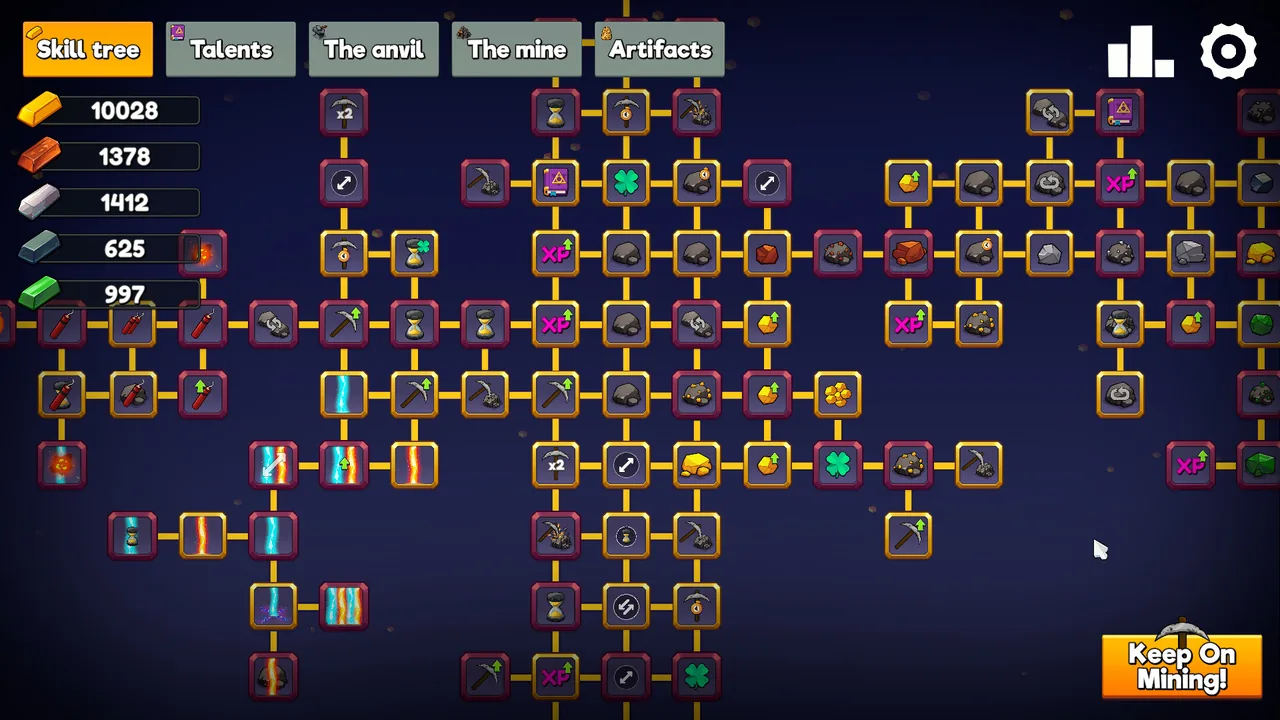
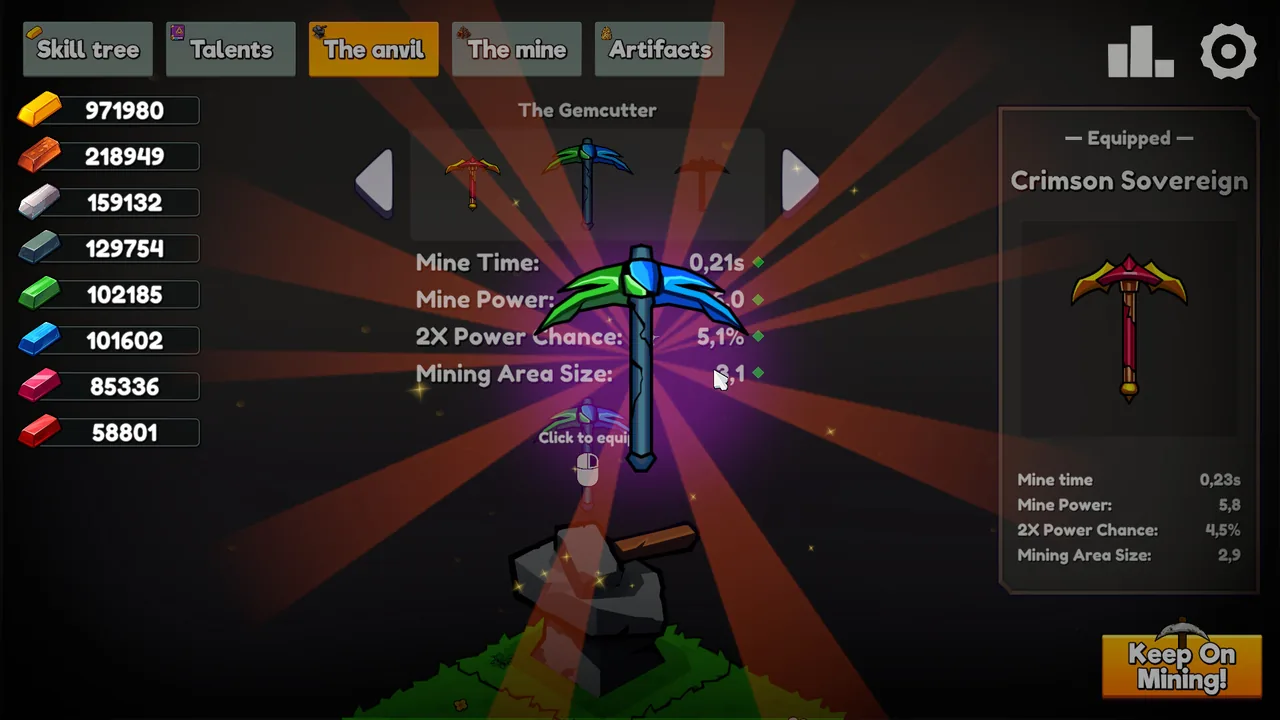
On top of that sits the standard incremental furniture, assembled well: ore tiers, a large skill tree, thirteen craftable pickaxes ending in a diamond one, artifacts, XP levels that unlock new mechanics. The unlock rhythm in the opening is the star. One 6.1-hour reviewer with 36 votes says the best part was the first twenty to thirty minutes and the moment lightning unlocked — "the dopamine was flowing." A 4.7-hour reviewer calls the unlock system "a massive mine in itself." They're right. For an hour this is as good as a cheap incremental gets.
It's also, notably, a game people complete. The global achievement figures put beatGame at 74.2% and the full-skill-tree achievement at 68.3%, with nothing in the set below 68%. That's the second-flattest curve I've measured, behind only Space Rock Breaker at 85.1% — and both are short paid incrementals that end on purpose. Whatever the criticism, this is not a game that loses people.
The half that isn't
The complaints are unusually specific, and they cluster on systems rather than vibes.
The Mine is the game's one passive-income structure, and the consensus is that it's a trap. A 5.1-hour reviewer: it is "simply never worth investing a single penny." A 4.6-hour reviewer, months later, does the arithmetic — millions of gold in, a random-ore roulette out, and a return that never justifies the input. In a game filed under idle, the one component that generates income while you're not sweeping the mouse is the one nobody recommends using.
Artifacts get collected, glanced at, and forgotten. Talents are worse than neutral in places: one reviewer points out that many nodes make the rocks harder to mine as a cost, so a chunk of the tree is a trade you'd rather not take. And the special effects — plasma, lightning, dynamite, the spawn pickaxe — read as toys rather than tools, because plain ore-value and pickaxe upgrades outrun them.
Put together, the endgame becomes what a 2.6-hour reviewer calls "move mouse in circle, do it again and again and again." There's no prestige and no ascension, so when the diamond pickaxe is equipped there's nothing to reach for. The developer did add Endless Upgrades a fortnight after launch — eight repeatable purchases at escalating cost — but repeatable purchases are a sink, not a structure, and the reviews treat them as such.
One genuine bug deserves noting because it dominated a month of criticism and then went away: a talent called "It's Hammer Time" could leave rocks taking no damage at all as you progressed. It's the source of several February 2026 negatives, and the developer diagnosed and fixed it on 3 March
- If you read a review about unkillable rocks, it's describing a build you won't get.
100,000 copies, and what happened next
Seventeen days after launch, the developer announced 100,000 copies sold at 93% positive. That is a spectacular result for a solo project priced at NZ$7.39, and the response was eight patches in six weeks, a mobile port on iOS and Android at around US$4 with no ads and no in-app purchases, trading cards, and an Endless Upgrades update.
Then it stopped. Patch #8 landed on 14 September 2025. The next announcement of any kind was on 4 February 2026, and it was a store page for Keep on Mining! - Worlds, a NZ$10.49 sequel that shipped on 30 March 2026. The developer's own post is candid about the decision — months of planning, weighing further updates and DLC against a sequel, and choosing the sequel.
The corpus reacted the way you'd expect. The most-upvoted negative review of 2026, at 81 votes, started as a straightforward "it's too short and it's not getting updates" and then carries an edit: "Instead of adding maybe a (free) DLC or update, they're just releasing an entire 'sequel'. This just seems like greed to me."
I think that's harsher than the facts support. A solo developer is entitled to build a bigger game rather than bolt content onto a small one, and nothing sold here was withdrawn. But it changes the purchase decision, and buyers deserve the plain version: this game is finished. What you see is what you get, forever. There's also one paid extra — a NZ$4.49 pack of 26 pickaxe skins, which is 61% of the base price for cosmetics. It's optional and it's honestly labelled as a support pack, but it's worth knowing the ratio before you're surprised by it.
Verdict
7 out of 10. The sweeping, no-click mining loop is a genuinely good idea, executed with more care than its price implies, and wrapped in accessibility options the rest of the genre ignores. Three quarters of the people who buy it see the ending, which almost nothing in this library manages. But the second half of that ending is padding, the passive-income system is a decoy, and there's nothing waiting once the diamond pickaxe is in your hand.
It's better value than Clicker Ore and a cleaner deal than most mobile mining games — the phone version genuinely has no ads and no purchases, which puts it ahead of Idle Planet Miner on principle if not on depth. Just buy it knowing what it is: a very good evening, not a game you'll still be poking at next month. If that's what you're after, Scratch Inc. is free and effectively endless, and Wanderer will keep your mining going while you're not there at all.
Pros and cons
Pros
- The hover-to-mine minigame is genuinely satisfying and requires no clicking at all
- Unusually good accessibility for the genre — mouse-only, no timed input, custom volume controls
- Enormous completion rate; three in four owners reach the ending
- No ads, no in-app purchases, and the mobile port carries the same promise
- The skill tree is large and the early unlocks land at a great rhythm
Cons
- The back half inflates costs so steeply that upgrades stop being perceptible
- The Mine, the game's one passive-income system, is widely described as never worth funding
- Artifacts and several talent nodes have no meaningful effect on play
- No prestige or ascension, so there's nothing to do once the credits roll
- Updates effectively stopped after six weeks and the developer moved to a paid sequel
Screenshots
-
Keep on Mining!Image: EagleEye Games via Steam -
Keep on Mining!Image: EagleEye Games via Steam -
Keep on Mining!Image: EagleEye Games via Steam -
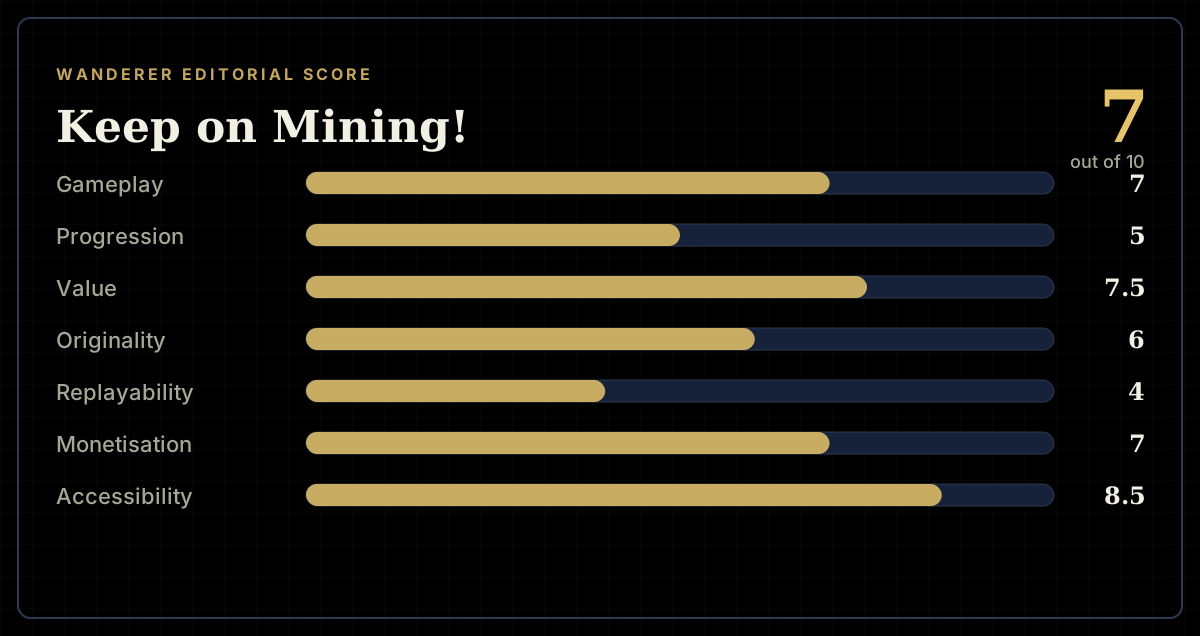
How the review scores each part of the gameWanderer Editorial -
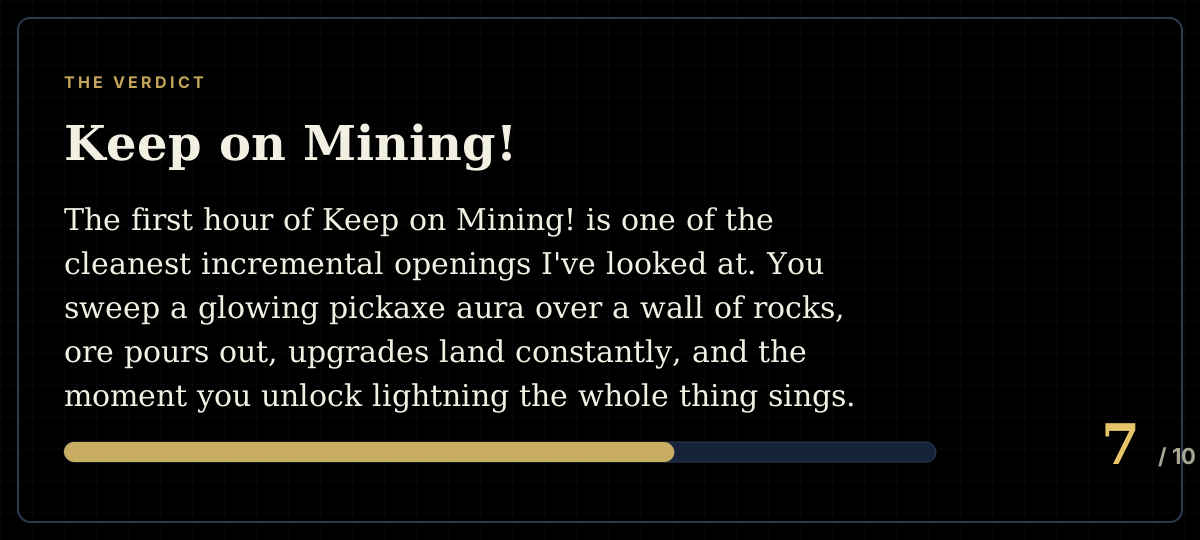
The short versionWanderer Editorial