Game review
The Prestige Tree
7 / 10
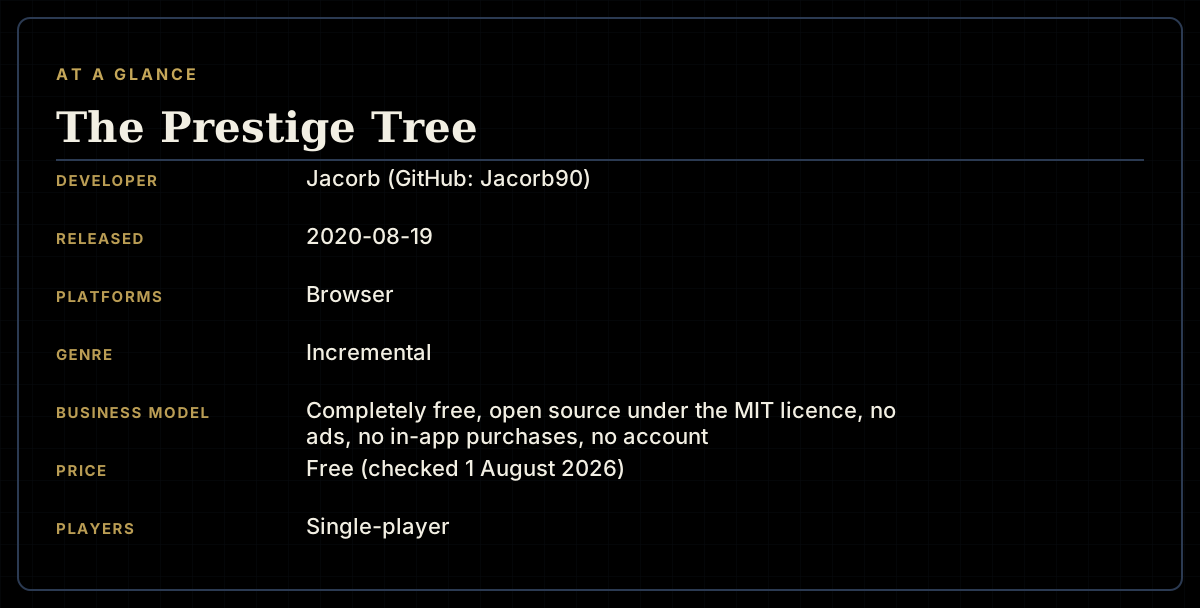
- Developer
- Jacorb (GitHub: Jacorb90)
- Publisher
- Jacorb
- Released
- 19 August 2020
- Platforms
- Browser
- Genre
- Incremental
- Monetisation
- Completely free, open source under the MIT licence, no ads, no in-app purchases, no account
- Players
- Single-player
The short version
The Prestige Tree takes the thing most incrementals treat as a between-content chore — resetting for a permanent bonus — and makes it the whole game. Thirty-one layers deep, most resets don't just multiply your numbers, they change what buying things even means, which is a genuinely well-built structure for a game built by one person in their spare time. It never quite answers whether that structure is saying something new about the genre or just performing the genre back at players who already speak its language, and by the late tree it leans harder on the second reading than the first.
Its bigger legacy isn't the game itself. Jacorb's original code became the seed for The Modding Tree, a fork built by a separate developer, Acamaeda, that turned this game's engine into a general-purpose incremental-building kit — one that has since been forked well over a thousand times by other hobbyists making their own games.
Biggest strengths
- Thirty-one distinct prestige layers ship in the base tree, and most genuinely change how the layers beneath them are used rather than just resetting their totals for a bigger number
- Completely free and open source under the MIT licence, with no purchases, ads or account anywhere in it
- The tree structure turns "what do I reset next" into a real spatial decision instead of a single linear button
Biggest weaknesses
- The interface is unstyled coloured buttons wired to a tree diagram, with no onboarding beyond hover tooltips, which is real friction even for genre veterans
- Development stopped at version 1.3.1 in March 2022; open issues filed as recently as December 2025 sit with zero replies
- A player who hasn't already finished a couple of reset-ladder incrementals will not follow what several of the later layers are asking for
Who it's for: Players who already know what an "Infinity reset" or a "meta-progression layer" is and want to see the concept pushed as far as it goes. Not a first incremental, and not for anyone who wants art, sound or a tutorial that explains itself.
Our recommendation: Play it free at jacorb90.me/Prestige-Tree — it's finished in the sense that matters (there's a real endgame), abandoned in the sense that matters less (no updates since 2022), and worth an afternoon if reset ladders are already your thing.
7 / 10
An incremental about incrementals
Most reset-based incrementals treat prestige as punctuation. You grind, you hit a wall, you reset for a permanent multiplier, and then you go back to the grind that was the actual point. The Prestige Tree inverts that relationship almost entirely. Jacorb's game, first committed to GitHub in August 2020 and settled at version 1.3.1 by March 2022, doesn't have a "real" game hiding behind its reset system — the reset system is the content. You start on a tree with a single node. Clicking it produces points. Producing enough points unlocks a second node, which resets the first for a permanent bonus. That second node then feeds a third, which resets the second, and by the time you're four or five layers in, you've stopped playing an incremental with a prestige mechanic and started playing a game that is only, explicitly, about what prestige mechanics are.
That's a real idea, not just a cute framing. Whether it's a big enough idea to justify a whole game is the question worth actually answering, and the honest answer is: partly.
Thirty-one layers, and what they actually change
The base tree defines thirty-one separate layers, from the earliest ("p" for Points) through named systems like Hyperium, Nebulae, Mastery, Complexity and further entries added across the 1.0–1.3 update cycle. That's a lot of tree for one developer to have shipped, and the game earns real credit for how many of those layers do more than sit next to each other multiplying the same number. Early layers hand you flat production bonuses; mid-tree layers start changing the shape of the decisions below them — unlocking automation, changing what a reset even costs, or making a previously-optimal strategy actively wrong. That's the same trick Antimatter Dimensions built its Infinity-into-Eternity ladder around, and our review of that game is the right comparison to reach for, because The Prestige Tree is unmistakably in conversation with it rather than working in isolation.
The difference is candour about what's happening. Antimatter Dimensions dresses its reset ladder up as antimatter production reaching further into physics-flavoured abstraction. The Prestige Tree doesn't bother with a fictional frame at all — there's no antimatter, no narrative, not even much of a naming convention beyond terse abbreviations on tree nodes. It's the ladder with the skin removed, which makes the structure easier to see and harder to feel invested in at the same time. Some players will find that clarifying. Others will find that a game with nothing to look at except the mechanism is asking a lot of the mechanism.
By the back third of the tree, the reframing thins out. Several later layers are recognisably the same "unlock a multiplier, spend it on the next multiplier" loop wearing a new two-letter abbreviation, and the honest reading is that the game's most interesting design work happens in its first twenty layers, not its last eleven. That's not a fatal flaw — plenty of incrementals run out of new ideas long before their content does — but it does undercut the pitch that every layer here is meaningfully rethinking the ones below it. Some are. A meaningful chunk are mostly restating the point.
Who this is actually for
Be direct about this, because the game itself won't be: The Prestige Tree assumes you already know what a prestige layer is for. There's no tutorial explaining why resetting is good, no framing narrative walking a newcomer through the first hour, and no attempt to make the early tree legible to someone who has never played an incremental before. Genre veterans will recognise the shorthand instantly. Everyone else is going to open the page, see a tree of unlabelled coloured buttons, and close the tab within minutes.
That's not automatically a criticism — Kittens Game and Idle Loops both make similar bets on their audience already knowing the genre's conventions, and our Idle Loops review covers a game that goes even further in that direction. But it's worth being blunt about the audience here specifically, because a large share of the people who'll click through from "free incremental game" searches are not going to be that audience, and this review would be doing them no favours by pretending otherwise.
The Modding Tree: the actual legacy
The most interesting fact about this game isn't in the game. Jacorb's source became the seed for The Modding Tree, a fork built by a different developer, Acamaeda (Harley White on GitHub), who turned the tree-and-layers engine into a documented, general-purpose framework for building prestige-layer incrementals without deep JavaScript experience. That distinction matters and got muddled in early coverage of this review: The Prestige Tree is Jacorb's game, credited to Jacorb in its own MIT licence file and in its in-game credits; The Modding Tree is a separate repository, under Acamaeda's name, that built on top of it.
The framework's reach is real and checkable rather than a vague claim. Acamaeda's The-Modding-Tree repository has been forked more than 1,700 times on GitHub and carries its own documentation set — tutorials, a components reference, a guide to updating a mod as the engine itself updates — none of which existed in Jacorb's original code. Most of those forks are exactly what you'd expect from a low-barrier hobbyist framework: small, first-project incrementals with a handful of stars or none at all, built by people teaching themselves to make a game rather than launching a commercial product. That's not a knock. A framework whose main legacy is "it let a very large number of people build their first incremental game" has done something Kittens Game, Antimatter Dimensions and most of the genre's other landmarks never set out to do: it turned a finished game into a teaching tool.
Interface, and the friction it adds
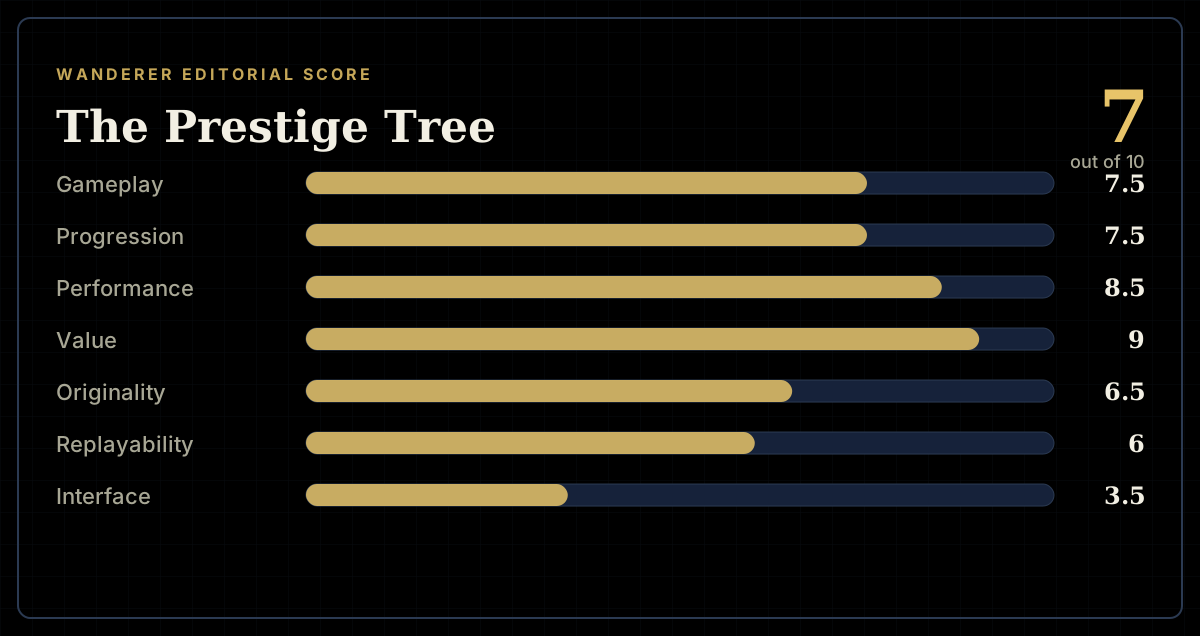
There is no art direction here beyond default HTML form controls and a handful of background colours per node. The tree itself is a genuinely useful piece of information design — you can see at a glance which layers feed which, and which are locked — but everything downstream of that first glance is dense text on cramped buttons, with tooltips doing the explanatory work a proper UI would handle with layout. It's playable. It's also the single biggest tax the game charges before it starts paying off, more so than most of its genre peers, because there's so little visual differentiation between thirty-one layers that keeping track of which tab does what falls entirely on the player's memory.
Does it end, and is anyone still updating it
Yes, it ends — there's a defined endgame threshold with a "Play Again" and a "Keep Going" option once you reach it, which is more than a lot of "infinite" incrementals bother to commit to. What doesn't continue is the developer's own involvement: the repository's last code change landed in March 2022, and issues filed against it as recently as December 2025 — including a straightforward question about a tutorial mentioned in a changelog entry — sit unanswered. The game is finished in the sense that it has a real ending; it's abandoned in the sense that nobody is going to fix anything that breaks or answer anything that confuses you. For a game this dependent on the player already knowing the genre's conventions, that combination puts more weight on outside knowledge — the genre's shared vocabulary, if not this specific wiki page — than the game's own text ever supplies.
Verdict
Seven out of ten. The Prestige Tree is a genuinely interesting artefact: an incremental that takes the genre's most take-for-granted mechanic and makes it the entire subject, with enough of its thirty-one layers actually reframing the ones beneath them to earn the premise for at least its first two-thirds. It's completely free, it runs on nothing, and it has a real ending. None of that changes the fact that it's built for an audience that has already played several other incrementals, wrapped in an interface that does the concept no favours, and left alone by its own developer since 2022.
What outlives the game is what it made possible for other people. The Modding Tree took this code and turned it into a starter kit that well over a thousand hobbyist developers have forked to build something of their own — which is a stranger and, in its own way, more impressive legacy than any single number this game asks you to grow. Play The Prestige Tree if you want to see where that framework came from, or if reset-ladder design is already the thing you show up for. Skip it if you're looking for your first incremental, or for a game that will meet you halfway.
Players who like the reset-ladder satisfaction The Prestige Tree is built around, minus the unstyled buttons, should read our Antimatter Dimensions review and our Synergism review next — both take the same core idea considerably further. Anyone who wants that same sense of permanent, accumulating progress attached to a character and a world to walk through, rather than a tree of abbreviations, is the exact player Wanderer is built for.
Price and monetisation details checked 1 August 2026.
Pros and cons
Pros
- Thirty-one distinct prestige layers ship in the base tree, and most genuinely change how the layers beneath them are used rather than just resetting their totals for a bigger number
- Completely free and open source under the MIT licence, with no purchases, ads or account anywhere in it
- The tree structure turns "what do I reset next" into a real spatial decision instead of a single linear button
- Runs on essentially any device that can open a browser tab, with no meaningful load on hardware
- Its codebase became The Modding Tree, a separate framework that has been forked more than 1,700 times by other hobbyist developers building their own incrementals
Cons
- The interface is unstyled coloured buttons wired to a tree diagram, with no onboarding beyond hover tooltips, which is real friction even for genre veterans
- Development stopped at version 1.3.1 in March 2022; open issues filed as recently as December 2025 sit with zero replies
- A player who hasn't already finished a couple of reset-ladder incrementals will not follow what several of the later layers are asking for
- Because the game's whole subject is prestige-as-concept, a number of layers spend more time reframing existing multipliers than introducing a genuinely new decision
- No layout concession to phones or touch input; the dense tree and small buttons assume a desktop pointer
Screenshots
-
How the review scores each part of the gameWanderer Editorial -
The game at a glanceWanderer Editorial -
The short versionWanderer Editorial