Game review
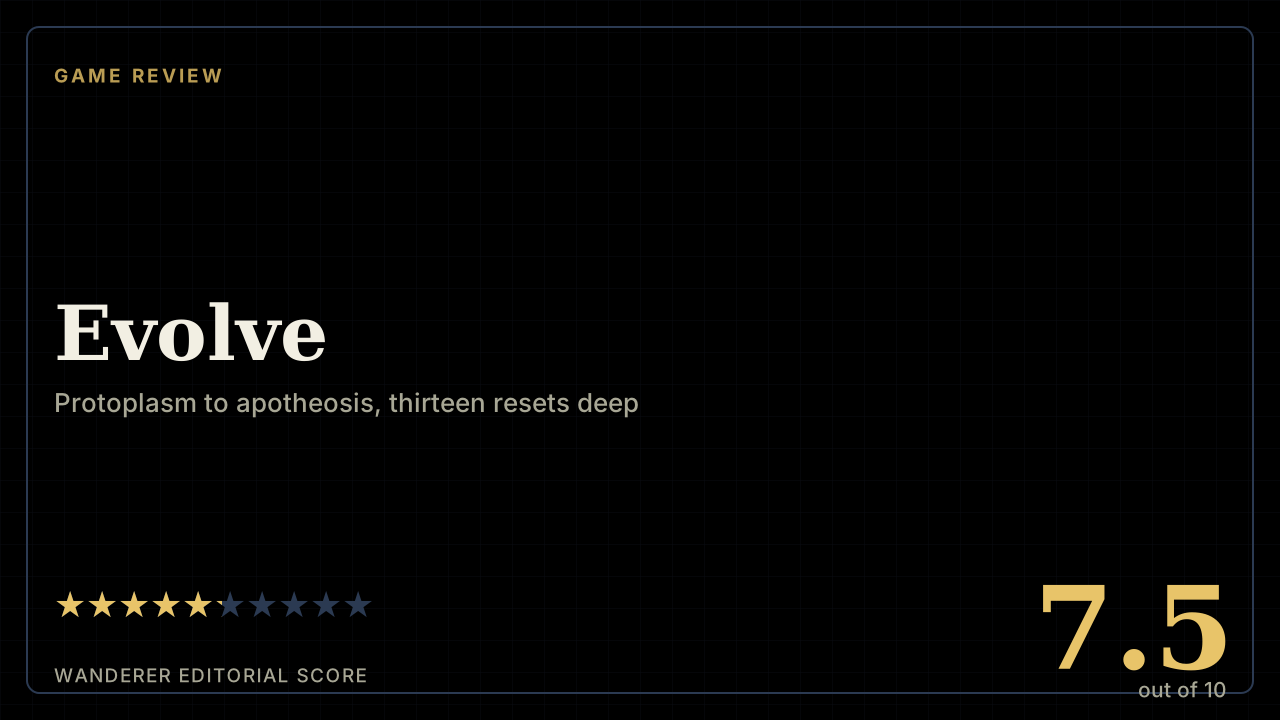
Evolve
7.5 / 10
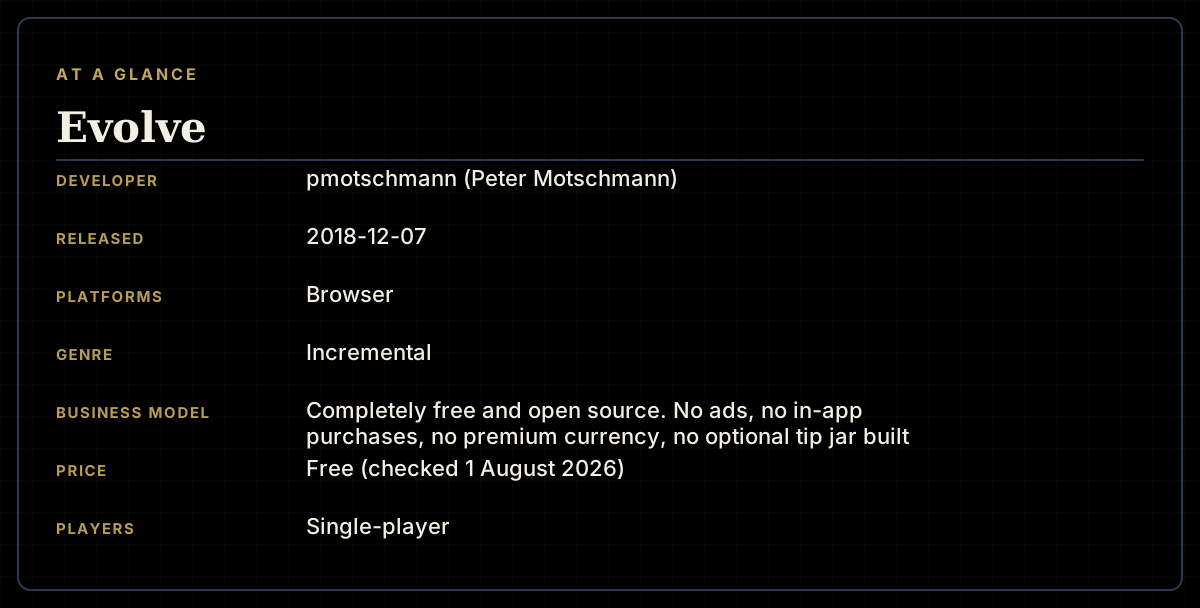
- Developer
- pmotschmann (Peter Motschmann)
- Publisher
- pmotschmann
- Released
- 7 December 2018
- Platforms
- Browser
- Genre
- Incremental
- Monetisation
- Completely free and open source. No ads, no in-app purchases, no premium currency, no optional tip jar built into the game itself.
- Players
- Single-player
The short version
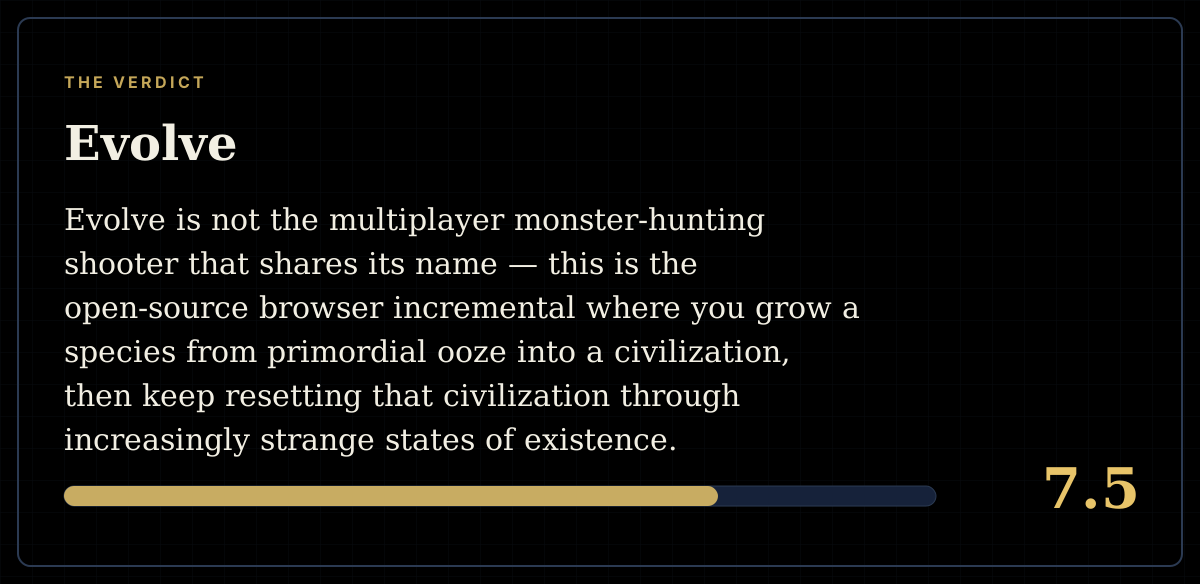
Evolve is not the multiplayer monster-hunting shooter that shares its name — this is the open-source browser incremental where you grow a species from primordial ooze into a civilization, then keep resetting that civilization through increasingly strange states of existence. It is genuinely one of the broadest idle games ever built: over sixty playable species, thirteen distinct prestige layers, and systems that keep opening up long after most incrementals would have run out of ideas.
It is also almost proud of how little it explains, and its most important weakness for anyone coming from a typical idle game is structural: there is no offline production simulation. Progress happens while the tab is open, full stop. What looks like an idle game on the surface is, underneath, one of the more demanding active-management games in the genre.
Biggest strengths
- Over sixty playable species with real trait differences fundamentally change strategy rather than just reskinning the same numbers
- Thirteen distinct reset layers, from Mutual Assured Destruction through Bioseed, Blackhole, Vacuum Collapse, Ascension, Cataclysm, Terraform, Infusion and beyond, each opening genuinely new mechanics
- Completely free and open source under the Mozilla Public License, with no ads, purchases, or premium currency anywhere in the game
Biggest weaknesses
- The game explains almost nothing proactively; its own built-in wiki mostly answers a question once you already know to ask it
- There is no offline production simulation whatsoever — closing the tab stops the game entirely, and returning only grants a capped period of double-speed catch-up, not real away-time progress
- The interface crams dozens of tabs, panels, and resource rows onto one screen with very little visual hierarchy to guide a first-time player
Who it's for: Incremental veterans who want genuine long-term depth and don't mind a wiki tab open at all times, and anyone specifically curious how far a completely free, ad-free browser game can go with no monetisation at all.
Our recommendation: Play it in a browser tab you're prepared to keep open and occasionally babysit — not one you can close and expect to have grown on its own. Bookmark the community wiki before you start; you will need it within the first hour.
7.5 / 10
Search "Evolve" and you'll find a 2015 four-versus-one monster hunt from Turtle Rock Studios first. This is not that game. This Evolve is a free browser incremental built by a single developer, pmotschmann (Peter Motschmann), that has been running continuously since December 2018: you begin as protoplasm in a tidepool, evolve into one of dozens of species, and spend the rest of the game building that species into a civilization that eventually leaves the planet entirely. If you arrived here looking for Kraken and 4v1 multiplayer, this isn't it — but the game you did find is arguably a stranger and more ambitious piece of design than its shooter namesake ever was.
From tidepool to typology
The opening minutes are recognisable to anyone who's played an incremental before: click to gather RNA, click to gather DNA, cross a threshold and evolve. What sets Evolve apart shows up almost immediately after, when you pick a species. There are more than sixty of them — humans, elves, orcs, sentient plants, cephalopods, demons, angels, and things stranger than that — and each carries genuine traits that change how the rest of the run plays, not just a different name on the same numbers. A Carnivore race skips farming entirely and lives off hunters. An Ent loses access to lumber and gets a flat cost discount everywhere else to compensate. A Balorg can't trade and has to loot titanium from combat instead of buying it. This isn't cosmetic variety sprinkled over one build order — it's sixty-odd different opening strategies wearing the same tech tree, and it's the single best argument for the amount of scope this game has accumulated.
From there the civilization-building loop is straightforward on its surface: assign citizens to jobs, research technology, expand the city, manage morale and weather and the occasional rival settlement to raid or annex. It stays straightforward for roughly as long as it takes to reach the first prestige reset, and then it stops being straightforward for a very long time.
Told nothing, shown everything eventually
Evolve's design philosophy on player guidance is close to the genre's most extreme case. Most buildings and technologies get a single sentence of flavour text and no worked numbers. Whole subsystems — Religion, for instance — are hidden entirely until you've reset once, at which point they simply appear with no signposting that they existed. The game ships its own in-game wiki tab, with dedicated FAQ, species, and reset-mechanics pages, which is a genuinely useful thing few incrementals bother building — but it's a reference, not a tutorial. It answers "why don't I have Lumber?" once you've already noticed you don't have Lumber. It doesn't tell you that trait complexity taxes, morale thresholds, or the Anthropology-versus-Fanaticism choice exist until you've stumbled into needing to know. The community-run Fandom wiki fills the rest of the gap, and treating it as required reading rather than an optional extra is close to mandatory once you're a few hours in.
This is where the comparison to Kittens Game is worth making directly, because the two games solve the same problem in opposite ways. Kittens Game says almost nothing and expects the community wiki to be your entire manual — there's no in-game reference at all, just a handful of colour themes over plain text. Evolve at least tries to be its own documentation: an actual wiki tab, built by the developer, shipped inside the game. The generosity is real. It's also not enough, because a reference you have to already know to consult isn't guidance, it's damage control. Evolve is more self-aware about its own opacity than Kittens Game, and it's still nearly as hard to learn without outside help.
Thirteen ways to reset
The reset ladder is where Evolve separates itself from almost everything else in the genre, including the games built specifically around reset ladders. Mutual Assured Destruction is the first — a nuclear-war reset that hands you Plasmids, the base prestige currency, and unlocks choosing your next species. From there the game doesn't just add a second reset, it adds twelve more: Bioseed sends a genesis ship to reseed a new planet. Blackhole detonates a stellar engine for a full universe reset and a second currency, Dark Energy. Vacuum Collapse, Ascension, Cataclysm, Terraform, Infusion, Apotheosis, an AI awakening, a Matrix simulation layer, a "Retired" epilogue state, and an Eden challenge run round out the list — each with its own currency, its own unlock chain, and its own genuinely different rules for how the following run plays out. Compare that to Antimatter Dimensions, which made its name on a four-deep reset ladder that redefines itself at every layer — Evolve runs more than three times as many distinct reset types, though it never matches Antimatter Dimensions' elegance in teaching you what each one does through the numbers alone.
What keeps this from collapsing into reset soup is that the early currencies keep mattering. Phage raises the soft cap on how many Plasmids you can usefully hold, so a second and third reset aren't just "the same run again" — they change what the first hour of every future run can achieve. It's the same lesson Kittens Game's Paragon system teaches, applied at a much larger scale: a good reset economy respects the version of the game you already played by making it faster, not identical.
The mid-game — roughly the stretch between your first MAD reset and unlocking Interstellar tech — is the part that tests patience hardest. This is where the tech tree, city management, and combat systems are all running simultaneously with no automation to lean on, and where the game's refusal to explain itself compounds with genuinely long production timers. It doesn't feel padded so much as unmanaged: nothing here is filler content added to stretch playtime, but nothing here respects that your attention is finite either. Whether that's a fair trade for the systems waiting on the other side of it is the central question anyone considering this game needs to answer for themselves.
An interface built for spreadsheets, not for strangers
Functionally, Evolve is a dense HTML and CSS panel game — rows of numbers, a strip of tabs across the top, and modals stacked on modals once you're managing Governors, Spy operations, and Space projects at once. To its credit, the settings menu is more thoughtful than most of the genre bothers with: nine colour themes including two dedicated red-green colourblind palettes, custom key bindings, and multiplier hotkeys (hold Ctrl, Shift, or Alt to buy in bulk, and you can combine them for a 1000x multiplier) that reward players who've put in the hours to learn the shortcuts.
None of that solves the core problem, which is information density with no hierarchy. A resource bar, a job-assignment panel, a tech tree, and an events log all compete for the same screen with identical visual weight, so a first-time player has no way to tell what's actually important right now versus what's simply present. It works on a desktop browser with a wide monitor and a lot of patience. It is playable in a mobile browser — nothing blocks it technically — but there's no dedicated mobile layout, no larger touch targets, and no simplified view, so doing this on a phone means a lot of pinch-zooming into text that was never designed for a small screen.
The idle question: what actually happens while you're away
This is the part that matters most if you're coming to Evolve expecting a typical idle game, and it's worth stating plainly: Evolve has no offline production simulation. There is no server behind it calculating what happened while you were gone and no "welcome back" lump sum of resources waiting when you reopen the tab. The game is a client-side JavaScript loop; when the tab is closed, or the browser quits, nothing runs. It uses a background Web Worker specifically so production keeps ticking while the tab is open but unfocused — switching to another tab or window won't stall it the way ordinary browser throttling would — but that's a mitigation for staying open in the background, not a substitute for being open at all.
What the game does offer is something narrower: a mechanic the code calls "Accelerated Time." If you return to an open tab after being away for more than two minutes, the game runs its own loop at double speed for a while — capped, not unlimited — so you catch up faster than real time would allow, but you still have to sit through it happening rather than receiving it as a finished result. It's a genuinely clever piece of engineering for a purely static, serverless game, and it's also categorically different from what most of Wanderer's readers mean when they ask whether a game "respects the player's time" while they're away. It doesn't. It respects your time while you're back and watching.
That distinction pushes Evolve closer to Trimps than to a pure idler: both eventually hand you real automation — Trimps through AutoFight and AutoUpgrade, Evolve through the Governor system, which lets an appointed advisor handle specific administrative tasks like tax balancing, crate management, and mercenary recruitment on your behalf. The catch in Evolve's case is that Governors don't exist until you've unlocked them through CRISPR technology, which itself requires having already reset once. Everything before that point — the entire opening stretch most players will judge the game by — is manual, in-tab, and unforgiving of looking away for long. Call this what it is: an active-management game that looks like an idler from a distance.
Free, really free
There's very little to say about Evolve's monetisation because there isn't any. No ads run anywhere in the game. There's no premium currency, no battle pass, no energy system gating how much you can play, and no paid tier that unlocks content the free version withholds. The whole project is open source under the Mozilla Public License, hosted on GitHub, built and deployed by one developer with community pull requests folded in over the years — translations, bug fixes, balance tweaks. The changelog shows regular version releases through 2025 and into 2026, with the most recent, 1.4.10, landing in June. That's a level of sustained, unpaid effort worth naming directly rather than treating as a footnote, and it's genuinely rare for something this large.
It's also not a reason to inflate the score. A free game with no monetisation still has to be judged on whether it respects the time it's asking for, and Evolve asks for a great deal of hands-on attention with very little explanation of why. Being free doesn't offset a rough first hour; it just means that rough first hour didn't cost anything to find out about.
Verdict
Seven and a half out of ten. Evolve's breadth is genuinely remarkable — sixty-plus species with real strategic weight, thirteen reset layers that keep opening new systems rather than just scaling old ones, and a prestige economy smart enough that later runs change what earlier hours can achieve. All of it is free, ad-free, and built in the open by one developer who's still patching it years later. That's a lot to respect.
What holds it back is that the game asks an enormous amount of active attention while presenting itself, at a glance, as exactly the kind of game you can walk away from. It can't be walked away from — not without losing every minute you're gone — and the interface doesn't do nearly enough to help a new player understand what any of the dozens of visible numbers are for. Players who specifically want progress that continues while they're offline should look elsewhere in the genre; players who want one of the deepest, strangest, and most generously free civilization incrementals available, and don't mind a wiki tab and an open browser window as the price of admission, will find a great deal here to get lost in.
Players who'd rather have their progress waiting for them after time away, without needing the tab open to earn it, may find that's closer to what Wanderer is built for.
Pricing and repository details checked 1 August 2026.
Pros and cons
Pros
- Over sixty playable species with real trait differences fundamentally change strategy rather than just reskinning the same numbers
- Thirteen distinct reset layers, from Mutual Assured Destruction through Bioseed, Blackhole, Vacuum Collapse, Ascension, Cataclysm, Terraform, Infusion and beyond, each opening genuinely new mechanics
- Completely free and open source under the Mozilla Public License, with no ads, purchases, or premium currency anywhere in the game
- A built-in wiki tab ships inside the game itself with FAQ, species, and reset reference pages, not just tooltips
- The Governor system offers real task automation once unlocked, letting late-game administration run itself instead of demanding constant clicking
- Still receiving version updates and community pull requests years after release, with an active issue tracker
Cons
- The game explains almost nothing proactively; its own built-in wiki mostly answers a question once you already know to ask it
- There is no offline production simulation whatsoever — closing the tab stops the game entirely, and returning only grants a capped period of double-speed catch-up, not real away-time progress
- The interface crams dozens of tabs, panels, and resource rows onto one screen with very little visual hierarchy to guide a first-time player
- Governor automation is locked behind a CRISPR technology that requires at least one full reset, so the entire early and mid game is hands-on clicking and menu management
- Visual presentation is plain HTML and CSS with almost no character art, animation, or sound design to soften the density of text
Screenshots
-
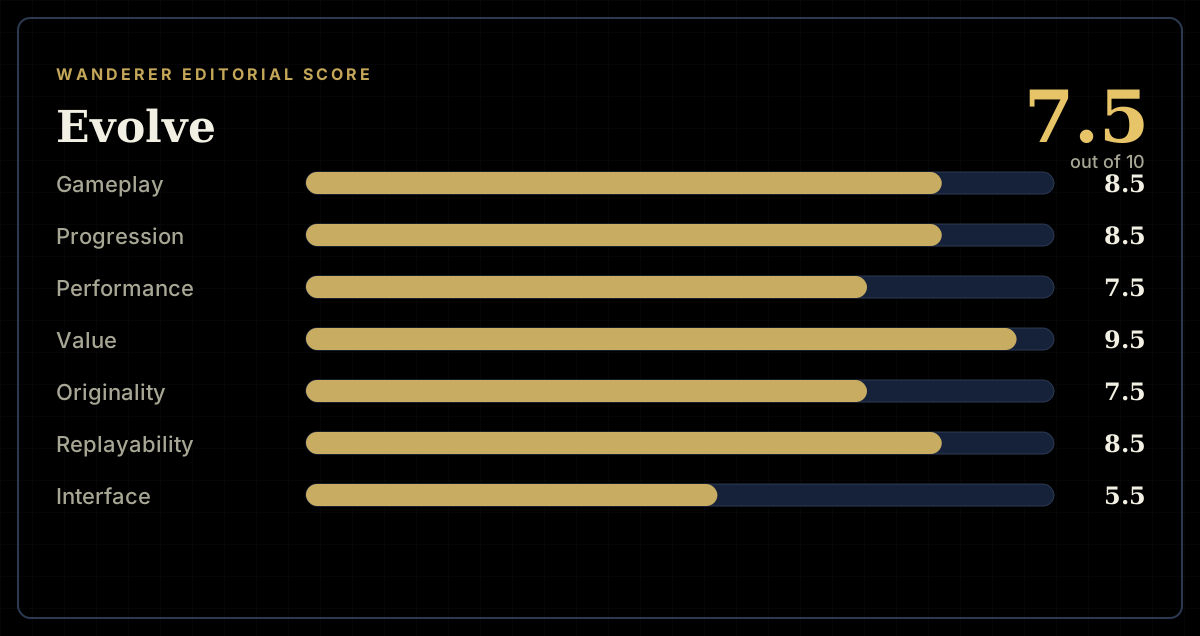
How the review scores each part of the gameWanderer Editorial -
The game at a glanceWanderer Editorial -
The short versionWanderer Editorial