
Game review
Increlution
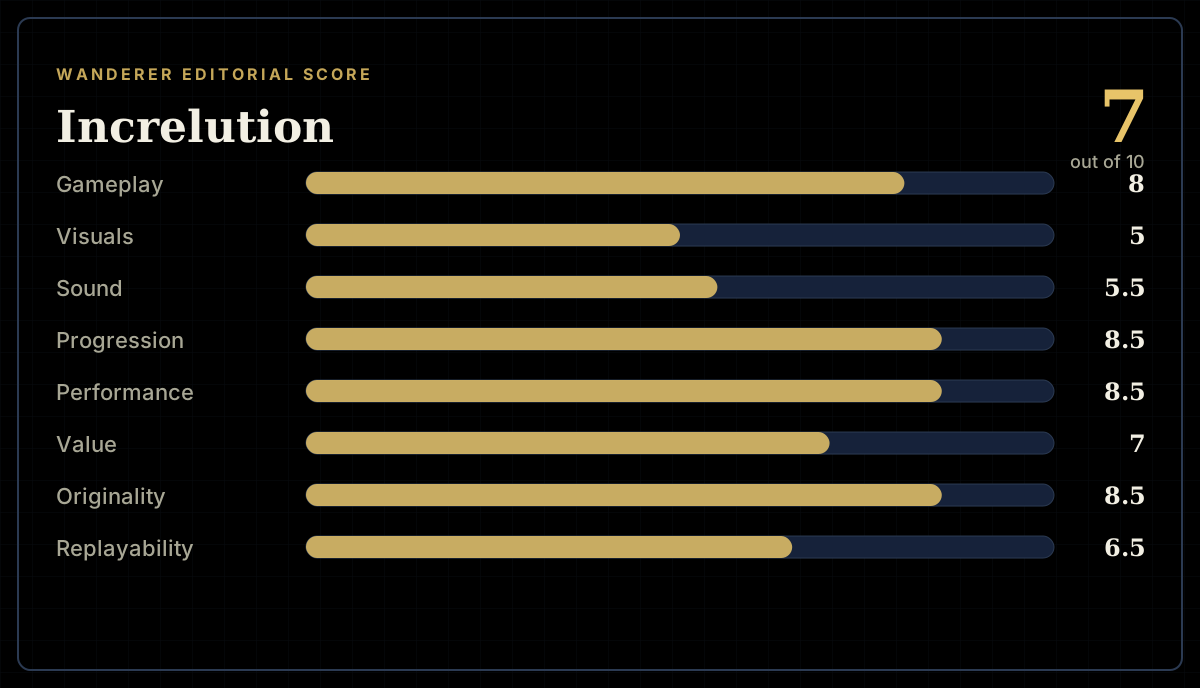
7 / 10
- Developer
- Gniller
- Publisher
- Gniller
- Released
- 13 October 2021
- Platforms
- Windows, macOS, Linux
- Genre
- Incremental
- Monetisation
- One-off purchase, no ads, no in-app purchases, no DLC; a free demo covering the first chapter
- Players
- Single-player
The short version
Increlution takes the thing every other incremental treats as failure — dying — and builds its entire structure around it. Every life is a queue of jobs, gathering trips and constructions you plan in advance, running against a health bar that only ever goes one direction, and every death hands your next life a permanent head start through the game's Instinct skill levels. It's a genuinely clever answer to a genre that usually treats progress as something you simply accumulate rather than something you have to keep re-earning under pressure.
The trouble is that the game itself is stuck in the same loop it designed for its characters, without the payoff. Steam's own listing confirms the last substantive update landed years ago, the story is still short of half the chapter count the developer originally promised, and the Early Access window that was supposed to close "until at least 2024" is now deep into its fifth year. What's here is good. What was promised isn't finished, and there's no clear evidence it will be.
Biggest strengths
- Instinct skill levels persist through every death, turning a permadeath-style reset into a genuine, compounding head start
- The queue-based planning system auto-pauses when empty, so nothing burns away while you're deciding what to do next
- A real story with a real ending instead of procedural filler means the game can actually be completed, unlike most of the genre
Biggest weaknesses
- Steam's own page confirms no substantive update since mid-2023, well past the "until at least 2024" timeline the developer originally set
- The story sits at eleven of a planned twenty to twenty-five chapters, meaning the game is still well short of the ending its own premise is built around
- Presentation is limited to menus, icons and text with no meaningful art direction or music to speak of
Who it's for: Players who want a genuinely novel spin on incremental design and are happy to judge the game on the chapters that exist today rather than the ones still promised.
Our recommendation: Play the free demo first — it's the entire opening chapter, roughly seven hours of unpaused content, and it tells you everything you need to know about the queue system and the death loop before you spend anything. Buy the full game expecting eleven chapters of finished content, not a completed story.
7 / 10
Most incrementals treat your run as something to protect. Keep the numbers climbing, keep the multipliers stacking, never let the counter go back to zero if you can help it. Increlution starts from the opposite premise: your character is going to die, on a schedule you can watch happening in real time, and the entire game is built around making sure that death was worth something anyway. It's a sharp, well-executed idea, and it sits inside a project that has visibly stopped moving forward — which makes this a review of two different things happening at once: a genuinely interesting piece of incremental design, and an Early Access listing that Steam's own metadata says hasn't been meaningfully touched in years.
Dying as the difficulty curve
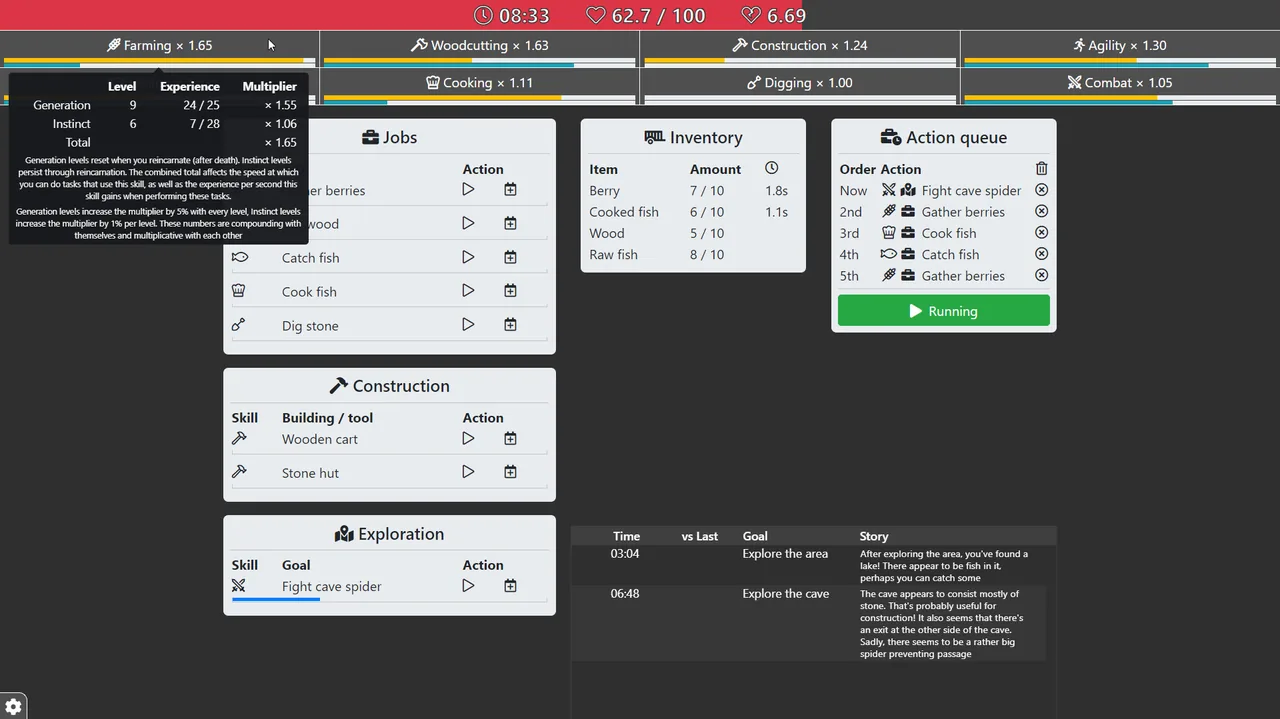
The loop is simple to describe and surprisingly deep to run. Each life, your health ticks down at an accelerating rate no matter what you do, and everything you do — farming, woodcutting, building, exploring — draws on one of several skills, each of which levels up in two separate ways at once. Generation levels rise quickly and give you a big boost for the rest of that single life. Instinct levels rise much more slowly, but they never go away: they're a permanent tax cut on every future life's version of the same skill. Death doesn't erase your progress so much as convert most of it into a smaller, permanent version of itself and hand it to your next attempt.
That structure does something most roguelite-incrementals fumble: it makes the early minutes of a new life feel different depending on how far you've come, without ever making the run itself feel optional. You still have to plan a life around a ticking clock. You just get to plan it with better tools each time, which is a genuinely satisfying way to turn a punishing mechanic — permanent, inevitable death — into the game's actual reward loop rather than its punishment. Compare that to Kittens Game, this site's other recent look at a text-first, scarcity-driven incremental: Kittens Game never resets your civilisation at all, and gets its tension from storage caps and a seasonal famine risk instead. Increlution's tension is more personal and more literal — you can watch the countdown happening to you specifically — and the two games make a useful pair for anyone curious about how differently "scarcity" can be implemented once art and animation are off the table.
The queue is the whole interface, and it works
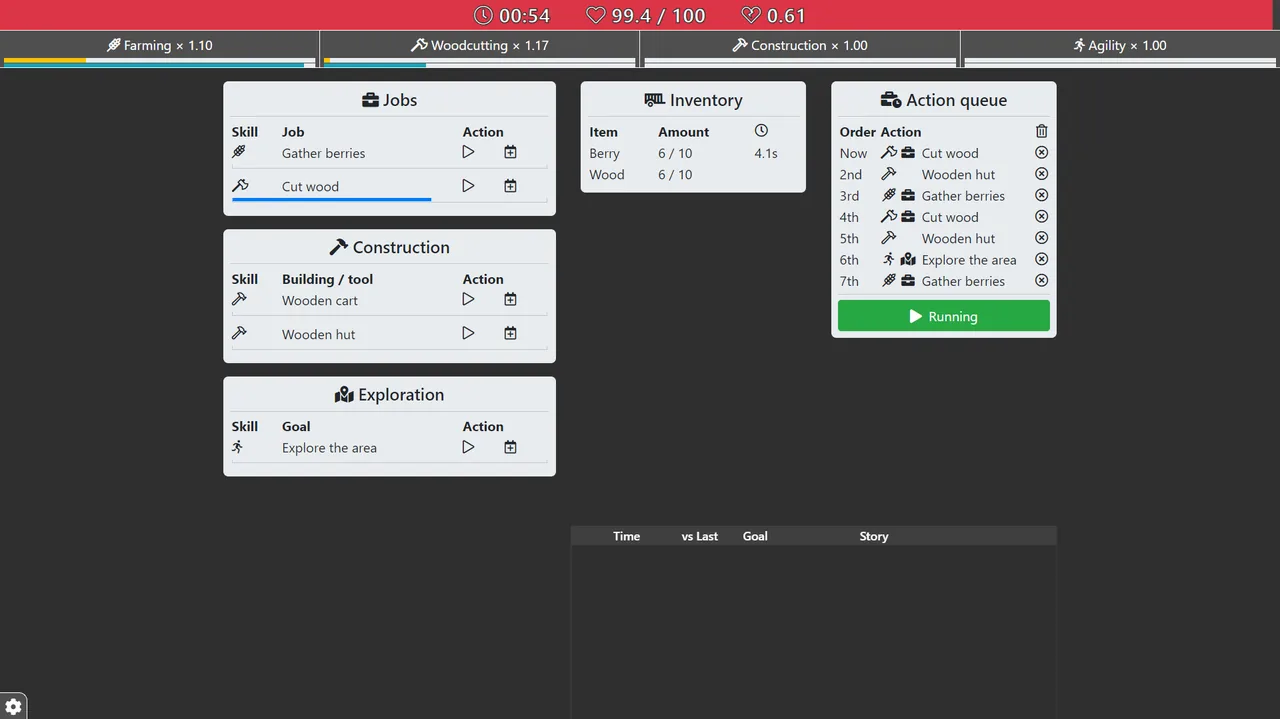
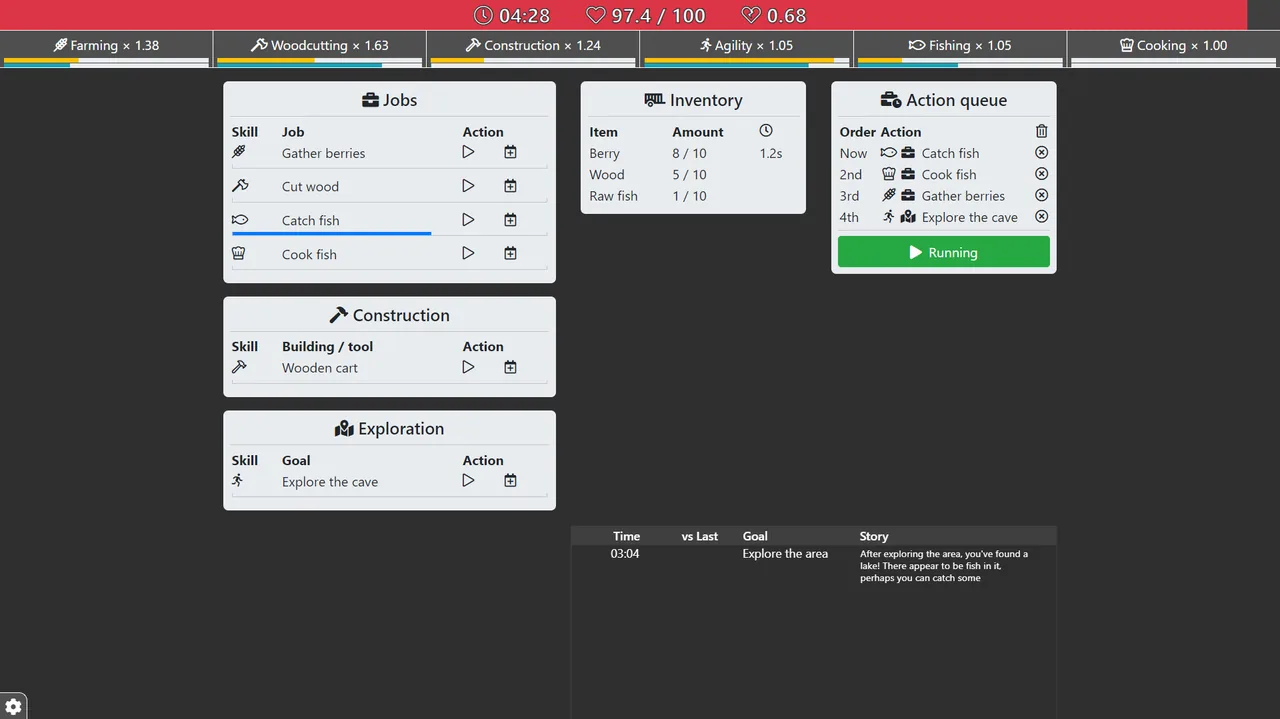
Rather than clicking through actions in real time, you build a queue: gather this, then build that, then explore over there, in whatever order you choose, and the game executes it automatically. When the queue runs dry, everything pauses. That single design choice removes almost all of the genre's most common friction — no idle time wasted because you stepped away, no frantic clicking to keep pace with a timer, no punishment for thinking before acting. It also reframes the entire game as a planning puzzle rather than a reaction test: the skill is in sequencing a life efficiently before it starts, not in your reflexes once it's running. Players who'd rather step away and think than sit and click will find this by far the most comfortable interface choice in the review this cycle, and it scales well against Increlution's own escalating time pressure — the faster your health clock runs down in later chapters, the more that upfront planning actually matters.
The one real limitation is that the queue is also the only interface. There's no controller support, and the design leans hard enough on precise ordering and menu navigation that it's built for mouse and keyboard specifically, not a couch or a phone screen. That's a reasonable choice for a one-person Early Access project, but it does put a ceiling on how portable the experience can be compared to browser- or app-based incrementals that run anywhere.
A story that can actually end
The detail that separates Increlution from most of the genre is that it isn't procedural. You progress through a fixed sequence of story chapters, discovering new tools, jobs and areas as you go, and — unusually for an incremental — the game is designed to be finishable rather than an infinite number-go-up treadmill. Eleven chapters are currently playable, adding up to roughly 220 hours of unpaused content, which is a genuinely large amount of designed material for the asking price. The developer's original plan called for twenty to twenty-five chapters before the story concludes, with a New Game Plus mode meant to expand further once it does.
That's also where the review has to turn from praising the design to weighing the project's current state honestly. Steam's own storefront page states plainly that the last substantive developer update landed more than three years ago — the last confirmed content patch on record added chapters ten and eleven in January 2023, with only small maintenance fixes following through mid-2023. The original Early Access roadmap targeted a close of "until at least 2024." That date has come and gone, and the story remains well under half of its originally promised chapter count. Recent player reviews increasingly describe the project as stalled, with some referencing the developer dealing with a serious health issue as a possible explanation for the gap; none of that is independently confirmable from official sources, and buyers shouldn't treat a resolution as guaranteed either way. What is confirmable, directly from Steam's own metadata, is that this is not an actively updated Early Access project by any normal reading of the term.
Minimalist by design, and it shows
Visually, Increlution is closer to a well-organised spreadsheet than a game in the usual sense — menus, icons and numbers, with no meaningful art direction, animation or music carrying any weight in the experience. That's consistent with the minimalist tag the developer applies to it, and for a game whose entire pitch is planning and numbers, it's a defensible allocation of a small team's time. It just means the presentation earns no points on its own; everything the game asks you to care about has to come from the systems, and for the eleven chapters that exist, it mostly does.
Value, for what's actually here
At NZ$5.99 with no ads, no in-app purchases and no DLC splitting the experience up, Increlution is priced fairly for the content that ships today, and the free demo — a full first chapter, around seven hours of unpaused play — is an unusually generous way to let buyers judge the queue system and the death loop before spending anything. The Steam community backs that assessment: 85% of over 1,200 reviews sit positive, a strong number for an Early Access title this far past its original roadmap. That figure reflects real enthusiasm for the eleven chapters that exist, not a verdict on the chapters that don't. Anyone buying in should be doing so for the game as it stands right now, not for the promise of a finished twenty-five-chapter story arriving on any particular timeline.
Verdict
Seven out of ten. The core idea — that death can be a currency instead of a failure state, spent through permanent Instinct levels rather than wiped away — is one of the smarter mechanical hooks this genre has produced, and the queue-based planning system built around it respects a player's time about as well as any incremental interface currently does. Eleven chapters and roughly 220 hours of unpaused content is a real amount of finished, well-liked design for a NZ$5.99 asking price.
What keeps the score from climbing higher is not a flaw in what's playable, but the state of the project around it. An Early Access game closing in on five years old, sitting well short of its own promised chapter count, with Steam's own page confirming no substantive update in years, is asking buyers to price in real uncertainty about whether the remaining two-thirds of the story ever arrives. Judge Increlution purely on its current eleven chapters and it's a genuinely inventive, well-built incremental worth the asking price. Judge it as the finished game it was pitched as five years ago, and it's an open question the developer hasn't answered in a long while. Players who enjoy Wanderer's own away-from-keyboard progression may find Increlution's queue system a satisfying cousin of the idea — just one built around a much harder deadline.
Price and store details checked 30 July 2026.
Pros and cons
Pros
- Instinct skill levels persist through every death, turning a permadeath-style reset into a genuine, compounding head start
- The queue-based planning system auto-pauses when empty, so nothing burns away while you're deciding what to do next
- A real story with a real ending instead of procedural filler means the game can actually be completed, unlike most of the genre
- The free demo covers a full opening chapter, so you know exactly what you're buying before you pay
- Roughly 220 hours of unpaused content across eleven chapters is a lot of design for a NZ$5.99 asking price
Cons
- Steam's own page confirms no substantive update since mid-2023, well past the "until at least 2024" timeline the developer originally set
- The story sits at eleven of a planned twenty to twenty-five chapters, meaning the game is still well short of the ending its own premise is built around
- Presentation is limited to menus, icons and text with no meaningful art direction or music to speak of
- No controller support and no mobile release limit where and how the queue system can actually be played
- Player reviews increasingly frame the project as stalled or abandoned, which colours how much future content buyers can reasonably expect
Screenshots
-
IncrelutionImage: Gniller via Steam -
IncrelutionImage: Gniller via Steam -
IncrelutionImage: Gniller via Steam -
How the review scores each part of the gameWanderer Editorial -
The short versionWanderer Editorial