
Game review
Exponential Idle
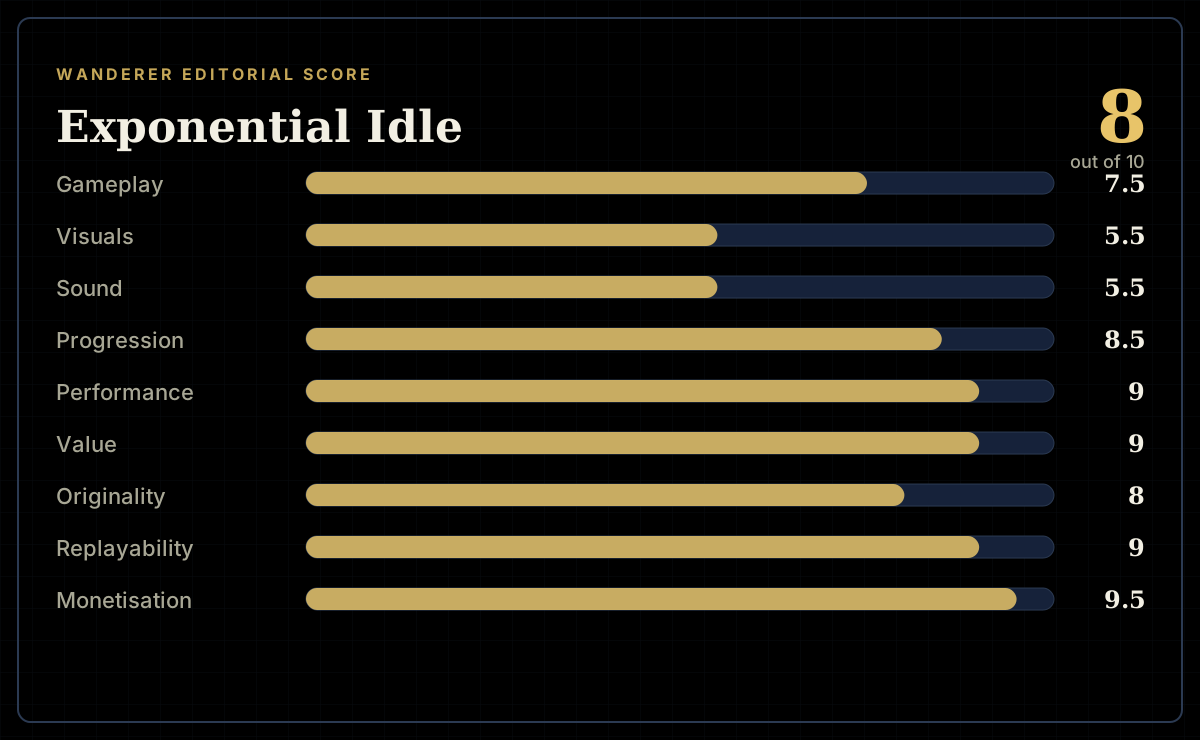
8 / 10
- Developer
- Conic Games (Gilles-Philippe Paillé)
- Publisher
- Conic Games (Gilles-Philippe Paillé)
- Released
- 11 November 2020
- Platforms
- Android, iOS
- Genre
- Incremental
- Monetisation
- Free on both stores. A single optional purchase (around $1.99 in the US) permanently replaces the optional rewarded-ad prompts, plus small one-off tip donations ($0.99–$3.99) that unlock nothing. No subscription, no energy system, no loot boxes, no currency that affects progression.
- Players
- Single-player
The short version
Exponential Idle plays a familiar mobile-incremental hand for its first several hours — tap an equation, buy upgrades, watch a number climb, reset for a permanent bonus — and does it cleanly enough that the math framing never gets in the way. What sets it apart only shows up once you've cleared the built-in story: a genuine JavaScript SDK that lets anyone write, test and publish a full custom theory, reviewed for balance and distributed through an official repository inside the app. That's not a gimmick bolted onto the marketing copy. It's the actual long-term plan, and it works.
The cost is that the built-in campaign is thinner than the scripting layer built to extend it, and the teaching stops the moment a player leaves the eight main theories for anything the community made.
Biggest strengths
- The Theory SDK is a real JavaScript toolkit with live reload, not a stripped-down mod menu
- The official custom-theory repository is curated for balance before anything goes public, so quality holds up
- No pay-to-win purchase exists anywhere in the game — the only IAP removes an optional ad prompt
Biggest weaknesses
- The eight built-in theories run out of new ideas well before a player has learned to write one
- Custom theories assume a working knowledge of JavaScript that the base game never asks for or teaches
- Visual presentation is a single scrolling equation screen with almost no identity of its own
Who it's for: Idle-game players who've run out of road in Cookie Clicker or Antimatter Dimensions and want a mobile-first alternative with a genuinely different endgame — and anyone curious what a fan-made expansion pack looks like when the developer builds the toolchain for it themselves.
Our recommendation: Free on Android and iOS with nothing to lose by installing it. Play through the built-in theories first before deciding whether the custom-theory repository is worth the time investment it asks for.
8 / 10
Most idle games treat "endgame content" as a promise the developer eventually has to keep in person: another prestige layer, another zone, another patch. Exponential Idle takes a different position entirely — it ships the tools and lets the community write the sequel itself. Whether that's the most generous decision an incremental developer can make, or a quiet admission that the built-in campaign was never going to be enough on its own, is worth working through properly, because the answer isn't as flattering as the marketing angle suggests, and it isn't as cynical as the phrase "user-generated content" usually implies either.
What the base game actually is
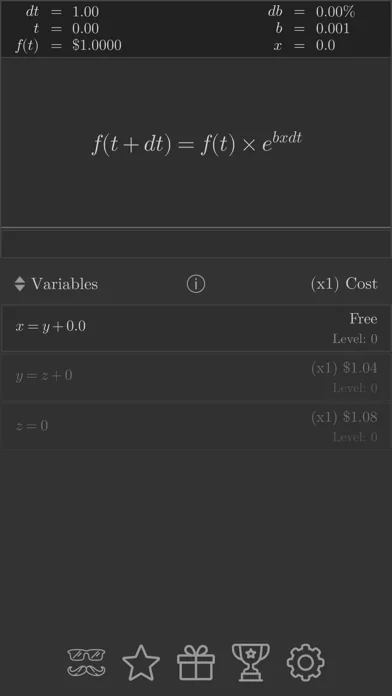
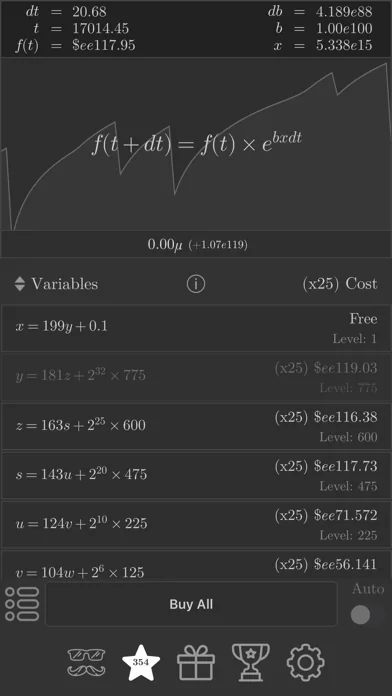
Strip away the scripting layer and Exponential Idle is a tidy, mobile-native math incremental. You have a currency — money, framed explicitly as the product of exponential growth — and you advance it by tapping an on-screen equation or letting time do the work automatically. Upgrades buy multipliers. A "change of variables" mechanic lets you restructure how your currency is generated rather than just buying more of the same thing, which is the first real skill the game asks a player to develop: recognising when the current setup has stopped scaling and needs restructuring instead of reinforcing. Publications — the game's prestige reset — hand back a permanent multiplier built around a τ value, and auto-buyers eventually take the tapping out of the loop entirely so the game keeps advancing while a phone sits in a pocket.
None of this is new territory. It's the same reset-ladder shape every serious incremental has used since the genre's early browser-game days, and Exponential Idle doesn't pretend otherwise. What it does well is keep the math approachable without dumbing it down to nothing: framing everything as "stacking money" rather than leading with abstract notation means a player who hasn't touched calculus since school can still follow what's happening turn to turn, even while the underlying systems the game is teaching — rates of change, diminishing returns, restructuring a formula rather than brute-forcing it — are genuinely mathematical ones. It's a gentler on-ramp than a lot of the genre's more overtly numbers-forward competitors, Antimatter Dimensions included, precisely because it never asks you to think of what you're doing as math until you're already comfortable doing it.
The built-in campaign runs through a fixed sequence of numbered theories, each restructuring the core loop around a different mathematical shape and its own publication curve. It's well-paced for what it is — new mechanics arrive roughly when the last one has been fully explored, and nothing overstays its welcome by more than an evening's play. But it's also a fixed, finite thing, and that matters enormously for what comes next.
The scripting layer is the actual pitch
Once the story is cleared, Exponential Idle unlocks custom theories, and this is where the game stops resembling its mobile-incremental neighbours. Conic Games publishes a Theory SDK — a real JavaScript toolkit, distributed on GitHub, that links a desktop code editor directly to the running app and pushes live updates to a theory every time the file is saved. Writing a theory means defining currencies, upgrades, a publication curve and the API hooks the game exposes for things like numeric input handling — this isn't a simplified visual scripting tool with training wheels, it's the same kind of interface a professional add-on developer would expect.
The results get reviewed for balance and playability before they're allowed into the official in-app repository, which matters more than it sounds like it should. Anyone can host a rogue theory file outside that repository, but the curated list is what most players actually browse, and Conic Games' own recent update notes show the range that curation allows: a new theory built around the Riemann Zeta function, another named directly for the Basel problem, a third modelling magnetic fields — genuine mathematical and physical concepts, not reskinned currency multipliers wearing a science name. That's a meaningfully different proposition from most "workshop" content in other genres, where curation usually means "doesn't crash the client." Here it means the theory is actually judged as a piece of design.
So: generous idea, or a confession the base game runs dry? Genuinely closer to the former, but not purely. The custom-theory system is too well-built, too actively maintained and too seriously curated to read as an afterthought bolted on to cover a content shortfall — a developer patching over thin content doesn't usually build and document a full live-reload SDK for the fix. But it's also true that the eight built-in theories are noticeably shorter than the amount of runway a dedicated player will burn through them in, and the game's own structure — unlocking the SDK the moment the story ends, rather than staggering it alongside the story — reads as an acknowledgement that the built-in campaign was always meant to be a demonstration of the format, not the whole product. Both things can be true at once, and they are here: the base game is the tutorial for a much bigger, community-authored game sitting one download away.
Where the teaching runs out
The base campaign's real achievement is making its optimisation puzzles legible to someone who isn't fluent in the underlying math. Custom theories don't extend that courtesy. The moment a player leaves the eight built-in chapters, the game stops holding anyone's hand — theory names, descriptions and difficulty are whatever the individual author wrote, the in-app repository doesn't surface a consistent difficulty signal or a recommended order, and actually writing a theory requires comfort with JavaScript that nothing in the tap-and-upgrade campaign prepares a player for. That's a fair trade for the audience the SDK is built for — hobbyist programmers who already wanted a sandbox like this — but it's a real wall for the much larger audience the base game successfully welcomed in. A review that only credited the SDK's ambition without naming that gap would be missing half the story the game itself is telling.
Presentation, performance and the mobile fit
Visually, Exponential Idle doesn't try to be anything other than a clean equation on a phone screen — there's no art direction competing for attention, no seasonal event skin, nothing asking to be screenshotted. That's a legitimate choice for a genre where the numbers are the content, and it pays off in the one place mobile players actually feel it: the game is light enough to run comfortably across the full spread of Apple hardware its own store listing covers, from an aging iPhone up through Apple Watch and Apple TV, and the Play Store build carries the same footprint on Android. For an idle game that's meant to sit in the background of a phone for most of its life, that restraint is a feature a heavier, more decorated competitor couldn't easily match.
The interface itself is straightforward rather than elegant — a scrolling equation, a row of upgrade buttons, a publication popup when it's time to reset — and it does its job without asking for praise. It also means there's very little room for the game to teach anything visually; almost every concept here is explained through numbers and text rather than through animation or spatial metaphor, which keeps the presentation honest but leaves it entirely dependent on the writing to make new mechanics click.
Monetisation: about as clean as mobile idle games get
There is exactly one purchase in Exponential Idle that changes anything about how the app behaves, and it removes an optional ad prompt rather than adding an advantage. Everything else on the store page is a flat donation with no in-game return. No energy system throttles play, no premium currency sits between a player and an upgrade, no battle pass demands daily logins, and nothing in the custom-theory repository costs anything beyond the time it takes to play through it. For a free mobile game with over four thousand rated reviews on iOS and tens of thousands more on Android, that's a genuinely rare position to hold, and it's worth stating plainly rather than burying it in a caveat: this is what a monetisation model looks like when a developer decided the game itself was the pitch.
Verdict
Eight out of ten. Exponential Idle earns its score less from the built-in campaign — a competent, well-paced but ultimately compact math incremental — and mostly from what sits underneath it: a genuine scripting SDK, a curated distribution channel, and a developer who treats community-made content as a real extension of the game rather than a fan-fiction sideshow tolerated at arm's length. That's a legitimately generous structure, and it's rare enough in the mobile incremental space to be worth calling out on its own terms.
The half-step it doesn't earn back is the gap between what the base game teaches and what the custom-theory layer demands. A player who found the built-in campaign approachable precisely because it never leaned on notation or code is handed a JavaScript toolkit the moment that campaign ends, with no bridge in between. The game is honest about that gap rather than hiding it, which counts for something, but it's still the wall most players will eventually hit.
Anyone who's already worked through Antimatter Dimensions or Cookie Clicker and wants a mobile-native version of the same reset-ladder satisfaction, with a genuinely different answer to "what happens after the story ends," should install this without hesitation — it costs nothing and asks for nothing. Players who like that kind of persistent, ever-extending progression but would rather it lived inside a world with a character in it than a column of equations are the audience Wanderer is built for instead.
Price and monetisation details checked 30 July 2026.
Pros and cons
Pros
- The Theory SDK is a real JavaScript toolkit with live reload, not a stripped-down mod menu
- The official custom-theory repository is curated for balance before anything goes public, so quality holds up
- No pay-to-win purchase exists anywhere in the game — the only IAP removes an optional ad prompt
- Runs comfortably on old and new hardware alike, from budget Android phones to Apple Watch
- The change-of-variables mechanic teaches the core optimisation skill before the game ever names it
- Auto-buyers and the offline calculator respect a player's time without making active taps pointless
Cons
- The eight built-in theories run out of new ideas well before a player has learned to write one
- Custom theories assume a working knowledge of JavaScript that the base game never asks for or teaches
- Visual presentation is a single scrolling equation screen with almost no identity of its own
- Comparing two custom theories' difficulty or quality requires reading community notes the game doesn't surface
- The publication/prestige language (τ, multipliers, supremacy) is introduced faster than it's explained
Screenshots
-
Exponential IdleImage: Gilles-Philippe Paille via the App Store -
Exponential IdleImage: Gilles-Philippe Paille via the App Store -
Exponential IdleImage: Gilles-Philippe Paille via the App Store -
How the review scores each part of the gameWanderer Editorial -
The short versionWanderer Editorial