Game review
Path of Idling
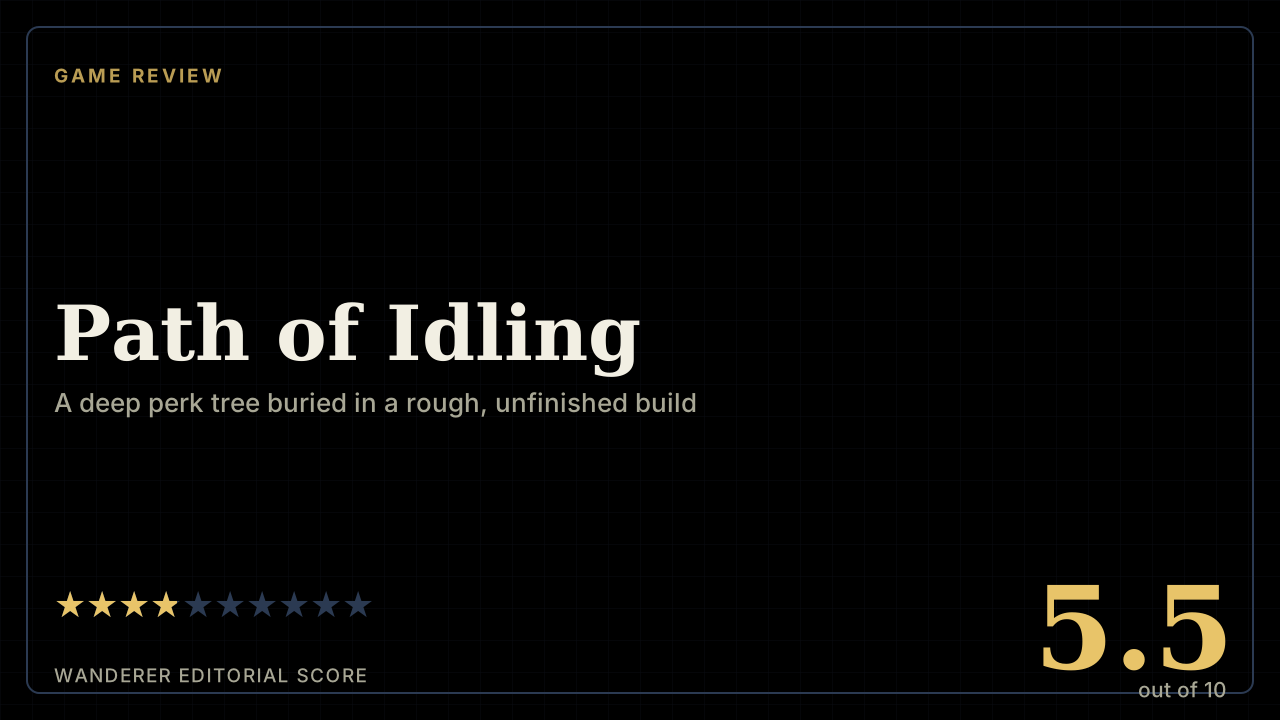
5.5 / 10
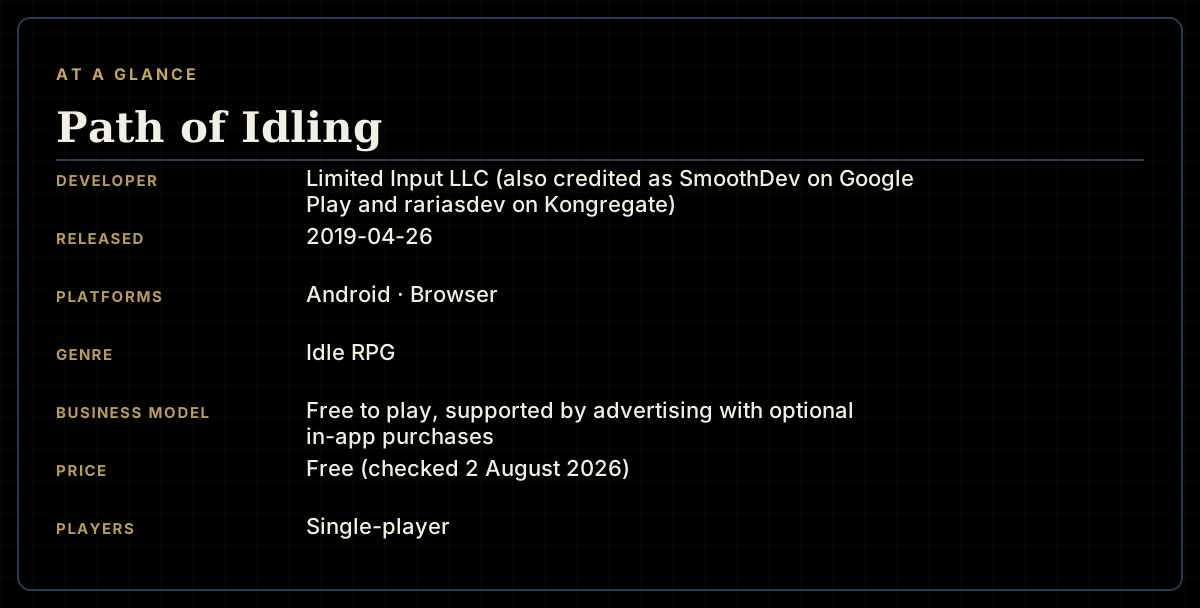
- Developer
- Limited Input LLC (also credited as SmoothDev on Google Play and rariasdev on Kongregate)
- Released
- 26 April 2019
- Platforms
- Android, Browser
- Genre
- Idle RPG
- Monetisation
- Free to play, supported by advertising with optional in-app purchases
- Players
- Single-player
The short version
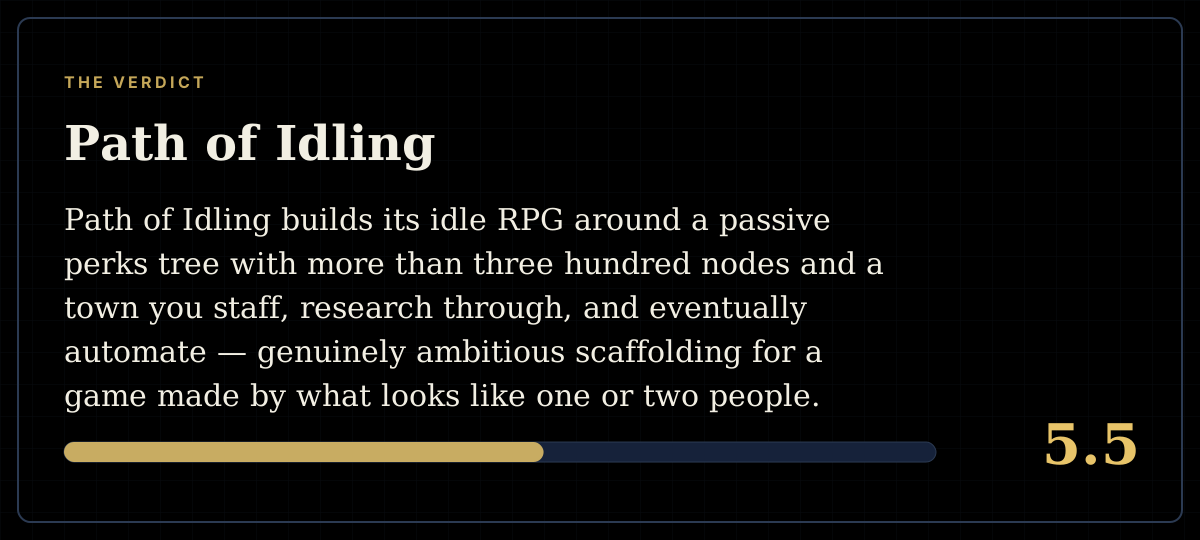
Path of Idling builds its idle RPG around a passive perks tree with more than three hundred nodes and a town you staff, research through, and eventually automate — genuinely ambitious scaffolding for a game made by what looks like one or two people. The trouble is everything wrapped around that scaffolding. The interface explains almost nothing, the Android build has drawn crash reports as recently as this year, and the game has spent since 2019 without reaching a 1.0 release.
If you can tolerate a rough, occasionally broken free mobile idler in exchange for a perk tree with real decisions in it, there's something here. Most players looking for a polished experience should look elsewhere in a genre that has no shortage of better-finished alternatives.
Biggest strengths
- The passive perks tree has enough genuine branching across 300-plus nodes to reward actual planning rather than a straight power-upgrade path
- Town workers and research let you automate supply generation over time instead of babysitting every resource manually
- Offline progress runs at the same rate as active play, so stepping away never feels like a tax on time not spent in the app
Biggest weaknesses
- A user review from January 2026 reports the app failing to load past its title screen, and no changelog entry documents a fix
- The interface introduces skills, maps, town research and the perks tree with almost no in-game explanation of how they interact
- Development has run since an April 2019 browser prototype without reaching a 1.0 release, and the current build is still labelled a work in progress
Who it's for: Idle RPG veterans who enjoy planning a build on paper more than watching numbers tick, and who don't mind a rough, unpolished Android app in exchange for a genuinely deep systems layer underneath it.
Our recommendation: Install it free and give the perks tree an honest hour before judging it, but keep expectations calibrated to an ongoing solo project rather than a finished commercial release. If a crash on launch stops you cold, that's a documented, recent complaint, not bad luck.
5.5 / 10
A perk tree with real decisions in it
Most mobile idle RPGs hand you a single upgrade column and call it progression: tap the biggest number, buy the next tier, repeat until the next zone unlocks. Path of Idling's central hook is that its passive perks tree refuses to be that simple. Spread across more than 300 nodes, it asks for a route rather than a purchase order — which branches you commit early points to changes which later nodes are even reachable, and reallocating later means unwinding a chain rather than swapping one number for another. That's a genuinely more interesting design than the genre usually bothers with at this budget, and it's the strongest argument for spending any time with the game at all.
The rest of the core loop supports that tree reasonably well. A town sits alongside the combat side of the game, and assigning workers there generates the supplies that feed both crafting and further research — research that, later on, starts automating jobs you were doing by hand. Equipment and maps both modify the numbers underneath a fight: gear changes what your hero brings to combat, while maps adjust enemy attributes and the quality of what they drop, giving you a second lever to pull once straightforward stat-stacking stops being enough. Skills pair an active ability with a support skill to modify how it behaves, a structure that will feel instantly familiar to anyone who has spent time with build-crafting action RPGs and translates reasonably well into an idle context.
Where the systems outrun the tutorial
None of that depth is explained particularly well. The game introduces the perks tree, the town, maps, skill pairing and prestige in close succession and largely leaves you to work out how they connect. A player review from October 2025 put it plainly: the foundation is interesting, but the game needs quality-of-life work to actually explain its own mechanics rather than assuming players will piece them together. That's a fair description of the whole experience. Nothing here is unfair once you understand it — the systems are consistent and the perk tree rewards patient planning rather than punishing experimentation with permanent loss — but "once you understand it" is doing a lot of work in a game that offers almost no help getting there. Compare it to Progress Knight or Increlution, both reviewed on this site, and the gap is obvious: those games also demand you learn systems the hard way, but they at least surface enough numbers and feedback that the learning is legible. Path of Idling's interface mostly just sits there, dense with menus and short on explanation.
Making that worse is the near-total absence of community infrastructure most idle games lean on to fill exactly this gap. There's no dedicated wiki, no active subreddit, and no Discord server turned up in any search for one. Games like NGU Idle get away with a similarly unexplained systems layer partly because a decade of player-built wikis and spreadsheets exists to translate it. Path of Idling has no equivalent safety net. What you don't figure out yourself, you simply don't get, at least not without digging through the sparse comment sections on its app store listing.
Free, but rough around the edges
The game is free to install, supported by advertising with optional in-app purchases layered on top — a fairly standard shape for a mobile idler, and one that doesn't gate the core perks-and-town loop behind spending. That's worth crediting; nothing about the perk tree or town automation requires a purchase to engage with meaningfully. What undermines the value proposition is stability rather than monetisation. A January 2026 user review describes the app failing to progress past its title screen entirely, and there's no changelog entry acknowledging or fixing that specific complaint in the versions that followed. For context, the app has continued receiving updates through that period — version 0.6 landed in early January 2026, following point releases across the back half of 2025 — so this isn't an abandoned project. It's an actively maintained one that still ships with visible, recent stability problems for at least some installs.
That maintenance pattern is really the whole story of where this game sits. It began life as a browser prototype on Kongregate back in April 2019, tagged by its own developer at the time as "Game In-Development," and one Kongregate comment thread from that era complained about a phone-shaped layout crammed into a browser window — the developer's own reply confirmed the game was being built mobile-first even then. Seven years later, the Android build is the actively developed version, still on a pre-1.0 version number, still adding content, and still occasionally breaking for players who just want to open it. That's not unusual for a solo or near-solo idle project, but it does mean judging this as a finished product means grading on a curve most commercial releases don't get.
Presentation and performance
There isn't much to say about Path of Idling's visual identity because it doesn't really have one beyond functional menus, icons for its various systems, and the numbers those systems produce. That puts it well behind idle RPGs that invest in art direction as part of the pitch, though it's consistent with a small, systems-first project rather than a mismatch between ambition and budget. Performance is the bigger concern: crash reports aren't a universal experience based on available feedback, but a title-screen failure reported this year on a game with 10,000-plus installs is a meaningfully worse failure rate than a finished release should carry, free or not.
Verdict
Five and a half out of ten. Path of Idling deserves credit for building a passive perks tree with actual branching decisions in it, backing that tree with a town-automation loop that respects offline time, and giving players map and gear systems with enough interlocking depth to reward planning rather than pure grinding. Those are the bones of a genuinely good idle RPG, and they were built by what appears to be a very small team working on this on and off since 2019.
What keeps the score in the middle of the pack is everything surrounding those bones: an interface that explains almost nothing, no community-built guides to compensate for that silence, and a current build that has drawn a specific, recent crash complaint the changelog doesn't address. Players who enjoy reverse-engineering a system through trial and error, and who can tolerate real instability in exchange for a free, ad-supported perk tree with genuine substance, will find something worth poking at here. Everyone else should try one of this genre's more finished entries first — Idle Loops and Increlution both ask for similar planning-first patience and back it with interfaces that actually meet the player partway. Wanderer's own progression keeps moving while players are away too, without asking them to debug the app first to get there.
Store listing, version history and player feedback checked 2 August 2026.
Pros and cons
Pros
- The passive perks tree has enough genuine branching across 300-plus nodes to reward actual planning rather than a straight power-upgrade path
- Town workers and research let you automate supply generation over time instead of babysitting every resource manually
- Offline progress runs at the same rate as active play, so stepping away never feels like a tax on time not spent in the app
- Maps that modify enemy attributes and loot give the mid-game a real lever beyond simply grinding harder content
- Completely free to install, with no premium currency gate blocking the core perks-and-town loop
Cons
- A user review from January 2026 reports the app failing to load past its title screen, and no changelog entry documents a fix
- The interface introduces skills, maps, town research and the perks tree with almost no in-game explanation of how they interact
- Development has run since an April 2019 browser prototype without reaching a 1.0 release, and the current build is still labelled a work in progress
- No wiki, subreddit or Discord exists for the game, so player-made guides that other idle RPGs rely on to fill the gaps simply aren't there
- The Kongregate browser version ships a phone-shaped layout inside a desktop window, forcing awkward scrolling for anyone who isn't on mobile
Screenshots
-
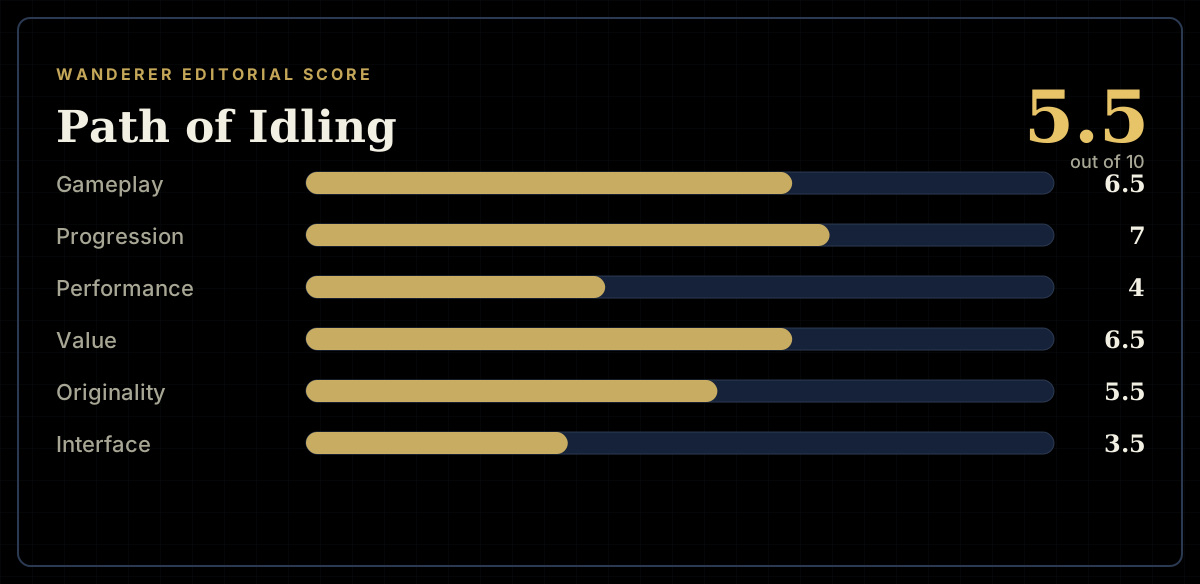
How the review scores each part of the gameWanderer Editorial -
The game at a glanceWanderer Editorial -
The short versionWanderer Editorial