Game review
Guild Quest
4 / 10
- Developer
- Hyper Hippo Games
- Publisher
- Hyper Hippo Games
- Released
- 26 January 2017
- Platforms
- Windows, macOS
- Genre
- Idle RPG / Guild Manager
- Monetisation
- Free-to-play, built on a purchasable gem currency and chests; no subscription
- Players
- Single-player
The short version
Guild Quest asks you to build islands, recruit "guildians," slot them into automated quest lines and watch rewards accumulate whether or not you're at the keyboard — a perfectly sound idle-RPG premise, and one Hyper Hippo executed with real charm in its first few islands. The problem is that this review is being written in 2026 about a game whose Steam page still says "Early Access," whose developer posted a content update roughly every week between June and September 2017, and then never posted one again.
Nothing has been pulled from sale. The store page is live, the game is still free to install, and Steam's own achievement data shows real players still grinding through it in 2024 and 2025. What they're grinding into is a mid-game wall where boss health outpaces player damage by orders of magnitude, a monetisation layer built to sell past that wall with gems and chests, and — as one of the more damning specifics in its review history — at least one achievement tied to a crafting feature the developers removed and never fixed, leaving it permanently unearnable for anyone who didn't play in the first few months.
Biggest strengths
- The opening islands deliver a clean, low-friction idle loop — recruit guildians, assign them to quest lines, come back to collected rewards — that several long-time reviewers still credit as genuinely well designed
- Entirely free to install and play with no mandatory spending in the early game
- Still technically live and playable nearly nine years after its last content update, with Steam achievement data showing real players still working through it as recently as 2025
Biggest weaknesses
- Marked "Early Access" on Steam since January 2017 with no content update since September 2017 — the developer's own last public update promised roughly six months to full release
- Boss health scales into the billions while player damage output caps in the tens of thousands in the mid-to-late islands, turning progression into a wall that funnels players toward the gem shop
- At least one Steam achievement is tied to a Forge feature the developers removed from the game without removing the achievement, making a full completion permanently impossible
Who it's for: Curious idle-genre completionists and anyone specifically researching what an abandoned-but-not-delisted Early Access free-to-play game looks like nine years on. Not recommended as a first idle RPG for anyone who wants a game that's actually going anywhere.
Our recommendation: It costs nothing to look, and the opening islands are genuinely pleasant for a few hours. Do not spend real money on it, and go in knowing you are playing a museum piece that Steam still classifies as unfinished.
4 / 10
Guild Quest has been an Early Access game for longer than some of its players have had driving licences. Hyper Hippo shipped it onto Steam on 26 January 2017 with a promise, made in the game's own Early Access blurb, of roughly six months to a full release. The last content update went out on 1 September 2017. Nobody has touched it since. It is still on Steam right now, still free, still tagged "Early Access," and still, according to Steam's own achievement data, being played by real people logging hundreds of hours as recently as last year. That contradiction — a dead development cycle wrapped around a live, installable game — is the whole story here, and it needs to be said up front rather than buried under a paragraph about guildians.
The loop, before the wall
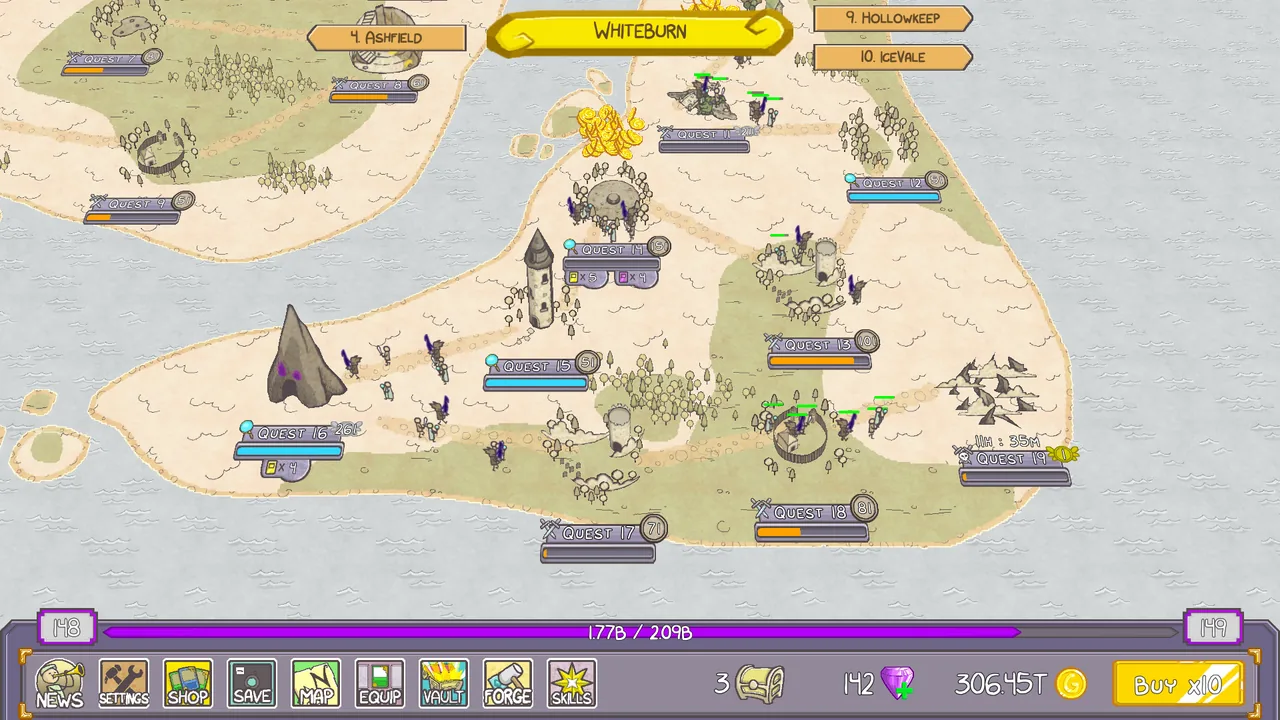
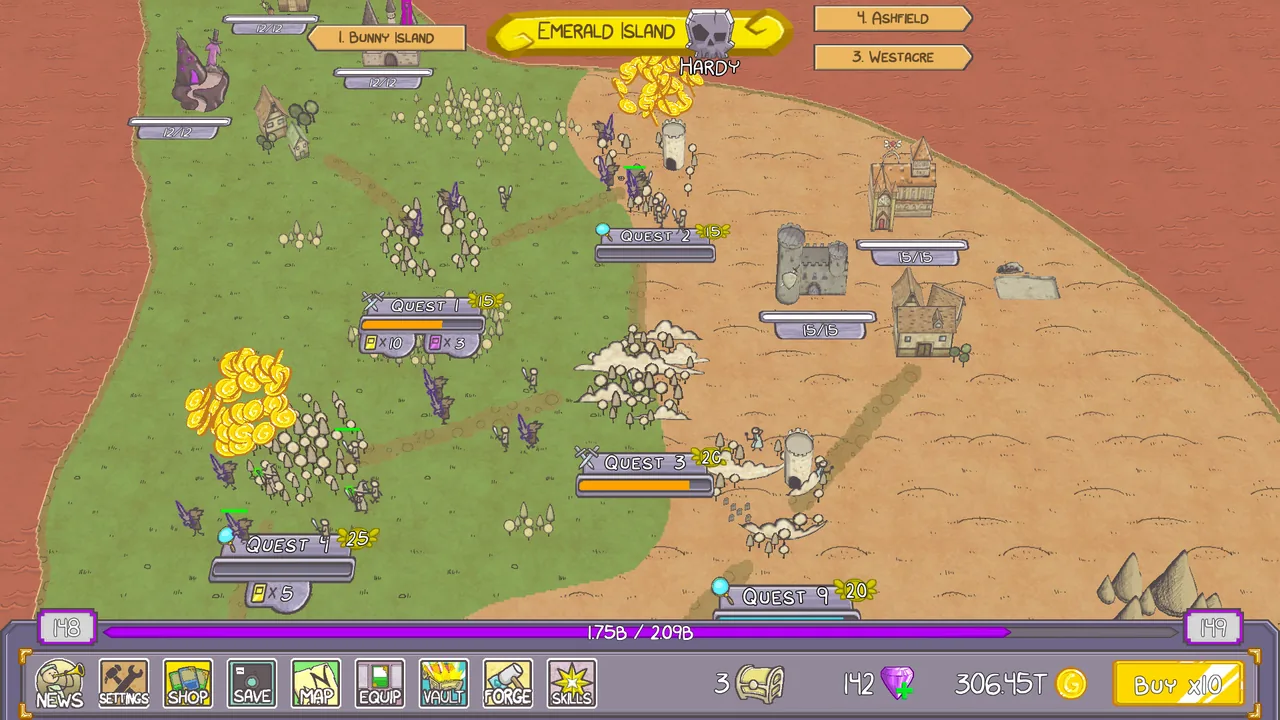
Strip away the Early Access sign and the core idea is a reasonable one. You buy an island, recruit "guildians" of different classes, upgrade their guildhalls and slot them into custom quest lines with adjustable difficulty. Send them out, let the timers run, and rewards land whether or not you're watching — the standard idle-RPG contract, executed with a bright, cartoonish art style that several long-time reviewers still call the game's best feature nearly a decade later. The opening hour or two on Bunny Island is genuinely pleasant: the achievement data backs this up directly, with the earliest milestones — fully building out Bunny Island, maxing its starting quests — sitting at 70 to 83% completion, meaning most people who install the game do at least get that far and evidently enjoy it enough to finish the tutorial island. It's the kind of clean, low-pressure opening the idle genre is good at, and Guild Quest's version of it holds up.
Where the curve breaks
The achievement curve tells the rest of the story just as clearly. Completion falls off a cliff through the mid islands — Emerald Island's build-out sits around 55%, its quest-maxing closer to 44%, and by the higher island tiers most milestones sit in the single digits, with the deepest ones under 2%. That's a steeper drop-off than a game losing players to boredom; it's the shape of a game losing players to a wall. Reviewers describe exactly that wall in concrete terms: boss health running into the billions in the later islands against a player damage output that caps out in the tens of thousands, a gap no amount of patient grinding closes on its own. Whether that was a deliberate monetisation funnel or simply a balance pass that never got its follow-up patch is impossible to say with the developer silent for nine years — but the practical effect for a player is the same either way, and the reviews agree on what it is: progress that used to feel achievable turns into a wall that only gems reliably get you past.
Monetisation that never lets up, on a game that stopped earning it
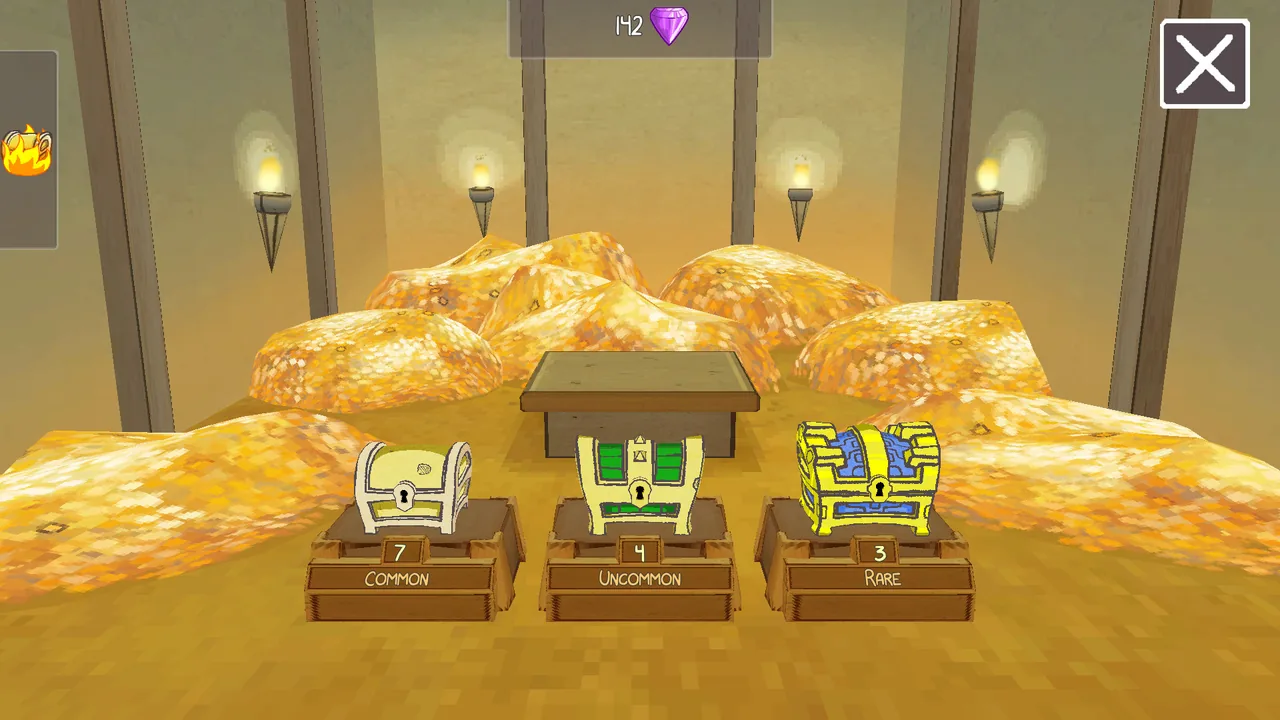
Guild Quest's economy runs on a gem currency spent on chests, and reviewers who reached the mid-game describe the pressure to buy them as blunt rather than subtle — one long-standing review sums up the later islands as "blatant money grabbing." That's a familiar shape for free-to-play idle games generally, and Hyper Hippo's other idle title, AdVenture Capitalist, runs a comparable gold-currency model that this library has reviewed and found reasonably fair, with every unlock reachable free and gold only ever buying speed. Guild Quest doesn't earn the same benefit of the doubt, because the systems the paywall is supposed to be a shortcut through stopped receiving balance passes in 2017. A monetisation loop built to sell past a difficulty spike only stays fair if someone keeps tuning the difficulty spike. Nobody has, for nine years, which turns "pay to skip the grind" into "pay because the grind was never finished."
The single most concrete black mark on the record is a widely corroborated account of an August 2017 update that restructured the quest-line system and, according to multiple reviews written in its immediate aftermath, deleted a large share of players' previously purchased quest nodes — progress some of them had spent real money to build — with compensation reviewers describe as token by comparison. It's the kind of event that would be a serious, fixable controversy in an actively developed game. In a game that stopped shipping updates three weeks later, it reads instead as the last thing that ever happened to it.
Broken on purpose or broken by neglect
One detail sums up what nine years of silence actually costs a player: Guild Quest removed its Forge feature at some point in its short development window, but left at least one Steam achievement tied to using it. There is no way to unlock that achievement anymore, for anyone, under any circumstances. It's a small thing next to the monetisation and the difficulty wall, but it's the cleanest evidence in the whole review that nobody has looked at this game's own scoreboard in a very long time. A live game ships a fix or quietly retires the achievement. Guild Quest has done neither, because doing either would require someone to be working on it.
Still, somehow, alive
What keeps Guild Quest from being a straightforward corpse is that it plainly isn't one in the sense that matters to a browser: the servers respond, the app installs, purchases are still offered, and Steam's review feed shows people still finding it and playing substantial amounts of it in 2024 and 2025 — reviews from that window describe hundreds of hours logged before writing a negative verdict, which says something about the early hours' pull even from players who end up recommending against the game. None of those recent reviewers report anything resembling a shutdown notice, a sunset announcement or degraded servers. It has simply been left exactly where it was on 1 September 2017, indefinitely, with Steam's own store page still carrying the "Early Access" label as though a next update were plausible.
Final verdict
Guild Quest is a decent idle-RPG skeleton with a genuinely likeable opening few hours, sitting inside a monetisation system that stopped being defensible the moment its designers stopped adjusting it. Nine years unmaintained, an Early Access tag that has quietly become a permanent label rather than a promise, an achievement that can never be earned again, and a well-documented update that reportedly cost paying players their purchased progress on its way out the door — none of that describes a game worth spending money on in 2026, whatever the opening islands still get right. It's free, it still runs, and if the idea of an idle guild manager appeals to you, there's no real cost to seeing the parts that work for yourself. Just don't expect the parts that don't to ever be fixed, and don't put a card number anywhere near it.
Players who want the automated-guild idea backed by a studio that's still actively tuning it should look at Hyper Hippo's other idle release, AdVenture Capitalist, or Hammerback Games' more recent Guildamation — both reviewed elsewhere in this library, and both still receiving the attention Guild Quest stopped getting in 2017.
Pros and cons
Pros
- The opening islands deliver a clean, low-friction idle loop — recruit guildians, assign them to quest lines, come back to collected rewards — that several long-time reviewers still credit as genuinely well designed
- Entirely free to install and play with no mandatory spending in the early game
- Still technically live and playable nearly nine years after its last content update, with Steam achievement data showing real players still working through it as recently as 2025
- A distinctive, lighthearted visual style for its guildian roster that reviewers from its launch window still single out as a highlight
Cons
- Marked "Early Access" on Steam since January 2017 with no content update since September 2017 — the developer's own last public update promised roughly six months to full release
- Boss health scales into the billions while player damage output caps in the tens of thousands in the mid-to-late islands, turning progression into a wall that funnels players toward the gem shop
- At least one Steam achievement is tied to a Forge feature the developers removed from the game without removing the achievement, making a full completion permanently impossible
- A widely-reported August 2017 update reportedly deleted a large share of players' purchased quest-line progress with minimal compensation, a scar that still shows up in reviews written years later
- No multiplayer, no live events, and no developer communication of any kind for the better part of a decade — every "guild" in the game is your own private roster of NPCs
Screenshots
-
Guild QuestImage: Hyper Hippo Games via Steam -
Guild QuestImage: Hyper Hippo Games via Steam -
Guild QuestImage: Hyper Hippo Games via Steam -
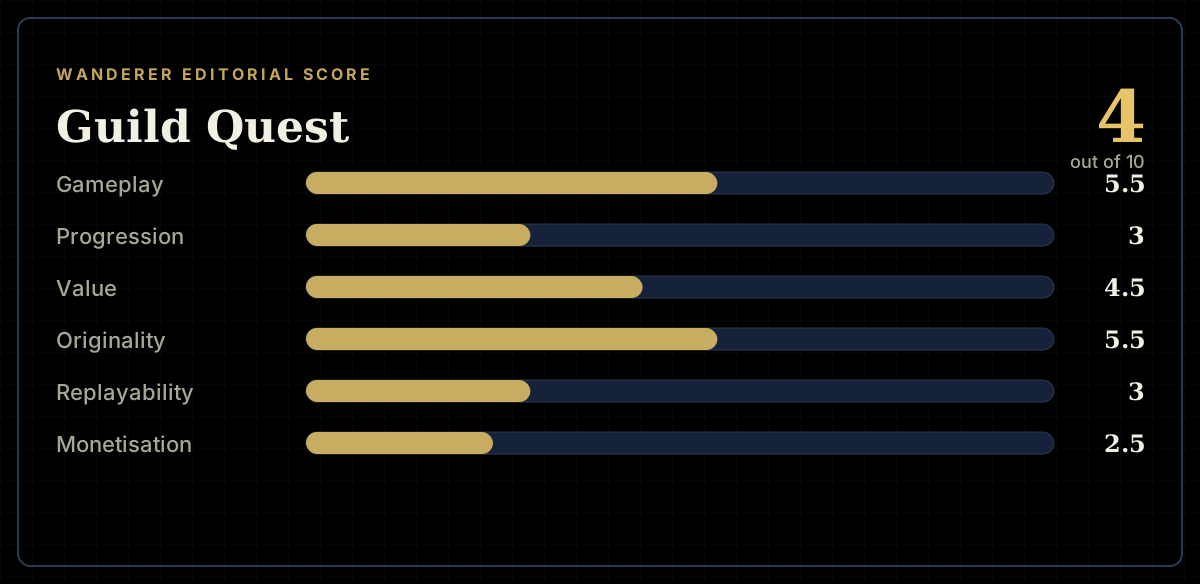
How the review scores each part of the gameWanderer Editorial -
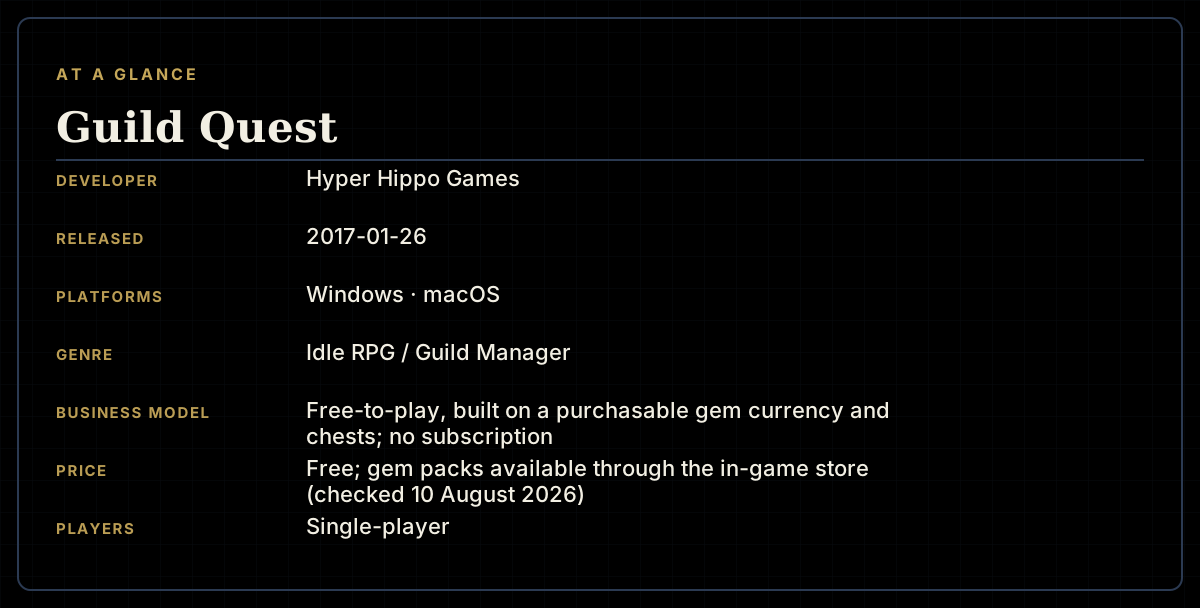
The game at a glanceWanderer Editorial -
The short versionWanderer Editorial