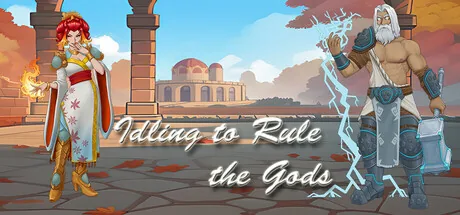
Game review
Idling to Rule the Gods
7 / 10
- Developer
- Shugasu GmbH (Ryu82)
- Publisher
- Shugasu GmbH
- Released
- 27 May 2016
- Platforms
- Windows, macOS, Linux, Android, Browser
- Genre
- Incremental RPG
- Monetisation
- Free to play. God Power, the game's core permanent-upgrade currency, can be earned entirely through play or bought directly in a Premium Shop, alongside a separate Lucky Draw gacha and cosmetic-and-convenience items
- Players
- Single-player, with a Discord community the developer points new players toward
The short version
Idling to Rule the Gods has been running since 2014 and it shows in both directions. The core idea — an army of shadow clones that trains, fights and dies on your behalf while you absorb everything they earn — is a genuinely clever spin on the idle-RPG premise, and the god-fight gates built on top of it give a formless genre something rare: real checkpoints. A decade of near-uninterrupted updates has piled system on top of system without the game ever really stopping to explain any of them.
The cost is presentation and patience. This is a mouse-only, tab-heavy browser game wearing a Steam client, its offline math has been the subject of confused community threads for years rather than months, and the sheer number of overlapping currencies means a new player is fighting the UI before they're fighting a single god. It is completely free to see everything in it, which buys it a lot of goodwill it wouldn't otherwise earn on looks alone.
Biggest strengths
- The shadow-clone loop is a genuinely distinct hook — you barely act directly, your clones do, and absorbing their gains is the whole game
- God fights function as real milestones in a genre that usually has none, giving each rebirth a concrete, visible target
- Over a decade of continuous free content, with patches still landing monthly through 2026 rather than tapering off
Biggest weaknesses
- The interface is a dense, unstyled wall of tabs, numbers and menus that has never had a real visual pass
- Onboarding assumes a wiki tab is open; the game itself explains only a fraction of what it hands you
- Offline and away progress runs at a reduced rate on several systems rather than the full online rate, and exactly how has confused players across years of forum threads
Who it's for: Idle-RPG veterans who want a decade-plus of systems to chew through and don't mind reading a wiki page before every major decision, not players looking for a clean first hour.
Our recommendation: Try it free on Kongregate or Android before committing to the Steam build — the save carries across platforms, and the first god fight is a fair test of whether the loop clicks before you invest further.
7 / 10
Most idle games ask you to imagine a worker you never see. Idling to Rule the Gods gives you an army of them instead, and names them after you. Shadow clones are the first thing the game hands you and the mechanic everything else is built around: you don't train stats directly so much as you create clones, put them to work training and fighting, and periodically absorb what they've earned into your own totals. It's a small reframing of the standard "click, buy, wait" idle loop, but it's the reason this game has a fanbase that measures its relationship with it in years rather than weeks, and it's the right place to start any honest account of why it has lasted this long.
A decade that started on Kongregate
Ryu82 — the developer credit behind Shugasu GmbH, the German studio that now owns the game — uploaded Idling to Rule the Gods to Kongregate on 1 October 2014, back when Flash-era browser portals were still where incremental games found their first audiences. It's still there. The Steam release followed in May 2016, and an Android build joined later, all of them sharing saves so a run started on a phone can keep going on desktop. That continuity is worth dwelling on: this isn't a browser prototype that got abandoned once the "real" Steam version shipped, and it isn't a Steam port that quietly stopped receiving love once the storefront listing existed. Patch notes were still landing in January, February and June of this year, adding new pet-village buildings, seasonal events and challenge modes — the kind of cadence you'd expect from a game two years old, not one closing in on twelve.
That longevity is both the pitch and the warning label. A system built up over a decade by one studio, patched continuously rather than rebuilt, accumulates depth the way a coral reef accumulates structure — genuinely impressive in aggregate, and genuinely hard to parse if you weren't there for each layer as it was added.
The clone economy, and why it works
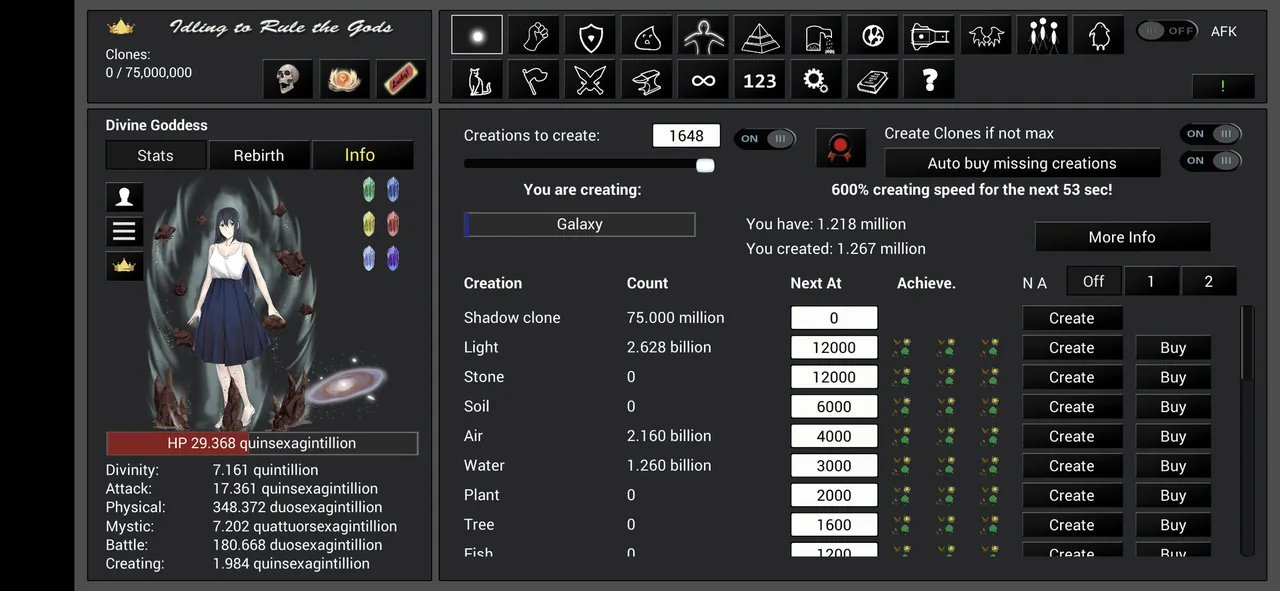
The opening hours are legible enough. You create shadow clones, up to a starting cap of a thousand, and assign them to train Physical and Mystic stats or fight low-level monsters. Every clone you make or lose nudges your cap upward for the next reset, so even failure is quietly productive. Your own character absorbs a share of whatever the clones accomplish, and once your absorbed stats clear a threshold, you take the fight to Hyperion — the first god, and the game's first real wall. Beat him and you rebirth: your run resets, but the increased clone cap, the unlocked recipes and the permanent God Power you earned all carry forward, and the next attempt starts from a meaningfully higher floor.
It's a clean idea executed with real conviction. Where a lot of idle RPGs dress up a single resource curve as "combat," Idling to Rule the Gods gives the loop an actual division of labour — the clones grind, you absorb, the gods gate — and the gating is what elevates it. Sequential boss fights against named gods (Hyperion, then Baal, then further into an escalating pantheon) turn an otherwise formless number-go-up game into something with visible checkpoints. Knowing you're "working toward beating the next god" is a much more concrete goal than "wait for the number to get bigger," and it's the single best design decision in the game.
Everything that gets bolted on afterward
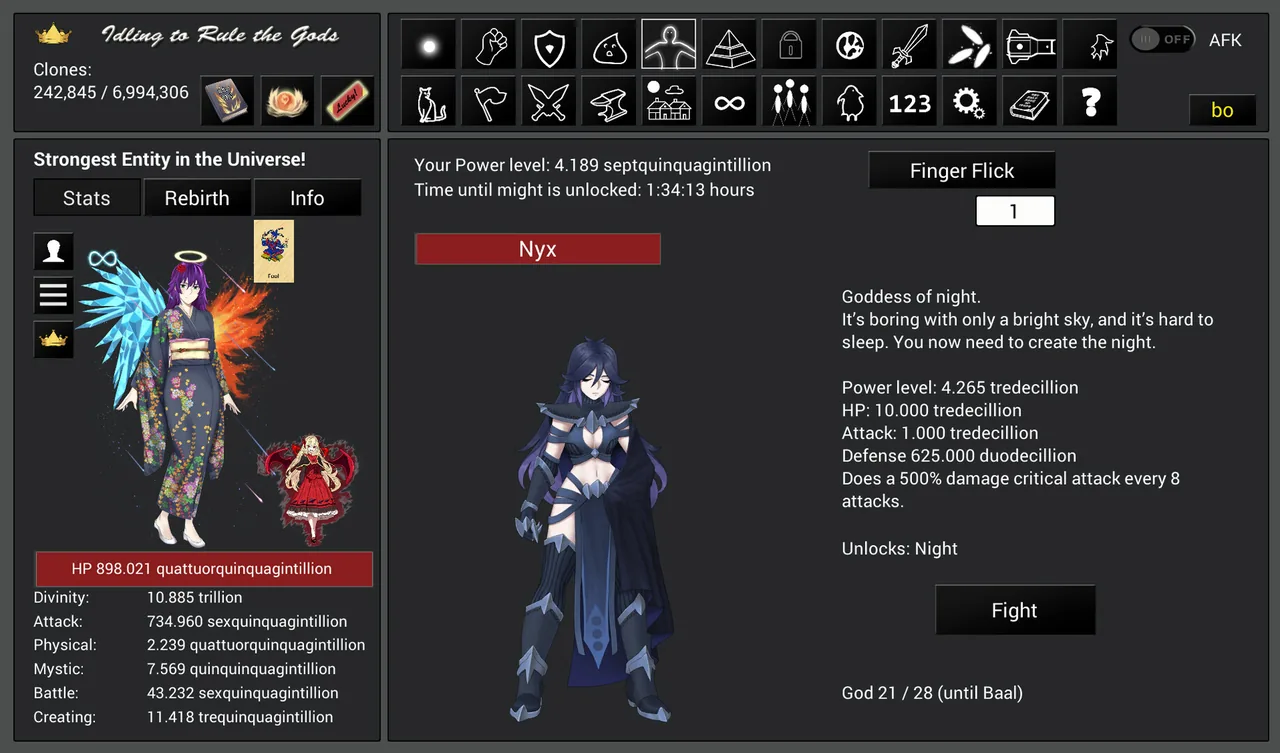
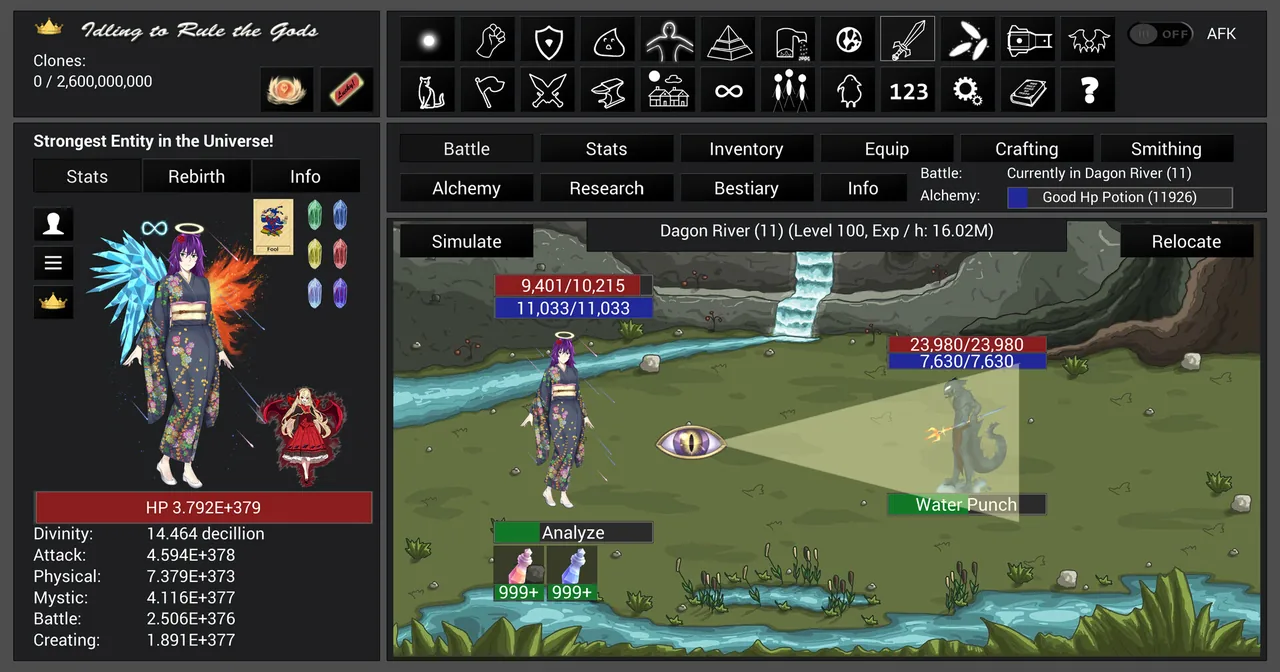
Past the first few rebirths, the game stops being one system and becomes a dozen loosely federated ones. Monuments provide permanent multipliers once specific gods fall. A Crystal Factory converts resources into stat-boosting crystals. Pets are trained, sent on campaigns, and eventually crafted into dungeon-crawling equipment through a whole sub-game of their own. Post-Baal content adds a critical-damage minigame, an Adventure mode with character classes, a card game for farming pet food, and a currency called Baal Power that behaves like a second God Power with its own spending tree. Challenges layer meta-goals — clearing them unlocks entire tabs, like the Crystal Factory or a "Ultimate Beings" combat system, that don't exist for players who haven't earned them yet.
None of this is bad design in isolation. Each system solves a real problem — what to do with spare resources, how to keep late-game progress from flatlining, how to give a decade-old game somewhere new to grow — and taken individually, most of them are reasonably well balanced against each other. The problem is that the game rarely stops to tell you why a given system exists or how it connects to the ones you already understand. A New Players Guide exists on the community wiki because the in-game tutorial doesn't cover nearly enough of this, and Idling to Rule the Gods leans on that guide, and on its own Discord, as a substitute for onboarding rather than a supplement to it. That's a defensible choice for a passion project that grew organically over eleven years. It is also, bluntly, a real cost to a player arriving today with no context.
Offline progress: real, but not the full rate
Idling to Rule the Gods does let you close the game and come back to progress, which is table stakes for the genre at this point. What's less table-stakes is how partial that progress is. Several systems only credit a fraction of the away-time rate rather than the full online one, and the exact mechanics of how much and under what conditions have been the subject of confused, recurring community discussion for years rather than a single well-documented FAQ entry — threads asking why a monument didn't advance overnight, or why offline creation speed capped out well short of the time actually spent away, are a running feature of the game's Steam forum rather than an occasional complaint. None of that makes the offline system broken; clones still work, gods still fall, and the numbers still climb while you're gone. But it means "how much did I actually gain overnight" is a question this game answers less cleanly than most of its modern competitors, and a player coming from a genre where away time is close to 1:1 should adjust expectations before judging the pacing.
Presentation and monetisation
Visually, this is exactly what a 2014 Flash-era browser idler looks like after a decade of feature additions and no real redesign: dense menus, small icons, walls of numbers, and an interface that communicates through tabs rather than scenes. It works, in the sense that everything is technically reachable, but nothing about it is pleasant to look at, and it hasn't been meaningfully modernised even as the systems underneath it multiplied. Mouse-only controls on desktop and a touch-adapted rather than touch-designed layout on Android reinforce the sense of a game that has never had a UI budget, only a content budget.
Monetisation sits in a similar place: not predatory, but not shy either. A Premium Shop sells God Power directly, alongside Lucky Draws — a gacha-style pull for rewards ranging from a small amount of God Power to rarer bonuses — and Daily Packs that bundle a few currencies together. Every one of those currencies is also earnable for free, through god kills, monument output, pet campaigns and challenge rewards, so nothing is genuinely locked behind spending. What the shop actually sells is speed, which is the honest version of free-to-play monetisation and the version this genre can mostly live with. Whether a decade-old, still-actively-monetised gacha layer belongs in a 2026 idle game is a fair question to sit with, but it isn't a trap: the free path stays open the entire time.
Who this is actually for
This isn't a review that can recommend Idling to Rule the Gods to someone who wants a clean first hour. The onboarding is thin, the interface is unfriendly, and the offline math will frustrate anyone expecting the away-time clarity that newer idle RPGs have made standard. What it can recommend, without much hedging, is the game to a player who already knows they like this genre and wants a system with real years of accumulated depth behind it — the shadow-clone loop is smart, the god-fight structure gives it shape a lot of idle RPGs lack, and there is, quite simply, an enormous amount of game here for zero dollars. Ten years of continuous free updates is not a small thing to have earned, and the fact that this studio is still shipping content in 2026 for a game that started on Kongregate says something honest about the relationship between developer and audience that a lot of shinier, better-funded idlers never manage to build.
Wanderer's own progression leans the other way on purpose — a single road east, gear you can see on your character, no gacha shop sitting next to the free currency. Players who want that same sense of a world getting harder as you push forward, without the spreadsheet overhead, might find Wanderer the more comfortable fit; players who want the spreadsheet overhead as the whole point should give Idling to Rule the Gods the time its first god fight deserves before deciding.
Verdict
Seven out of ten. The core hook is genuinely good, the boss-gated rebirth structure is smarter than most of the genre's, and a completely free decade-plus of content is hard to argue with on value alone. What holds it out of the top tier is everything around that hook: a UI that has never been rebuilt for the game it grew into, an onboarding pass that still assumes a wiki tab, and an offline system whose own community isn't fully sure how it works. Idling to Rule the Gods earned its long-haul reputation the honest way — one update at a time, for eleven years — and it asks a comparable investment of patience from anyone arriving now to catch up.
Pros and cons
Pros
- The shadow-clone loop is a genuinely distinct hook — you barely act directly, your clones do, and absorbing their gains is the whole game
- God fights function as real milestones in a genre that usually has none, giving each rebirth a concrete, visible target
- Over a decade of continuous free content, with patches still landing monthly through 2026 rather than tapering off
- Nothing is paywalled — God Power, the premium currency, is earnable through ordinary play at every stage
- Runs on almost anything, with saves syncing across Steam, Kongregate, browser and Android
Cons
- The interface is a dense, unstyled wall of tabs, numbers and menus that has never had a real visual pass
- Onboarding assumes a wiki tab is open; the game itself explains only a fraction of what it hands you
- Offline and away progress runs at a reduced rate on several systems rather than the full online rate, and exactly how has confused players across years of forum threads
- Mouse-only with no controller support, and the touch-adapted Android build is a compromise rather than a redesign
- A Premium Shop and gacha-style Lucky Draws sit next to the free currency path, and while nothing is locked behind them, their presence in a 2026 build still reads as dated design
Screenshots
-
Idling to Rule the GodsImage: Shugasu GmbH via Steam -
Idling to Rule the GodsImage: Shugasu GmbH via Steam -
Idling to Rule the GodsImage: Shugasu GmbH via Steam -
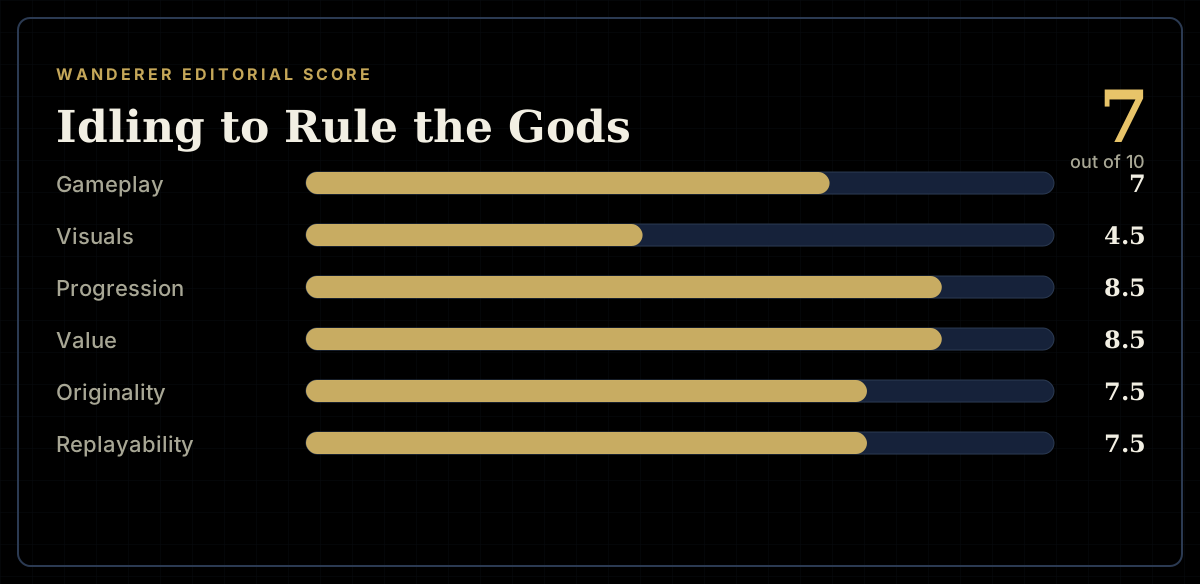
How the review scores each part of the gameWanderer Editorial -
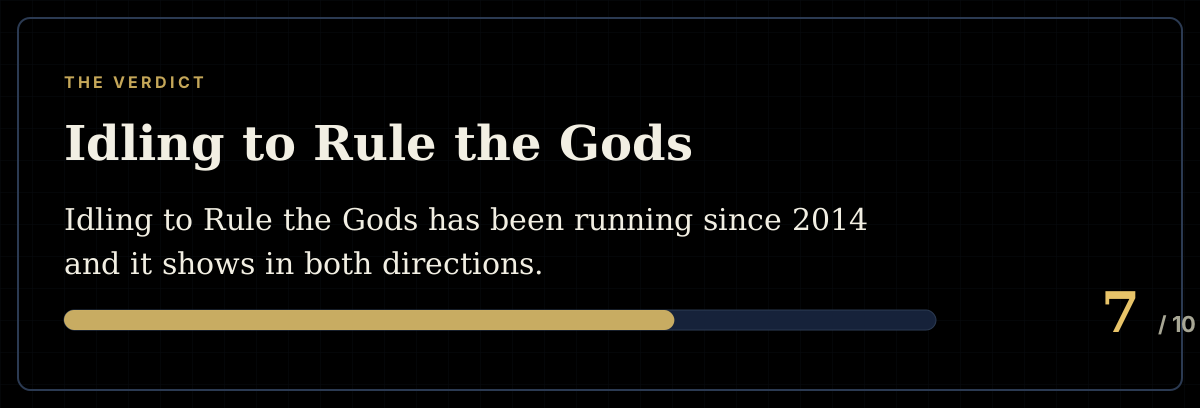
The short versionWanderer Editorial