Game review
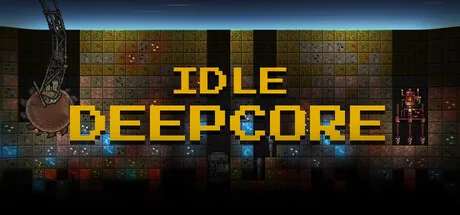
Idle Deepcore
7.5 / 10
- Developer
- Bluehood Games
- Publisher
- Bluehood Games
- Released
- 14 April 2026
- Platforms
- Windows
- Genre
- Incremental Simulation
- Monetisation
- One-time purchase on Steam, no ads, no in-app purchases, no energy timers
- Players
- Single-player
The short version
Idle Deepcore takes the familiar dig-smelt-upgrade loop of the incremental mining subgenre and gives it real shape: a claimable world map splits your attention across several mines running in parallel, and the climb from a hand-swung pickaxe to steam drills and furnace lines is paced generously enough that quitting for the night never feels like it costs you anything. The trouble starts once the game's marquee systems kick in. Prestiging is meant to open the door to automation, rockets and asteroid mining, but the reset math undercuts its own pitch — the payout rarely justifies what you give up, and the automation you've been promised turns out to only half deliver, letting you pick what gets bought without ever letting you say in what order.
At seven dollars with no ads, no premium currency and no timers standing between you and the next furnace tier, it's an easy recommendation for the opening stretch alone. Just don't go in expecting the prestige loop to be the reason you stay.
Biggest strengths
- The early loop of manual mining into ore, smelting into ingots and reinvesting into faster drills and bigger furnaces is tuned well enough that new upgrades keep arriving right as the old ones stop mattering
- Claiming separate mining zones on the world map turns "what do I upgrade next" into "which site is worth developing next," a genuine strategic layer most miner-idles skip
- A flat $6.99 with no ads, no gacha currency and no energy system is a rare and welcome deal in a genre that leans heavily on free-to-play
Biggest weaknesses
- The prestige reset is widely reported to pay out far less than it costs to trigger, leaving several players finishing the game having prestiged once or twice rather than the dozens of times the system seems built around
- The automation panel lets you choose what a routine buys but not the order it buys things in, which blunts the exact kind of fine control an automation system is supposed to hand you
- Once the late-game systems (asteroid mining, rocket launches, the tech lab) unlock, several of the reward numbers are trivially exceeded within a single run, leaving little reason to push further prestiges
Who it's for: Incremental and idle-game players who want a mining loop with an actual map to plan around, and anyone burned out on free-to-play idles who wants a clean premium alternative with no ad breaks.
Our recommendation: Worth the asking price for the first ten to twenty hours on its own merits. Go in treating the prestige layer as a bonus mode rather than the main event, and you won't be disappointed when it underdelivers.
7.5 / 10
The loop before the prestige button
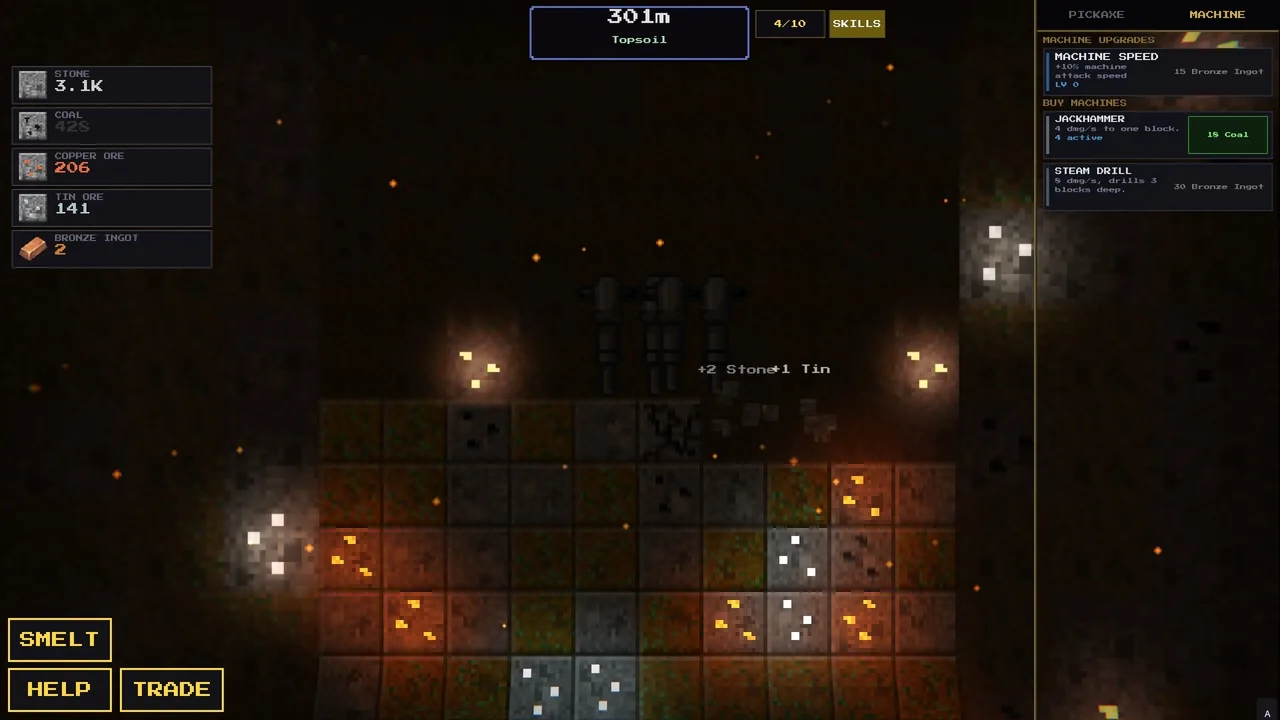
Idle Deepcore opens exactly where you'd expect an incremental mining game to open: a single seam, a single pickaxe, and a screen that fills up with raw ore faster than you can decide what to do with it. The smart move early on is resisting the urge to just click faster. Ore alone doesn't buy anything — it has to go through the smeltery and come out the other side as ingots before it's worth spending, and that one extra conversion step does more for the game's pacing than it looks like it should. It forces you to think in terms of throughput rather than raw output, which is the difference between an incremental game that feels like a spreadsheet and one that feels like a production line.
What sets Deepcore apart from the glut of "tap the rock, buy the upgrade" mining idles it's obviously drawing from is the world map. Rather than digging one ever-deeper shaft, you claim separate zones, each with its own terrain and its own ceiling on what it can produce, and you decide where fresh investment goes. Early on that's a minor flavour touch — you don't have the capital to run more than one site properly — but by the time you're juggling three or four claimed zones with different upgrade priorities, it's doing real work as a resource-allocation puzzle rather than a single number going up.
Automation promises more control than it gives
The tech lab is where Deepcore tries to graduate from "idle clicker" to "management sim," and on paper the pitch is exactly right: unlock automation nodes, wire them into routines built from action and condition blocks, and let a steady tick evaluate those routines so your mines keep running while you're doing something else. Routines persist through a prestige reset too, which matters in a genre where losing your setup every time you restart is a common source of quiet resentment.
The gap between the pitch and the execution shows up fast once you actually try to build something with it. You can tell a routine which upgrades to buy, but not the sequence to buy them in — and in a game where upgrade ordering is frequently the entire skill of the mid-game, that's a strange thing to leave out. The result is an automation system that removes drudgery without removing decision-making, which sounds like a fair trade until you notice the decisions it's removing are the more interesting ones and the ones it's leaving behind are the repetitive ones.
The prestige layer is where the pacing breaks
Prestiging is the game's biggest single moment: it's the gate that opens rockets, asteroid mining, new resource chains, a new furnace tier and the automation system all at once, dressed up as the reward for finishing your first serious run. It's a lot to unlock in one go, and that's part of the problem — a system pitched as the long game's backbone needs the reset cost to feel worth paying more than once, and the recurring complaint across player feedback is that it doesn't. The currency you bank from prestiging is consistently reported as generous enough to buy everything worth having after a single reset, which means the dozens of prestiges the system seems designed to support just don't happen. Players report finishing runs having prestiged once or twice, sometimes concluding they could have gone faster with zero prestiges at all rather than sinking time into a reset that set them back further than it paid forward.
That's a real design problem rather than a difficulty complaint, because it undercuts the exact system the marketing leans on hardest. The core mine-smelt-upgrade loop being strong enough to carry the opening ten hours on its own is a compliment to that loop, not a fix for what happens after it hands off to prestige.
Presentation and value
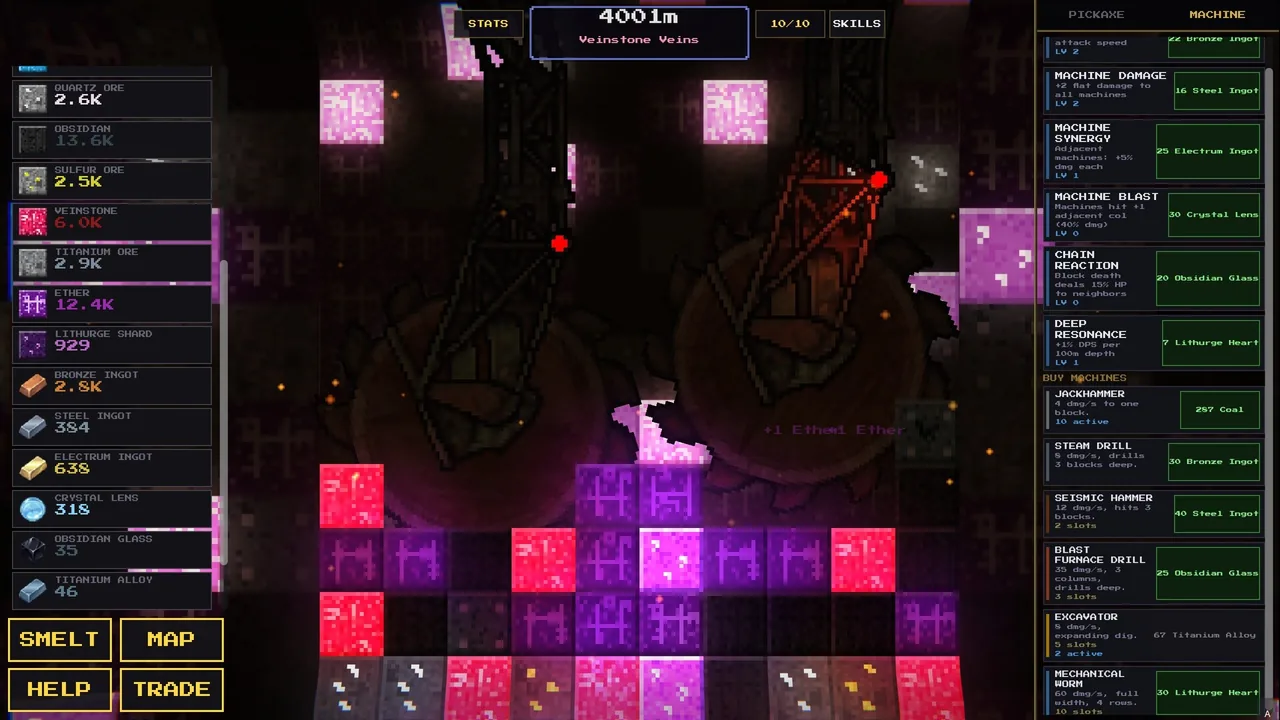
Deepcore isn't chasing a distinctive visual identity — it's a functional, readable incremental interface built around a mine cross-section and a zoomable world map, doing exactly what the genre needs and nothing more. The soundtrack has drawn more specific praise from players than the visuals have, which tracks with a game that expects to run in a corner of your screen for long stretches rather than hold your full attention.
Where Deepcore earns real credit is the business model. Seven dollars, paid once, for a Steam release with no ad breaks, no premium currency and no energy meter gating how much you can play in a sitting puts it well ahead of most of its genre neighbours on value alone — a real point in its favour given how much of the incremental space runs on exactly those levers. It's worth knowing that Bluehood Games also ships a free-to-play mobile version of Deepcore carrying ads and in-app purchases; that's a separate product with a separate deal, and the clean pitch here is specific to the Steam release.
Final verdict
Idle Deepcore is a well-built incremental mining game let down by the one system it built its whole back half around. The mine-smelt-upgrade loop, the parallel-mine world map and the fair asking price make the opening stretch genuinely easy to recommend, and the frequency of post-launch patches suggests Bluehood Games is still actively tuning the game rather than treating it as finished. But the prestige economy and the half-finished automation system are the parts doing the heaviest lifting in the pitch, and right now they're the parts most likely to leave a player wondering why they bothered resetting at all. Buy it for the first ten hours. Stay only if you're willing to treat everything past the first prestige as a bonus rather than the point.
Players who like a persistent world that keeps ticking over while they're away from the keyboard, without needing a prestige reset to make that progress worthwhile, may also want to look at Wanderer.
Pros and cons
Pros
- The early loop of manual mining into ore, smelting into ingots and reinvesting into faster drills and bigger furnaces is tuned well enough that new upgrades keep arriving right as the old ones stop mattering
- Claiming separate mining zones on the world map turns "what do I upgrade next" into "which site is worth developing next," a genuine strategic layer most miner-idles skip
- A flat $6.99 with no ads, no gacha currency and no energy system is a rare and welcome deal in a genre that leans heavily on free-to-play
- Frequent content patches since launch have added achievements and smoothed early rough edges, evidence of a developer still working the game
Cons
- The prestige reset is widely reported to pay out far less than it costs to trigger, leaving several players finishing the game having prestiged once or twice rather than the dozens of times the system seems built around
- The automation panel lets you choose what a routine buys but not the order it buys things in, which blunts the exact kind of fine control an automation system is supposed to hand you
- Once the late-game systems (asteroid mining, rocket launches, the tech lab) unlock, several of the reward numbers are trivially exceeded within a single run, leaving little reason to push further prestiges
- A separate free-to-play mobile release under the same name carries ads and in-app purchases, so the "no ads, no IAP" pitch applies to the Steam version specifically, not the brand as a whole
Screenshots
-
Idle DeepcoreImage: Bluehood Games via Steam -
Idle DeepcoreImage: Bluehood Games via Steam -
Idle DeepcoreImage: Bluehood Games via Steam -
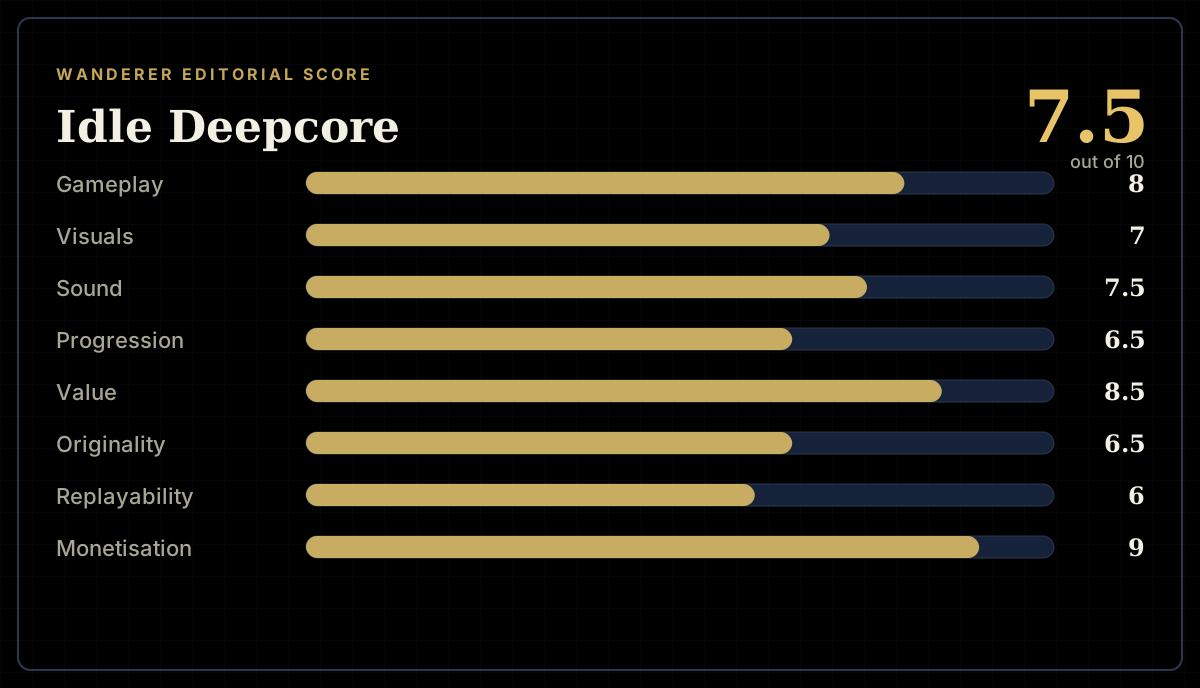
How the review scores each part of the gameWanderer Editorial -
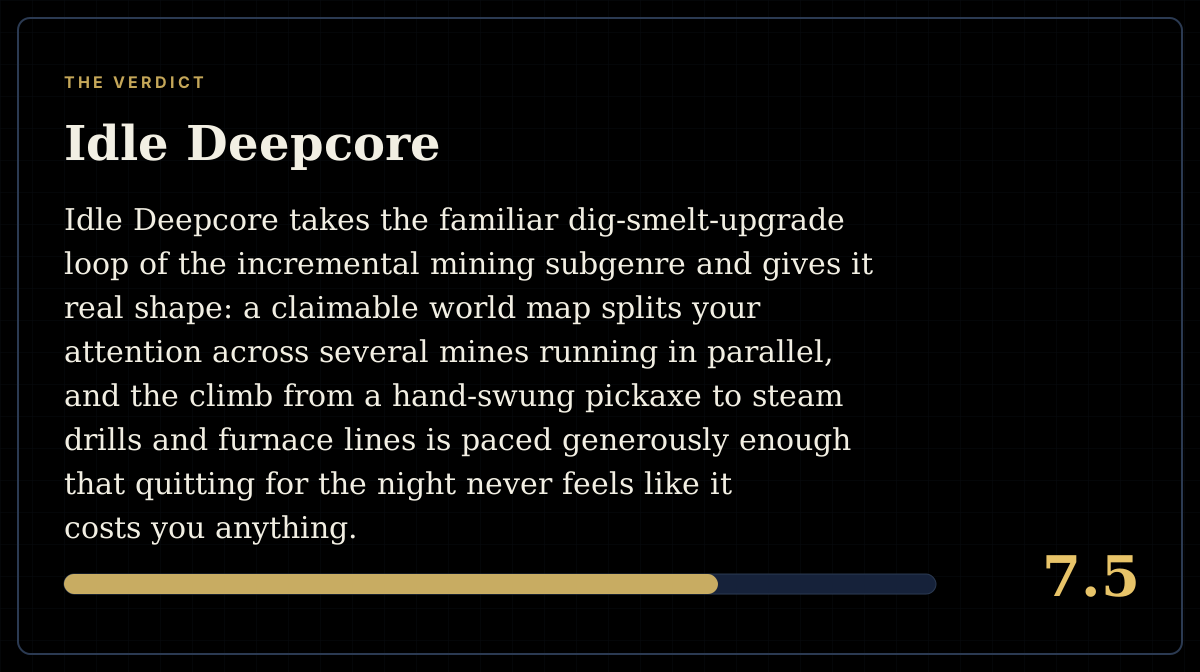
The short versionWanderer Editorial