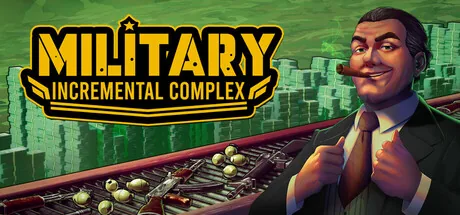
Game review
Military Incremental Complex
6.5 / 10
- Developer
- Space Kraken Studios
- Publisher
- Space Kraken Studios
- Released
- 21 November 2025
- Platforms
- Windows
- Genre
- Idle Simulation
- Monetisation
- Premium, one-time purchase, no in-app purchases or DLC add to the core loop
- Players
- None; single-player with Steam Cloud saves and leaderboards
The short version
Military Incremental Complex takes the standard incremental shape — click, automate, research, prestige — and welds a satirical arms-dealer theme onto it that actually lands: you hand-crank bullets, then whole factories, then lobby Congress for looser regulations and better contracts on the way to a literal nuke. The manufacturing minigames and the political-commentary tone are the best things about it. What holds it back is the back half of the game: a stock market that reviewers repeatedly describe as trivialising every other system once it opens up, a prestige loop several players call more chore than strategy, and a second wave of achievements added after launch that a meaningful slice of the review sample says simply do not fire.
It's a well-made three-to-fifteen-hour idler with real personality, sold at a price several players think is steep for that length, and currently going through a rough patch on completion tracking that anyone chasing 100% should check on before buying.
Biggest strengths
- The manual crafting minigames — winding a bullet press, timing a grenade pin, balancing a slider for artillery shells — give the early game a tactile identity most incrementals skip entirely, and reviewers who bounced off the late game still praise this part
- The satirical framing holds together end to end, from lobbying "fewer regulations, better contracts" to an achievement literally named "$1B"; several players single out the writing and 1990s-desktop presentation as the game's most distinctive feature
- A genuinely playable demo that carried real progress into the full release for buyers, letting prospective players test the exact manufacturing loop before paying
Biggest weaknesses
- Once the stock market unlocks, a large share of negative reviews independently describe it swallowing the rest of the game: dividends and automatic buybacks reportedly outproduce every manufacturing line combined, leaving research and factory upgrades feeling optional
- A second wave of achievements added after launch is the single most repeated complaint in the current review sample; Steam's own global stats show several "no failed attempts" manufacturing streak achievements sitting under 3% completion, well below what a working, fairly-tuned achievement should show
- The core loop is short for the asking price — multiple reviewers report finishing a first prestige run and "seeing everything" within three to ten hours, with 100% completion the main source of remaining playtime
Who it's for: Incremental fans who want a game with a satirical hook and hands-on manufacturing minigames rather than pure numbers, and who don't mind a shortish, front-loaded campaign.
Our recommendation: Worth it at a discount, or if the demo's manual-crafting loop hooks you; achievement hunters should read the current reviews for the achievement-bug status before buying at full price.
6.5 / 10
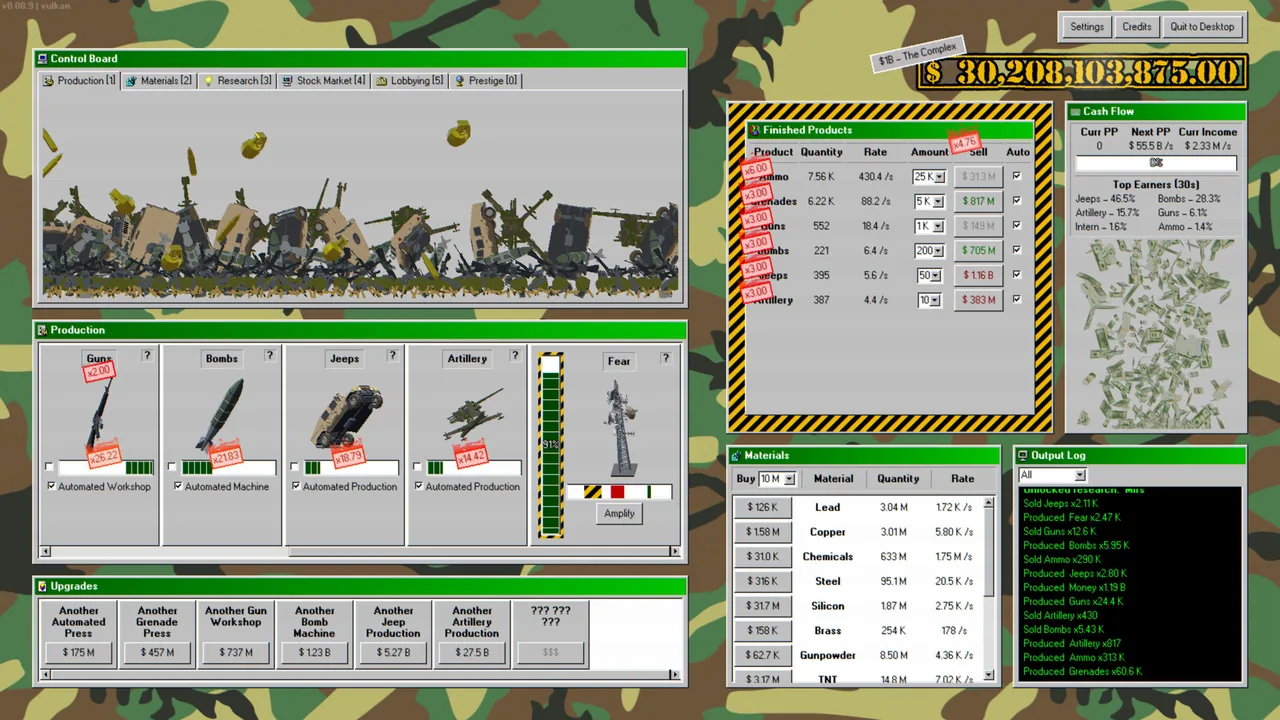
Most incrementals ask you to imagine what your numbers represent. Military Incremental Complex shows you: a hand-crank bullet press you have to wind yourself, a grenade pin you time by feel, an artillery shell you balance on a wobbling slider before it's ready to ship. It's an incremental game about building a weapons manufacturer from a garage operation into a company that lobbies Congress and launches nukes, and for the first several hours, the satire and the manufacturing minigames make it one of the more distinctive-feeling entries the genre has produced this year. The trouble starts once the stock market opens and the game's own economy stops needing you.
Hand-cranked bullets to Congress
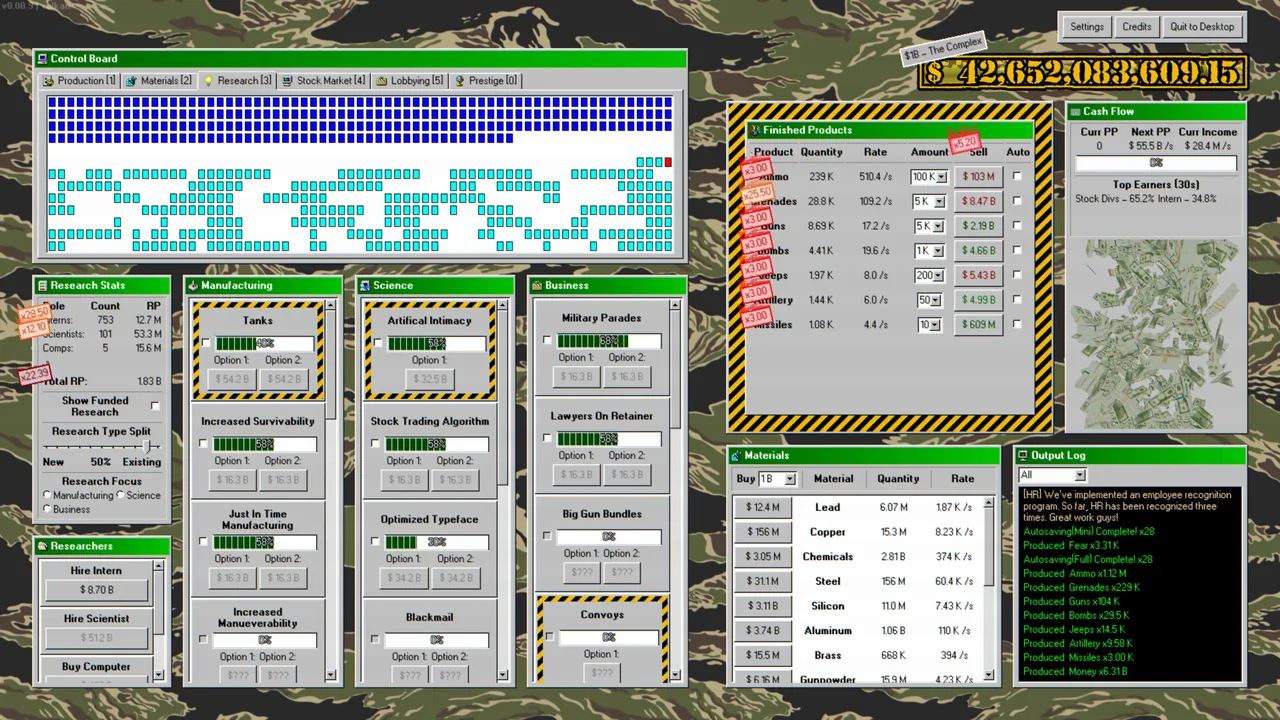
The pitch is straightforward: start making bullets by hand, graduate to machines, then whole factories, and keep climbing until the eleven-weapon roster — guns, tanks, planes, and eventually a nuke — is fully automated. Layered on top are 120-plus research upgrades, nine public companies to invest in, six government lobbying paths, and more than 280 upgrades in total. It's a lot of systems for an idler, and the game earns the complexity early by giving each weapon its own distinct manual-assembly minigame rather than a single generic "click here" loop. Reviewers who liked the game consistently point to this part first: one calls the building and upgrading "super satisfying," another describes staying up past 2am on launch weekend specifically because the manual crafting kept pulling them back in.
The writing carries its share of the load too. The tone sits somewhere between Cookie Clicker's absurdism and a pointed joke about defence contracting — lobbying for "fewer regulations, better contracts, and more demand," an achievement literally titled "$1B," a retro Windows-98 desktop skin wrapped around the whole enterprise. One player summed it up asking whether the game was "biting commentary on the world and the people who profit on proliferating weapons... or if it is just a game about numbers going up," and concluding it can comfortably be both. That double reading is doing real work: it gives an otherwise standard incremental structure a reason to exist beyond the mechanics.
The stock market problem
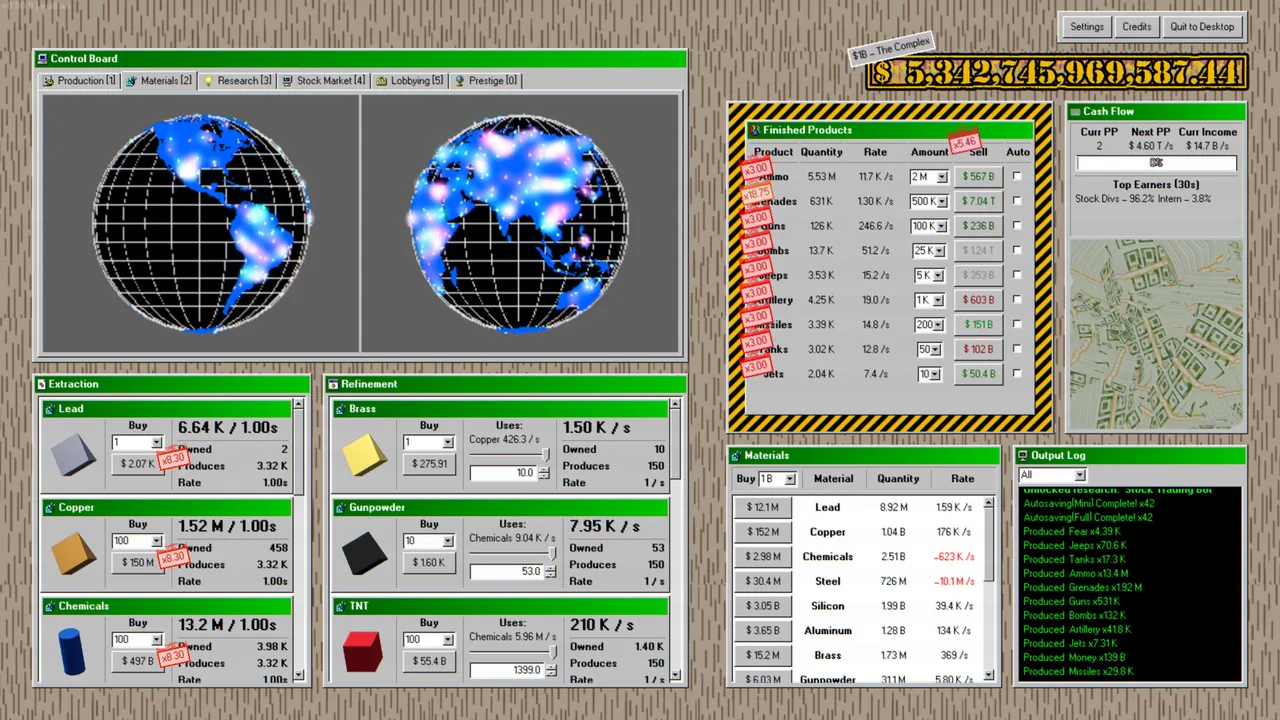
The most consistent complaint in the negative review sample is structural rather than cosmetic. Once players unlock the stock market, several describe it quietly taking over the game: "once you get access to the stock market you can basically ignore nearly every other mechanic," reads one detailed review, and another independently arrives at the same conclusion — "dividends from stock accounted for about 98% of my income" by the midgame. A third reviewer puts numbers on it directly: "once you open the stock market and get free automatic purchases, the entire rest of the game is pointless... you're just waiting for free stocks then all of the weapons crafting is entirely pointless." That's three independent accounts converging on the same specific mechanical shape, which is stronger evidence of a genuine balance gap than any one frustrated post.
It's a shame because the systems being trivialised are the game's best ideas — the manual crafting, the factory automation, the research tree the marketing leans on. A design built around eleven distinct weapon-manufacturing chains loses a lot of its point if one passive investment loop out-earns all of them combined by the time a run is half over.
Prestige, and the achievement wave that broke it
Prestiging resets progress for permanent multipliers, and here the sample splits along a familiar incremental fault line: some players enjoy the build variety across the 35-plus prestige abilities, while a larger group describes the loop itself as tedious rather than strategic, one calling it "too slow and tedious and just not fun" after a few resets, another comparing repeat manual crafting after every prestige to being "a victorian child in coal mines."
The sharper, more recent problem is achievements. A wave of new achievements added after launch is the single most repeated complaint in the current sample, and it shows up as a distinct dip in recent sentiment: Steam's lifetime score sits at Very Positive (469 of 566, 83%), but the recent window — weighted toward players who bought in after that update — reads Mostly Positive (121 of 159, 76%). Individual reports back that gap up with specifics: "I have completed the game including launching the nuke and I only have 57/96 achievements because they don't trigger," and "new achievements are buggy and not counting." Steam's own global achievement statistics support this rather than just repeating player claims — several "no failed attempts" manufacturing-streak achievements (perfect, unbroken runs of bombs, tanks, jets, ships, artillery) sit at completion rates between 0.9% and 2.5% across the entire player base, an unusually low floor for a game where over 60% of players have finished basic story milestones. Some of that gap is legitimate difficulty — several reviewers confirm the streak requirements are simply harsh, wanting "50 in a row" reduced to something more forgiving — but the volume of "doesn't trigger" reports specifically suggests a real bug sitting underneath the difficulty complaint, not just a hard achievement.
The game's own storefront also discloses AI-assisted development directly: "We used AI to help write some of the code for the game, as well as to help generate some of the story beats and upgrade descriptions." A few reviewers cite that disclosure as a factor in their price complaints specifically, arguing the asking price should reflect it; it's worth knowing about going in either way, since Space Kraken Studios states it plainly rather than leaving it to be discovered.
Length, price, and stability
Multiple reviewers reach the same rough number independently: three to ten hours to see the whole game once, with 100% completion — now complicated by the achievement issue above — accounting for most of the time beyond that. At around NZ$15, that reads as expensive to a chunk of the sample next to free or cheaper incrementals with more raw content, even from players who otherwise enjoyed their time with it. A smaller but consistent group also reports crashes tied to specific actions — opening the materials tab, selling items manually, finishing the nuke sequence — severe enough in a few cases to block further progress entirely until a patch lands.
None of this erases what the game does well. The manual-crafting identity and the satirical framing are still the reasons to seek this out over a more generic clicker, and the demo remains an honest way to test whether that hook works for you before paying anything.
Final verdict
Military Incremental Complex has a real idea — an incremental about the weapons trade, with manufacturing minigames tactile enough to matter and satire sharp enough to be worth reading — and it delivers on that idea for the first several hours better than most genre entries manage. It loses momentum where a lot of incrementals do: a late-game system that outpaces everything else, a prestige loop that trades strategy for repetition for a chunk of its audience, and right now, a specific and well-corroborated achievement bug that's souring exactly the players who liked it enough to chase 100%.
Recommended for incremental fans drawn to the theme and the hands-on crafting, ideally at a discount or after trying the demo, with achievement hunters advised to check current patch notes before buying at full price. Players who want that same blend of active building and idle automation, minus the completion-tracking headaches, might also want to look at Wanderer.
Pros and cons
Pros
- The manual crafting minigames — winding a bullet press, timing a grenade pin, balancing a slider for artillery shells — give the early game a tactile identity most incrementals skip entirely, and reviewers who bounced off the late game still praise this part
- The satirical framing holds together end to end, from lobbying "fewer regulations, better contracts" to an achievement literally named "$1B"; several players single out the writing and 1990s-desktop presentation as the game's most distinctive feature
- A genuinely playable demo that carried real progress into the full release for buyers, letting prospective players test the exact manufacturing loop before paying
- Six government lobbying paths and 35-plus prestige abilities give experienced players real build variety across repeat runs, not just a single optimal line
- Active, visible post-launch support — the developer has shipped balance changes and patches addressing specific community complaints since November
Cons
- Once the stock market unlocks, a large share of negative reviews independently describe it swallowing the rest of the game: dividends and automatic buybacks reportedly outproduce every manufacturing line combined, leaving research and factory upgrades feeling optional
- A second wave of achievements added after launch is the single most repeated complaint in the current review sample; Steam's own global stats show several "no failed attempts" manufacturing streak achievements sitting under 3% completion, well below what a working, fairly-tuned achievement should show
- The core loop is short for the asking price — multiple reviewers report finishing a first prestige run and "seeing everything" within three to ten hours, with 100% completion the main source of remaining playtime
- Manual crafting, which is the game's best idea early on, becomes a punishing chore for completionists once later achievements demand long unbroken streaks of perfect assembly
- A handful of reviewers report crashes tied to specific actions — opening the materials tab, selling items manually, or completing the nuke sequence — severe enough in some cases to block further progress until patched
Screenshots
-
Military Incremental ComplexImage: Space Kraken Studios via Steam -
Military Incremental ComplexImage: Space Kraken Studios via Steam -
Military Incremental ComplexImage: Space Kraken Studios via Steam -
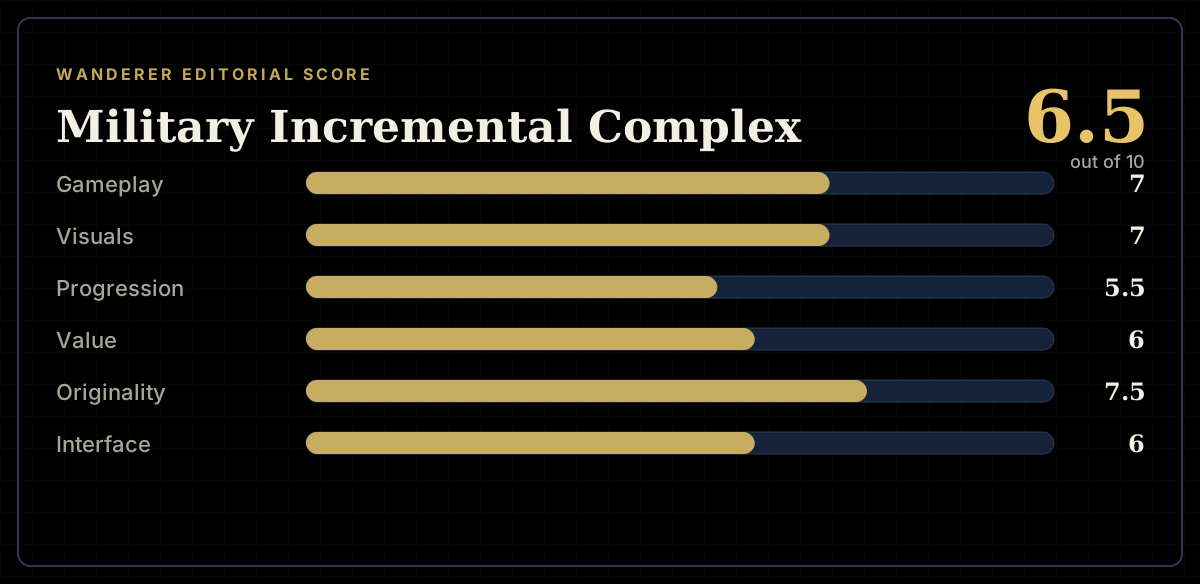
How the review scores each part of the gameWanderer Editorial -
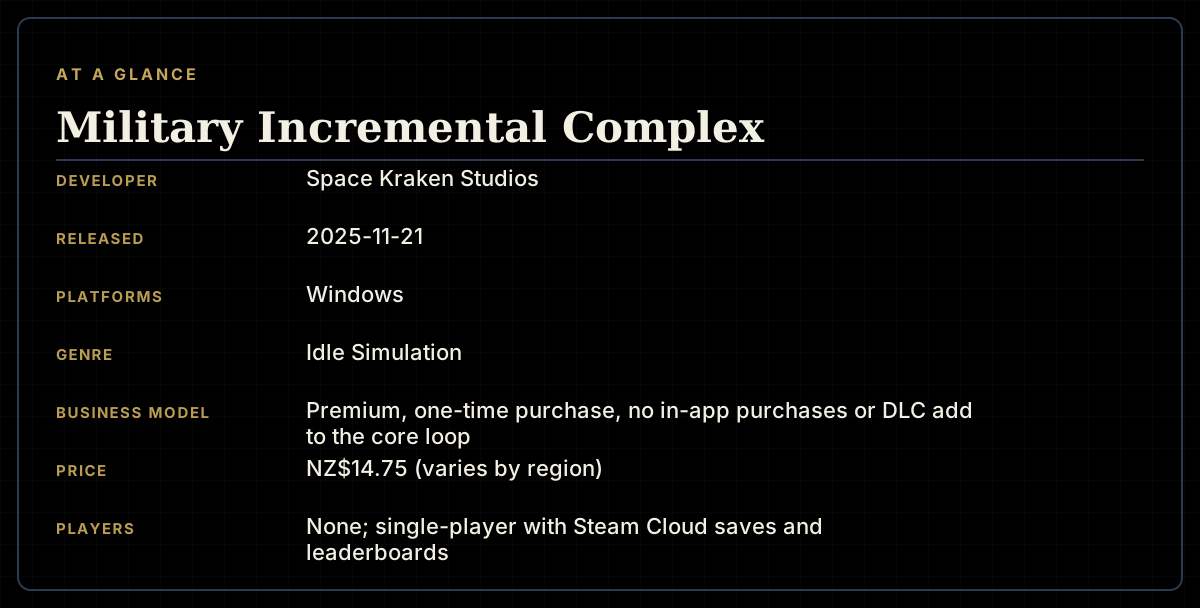
The game at a glanceWanderer Editorial -
The short versionWanderer Editorial