
Game review
Oxygen Not Included
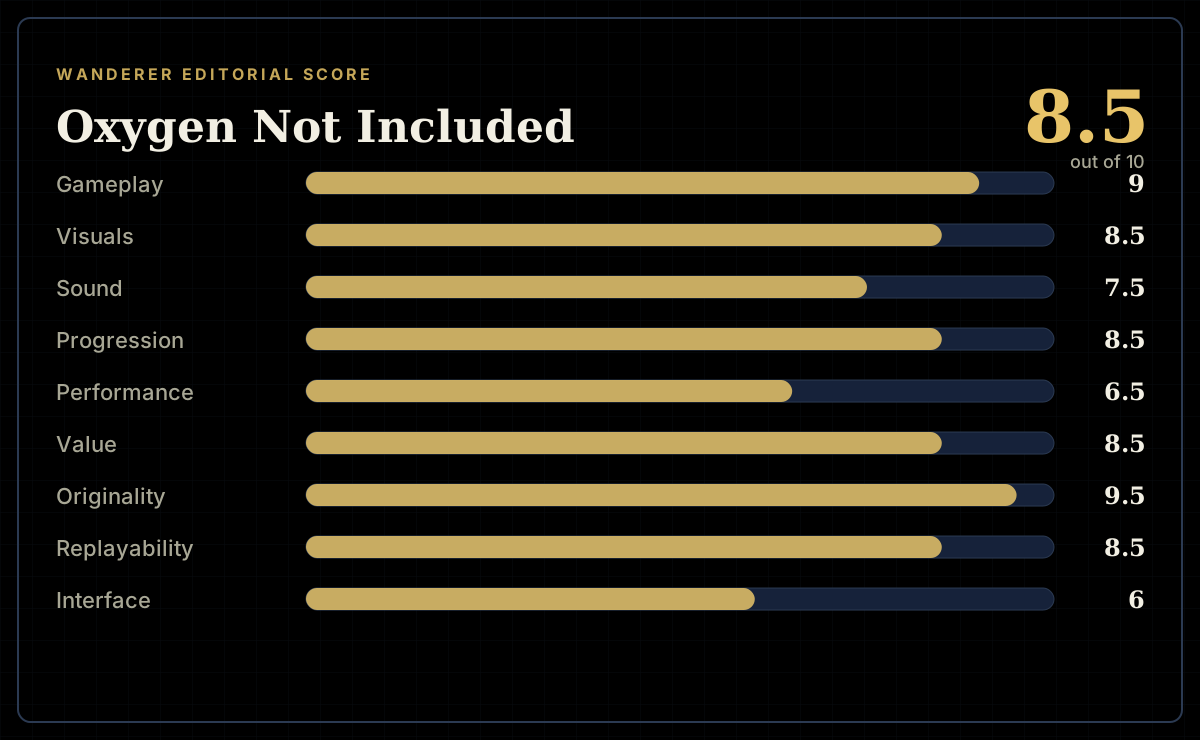
8.5 / 10
- Developer
- Klei Entertainment
- Publisher
- Klei Entertainment
- Released
- 30 July 2019
- Platforms
- Windows, macOS, Linux
- Genre
- Colony survival simulation
- Monetisation
- Premium, one-off purchase — no in-game currency, ads or energy systems. Six paid DLC packs exist on top of the base game (one major expansion, four content packs and one cosmetics pack), plus an optional soundtrack; none of it is required to finish a colony
- Players
- Single-player only, no co-op or competitive mode
The short version
Oxygen Not Included takes the number-go-up instinct that drives every progression game and points it somewhere unusual: instead of a character sheet, what grows is the sophistication of the machine you're maintaining, and the antagonist is thermodynamics itself rather than a monster roster. Klei built a gas, liquid and heat simulation precise enough to punish bad plumbing decisions twenty hours after you made them, wrapped it in logic circuits and a research ladder that keep rewarding cleverness, and gave the whole thing some of the best character animation in the genre.
It costs a brutal learning curve that the in-game tutorial barely acknowledges, an interface that hides the state you most need to see, and a simulation engine that visibly strains once a base gets ambitious. None of that is an accident of scope — it's the price of a systems sandbox this honest, and it's worth paying for the right kind of player.
Biggest strengths
- The gas, liquid and heat simulation creates emergent problems no scripted encounter could match
- Automation wiring and logic gates turn late-game colonies into genuine engineering puzzles
- Duplicant traits, interests and skill trees make every new arrival a small resourcing decision
Biggest weaknesses
- The in-game tutorial teaches individual buildings but never explains how heat, pressure and disease interact until you've already broken something
- Critical state — gas composition, heat flow, germ counts — is scattered across overlay modes that don't talk to each other well
- A colony past 20-30 duplicants with mature automation visibly slows the simulation, even on strong hardware
Who it's for: Players who liked Factorio's ratio-solving or Rimworld's colony-management tension and want both problems solved by the same simulation at once; anyone who enjoys being handed a system with no shortcuts and told to figure it out. A poor fit for anyone who wants a tutorial that actually prepares them, or a game that forgives an off-screen mistake.
Our recommendation: Worth the full price if the description of "gas and liquid physics as the real boss fight" sounds appealing rather than exhausting. Buy the base game first and finish at least one full research tree before deciding whether Spaced Out! is worth adding — it changes the shape of the mid-game enough that it shouldn't be your first colony.
8.5 / 10
Most survival games threaten you with a monster. Oxygen Not Included threatens you with a spreadsheet you haven't opened yet. Somewhere in your base there is a pocket of chlorine gas slowly drifting toward the bedroom you built for eight sleeping duplicants, or a pipe carrying water at ninety-five degrees Celsius toward a pump rated for forty, or a carbon dioxide layer quietly pooling at floor level because nobody told it where to go. Nothing in the game is going to warn you. That's the whole design, and it's why a decade-old Early Access project from Klei Entertainment is still one of the most distinctive things a PC can run.
What actually goes up isn't a number on a character
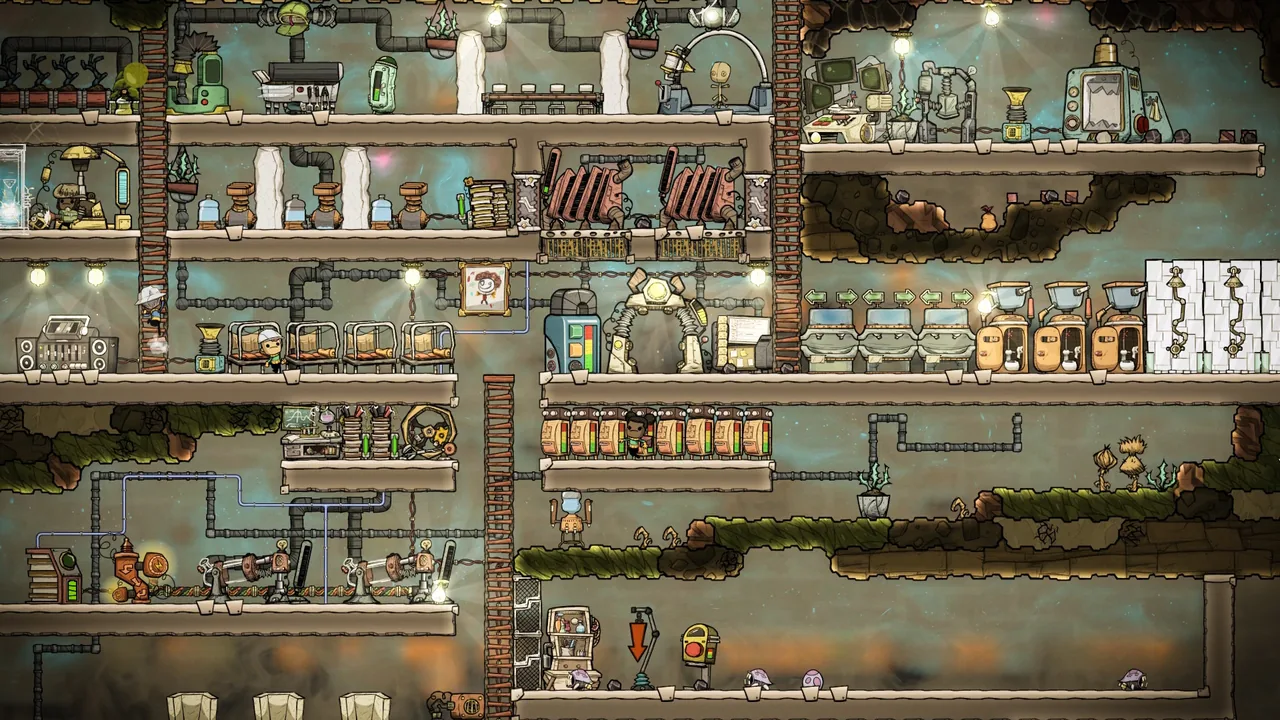
Progression games train players to look for the number that climbs — a level, a gear score, a skill tree filling in. Oxygen Not Included has all three of those in miniature, but none of them is really the point. Duplicants — the small, permanently overwhelmed colonists you recruit every few cycles — do carry attributes and a skill tree, and skill points do raise digging speed or research output in familiar RPG fashion. But the thing that actually scales as you play isn't any duplicant's sheet. It's the base itself: the length and complexity of the pipe network moving liquid and gas around, the layers of logic wiring watching sensors and flipping pumps, the number of interlocking systems that all have to keep working at once for anyone to keep breathing. The "character" whose stats you're really building is the colony as a machine, and that reframing is what separates this from almost everything else calling itself a survival-management game.
Duplicants themselves are handled with more care than the "faceless worker unit" premise suggests. Each one arrives with a randomised set of attributes across roughly a dozen categories — strength, athletics, cooking, machinery and so on — plus one to three personal interests that speed up related tasks and ease stress while doing them, and sometimes a trait that's flatly disruptive (a duplicant who panics near open flame is a genuine hazard, not flavour text). None of that is cosmetic. Assigning jobs badly against a duplicant's attributes measurably slows the colony, and stress that isn't managed produces a specific, individually-coded breakdown — one duplicant might destroy furniture, another might simply refuse to work — that then has to be worked around like any other systems failure. It's a skill tree wearing a personnel-management costume, and it's a smart one: every new arrival is a small resourcing puzzle before they've picked up a single tool.
The simulation is the antagonist
Take away the story beats — there barely are any — and Oxygen Not Included is a physics engine you're negotiating with. Gas and liquid move as discrete elements with mass, pressure and temperature, diffusing and settling according to density the way real fluids do: oxygen and carbon dioxide separate into visible layers if you don't actively mix or vent them, and a badly sealed room will happily let its breathable air get replaced by whatever's next door. Heat moves independently through every material and every tile, conducting between machines, pipes and terrain in ways that are individually simple and collectively unforgiving — a refrigeration loop that looked fine on paper can quietly warm an entire wing over fifty cycles because one insulated tile wasn't actually insulated.
This is the review's central point, and it's worth being blunt about it: nothing else in the genre commits to a simulation this literal. Rimworld fakes most of its systems with abstracted numbers and event rolls; Oxygen Not Included actually runs the thermodynamics and the fluid dynamics, tile by tile, cycle after cycle, and expects you to reason about them like an engineer rather than a general. That's the source of both the game's best moments and its cruelest ones. Solving a genuine heat-management problem — routing waste heat from a power plant into a system that needed warming anyway, say — produces a satisfaction that a scripted quest reward can't fake, because you built the solution out of real constraints rather than being handed it. But the same honesty means a mistake made in cycle 40 can sit invisible until cycle 140, at which point it isn't a setback, it's a catastrophe that arrives with no warning and no obvious point of origin.
Automation turns the sandbox into an engineering problem
Once basic survival is under control, Oxygen Not Included opens its second, arguably better game: automation. Wires carry a simple binary signal between sensors and machines, and logic gates — AND, OR, NOT, buffers, filters, counters — let you compose those signals into genuine conditional logic. A pressure sensor gating a vent, filtered through a NOT gate so it only opens below a threshold, feeding a counter that only lets the door cycle open twice a cycle to conserve heat — none of that is scripted content, it's you building a small circuit out of primitives the game hands you and trusting it to run unattended. It's the same intellectual pleasure Factorio gets out of belts and inserters, translated into gas pressure and thermal thresholds instead of item throughput, and it's just as capable of eating an evening on a single junction box.
The research ladder is built to keep feeding that loop rather than just inflating stats. New tiers don't arrive as "faster mining" reskins — they introduce entirely new categories of problem. Oil refining forces you to solve a byproduct chain the way Factorio's petroleum cracking does. Later power tiers introduce genuinely dangerous failure modes (overloaded wiring starts fires; certain generators demand cooling loops of their own) rather than just bigger numbers on a battery. Even food production splits into multiple competing strategies — farming, ranching critters, algae terrariums — each with its own resource and space cost, so "how do I feed everyone" stays an interesting question well past the point where a lesser game would consider it solved. Very little of the tech tree is padding; almost all of it is a new kind of homework.
The tutorial doesn't remotely cover this
Here's the honest problem, and it's a serious one. Oxygen Not Included's built-in tutorial teaches you what individual buildings do — this is an oxygen diffuser, this is a manual generator — and then simply stops, well before it's taught you the interactions that actually run the game. Heat conduction, gas layering, germ transmission and pressure behaviour are all systems you're expected to reverse-engineer from consequences, because the tutorial never sits you down and explains how they compound. New players routinely lose their first two or three colonies to problems the game never told them were problems: a slime-adjacent tile quietly seeding a disease, a sealed room slowly pressurising past a safe threshold, a battery bank overheating because nobody explained that wire has a wattage limit. That's not a minor onboarding wrinkle the way it is in a lot of management games — it's one of the steepest learning curves the genre has, and Klei has spent years of updates smoothing individual rough edges without ever actually closing the gap between "I understand what this button does" and "I understand why my base just died."
The interface makes the climb steeper than it needs to be. Critical state is real and readable — it's just scattered. Gas composition lives in one overlay, heat in another, disease in a third, and none of them cross-reference cleanly, so diagnosing a compound failure (say, a heat spike that's also breeding germs) means tabbing between screens and mentally overlaying them yourself. Compared to the single, legible readouts a game like Factorio gives you for throughput, Oxygen Not Included asks you to build your own mental model of information the game is fully capable of showing you at once and simply doesn't.
When it goes wrong, it goes wrong quietly
The compounding-disaster problem deserves its own paragraph, because it's the game's signature frustration and its signature achievement at the same time. Because temperature, pressure and gas composition all drift slowly rather than triggering immediate alarms, a genuinely fatal decision can sit dormant for dozens of cycles before it surfaces. A pipe insulated with the wrong material, a vent placed one tile too close to a heat source, a duplicant assigned to a job that quietly stresses them past their threshold — none of these announce themselves. They arrive as a crisis: a coolant loop failing catastrophically, an oxygen generator seizing from heat damage, a stress-induced breakdown that cascades into two or three more. Untangling which decision, cycles ago, actually caused it is often the real puzzle, harder than the crisis itself. Some players will find that the most satisfying kind of detective work a colony sim offers. Others will reasonably feel like the game waited twenty hours to tell them they'd already lost.
Presentation earns its keep
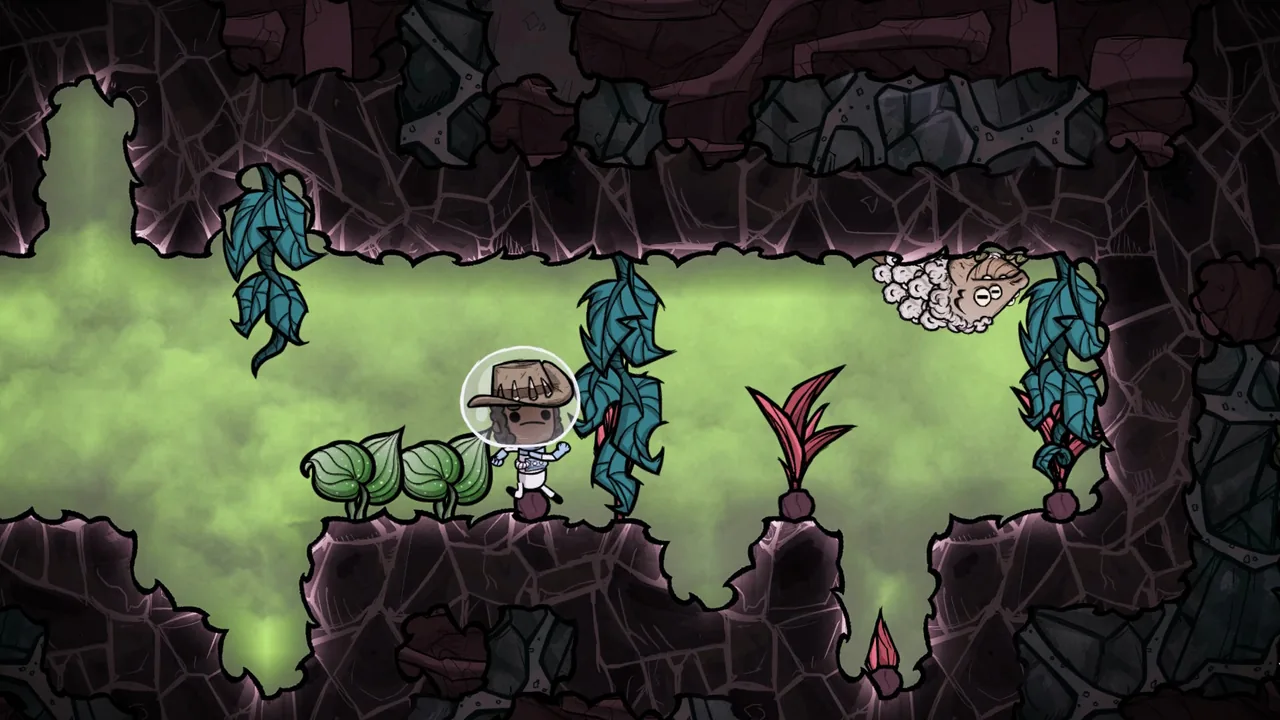
Klei's house style carries a lot of weight here, and it's worth crediting directly. The 2D character animation is some of the best in the genre — duplicants stagger visibly when overheated, slump when exhausted, and each stress breakdown reads as a distinct little performance rather than a generic debuff icon. Biome art is legible at a glance despite an enormous amount of simultaneous information (gas layers, liquid pools, terrain, machinery), which matters enormously once a base has forty tiles of pipe running through frame. The sound design is more restrained — ambient hums and mechanical clatter do their job without becoming memorable on their own — but nothing about presentation works against the simulation, which is the more important test for a game this systems-heavy.
Performance is where the simulation's honesty costs the most
Running gas, liquid and heat as genuinely simulated tiles rather than abstracted numbers is the whole appeal, and it's also the reason a mature colony visibly slows down. Community reports converge on the same pattern regardless of hardware: clutter left on the floor, large open gas pockets and, especially, a big population of duplicants and critters with independent pathfinding all compound to drag simulation speed down, sometimes to a crawl well before a base looks "big" by any other genre's standard. Twenty duplicants and modest automation runs cleanly on most systems; fifty duplicants and a few hundred critters is a stress test that will bring a strong CPU to its knees, because this is a CPU-bound simulation problem, not a rendering one, and there's no graphics setting that fixes it. It's an honest cost of the design rather than sloppy optimisation, but it's a real one, and anyone planning a truly sprawling megabase should know going in that the late game is where the engine starts to show its age.
DLC, and what the full experience actually costs
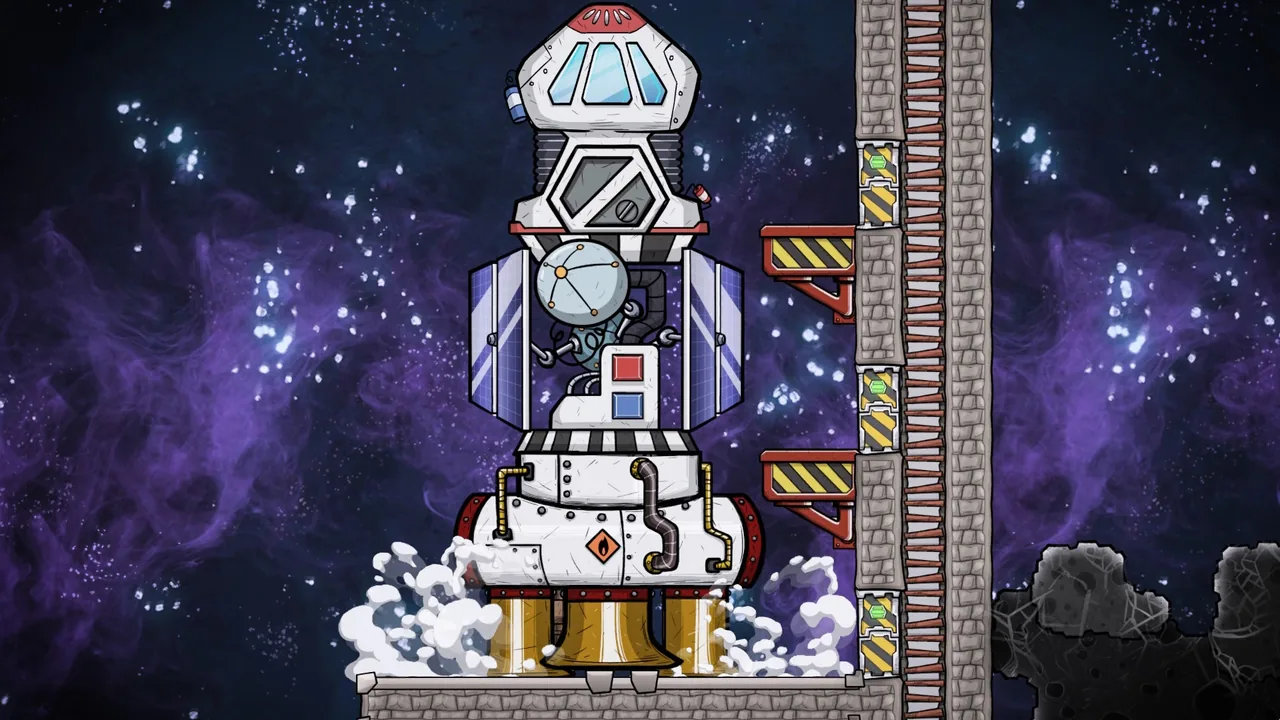
The base game is a complete, self-contained loop, and Klei has never made any of the paid add-ons necessary to finish a colony or see the credits. On top of the NZ$29.95 base price, the storefront currently lists six paid DLC: Spaced Out! (NZ$16.49), the largest of them, restructures the mid-to-late game around multiple linked asteroids and interplanetary logistics rather than a single rock; four smaller content packs — the Frosty Planet Pack (NZ$11.79), the Bionic Booster Pack (NZ$11.79), the Prehistoric Planet Pack (NZ$11.79) and the Aquatic Planet Pack (NZ$15.75) — each add a themed world, a handful of buildings and new resource chains without touching the base game's core systems; and a Neutronium Cosmetics Pack (NZ$7.39) that's purely decorative. A separate soundtrack release rounds out the storefront listing. None of it is paywalled progression in the sense that matters for a monetisation verdict — nothing here is faster-or-pay, and the base game alone is a legitimate hundred-plus-hour experience — but buying everything currently on offer comes to considerably more than the headline price, and Spaced Out! specifically changes enough of the mid-game structure that it's a poor choice for a first colony rather than a second one.
Verdict
Oxygen Not Included earns its reputation by refusing to fake the thing it's about. The gas, liquid and heat simulation isn't set dressing for a management game — it is the game, and the automation and research systems layered on top of it exist to give you tools sophisticated enough to actually negotiate with it. That's a genuinely rare kind of design commitment, and it produces the best moments the genre has to offer: the first time a heat-recycling loop actually works, or a logic circuit correctly anticipates a failure before it happens, feels earned in a way scripted content rarely manages.
It also produces real, unglamorous problems. The tutorial doesn't remotely prepare a new player for what the systems actually demand of them. The interface hides exactly the information a crisis needs read all at once. A colony that grows past a modest size will visibly strain the simulation regardless of hardware. And because failures compound slowly and silently, the game's most memorable disasters tend to be ones you caused hours or days ago without knowing it. None of that is incompetence — it's the honest cost of a simulation this literal — but it's a real cost, and it keeps this from the very top tier alongside a game like Factorio, whose equivalent onboarding problem at least sits on top of a simulation that doesn't also punish you for mistakes you can't see.
Players who came to Wanderer for a loop where the numbers keep climbing on a system you built yourself, rather than a stat sheet handed to you by a loot table, will recognise exactly what Oxygen Not Included is selling — it's just selling it through a base that breathes instead of a character that levels.
Price and platform details checked 30 July 2026.
Pros and cons
Pros
- The gas, liquid and heat simulation creates emergent problems no scripted encounter could match
- Automation wiring and logic gates turn late-game colonies into genuine engineering puzzles
- Duplicant traits, interests and skill trees make every new arrival a small resourcing decision
- Character animation communicates exhaustion, stress and death with more personality than the genre usually bothers with
- The research ladder consistently unlocks new problems (oil refining, cooling loops, power grids) instead of just bigger numbers
- No energy timers, premium currency or gameplay-relevant purchases sit anywhere near the loop
Cons
- The in-game tutorial teaches individual buildings but never explains how heat, pressure and disease interact until you've already broken something
- Critical state — gas composition, heat flow, germ counts — is scattered across overlay modes that don't talk to each other well
- A colony past 20-30 duplicants with mature automation visibly slows the simulation, even on strong hardware
- Small plumbing or ventilation mistakes often surface as an unrecoverable heat spike or oxygen failure ten or twenty hours after the decision that caused them
- Six separate paid DLC packs plus a soundtrack make the full current experience a considerably larger purchase than the NZ$29.95 headline price
- No controller support and no accessibility options beyond adjustable game speed
Screenshots
-
Oxygen Not IncludedImage: Klei Entertainment via Steam -
Oxygen Not IncludedImage: Klei Entertainment via Steam -
Oxygen Not IncludedImage: Klei Entertainment via Steam -
How the review scores each part of the gameWanderer Editorial -
The short versionWanderer Editorial