
Game review
Space Haven
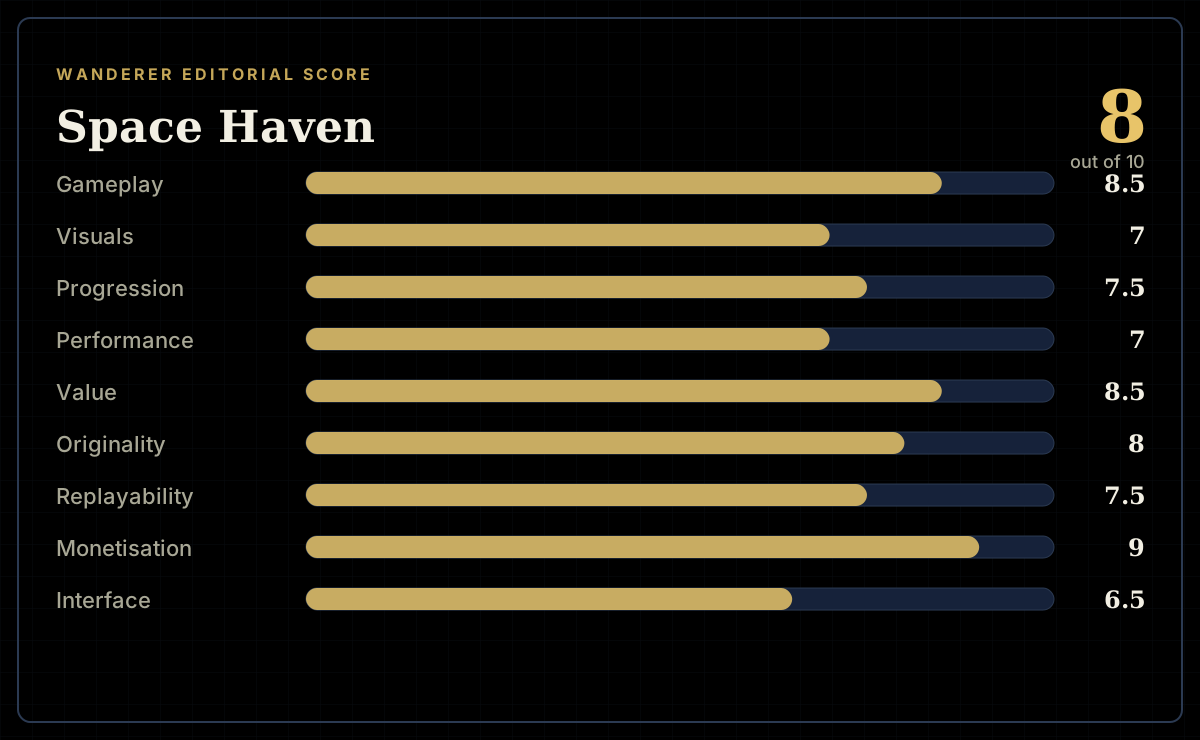
8 / 10
- Developer
- Bugbyte Ltd.
- Publisher
- Bugbyte Ltd.
- Released
- 13 May 2026
- Platforms
- Windows, macOS, Linux
- Genre
- Spaceship colony simulation
- Monetisation
- Premium, one-off purchase. An optional soundtrack is sold separately; no other DLC or in-game purchases
- Players
- Single-player only
The short version
Space Haven's whole identity is the gap between what your crew can survive and what your ship can provide. Oxygen, heat, food, and morale are simulated tile by tile rather than tracked as abstract bars, so a hull breach or a broken scrubber becomes a spatial problem you route people and pipes around, not a stat you top up. Six years of Early Access polish show: the crew handles its own oxygen tanks and injuries with a competence RimWorld's colonists never managed, and Steam Workshop support arrived alongside 1.0 to open the design up to mods.
It's still a dense, occasionally unforgiving game to read at a glance, crowd pathfinding wobbles exactly when you need it not to, and the run's actual goal resolves as a single binary choice rather than a proper endgame. None of that undoes what's here — a genuinely distinctive simulation sandbox that earned its long Early Access run rather than merely surviving it.
Biggest strengths
- Crew members manage their own oxygen tanks, wounds, and hunger without micromanagement, handling the busywork RimWorld still makes the player do by hand
- The tile-based gas and temperature simulation turns a breached hull or a chemical leak into a spatial puzzle you route scrubbers and doors around, not a number ticking down
- Ship design has real mechanical consequences — a badly ventilated layout measurably taxes simulation performance, not just aesthetics
Biggest weaknesses
- The interface stays dense and reference-heavy even at 1.0 — reading a busy multi-deck ship's status takes real practice next to genre leaders like RimWorld
- Crowd pathfinding still wobbles during multi-crew emergencies, occasionally turning a tense hull breach into a farce of crew members walking past each other
- Reaching Eden, the game's stated goal, resolves as a single binary prompt rather than a built-out endgame, and looping into a new galaxy doesn't introduce enough new pressure to stay tense on repeat runs
Who it's for: Fans of RimWorld, Oxygen Not Included, and Dwarf Fortress who want those games' systemic depth applied to a spaceship instead of a planet, and anyone who enjoys building a machine that keeps a crew alive as much as building the crew itself. A poor fit for players who want a tidy, legible interface from hour one, or who need a hand-authored story rather than an emergent one.
Our recommendation: Buy it. A one-time NZ$34.99 for a simulation this deep, with no DLC treadmill and a developer that used six years of Early Access to actually finish the job, is straightforward value for the audience it's built for. Newcomers to the genre should expect a real learning curve before the game clicks.
8 / 10
Most colony sims give you a patch of ground and let gravity, weather, and soil do their work quietly in the background. Space Haven gives you a hull instead, and nothing about a hull is quiet. Every room you carve out of the ship has to hold its own air, its own temperature, its own pressure, and if you get the layout wrong, the game doesn't dock your happiness meter — it lets the atmosphere itself turn against you. That single decision, simulating gas and heat as physical things moving through a ship rather than abstracted stats sitting behind a wall, is what separates Space Haven from the RimWorld-shaped crowd it otherwise resembles, and it's the reason six years in Early Access were spent productively rather than just survived.
Building a ship that has to keep you alive
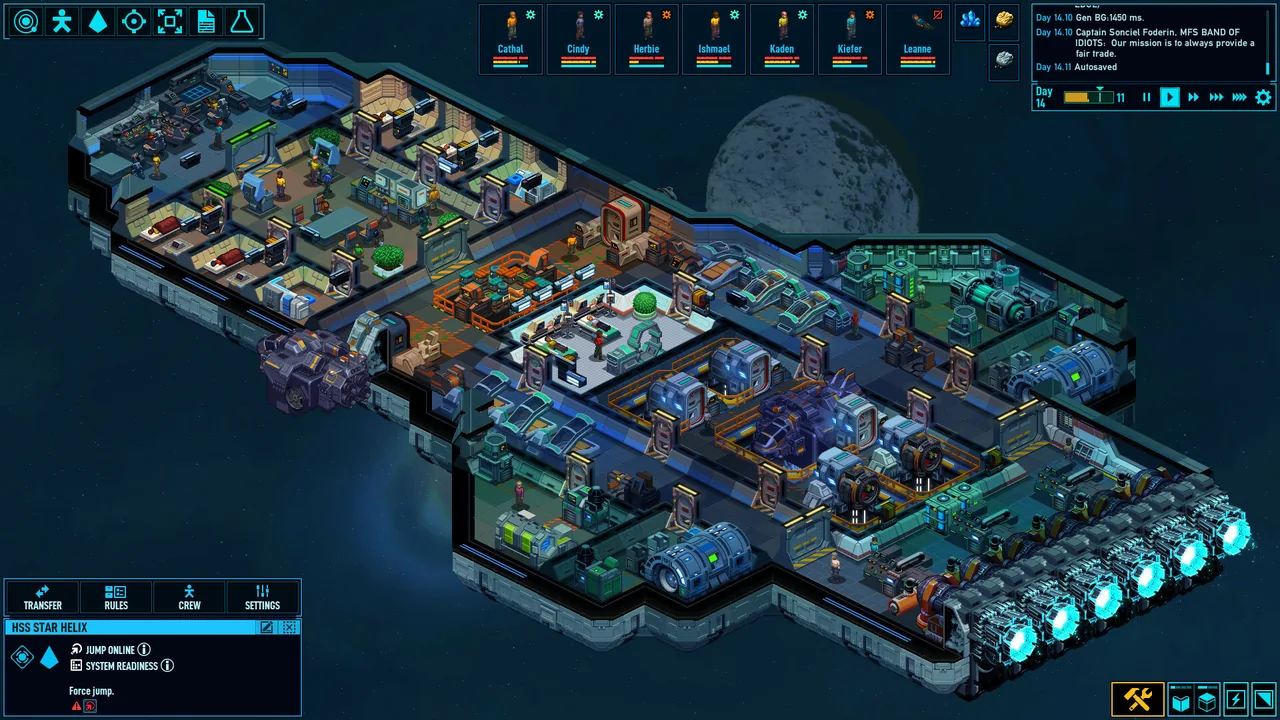
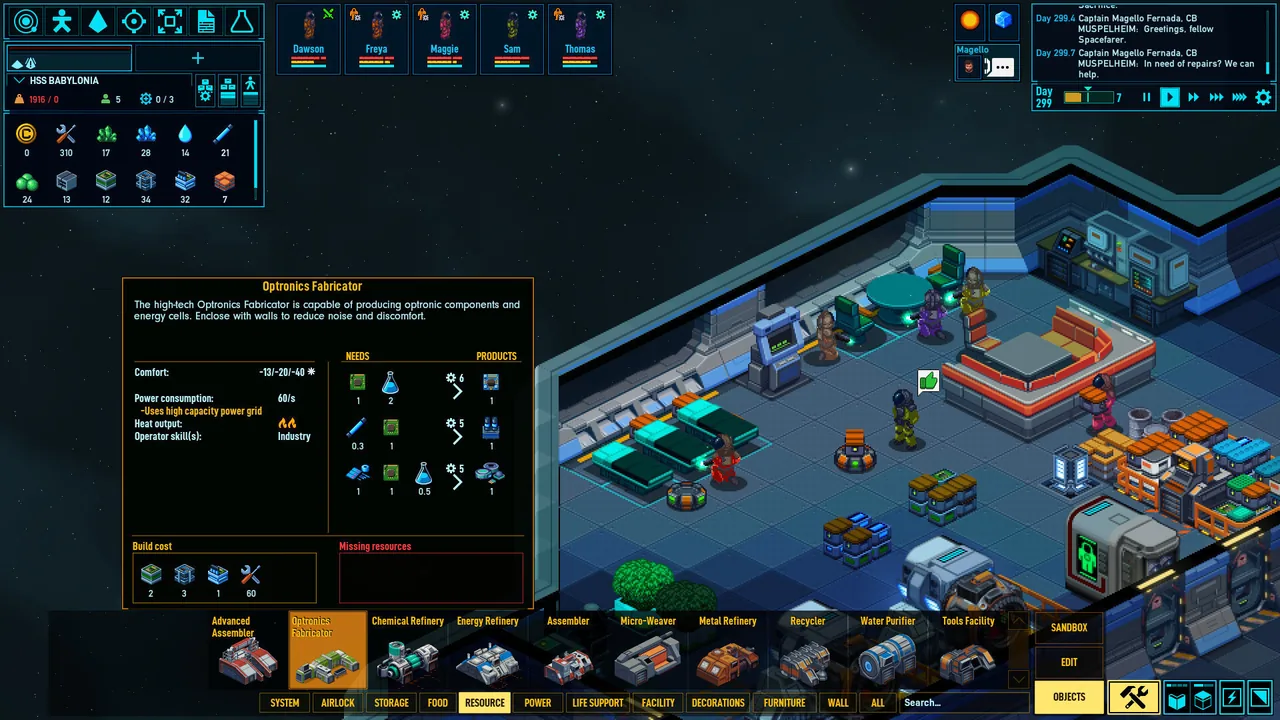
The core loop starts simple: design a hull tile by tile, wall off rooms, and drop down the machinery that turns raw hydrogen and scrap into breathable air, drinkable water, and edible food. It escalates quickly. Every room needs adequate atmosphere, which means oxygen generators, scrubbers to pull out contaminants, and enough ductwork to actually circulate it all where your crew is standing. Temperature control matters just as much — a reactor room running hot without proper venting will cook the crew members working next to it, and a hull breach in open space will flash-freeze a compartment in seconds if you don't seal it fast enough. None of this is decorative. The isometric gas simulation genuinely tracks where oxygen, toxins, and heat sit tile by tile, closer to Oxygen Not Included's atmospheric modelling than to RimWorld's more abstracted room-quality system, and it means ship design is never purely an aesthetic exercise. A beautiful-looking ship with poor ventilation is a ship that will eventually kill someone, and a scrappy, ugly one with good airflow will keep its crew alive far longer.
That has a direct mechanical payoff most colony sims never bother chasing: your build decisions and your simulation's behaviour are the same decision. Route ducts badly and gas has to route around your layout the hard way, which costs real computational overhead as much as it costs crew safety. Good design isn't just satisfying to look at — it's the thing keeping your frame rate honest later in the run, a rare case of a game's aesthetic and technical incentives actually pointing the same direction.
Crew that mostly looks after itself
Where Space Haven earns its most direct comparison to RimWorld is in how much its crew handles without being told. Civilians salvaging a derelict wreck in vacuum will monitor and swap their own oxygen tanks. Injured crew will patch themselves up or seek out a medical bay on their own initiative rather than standing around waiting for a player to manually assign first aid. Hungry crew feed themselves from stores without a queued order. It's a meaningful quality-of-life difference from a genre that has historically demanded the player micromanage every individual colonist's next five minutes, and it lets Space Haven's difficulty come from systemic pressure — a bad ship layout, a hostile encounter, a cascading gas leak — rather than from the tedium of babysitting.
The trade-off shows up exactly where you'd expect: crowds. Pathfinding holds up fine when a handful of crew are moving calmly between rooms, but throw a boarding action, a fire, and a decompression event at the same compartment simultaneously, and the AI can visibly struggle to route everyone sensibly, producing the odd standoff where two crew members block each other in a doorway during what should be a life-or-death sprint. It's not a constant problem, but it reliably shows up at the worst possible moment, which is exactly when a colony sim's crew AI needs to be at its most reliable.
Combat, salvage, and the wider galaxy
Beyond the home ship, Space Haven sends you out into a procedurally generated galaxy filled with other factions, derelict wrecks worth boarding for scrap and survivors, and pirates who will board you right back if your ship looks weak. Ship-to-ship combat plays out as a tense exchange of shields, hull damage, and boarding parties, and repelling an armed crew that's cut through your hull is a genuinely different kind of emergency than managing a slow atmospheric leak — every weapon locker, every choke point, every airlock becomes a tactical decision rather than just a room on the blueprint. Salvaging a wreck for parts and rescuing its survivors to join your own crew gives exploration a tangible payoff beyond loot, since every rescued civilian is a future set of hands who can also, eventually, become a future liability if you can't keep them fed and sane.
Progression, and where it runs out of road
The stated long-term goal is finding Eden, a habitable new home for your wandering crew, and it's here that Space Haven's endgame shows its age. Reaching it resolves as a single choice — end the run there, or jump into a fresh galaxy with your existing ship and crew intact and the difficulty carried forward, theoretically extending the game indefinitely. It's a clever structural idea on paper, letting a committed player keep pushing a veteran crew into ever-harder space, but in practice a crew that has already out-levelled most early threats doesn't face enough new pressure in a second galaxy to recapture the tension of the first one. The middle hours, when your ship is capable but still fragile and every encounter carries real risk, remain the game's strongest stretch. The late game is where a lot of that risk quietly drains away, and the loop leans more on repetition than on genuinely escalating stakes.
An interface that never quite gets out of its own way
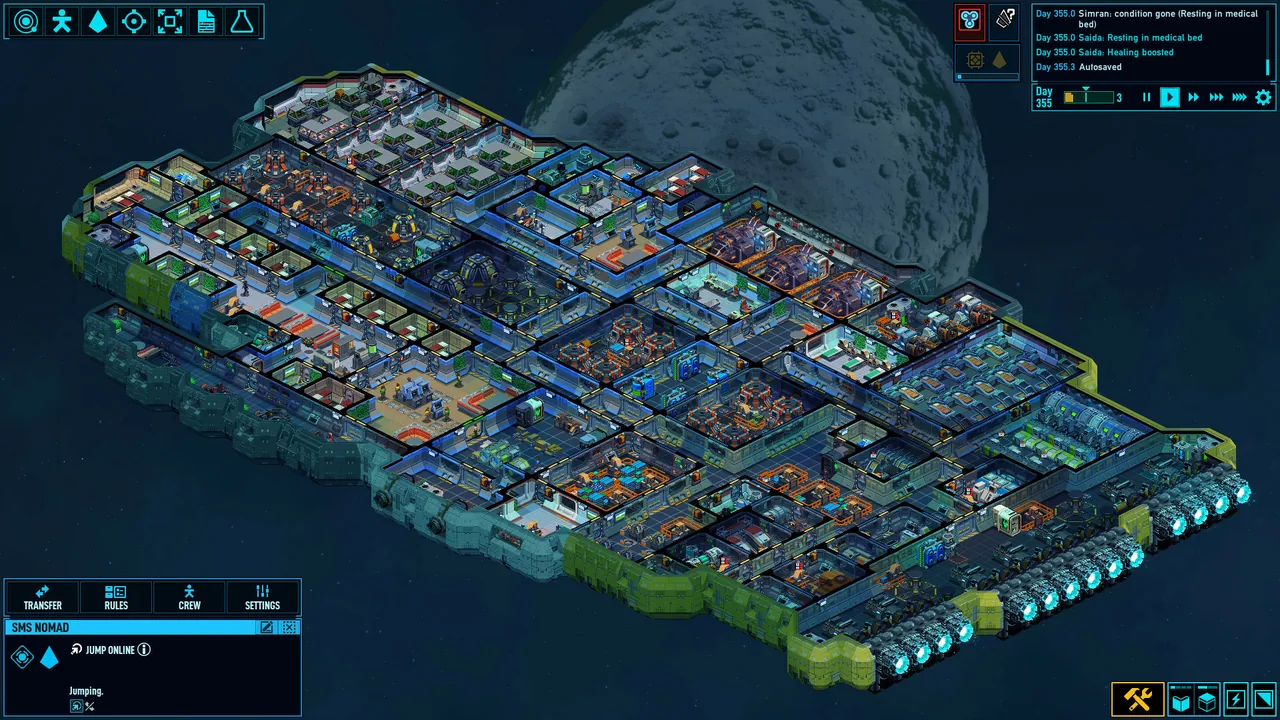
Space Haven's UI has improved across six years of Early Access, but it hasn't caught up to genre leaders. Reading the state of a sprawling, multi-deck ship — which rooms are pressurised, which crew member is doing what, which system is one failure away from cascading — takes real practice, and the information is denser and less immediately legible than RimWorld's comparatively clean colonist and room overlays. That's partly the cost of simulating more things more literally; a game tracking individual gas tiles has more to show you than one abstracting room quality into a single number. It's a fair trade for the depth on offer, but new players should expect a real adjustment period before the interface stops feeling like it's fighting them.
Performance scales with how well you build
Because the atmospheric and thermal simulation runs continuously across every tile of every ship, performance is tied directly to CPU load rather than graphics hardware, and it scales with how much simulation work your own designs generate. A sprawling ship with poor ventilation and lots of small, disconnected compartments forces the simulation to do more work moving gas around than a more open, efficiently ducted layout — sometimes making two well-designed large ships run better than several smaller, badly planned ones. That's a genuinely interesting design consequence, but it's also an invisible tax that a new player has no way to anticipate; nothing in the early game flags that a cramped, maze-like layout will eventually become a frame rate problem as much as a gameplay one.
Modding arrives, six years late but genuinely useful
One of 1.0's more significant additions is official Steam Workshop support, letting players subscribe to community mods directly through Steam rather than relying on manual file installs. For a game whose systems — modular ship parts, a tile-based simulation, a fairly open crew and item framework — were clearly built with extensibility in mind, formal Workshop integration is a meaningful, if overdue, capstone to the Early Access run. It won't matter to a player who just wants the base game, but it meaningfully extends the ceiling for anyone who sticks with Space Haven past a first galaxy.
Value and the six-year runway
At NZ$34.99 with no DLC beyond an optional soundtrack, Space Haven's pricing has stayed honest through its entire development. There's no expansion pass, no cosmetic shop, no premium currency waiting behind a paywall — you buy the game once and you have all of it, including whatever mods the Workshop produces. Given how much of the genre has drifted toward paid content drops even in single-player sandboxes, that restraint deserves real credit, and it makes the six years of Early Access easier to forgive: Bugbyte spent that time building the game rather than building a monetisation layer around it.
Players who like the idea of a system that keeps quietly running and demanding attention on its own terms — atmosphere that has to be maintained rather than a bar that just refills — might recognise a distant cousin of that appeal in Wanderer's own gathering and crafting loop, on a much smaller scale.
Verdict
Space Haven's core idea — simulate the air itself, and let a ship's design have real physical consequences — is executed with a conviction that six years of Early Access clearly went toward earning rather than stalling on. The crew AI outclasses genre expectations for self-sufficiency, ship-to-ship combat and boarding give exploration genuine stakes, and a single honest price with no DLC ladder is a rare thing to find in a simulation this deep. The interface never fully sheds its density, crowd pathfinding wobbles at the worst moments, and an endgame that resolves as a binary choice leaves the late hours thinner than the middle ones. Buy it for the mid-game tension and the atmospheric simulation alone — just don't expect the finish line to be as interesting as the journey there.
Pros and cons
Pros
- Crew members manage their own oxygen tanks, wounds, and hunger without micromanagement, handling the busywork RimWorld still makes the player do by hand
- The tile-based gas and temperature simulation turns a breached hull or a chemical leak into a spatial puzzle you route scrubbers and doors around, not a number ticking down
- Ship design has real mechanical consequences — a badly ventilated layout measurably taxes simulation performance, not just aesthetics
- Steam Workshop support landed with 1.0, giving a design built for modularity an actual modding pipeline for the first time
- A single NZ$34.99 purchase covers everything; no expansion packs, no premium currency, no battle pass
Cons
- The interface stays dense and reference-heavy even at 1.0 — reading a busy multi-deck ship's status takes real practice next to genre leaders like RimWorld
- Crowd pathfinding still wobbles during multi-crew emergencies, occasionally turning a tense hull breach into a farce of crew members walking past each other
- Reaching Eden, the game's stated goal, resolves as a single binary prompt rather than a built-out endgame, and looping into a new galaxy doesn't introduce enough new pressure to stay tense on repeat runs
- Large ships with inefficient ventilation can visibly bog down simulation performance, and nothing in the early game warns a new player which layouts will cause it
Screenshots
-
Space HavenImage: Bugbyte Ltd. via Steam -
Space HavenImage: Bugbyte Ltd. via Steam -
Space HavenImage: Bugbyte Ltd. via Steam -
How the review scores each part of the gameWanderer Editorial -
The short versionWanderer Editorial