Game review
Banished
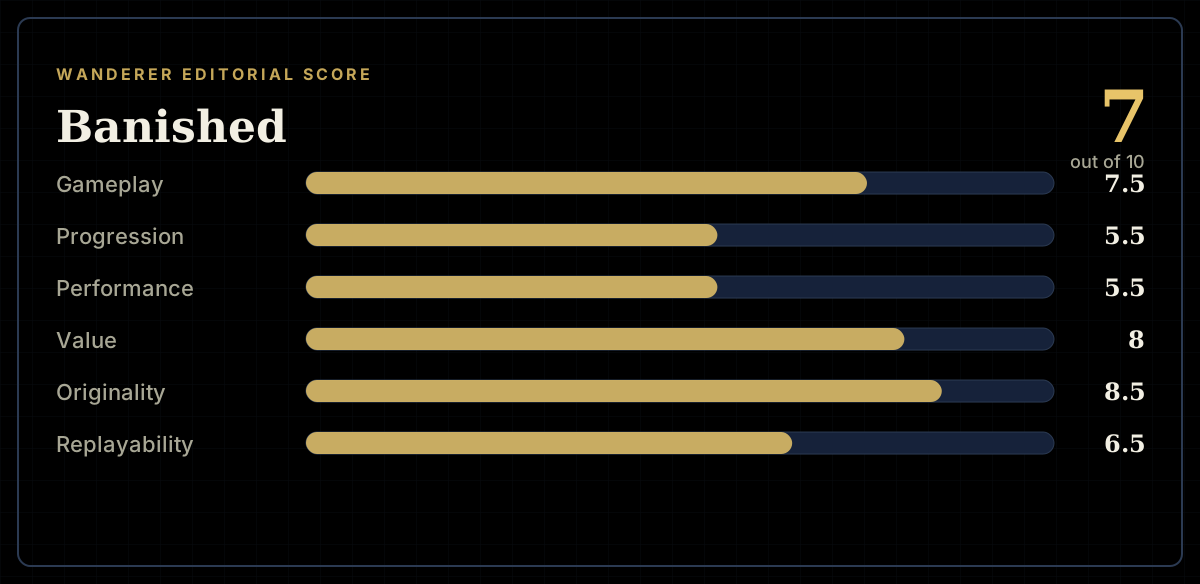
7 / 10
- Developer
- Shining Rock Software LLC
- Publisher
- Shining Rock Software LLC
- Released
- 18 February 2014
- Platforms
- Windows
- Genre
- City-Building Survival Strategy
- Monetisation
- One-time purchase, no in-app purchases, no ads, no subscription, no DLC
- Players
- Single-player only
The short version
Banished asks you to keep a small, fragile population fed, housed and warm through winters that will kill them if you plan badly, using a resource system with no money and no skill trees — you either have the tools, food and materials for a job or you don't. It's a genuinely distinctive pitch for 2014, and it's held up: the game still sits at Very Positive across more than 37,000 reviews, over a decade after launch, with no marketing push keeping it there.
What hasn't held up as well is the middle of the game. Once a stable trade route and a working food chain are in place, there's very little left to discover, and reviewers from launch week and reviewers from this year describe an almost identical moment of realising they've seen everything the game has to offer. The developer hasn't patched it since 2015, so that ceiling is permanent.
Biggest strengths
- The no-money, no-skill-tree resource loop is still a genuinely distinctive take on the city builder, and it's the reason the game gets cited as an influence on newer colony sims
- The citizen life-cycle system — birth, aging, marriage, death — produces real emergent stories that show up in reviews from every year of the game's life, not just launch week
- A single NZ$23.99 purchase with no DLC, no microtransactions and no ads, and it frequently drops to a third of that price in Steam sales
Biggest weaknesses
- Once trade routes and a stable food supply are established, there is very little left to build toward — a complaint that reads almost identically in reviews from 2014 and reviews from 2026
- Citizen pathing and job-priority AI is a decade-old sore point: workers routinely starve next to full storehouses or walk past the nearest supply to reach a farther one
- Large populations bog the simulation down badly, and one review logging nearly 2,000 hours reports the game becoming unplayable past roughly 800 residents on any hardware
Who it's for: City-builder and colony-sim fans who want a tight, punishing early game and don't mind that the back half of the box is mostly repetition, and anyone curious about the game that predates and influenced a lot of what Timberborn, Frostpunk and Manor Lords do today.
Our recommendation: Worth the low asking price, and worth grabbing on one of its frequent deep discounts if the current NZ$23.99 feels steep for a game whose content was locked in over a decade ago — go in for the first fifteen to twenty hours, not for the hundred-hour ambitions the Steam page implies.
7 / 10
Two Banished reviews, twelve years apart, describe the same moment. One was written the week the game launched in February 2014: after a few good harvests and a working trade dock, there was nothing left to figure out. The other was written this April: "after you've built the ~15 buildings there are, there's really nothing left to do except make more of them." Between those two points sits a game that still holds a Very Positive rating from over 37,000 players, a genre it's frequently credited with reviving, and a developer who hasn't touched its code since 2015. All three of those things are true, and none of them contradict each other once you understand what Banished actually is.
A colony that lives or dies on logistics
Banished's whole design rests on a single, unusually strict rule: there is no money. You can't sell a surplus of wood to buy the tools you're short on. What you have is what your people have made or gathered, full stop, and the only way to convert one resource into another is a trade caravan that shows up on its own schedule and might just as easily bring disease as bring the livestock you wanted. There are no skill trees and no tech unlocks gating what you can build — any structure is available from the first winter, provided you can spare the labour and the materials to raise it. That's a genuinely different foundation from almost every city builder that came before or after it, and it's the reason the opening hours are as tense as the genre gets. A single bad harvest, timed badly against a hard winter, can spiral into starvation before you've noticed the problem exists. Nothing in Banished holds your hand through that; the game's difficulty is entirely a function of how well you read a map before you commit to it.
The citizens themselves carry the other half of the appeal. They're born, they age, they marry, they have children of their own or they don't, and they eventually die of old age or something less dignified — and none of it is scripted. It produces the kind of emergent, personal storytelling that keeps showing up in reviews from every year of the game's life: a founding couple who never had children and left the town's second generation to strangers, a blacksmith's whole line dying out in one bad winter. That system alone is why Banished still gets cited as an influence on the colony sims that followed it.
The wall almost everyone hits
The trouble is that the same rule set that makes the opening so gripping runs out of things to say fairly quickly. Once a town has a stable food chain, a couple of trade routes bringing in whatever was missing, and enough houses to keep the population climbing, there's no new problem left to solve — just the old ones, again, at a slightly larger scale. That specific complaint is remarkably consistent across the game's entire lifespan. A review from November 2024 puts it plainly: "there is no real progress after u get the hang of it and unlocked everything by trading... after 8h I have everything unlocked and don't see a point in further play." One from December 2025, at 67 hours logged, says almost the same thing in more words: "after a solid foundation it's just incredibly shallow. After a few hours you've seen it all and done it all." These aren't players who bounced off in the tutorial — most of the negative reviews making this argument sit between ten and seventy hours, which is long enough to have genuinely explored what the game offers before concluding there's a ceiling.
Citizen AI compounds the problem rather than distracting from it. Workers will walk past a nearby storehouse to reach a farther one, or starve in a field with food sitting in their own inventory — complaints that show up from a 2023 review ("stupid AI... how is it possible for a hunter to starve in the field when they have food in their inventory") through to a 154-hour review from December 2024 calling out the same inability to route goods sensibly between a dock, a storage barn and four adjacent houses. None of it is game-breaking on a small town. It becomes the whole experience once a settlement grows large enough that logistics is the only thing left to manage — which, per the progression complaints above, is exactly the point at which most players are already looking for a reason to keep going.
What the numbers say about who gets anywhere
Steam's global achievement data backs this up with something harder than aggregated grumbling. Even the single most commonly earned achievement in Banished's 36-achievement list — Smiles All Around — sits at just under 21% of all owners. The next tier down, covering things like keeping a town healthy or building your first sizeable settlement, clusters in the 13–20% range, and the list falls off fast from there: Educated sits at 4.8%, Miner at 4.3%, and long-haul achievements like Tenure bottom out at 1.3%. Read plainly, that means a large majority of people who own Banished never reach even its earliest milestones. Some of that is simply the nature of an open-ended sandbox with no scripted win condition — plenty of players build one town, feel satisfied, and stop without chasing achievements at all. But set against a decade of reviews independently describing the same mid-game plateau, the achievement curve reads less like disinterest and more like corroboration.
The one place the game's limitations get genuinely severe rather than just repetitive is scale. A review logging just under 1,951 hours — by some distance the longest playtime in the negative-review sample — reports that populations above roughly 800 residents grind the simulation to a crawl "no matter if you have the best computer on the planet," and says the developer has shown no interest in addressing it. That's a specific, high-investment complaint from someone who clearly likes the game enough to have spent two solid months of real time playing it, which makes it worth more than a one-hour refund review saying the same thing.
The price is fair; the support isn't there
None of that is really Banished's own fault at this point, and it needs saying plainly: this is a one-person game, and it has not received a content update since a beta build in October 2015, per Steam's own news history for the app. Shining Rock Software's own website has posted exactly once since November 2021 — a short piece from April 2022 about "code rot," discussing an entirely separate, still-unreleased successor about nomadic villages travelling between islands, with no release date attached even now. There's no indication Banished was abandoned in anger or that anything is broken beyond repair; it's simply a decade-old solo project whose developer moved on to building something new a long time ago. A community mod scene has picked up a fair amount of the slack, and Steam's own news feed has pointed players toward mod round-ups as recently as 2020, which says something about how much life modders have squeezed out of a game its own studio stopped maintaining nearly a decade earlier.
Against that, the asking price is easy to defend. NZ$23.99 with no DLC, no in-app purchases and no premium currency of any kind, and Banished spends a lot of its life on sale at 66% off, per Steam's own promotional history. Whatever you think of the mid-game plateau, nobody is being nickel-and-dimed for it.
Final verdict
Banished earns its long-standing Very Positive rating on the strength of an opening act that's still genuinely excellent: a resource system with no money and no shortcuts, a population that lives and dies as individuals rather than a number ticking upward, and a real sense that one bad decision can end a town. What keeps it at a 7.0 rather than higher is that the game has never grown past that opening act, that its citizens still can't be trusted to route their own supplies competently after twelve years, and that nobody at Shining Rock Software has touched the code since 2015. Judged against what it was trying to do in 2014 — reinvent the city builder's basic economy — it succeeded, and succeeded distinctively enough that its fingerprints are still visible in newer colony sims. Judged as something worth a hundred hours of a 2026 player's time, it isn't, and the achievement numbers and a decade of consistent reviews both say so.
Players drawn to the idea of a small population you manage individually, one life and death at a time, without a scripted campaign steering the outcome, might also enjoy Wanderer, where long-term progression keeps moving even when you're not actively steering it.
Pros and cons
Pros
- The no-money, no-skill-tree resource loop is still a genuinely distinctive take on the city builder, and it's the reason the game gets cited as an influence on newer colony sims
- The citizen life-cycle system — birth, aging, marriage, death — produces real emergent stories that show up in reviews from every year of the game's life, not just launch week
- A single NZ$23.99 purchase with no DLC, no microtransactions and no ads, and it frequently drops to a third of that price in Steam sales
- A long-lived community mod scene has kept adding maps, buildings and mechanics years after the developer stopped, extending the game well past its official content
- The early hours, when one bad harvest can genuinely collapse a town, are as tense as city builders get
Cons
- Once trade routes and a stable food supply are established, there is very little left to build toward — a complaint that reads almost identically in reviews from 2014 and reviews from 2026
- Citizen pathing and job-priority AI is a decade-old sore point: workers routinely starve next to full storehouses or walk past the nearest supply to reach a farther one
- Large populations bog the simulation down badly, and one review logging nearly 2,000 hours reports the game becoming unplayable past roughly 800 residents on any hardware
- No content update has landed since a beta build in October 2015, and the developer's own site has posted only once since 2021 — Banished itself is not being actively maintained
- Windows only, per the current store listing, with no controller support and no cloud saves beyond Steam's generic remote-play features
Screenshots
-
BanishedImage: Shining Rock Software LLC via Steam -
BanishedImage: Shining Rock Software LLC via Steam -
BanishedImage: Shining Rock Software LLC via Steam -
How the review scores each part of the gameWanderer Editorial -
The short versionWanderer Editorial