Game review
Going Medieval
8 / 10
- Developer
- Foxy Voxel
- Publisher
- Mythwright
- Released
- 17 March 2026
- Platforms
- Windows
- Genre
- Colony management and survival-building simulation
- Monetisation
- Premium, one-off purchase for the base game. The only paid add-ons are a cosmetic Supporter Pack that launched alongside 1.0 and a separate soundtrack — no ongoing purchases, no other DLC tiers
- Players
- Single-player only. There is no co-op or multiplayer mode, and none is on the public roadmap
The short version
Going Medieval's founding idea — a colony sim you build in three dimensions, with real structural stability instead of an infinite flat grid — is still its best one, and 1.0 finally gives that sandbox a reason to end. Renown and the six Grand Objectives turn open-ended tinkering into something you can actually finish, whether that means founding a university, a religious order, or a mercantile empire. What hasn't caught up is combat: raids are functional but rarely surprising, and settler pathfinding still trips over its own multi-floor ambitions often enough to notice.
It doesn't replace RimWorld so much as answer one specific complaint about it. Anyone who bounced off RimWorld's 2D footprint, or wanted the option to actually dig in rather than only build out, has a real alternative here — just don't expect the same depth of settler personality or storyteller-driven chaos underneath the extra dimension.
Biggest strengths
- Voxel terrain with real structural stability makes vertical construction — towers, buried cellars, load-bearing walls — an actual design constraint rather than a cosmetic layer
- Renown and the six Grand Objectives finally give open-ended colonies a defined way to conclude a campaign, something the genre has historically struggled with
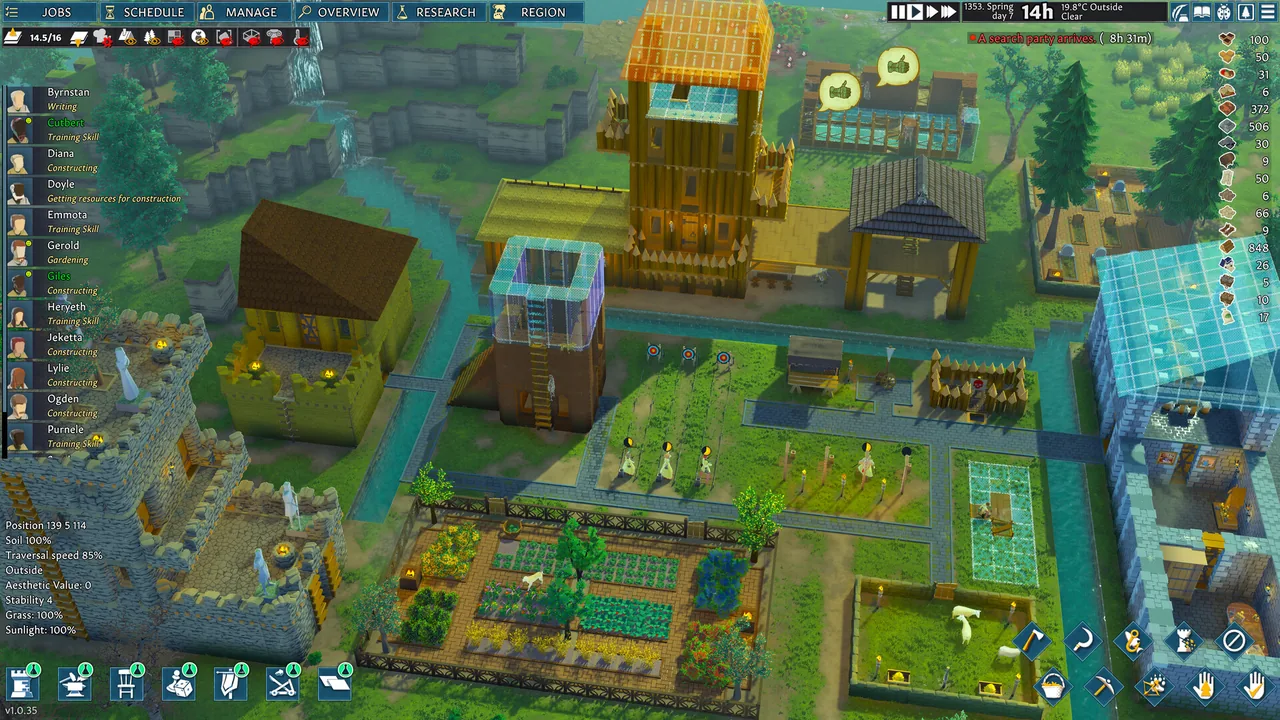
- The jump from three survivors to a walled, multi-storey settlement stays legible even as the colony grows into dozens of rooms across several floors
Biggest weaknesses
- Raids and combat stay a secondary system throughout — defensive layouts reward planning, but the encounters themselves rarely escalate beyond familiar patterns
- Settler pathfinding still stumbles in dense, multi-floor bases, with settlers occasionally taking absurd routes or stalling on tasks that need manual correction
- Renown turns settlement progress into tracked stats aimed at a specific objective, which can make late-game play feel like working through a checklist rather than reacting to an emergent story
Who it's for: Colony-sim and survival-crafting fans who want vertical, structurally real building — towers, buried storerooms, defensible multi-level keeps — and are willing to trade some of RimWorld's narrative depth and settler personality for it. Less suited to players chasing sharp, demanding tactical combat, or anyone who specifically wants multiplayer.
Our recommendation: Worth buying at full price now that 1.0 has given the sandbox an actual finish line. The vertical building alone justifies the purchase for genre fans who haven't tried it, and Steam Workshop support extends its life well past the base campaigns. Go in expecting a builder with survival pressure rather than a combat-forward strategy game, and the six Grand Objectives as a satisfying but still fairly mechanical way to close out a run rather than a branching narrative payoff.
8 / 10
Most colony sims give you a flat plot of land and let you spread sideways for as long as you can keep the lights on. Going Medieval gives you a hillside and a shovel. Dig into it, stack stone on top of what you've hollowed out, and the game will actually check whether the resulting structure holds up — a buried cellar needs support columns, a third-storey keep needs walls underneath it that can bear the weight, and getting that wrong collapses the building instead of politely ignoring the problem. Four years and nine months after Foxy Voxel put the game into Early Access, that single idea — build in three dimensions, with consequences — is still what separates it from the crowded field of colony-management sims it otherwise resembles, and the 1.0 release finally gives that sandbox an actual ending to work toward.
Building in three dimensions, not just decorating in them
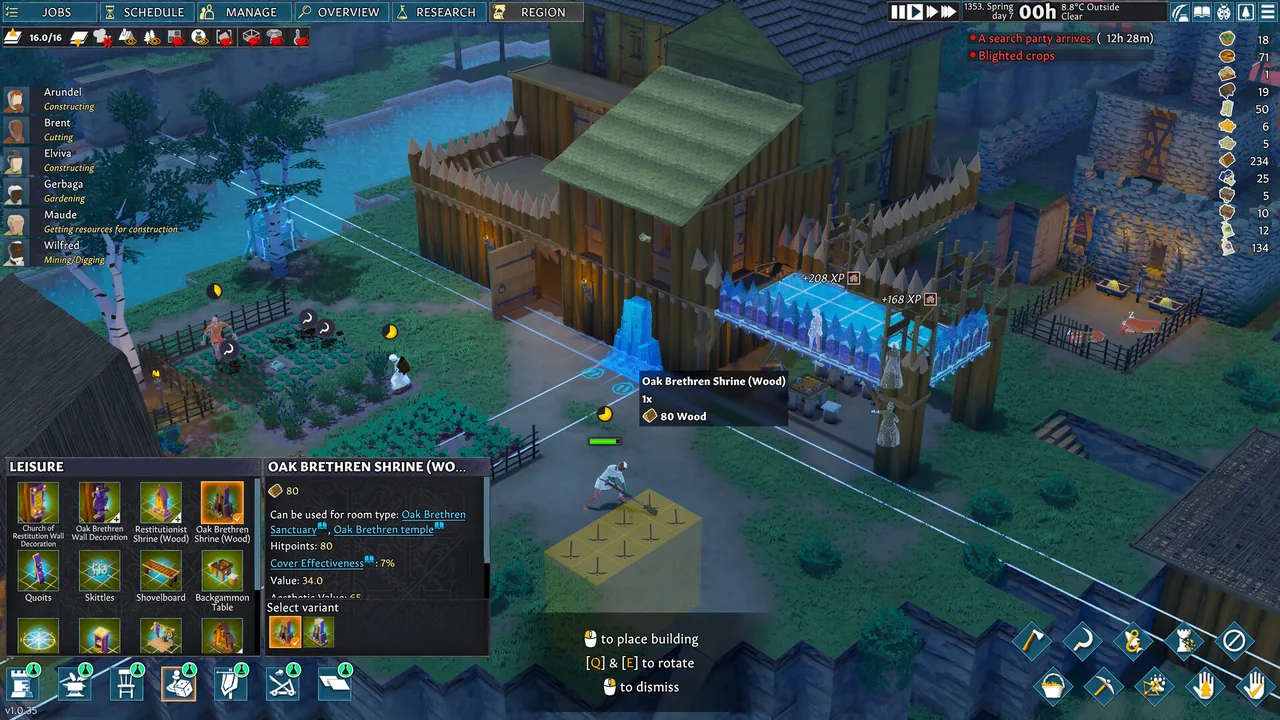
The comparison every player and every review reaches for is RimWorld, and it's the right one, because Going Medieval is best understood as a direct answer to the one thing RimWorld's 2D grid can never offer: real verticality. Terrain here is voxel-based rather than tile-based, which means you can excavate into a hillside to carve out storerooms and defensive tunnels, then build upward from the same footprint into a multi-storey keep, with each floor a genuine structural layer rather than a cosmetic overlay. Roofs generate automatically based on what's supporting them, unsupported overhangs collapse, and stacking a heavy stone tower on a timber frame is the kind of mistake the game will happily let you make once before you learn better. It turns base layout into a spatial puzzle that most of the genre simply doesn't ask players to solve, and it's the reason Going Medieval carved out its own audience rather than getting dismissed as a RimWorld clone during Early Access.
The trade-off is that verticality adds real cognitive load. Managing a sprawling, multi-floor settlement means tracking supply routes, temperature, and defensive chokepoints across several Z-levels at once, and the game's tools for doing that — floor-by-floor view toggles, cross-section slicing — are functional but require more deliberate navigation than a flat map ever would. It's a fair price for what the mechanic delivers, but new players used to single-layer city builders should expect a steeper spatial learning curve than the genre's marketing usually admits to.
From three survivors to a walled city
The core loop underneath the voxel gimmick is familiar colony-sim structure: three ragged survivors of a plague-emptied world arrive with nothing, and you direct them through gathering, building, farming, and crafting toward something resembling a fortified town. Settlers have individual skills and preferences that steer which jobs they'll actually pick up versus which you have to force, seasons apply real pressure through cold and crop cycles, and the crafting chain runs deep enough — from raw ore through smithing to full plate armour, from grain through a working brewery — that self-sufficiency is a genuine mid-game milestone rather than something that happens by default.
Where it diverges from its most obvious rival is in how much personality the settlers carry. RimWorld builds a soap opera out of grudges, romances, and mental breaks triggered by a mood system that stacks dozens of small modifiers into a believable psychological state. Going Medieval's settlers have needs — hunger, rest, comfort, safety — but no relationship web and nothing resembling a storyteller pulling narrative strings behind the scenes. The result is a settlement that reads as a functioning machine rather than a cast of characters, which is a real loss for players who came to the genre for the emergent drama RimWorld is famous for. It's also, honestly, part of why Going Medieval is easier to pick up: a new player is reaching a stable, working colony in something like four to six hours, where RimWorld's mood stacking, storyteller pacing, and relationship webs routinely take ten to fifteen hours before they click. Which trade-off is better depends entirely on whether you came here for a puzzle or a soap opera.
Renown and six ways to actually finish
For most of Early Access, Going Medieval's biggest structural weakness was one shared by half the genre: there was no ending. You built, you defended, you kept building, and eventually you simply stopped because there was nothing left the game was asking of you. The 1.0 release addresses that directly with Renown, a set of global stats — trade, military, intellect, faith, and more — that track your settlement's behaviour across the whole campaign, each rising or falling in response to the choices you actually make rather than a score you have to remember to farm. Once any individual stat hits 100%, it unlocks a Grand Objective: a defined, epic goal tied specifically to that stat, whether that's founding a renowned university around a Grand Research Desk, building out a religious sanctuary, or cementing your settlement as a trade power. Six Grand Objectives exist at launch, and reaching one functions as that campaign's genuine win condition, alongside new supporting systems like drawbridges and rally points for managing sieges, and dedicated room types — training halls, treasuries, libraries — that buff the stats those objectives are tracking.
This is a real structural improvement, and it answers a complaint that dogged the game for years. It's also worth being honest about its limits. Turning settlement behaviour into a set of tracked, completable stats risks doing to Going Medieval's sandbox what achievement lists do to open-ended games generally: once you know which lever moves which stat, there's a pull to optimise directly toward it rather than let a campaign develop on its own terms, and a Renown-driven endgame can start to feel like working through a checklist instead of reacting to whatever the world throws at you. Foxy Voxel's own systems don't force that mindset — you can ignore Renown entirely and keep playing an open sandbox indefinitely, exactly as before — but the mere existence of a visible completion bar changes how a lot of players will approach a run, for better and for worse. It's a meaningfully better place than "no ending at all," even if it isn't quite the fully emergent capstone the four-year wait might have implied.
Raids that hold the line but rarely surprise
Combat is where the RimWorld comparison stops flattering Going Medieval. Raids arrive on a predictable cadence, scale roughly with your settlement's apparent wealth and strength, and reward the same core preparation every time: choke points, ranged coverage from elevated positions, and armed settlers stationed before the enemy arrives. Drawbridges and rally points, both new in 1.0, give you sharper tools for managing where a siege actually happens, which is a welcome addition for anyone who found the older defensive toolkit thin. But the encounters underneath those tools rarely evolve — there's no equivalent to RimWorld's escalating threat variety or storyteller-driven curveballs, and once a defensive layout works, it tends to keep working with only minor adjustment for a long time. Combat functions as a supporting system that justifies your defensive architecture rather than a central pillar players are meant to master in its own right, and players who want their colony sim to double as a tactics game will find this one consistently shallower than that ask.
Settler AI compounds the issue in a specific, avoidable way: pathfinding through dense, multi-storey settlements still produces the occasional absurd route or stalled task, particularly once a base has several floors, narrow stairwells, and a lot of stockpiled clutter competing for the pathing engine's attention. It's not constant, and it's rarely fight-losing, but it happens often enough across a long session that manual intervention — reassigning a stuck hauler, redirecting a settler who's decided to walk the long way around a collapsed floor — becomes a recurring background chore rather than a rare annoyance.
Interface, modding, and the long tail
The interface carries the weight of a genuinely deep simulation reasonably well. Floor-by-floor navigation, room designation, and the crafting menus are all functional once learned, though the sheer number of overlapping systems — stockpiles, room requirements, settler schedules, the new Renown tracking — front-loads more for a new player to absorb than a lighter city builder would. Steam Workshop support has had years to mature, and the modding community built around it is active enough to extend the base game meaningfully for players who exhaust the vanilla content, which matters more here than in most single-player-only sandboxes since there's no multiplayer to fall back on for replay value.
Value is straightforward to assess: NZ$43.59 for a game that, even before 1.0, was already delivering well past a hundred hours for players chasing a fully developed settlement, and the only paid extras are a modest cosmetic Supporter Pack and a soundtrack — no recurring purchases, no expansion tiers competing for attention. Against genre peers charging similar prices for less finished products, that's an easy value case to make now that the core loop actually has a destination.
Players who like the idea of a system that keeps running and rewarding attention over a long stretch, without needing constant hands-on management, might find something familiar in Wanderer's own gathering and crafting loop — a much smaller-scale cousin of the same "let the settlement work while you plan the next building" satisfaction.
Verdict
Going Medieval earns its place with the one idea it built the whole game around: a colony sim where up and down are as real as north and south, with structural consequences that make vertical building a genuine design problem instead of a visual flourish. Nearly five years after Early Access began, 1.0 finally answers the sandbox's biggest structural complaint by giving Renown and six Grand Objectives a real finish line, even if that finish line occasionally feels more like a checklist than a story. Combat stays the weak link throughout — functional, rarely surprising, and still tripped up by pathfinding quirks in the exact multi-floor bases the game encourages you to build — and settlers carry noticeably less individual personality than the genre's benchmark.
None of that erases what's genuinely excellent here. Recommend it to anyone who wants a colony sim that takes verticality seriously and doesn't mind trading some of RimWorld's narrative chaos for a gentler learning curve and a real sense of architectural stakes. Steer combat-focused players and anyone hoping for multiplayer elsewhere. At a clean one-time price with no monetisation traps and a modding scene that's had years to mature, this is an easy recommendation for the audience it's actually built for.
Price and platform details checked 31 July 2026.
Pros and cons
Pros
- Voxel terrain with real structural stability makes vertical construction — towers, buried cellars, load-bearing walls — an actual design constraint rather than a cosmetic layer
- Renown and the six Grand Objectives finally give open-ended colonies a defined way to conclude a campaign, something the genre has historically struggled with
- The jump from three survivors to a walled, multi-storey settlement stays legible even as the colony grows into dozens of rooms across several floors
- Steam Workshop support and four-plus years of active patching have left a healthy modding scene layered on top of the base systems
- Monetisation is about as clean as premium PC gaming gets — one purchase, one small cosmetic add-on, no recurring costs
- Onboarding is noticeably faster than RimWorld's; new players reach a working colony in hours rather than needing a dozen to parse mood stacking and storyteller logic
Cons
- Raids and combat stay a secondary system throughout — defensive layouts reward planning, but the encounters themselves rarely escalate beyond familiar patterns
- Settler pathfinding still stumbles in dense, multi-floor bases, with settlers occasionally taking absurd routes or stalling on tasks that need manual correction
- Renown turns settlement progress into tracked stats aimed at a specific objective, which can make late-game play feel like working through a checklist rather than reacting to an emergent story
- No mood stacking, relationship web, or storyteller-driven event pacing, so colonists carry noticeably less individual personality than RimWorld's do
- Strictly single-player, with no multiplayer support even after five years of development
Screenshots
-
Going MedievalImage: Mythwright via Steam -
Going MedievalImage: Mythwright via Steam -
Going MedievalImage: Mythwright via Steam -
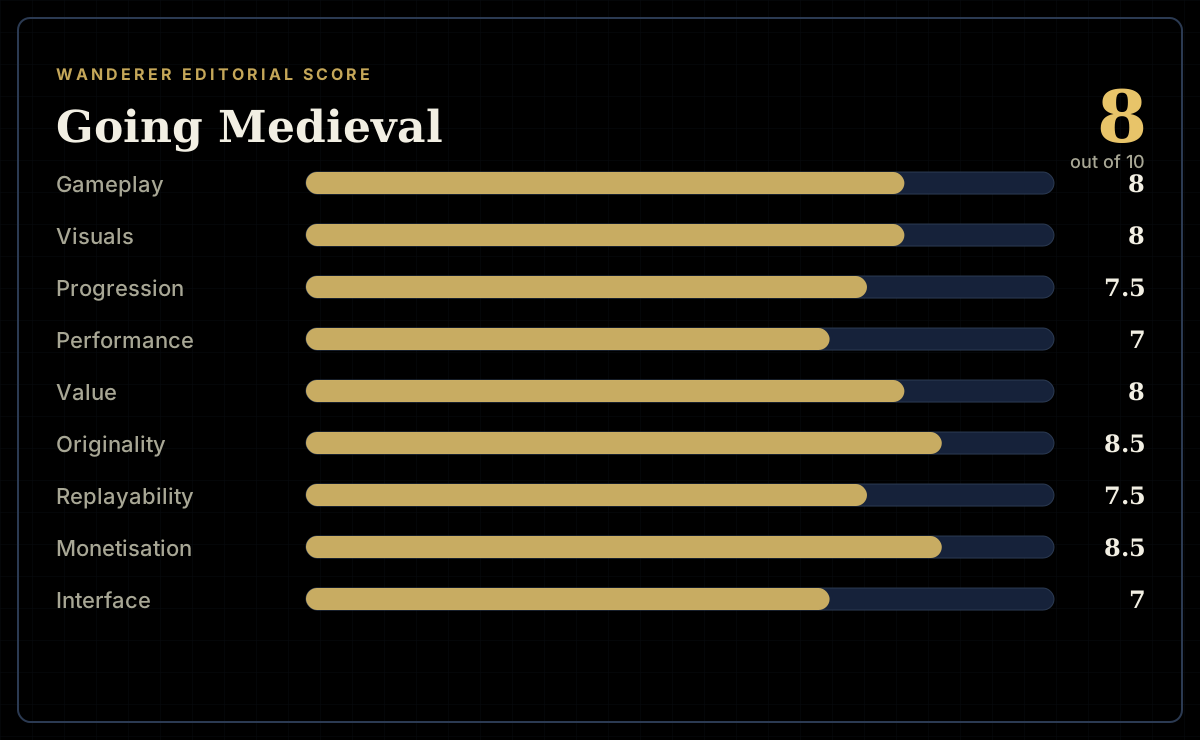
How the review scores each part of the gameWanderer Editorial -
The short versionWanderer Editorial