Game review
Desynced
7 / 10
- Developer
- Stage Games Inc.
- Publisher
- Forklift Interactive, Gamersky Games
- Released
- 5 March 2026
- Platforms
- Windows
- Genre
- Automation strategy, colony simulation and real-time strategy
- Monetisation
- Premium, one-off purchase. No ads, no in-app purchases, no premium currency, no DLC and no subscription
- Players
- Online co-op and online PvP for up to a handful of players sharing or contesting a map, plus Steam Workshop support; no dedicated matchmaking, sessions are direct-connect
The short version
Desynced's whole pitch is that automating your colony shouldn't mean picking orders from a menu — it should mean actually programming the units that carry them out, with a real node-based behavior language capable of variables, conditions and loops. That idea is the best thing about the game and, five months past its 1.0 launch, still the reason it's worth talking about: nothing else in the automation genre asks this much of you, or rewards the ask this well once you clear the hump.
The hump is real, though, and 1.0 didn't remove it. The interface buries that clever system under menus that were confusing in Early Access and are still confusing now, the tutorial doesn't build the right mental model before it lets go, and the combat and exploration layers wrapped around the automation core feel like pressure valves rather than fully developed systems in their own right.
Biggest strengths
- The behavior-graph editor is a genuine visual programming language — variables, conditions, loops and reusable sub-graphs — not a dressed-up order menu, and it scales to real complexity once you're fluent in it
- Automating a squad's combat roles (scout, tank, healer) end to end is a payoff no menu-driven RTS or colony sim offers, and multiplayer PvP lets you turn that payoff against another player's base
- Co-op and PvP both work over a direct connection without needing a dedicated server, which is more multiplayer access than most automation games bother to build
Biggest weaknesses
- The interface is the single most repeated complaint across nearly three years of player reviews, and post-1.0 reviews from March 2026 onward still describe it as confusing rather than fixed
- The tutorial explains individual screens without building the mental model the behavior editor actually requires, so many players bounce off before reaching the system the game is built around
- The same three complaints — editor tedium, an opaque interface, a tutorial that stops too early — recur consistently from 2023 through reviews written after the 1.0 launch
Who it's for: Players who already like writing scripts, solving logic puzzles, or pushing Factorio's ratio-thinking a step further into actual code. A poor fit for anyone who wants an automation game they can pick up casually — this one wants a notebook and a second monitor for the wiki.
Our recommendation: Worth buying at the current discount if the pitch — programming your colony's units instead of ordering them around — genuinely excites you. Go in expecting to fight the interface for the first several hours, and don't expect the exploration or combat layers to carry the experience if the automation puzzle doesn't click for you.
7 / 10
Most automation games let you pretend to program something. You drag a belt, you place an inserter, you set a filter on a splitter, and the game lets you feel like an engineer without ever asking you to think in variables or loops. Desynced doesn't let you pretend. Open its behavior editor for the first time and you're looking at a node graph with conditionals, memory slots and function calls — a genuine visual programming language sitting on top of a factory-and-colony sim, not a metaphor for one. That's the single most interesting idea in the automation genre right now, and it's also, by the weight of nearly three years of player feedback, the thing that keeps a meaningful share of buyers from ever finishing the tutorial.
Stage Games' colony sim spent two and a half years in Early Access, from 15 August 2023 to a 1.0 launch on 5 March 2026, and it hasn't slowed down since — the developers have kept pushing near-weekly builds to an experimental branch every few weeks right through to late July 2026, alongside a public promise of new missions, UX passes and further behavior-system refinements still to come. Five months on from 1.0, this is a genuinely finished game rather than one frozen mid-thought, and it's worth reviewing as one. It's also, going by its own review corpus, a game whose central idea and central problem are the same feature.
Behaviors: the real hook, and the real wall
Every unit in Desynced — miners, builders, combat drones, scouts — runs on a behavior graph you build yourself. You wire together sensor nodes, decision nodes and action nodes, attach conditions, store values in variables, and call one graph from inside another the way you'd call a function. It is not Factorio's belt-thinking, where the logic is implicit in how you physically route items and the "program" is really just geometry. It's not Autonauts' record-and-replay either, where you demonstrate an action once and a bot repeats it verbatim with essentially no abstraction available past that. Desynced sits somewhere neither of those does: an explicit, symbolic language you write by hand, with the full expressive range that implies and none of the physical intuition that makes belt-based automation approachable to someone who has never coded.
That distinction matters more than it sounds like it should. Belt-thinking is spatial — you can often eyeball why a factory is jammed by looking at where items are backing up. Record-and-replay is procedural but concrete — you watched the bot do the thing, so you know roughly what it will do again. A node graph with variables and conditionals asks you to hold state in your head the way actual programming does, and Desynced's own review history shows that ask landing badly for a lot of players who came in expecting an automation game rather than a light coding exercise. "The problem with the game is the tedious and painful visual programming," reads a fairly typical complaint from mid-2026, months after 1.0 shipped; a January 2025 review put it more bluntly: bot "programming" is "done with spaghetti nodes," and building anything felt tedious before the automation even paid off.
The flip side is that when it clicks, it clicks hard. Positive reviews describe programming full squads with distinct roles — a scout that hunts, a tank that holds aggro, a healer that follows — running entirely on graphs the player wrote, with no equivalent menu-driven order system in any comparable RTS or colony sim. One recent review put it plainly: the game is "fully playable without touching the light visual scripting side," but "immensely more engaging" once you do. That's an honest summary of the whole design. Desynced doesn't gate basic play behind the behavior system, but it reserves its actual ceiling for players willing to learn to write in it.
An interface that never stopped being the problem
Reading the negative-review corpus in order, from August 2023 through the weeks after 1.0, is striking mostly for how little it changes. Complaints about a clunky, overcomplicated interface appear in reviews from every single month sampled, including several written after the March 2026 launch: "even with the 1.0 release," one reads, "the seed gen for the initial conditions are sketchy at best"; another from the same week says plainly "it's not ready for 1.0 — poorly documented, not much reward, slow pace, overly convoluted." A June 2026 review — three months after full release — is still describing "the tedious and painful visual programing" as the game's core problem, unprompted and independent of the March-launch cluster.
None of that means the interface never improved. Four major content updates across Early Access and a genuinely active patch cadence since 1.0 both suggest real ongoing investment, and some reviewers do note incremental fixes arriving on the experimental branch. But the pattern across years of feedback, and the fact that a menu system built for a node-based programming game is still being called confusing by players three years in, says the fundamental information architecture hasn't been solved so much as smoothed at the edges. For a game whose whole proposition is "learn to write in our language," that's a heavier cost than it would be anywhere else — a bad menu in a normal colony sim costs you convenience; a bad menu here can cost you the thing you actually bought the game for.
What the achievement numbers can and can't tell you
Global achievement percentages are usually the fastest way to check whether a "tutorial problem" complaint is a loud minority or the median experience, and Desynced's look alarming at first glance: the most-earned achievement on the list sits just over 10%, nothing else clears 8%, and most sit under 3%.
Those numbers are close to meaningless here, and it's worth saying why rather than quietly using them. Steam Achievements were only added to Desynced in the 1.0 patch on 6 March 2026, alongside trading cards. Everyone who bought the game across two and a half years of Early Access — which is most of the people who own it — sits in the denominator of every one of those percentages without ever having had the chance to earn a single one. A 2% figure measures the age of the achievement system, not the point where players gave up.
The complaint pattern in the reviews themselves survives that correction intact, though, and it's the more telling evidence anyway. The same three objections — the editor's tedium, an interface that hides its own rules, a tutorial that stops well short of the skills the game expects — turn up consistently from 2023 right through reviews written after the 1.0 launch. A rough on-ramp that a full release didn't smooth over is a design problem the numbers were never needed to prove.
Combat and the mystery narrative: pressure, not partners
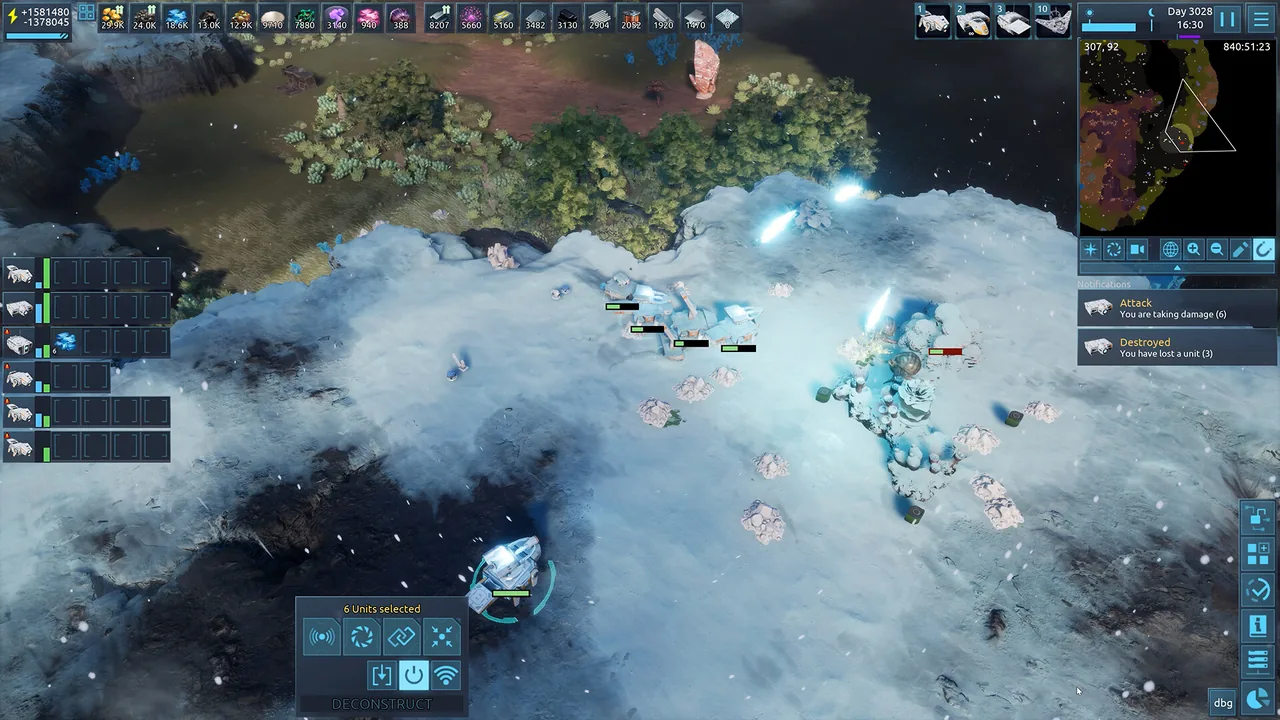
Desynced frames its factory-and-colony loop inside a sci-fi mystery about an AI edging toward self-awareness, spread across procedurally generated worlds with alien factions to fight or avoid. It's a reasonable hook, and the multiplayer PvP option — raiding another player's automated base rather than just an AI's — is a genuinely distinctive addition few automation games attempt. But on the single-player side, several long-playtime reviews describe the threat and the plot as thin scaffolding rather than a second real system: "an RTS with no real enemy," one 400-plus-hour review calls it, and others describe reaching a vague, unsatisfying stopping point rather than a proper ending. That's a familiar shape from this genre — Factorio's biters exist mainly to give the factory a reason to defend itself, not to be a deep combat game in their own right — but Desynced sells itself more heavily on exploration and story than Factorio ever does, which makes the thinness read as a bigger gap between promise and delivery.
Where combat does integrate well is exactly where the behavior system does: automating a squad's roles turns fighting into another automation puzzle rather than a separate minigame, and that's the strongest evidence the three layers — factory, combat, exploration — were designed to share one core rather than get bolted together. The problem is that reaching that integration requires already having cleared the interface and behavior-editor hump discussed above, so the game's best idea is gated behind its worst first impression.
Multiplayer and value
Co-op and PvP both run over a direct connection without a dedicated-server requirement, which is a genuinely accessible amount of multiplayer support for a genre where most entries are single-player only or bolt multiplayer on as an afterthought. At NZ$43.59 standard, discounted to just over thirty dollars at the time of writing, and with reviews describing playtimes well past a hundred hours for players who get past the early wall, the value case is solid for the intended audience — this is not a short game, and its price reflects roughly what a mid-tier premium Steam release should cost, not a game trying to overreach on that front.
The verdict
Desynced is the most technically ambitious game in the automation-strategy space right now, and it earns that description honestly: nothing else asks you to write actual node-based programs for your units, and nothing else pays that ask off as well once you're fluent. What it hasn't solved, across two and a half years of Early Access and five months past a full 1.0 release, is the interface and onboarding standing between a new player and that payoff — the one complaint that has never stopped recurring. Players who already think in loops and conditionals, or who enjoyed Factorio's ratio-solving and Autonauts' record-and-replay automation and wanted something that pushes further into real programming, will find a genuinely rewarding system underneath the mess. Anyone hoping for an easier on-ramp into automation should look at shapez 2 or Mindustry first, and come back to Desynced once the idea of writing your colony's code, rather than just directing it, sounds like fun rather than homework.
Wanderer players who like the idea of systems that keep working while you're not watching them will recognise the appeal here, even if Desynced asks for a much steeper up-front investment to get there.
Pros and cons
Pros
- The behavior-graph editor is a genuine visual programming language — variables, conditions, loops and reusable sub-graphs — not a dressed-up order menu, and it scales to real complexity once you're fluent in it
- Automating a squad's combat roles (scout, tank, healer) end to end is a payoff no menu-driven RTS or colony sim offers, and multiplayer PvP lets you turn that payoff against another player's base
- Co-op and PvP both work over a direct connection without needing a dedicated server, which is more multiplayer access than most automation games bother to build
- Four major content updates across Early Access and a still-active near-weekly patch branch after 1.0 show a team that keeps shipping rather than walking away at launch
Cons
- The interface is the single most repeated complaint across nearly three years of player reviews, and post-1.0 reviews from March 2026 onward still describe it as confusing rather than fixed
- The tutorial explains individual screens without building the mental model the behavior editor actually requires, so many players bounce off before reaching the system the game is built around
- The same three complaints — editor tedium, an opaque interface, a tutorial that stops too early — recur consistently from 2023 through reviews written after the 1.0 launch
- Combat and the exploration narrative both read as pressure and flavor wrapped around the automation core rather than systems developed to the same depth, echoing complaints about "an RTS with no real enemy"
Screenshots
-
DesyncedImage: Forklift Interactive via Steam -
DesyncedImage: Forklift Interactive via Steam -
DesyncedImage: Forklift Interactive via Steam -
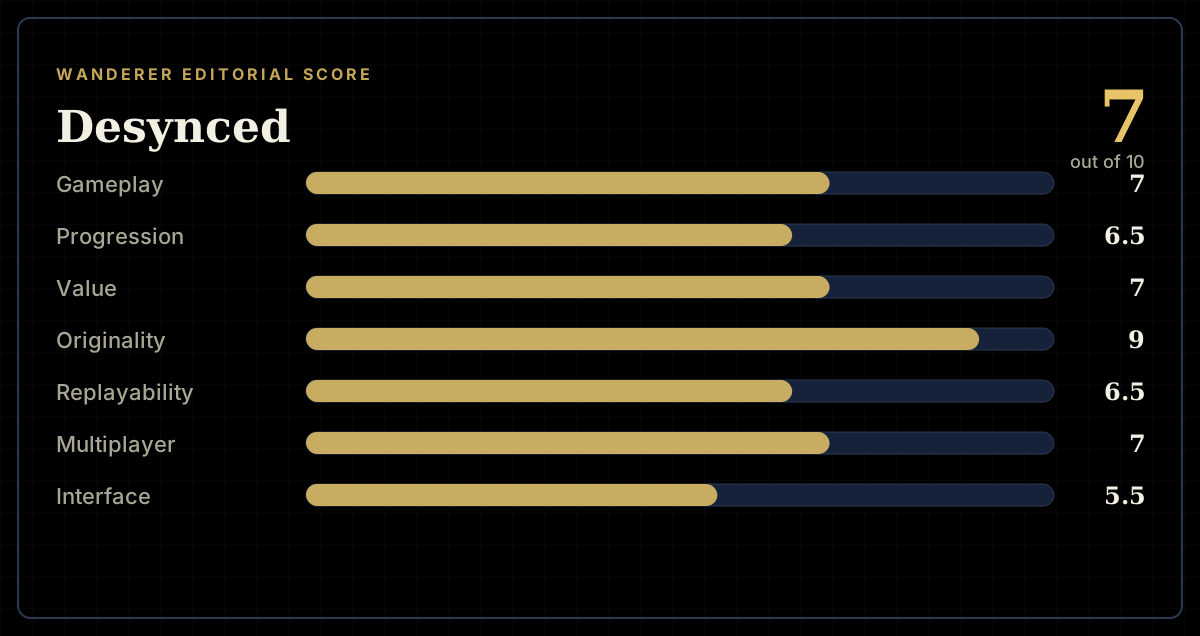
How the review scores each part of the gameWanderer Editorial -
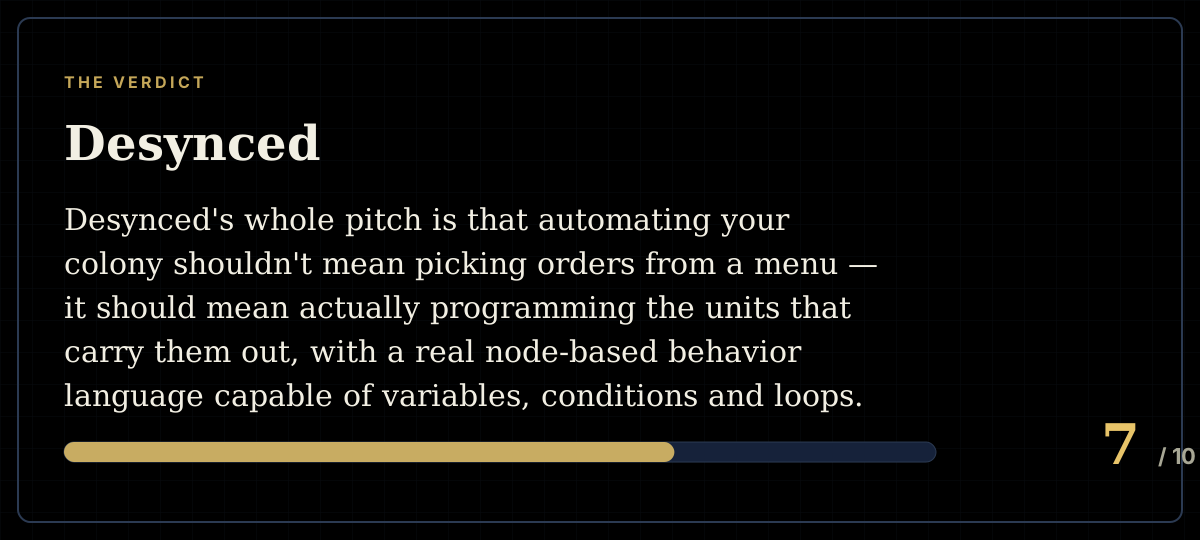
The short versionWanderer Editorial