Game review
Mindustry
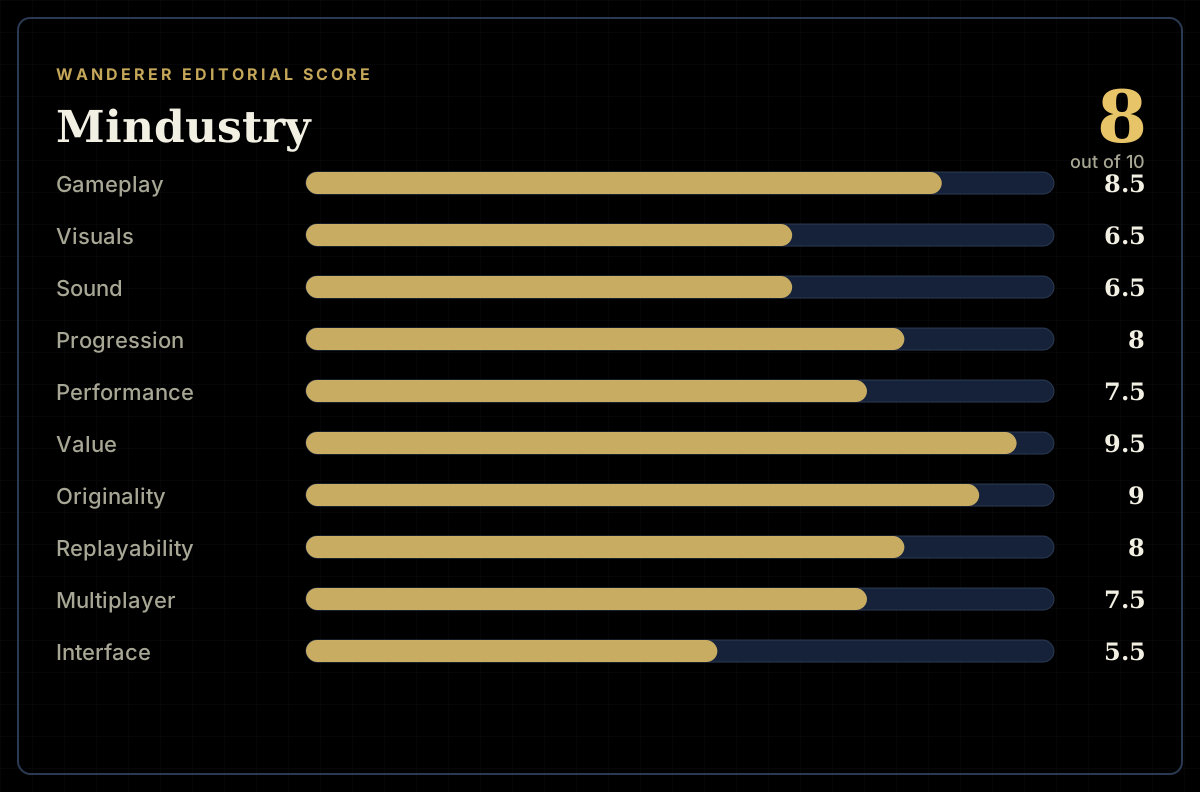
8 / 10
- Developer
- AnukenDev (Anuken)
- Publisher
- AnukenDev (Anuken)
- Released
- 26 September 2019
- Platforms
- Windows, macOS, Linux, Android, iOS
- Genre
- Factory automation, tower defense and real-time strategy
- Monetisation
- Free and open source (GPL-3.0) on Android, F-Droid and itch.io, where it is offered pay-what-you-want including nothing at all; a paid one-off purchase on Steam and the App Store, with no ads, no in-app purchases and no premium currency on any platform. Development is funded through donations and the Steam/App Store sales of what is, underneath, a free codebase
- Players
- Cross-platform co-op against AI and team or free-for-all PvP over dedicated servers, plus a Steam Workshop for maps and community server browsing; anyone can run their own server from the free codebase
The short version
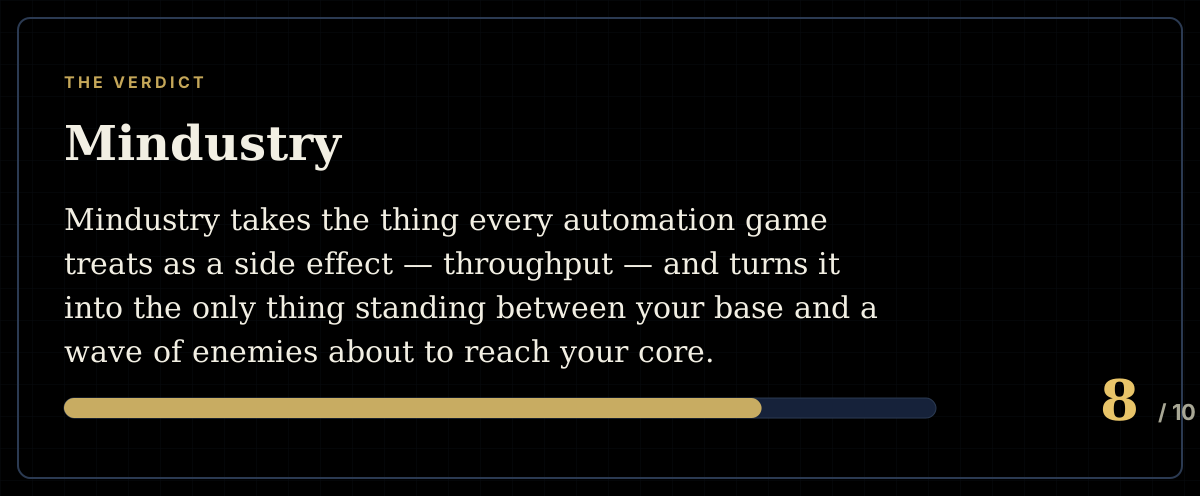
Mindustry takes the thing every automation game treats as a side effect — throughput — and turns it into the only thing standing between your base and a wave of enemies about to reach your core. The result is a genuinely distinctive hybrid: build too slowly and you don't miss a production quota, you watch a turret run dry mid-fight. It's rough around the edges, the tutorial barely explains itself, and the interface throws small, similar-looking icons at you from the first minute. But it's free on the platforms where most people will actually meet it, fully open source underneath, and there's nothing else quite like it.
Biggest strengths
- Ammo, coolant and power for every turret come from the same belts you build everything else with, so a supply-chain mistake shows up as a losing fight, not a stalled counter
- Two structurally different campaigns (Serpulo and Erekir) ask you to rebuild your understanding of production rather than just unlocking bigger versions of the same blocks
- The logic processor system lets you script unit behaviour and automation with a real, if intentionally low-level, assembly-style language
Biggest weaknesses
- The tutorial explains which button does what but not why a base falls apart, leaving new players to work out supply ratios and defence timing largely on their own
- Menus and block icons are small, densely packed and often visually similar, with too little text labelling for a game this mechanically deep
- Mobile touch controls make precise belt and turret placement noticeably harder than on desktop, and imprecise taps on small screens are a common complaint
Who it's for: Automation fans who want their production line to matter in real time rather than on a spreadsheet, tower-defense players who'd rather build the factory behind their turrets than just place them, and anyone curious what an actively-maintained open-source passion project looks like six years after its 1.0.
Our recommendation: Try it for nothing on Android or itch.io first — that is the same game, not a demo. Move to Steam once you know you want achievements, the Workshop and frictionless multiplayer; NZ$12.39 for a game this replayable and this actively maintained is an easy yes.
8 / 10
Most factory games let you take your time. Build the wrong ratio in Factorio and a science pack queue backs up quietly somewhere off-screen; you notice, you fix it, nothing was ever actually at risk. Mindustry doesn't extend that courtesy. Build the wrong ratio here and the turret at the end of that belt runs dry three waves into an attack, and the consequence isn't a stalled counter, it's a hole in your perimeter with enemies pouring through it. That one structural decision — making your production line double as your ammo supply and your defence budget — is the whole reason a free, solo-developed factory game with pixel-art sprites has spent six years building one of the more devoted followings in the automation genre, and it's still the best reason to take it seriously.
The pitch: throughput you can lose a fight over
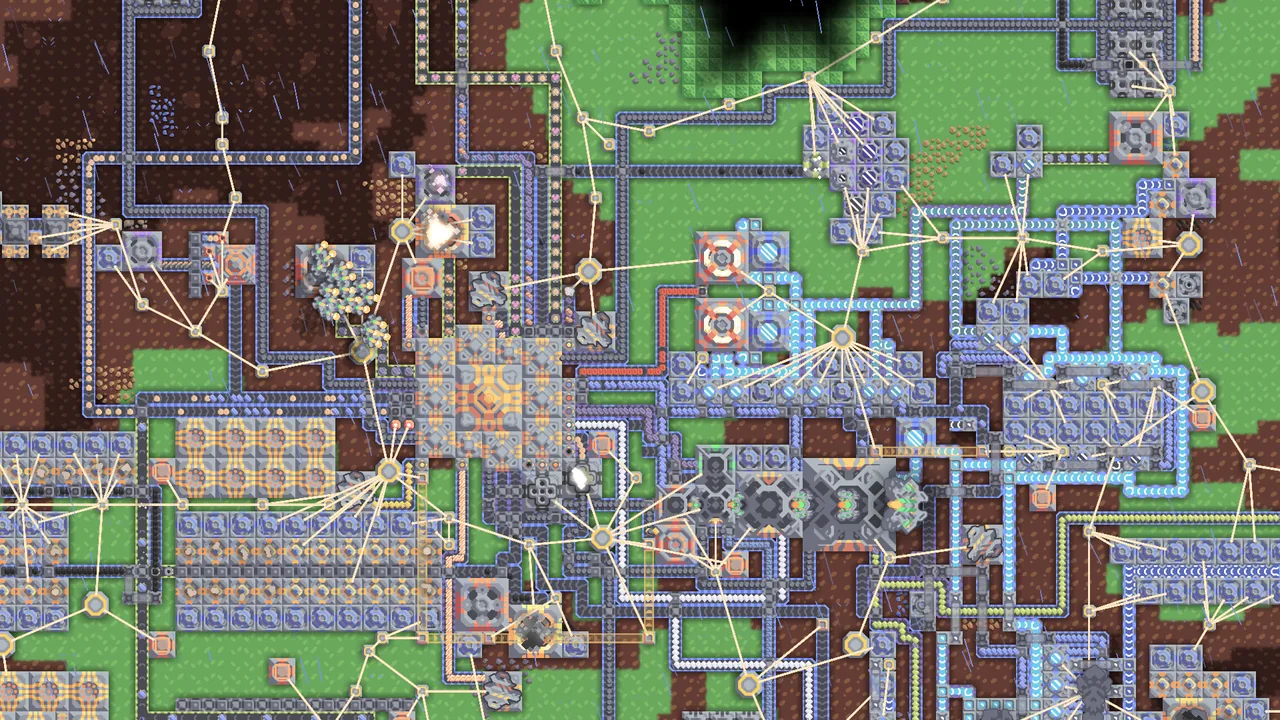
Strip away the tower-defense dressing and Mindustry's factory half is recognisable to anyone who's played Factorio or Satisfactory: drills pull ore, conveyors move it, factories refine it into denser materials, and pipes carry liquids like water and oil between them. What's different is what all of that feeds into. Turrets need ammunition — specific crafted materials, not an abstract resource pool — and many also need coolant or a stable power supply to keep firing at full rate. Miss any one of those and the turret doesn't just underperform, it stops entirely, at the exact moment an enemy wave is testing whether your wall holds.
That single design choice reframes every automation decision as a defensive one. Deciding whether to route more copper toward a new production block or toward your frontline turrets isn't a min-maxing exercise, it's triage, made under a visible countdown to the next wave. It's a smarter marriage of two genres than the premise sounds like on paper, and it's the reason Mindustry reads as its own thing rather than "Factorio with enemies bolted on."
Two campaigns, two different games underneath
Mindustry's campaign spans two planets, and they don't just reskin the same production chain with different numbers. Serpulo, the original planet, is the more approachable of the pair: conveyor belts, drills, and — its signature late-game system — logic processors, which let you write short, assembly-style scripts to automate unit behaviour, resource routing and turret targeting beyond what the default AI handles. It's a real, if deliberately low-level, programming environment sitting inside a factory game, and players who lean into it get automation that goes meaningfully further than "place block, connect belt."
Erekir, added in 2022, changes the rules almost entirely. Conveyor belts are gone in favour of a different logistics model built around beam-based transport and impact reactors, unit production shifts to modular assembly, and — the one change that draws real pushback from committed players — the logic-processor system doesn't carry over. Judged purely as a second campaign, Erekir is a legitimately interesting design exercise: it forces you to relearn assumptions Serpulo spent hours training into you, in the same way a good expansion should. Judged against the players who'd already built their favourite tools in mlog, it's a genuine step backward, and the split reception on that point is fair. Both campaigns share the sector-based structure — hand-built maps early on, then dozens of procedurally generated sectors you capture, garrison and use to feed resources back to your core worlds via launch pads — which gives the whole campaign a sense of actually expanding outward rather than just unlocking a longer tech tree in place.
Schematics turn repetition into design
The single feature that does the most to keep Mindustry's midgame from becoming repetitive manual labour is schematics: select a working section of your factory, save it, and stamp identical copies down anywhere else you need that same production block. It's a smaller-scale version of the same trick Factorio's blueprints pull off, and it has the same effect — once you've solved "a self-sufficient graphite line" or "a turret cluster with its own coolant loop" once, you're not solving it again, you're deploying it, which frees up attention for the actual strategic layer of expansion and defence rather than repetitive placement.
Waves, and the pressure they put on your layout
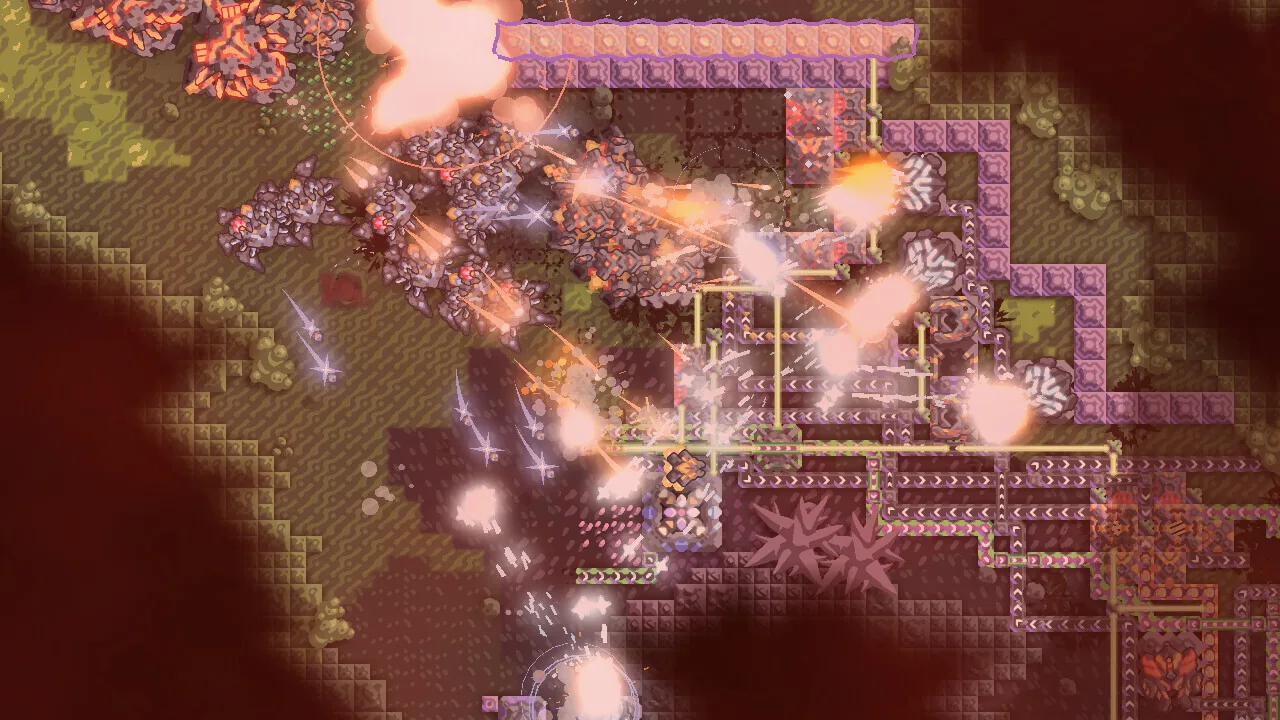
Combat itself doesn't ask much of you directly — you're rarely aiming or dodging by hand, you're deciding where turrets go and keeping them fed. The real skill being tested is layout: whether your walls funnel enemies into overlapping fields of fire, whether your power grid can survive a generator going down mid-wave, and whether your ammo production scales with how far into the campaign you are rather than how far it got you three sectors ago. That puts Mindustry closer to a tower-defense puzzle wearing a factory game's skin than the reverse, and it means the tension the brief promises — build calmly, or defend under attack — is close to constant. There's rarely a phase where you're purely building without one eye on the next wave timer, which some players find is exactly the hook that keeps a factory game from turning into idle busywork, and others find exhausting when all they wanted was to optimise a production line in peace. Both reactions show up regularly in the game's own Steam reviews, and neither is wrong; it's a legitimate fork in what "automation game" even means to different players.
An interface that doesn't meet the systems halfway
Here's where Mindustry's ambition outruns its presentation. Blocks are represented by small, often visually similar icons with limited text labelling, tooltips are sparse compared to the depth of what they're describing, and the sheer number of interlocking systems — production, logistics, power, unit control, logic scripting, sector management — gets thrown at new players with very little scaffolding to tell them what matters first. The in-game tutorial teaches the mechanical basics of the opening mission competently enough, but a meaningful share of the game's own negative Steam reviews single out exactly this: a tutorial that shows you which button builds a turret without ever explaining why your base is about to fall apart, and a UI dense enough that even players who stick around describe relying on the community wiki to make sense of icons the game never labels clearly. None of that is a small nitpick for a game this mechanically rich — it's the single biggest thing standing between Mindustry and a much larger audience than the one it currently has.
Presentation and sound: functional, not the draw
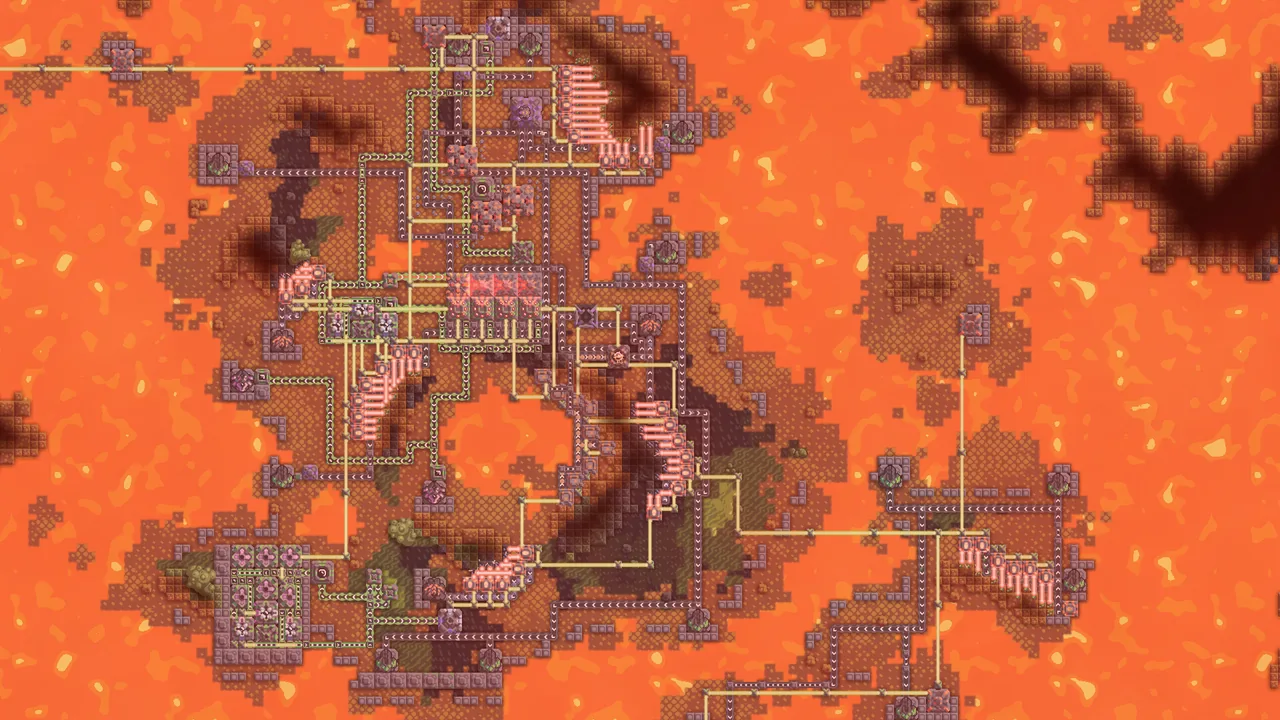
Visually, Mindustry is clean pixel art that reads well at the zoom levels you'll actually play at, but it isn't chasing spectacle and it hasn't meaningfully evolved its core look across major versions the way its systems have. Sound design covers the basics — machine hums, explosions, wave alerts — competently without doing much to elevate the experience. Neither is a weakness exactly; they're simply not where a solo developer with this much system design to maintain has chosen to spend limited time, and it shows.
Mobile play: the same game, a harder interface
Mindustry's presence on Android is one of its most genuinely unusual decisions — the full game, not a stripped-down companion app, running free on phones and tablets. That's a real achievement for a project this systemically dense. It's also where the interface problems above compound rather than ease. Precise belt routing and turret placement, fiddly enough with a mouse, get noticeably harder on a touchscreen, and a recurring thread in player feedback describes accidentally tapping the wrong adjacent tile on smaller phones, exactly the kind of input error that costs you a turret's ammo supply at the worst possible moment. The systems underneath are identical to the desktop version — nothing is cut for mobile — but the game was clearly designed with a mouse's precision in mind first, and touch controls are still working to catch up to what the design demands of them.
Multiplayer, servers and a genuinely open ecosystem
Multiplayer covers co-op against AI, team-based PvP and free-for-all matches, all running cross-platform between desktop, Android and iOS players on the same servers. Anyone can host their own dedicated server directly from the free, open-source codebase, and the Steam version layers a Workshop on top for community maps and easier server browsing. That's a meaningfully more open multiplayer model than most premium PC games bother with, and it's a direct product of the codebase being public in the first place — plugin support and total-conversion mods exist because nothing about the server or client is locked away from the community running it.
The value question, answered twice
Most reviews only have to answer one pricing question. Mindustry has to answer two, and they point in different directions on purpose. On Android, F-Droid and itch.io, the entire game — both campaigns, full multiplayer, the logic system, everything — is free, released under the GPL-3.0 licence with the source sitting in a public GitHub repository that has passed 28,000 stars. Itch.io explicitly frames it as pay-what-you-want, nudging supporters toward buying the Steam version instead for its achievements, Workshop integration and smoother matchmaking, but never gating content behind that choice. On Steam and the App Store, the same game costs a one-off NZ$12.39, with no in-app purchases, no ads and no premium currency on any platform. That's an unusually honest way to fund an open-source project: charge for convenience and platform features on the storefronts that support it, and never take those features away from the people who can't or won't pay. For a game a serious player will sink hundreds of hours into, either price point is close to disposable — the free option removes even that argument.
Development has kept pace with that goodwill. Version 8 landed in 2026 with a reworked campaign and multiplayer structure, following the 2022 addition of an entire second planet, on top of a steady stream of smaller releases in between. Very few games at any price, let alone free ones, are still shipping structural changes six years after their 1.0.
Players who like the idea of a production line running steadily in the background, without needing enemies breathing down its neck to make it matter, may find a calmer version of that same appeal in Wanderer's own gathering and crafting systems.
Verdict
Eight out of ten. Mindustry's core idea — that your factory's output is also its defence budget, so a bottleneck is a battle you're about to lose rather than a number you'll get around to fixing — is genuinely distinctive, and the two campaigns, the logic-scripting system and schematics all give that idea real depth to grow into. The multiplayer model and the open-source foundation underneath it are close to unimpeachable for a project this size.
What holds it under the very best in its genre is mostly self-inflicted: a tutorial that explains buttons rather than reasons, an interface that asks a lot of new players before it gives much back, and touch controls that make the mobile version of a genuinely excellent free game meaningfully harder to enjoy than the desktop original. None of that is fatal, and none of it changes what happens once the systems click — it just means more players bounce off the first few hours than the game's ambition really deserves.
If the idea of your ammo supply and your factory floor being the same spreadsheet appeals at all, there's no real reason not to try it: it's free on the platforms most people will actually meet it on, and the Steam price for everyone else is close to nothing against what the game gives back.
Price and platform details checked 30 July 2026.
Pros and cons
Pros
- Ammo, coolant and power for every turret come from the same belts you build everything else with, so a supply-chain mistake shows up as a losing fight, not a stalled counter
- Two structurally different campaigns (Serpulo and Erekir) ask you to rebuild your understanding of production rather than just unlocking bigger versions of the same blocks
- The logic processor system lets you script unit behaviour and automation with a real, if intentionally low-level, assembly-style language
- Schematics let you save and stamp a working block layout anywhere, turning repetitive building into reusable design once you've solved a problem once
- Free, GPL-3.0 open-source, and under genuinely active development years after launch, with a public GitHub repo past 28,000 stars
- Cross-platform co-op, PvP and a Steam Workshop mean the multiplayer side isn't a bolted-on afterthought
Cons
- The tutorial explains which button does what but not why a base falls apart, leaving new players to work out supply ratios and defence timing largely on their own
- Menus and block icons are small, densely packed and often visually similar, with too little text labelling for a game this mechanically deep
- Mobile touch controls make precise belt and turret placement noticeably harder than on desktop, and imprecise taps on small screens are a common complaint
- Visual presentation is functional pixel art rather than a showcase, and it hasn't chased spectacle even as the systems underneath it have grown
- Erekir's campaign drops the logic-processor scripting that gives Serpulo its most distinctive late-game tool, which reads as a step back for players who'd already invested in it
- A large minority of Steam reviews describe bouncing off entirely, calling the early game confusing or comparing it unfavourably to more polished automation games
Screenshots
-
MindustryImage: AnukenDev via Steam -
MindustryImage: AnukenDev via Steam -
MindustryImage: AnukenDev via Steam -
How the review scores each part of the gameWanderer Editorial -
The short versionWanderer Editorial