Game review
shapez
7.5 / 10
- Developer
- tobspr Games
- Publisher
- tobspr Games, Doyoyo Games
- Released
- 7 June 2020
- Platforms
- Windows, macOS, Linux
- Genre
- Factory automation puzzle
- Monetisation
- Premium, one-off purchase — no ads, no premium currency, no subscription. Two small optional DLCs exist — a Puzzle mode expansion with its own constrained levels, and a soundtrack release. Neither is required to finish the base game
- Players
- None. shapez is entirely single-player
The short version
shapez is the game that proved you could delete everything from Factorio except the logistics puzzle and still have something worth playing. Cut, rotate, stack and paint shapes into increasingly demanding deliveries, with no enemies, no starvation and no clock — the entire challenge is spatial reasoning against a static diagram, and for the first dozen or so hours that idea carries the whole game.
It's also the rougher, earlier draft of an idea its own sequel later executed with far more polish. Controls and UI friction are a constant thread in player feedback, the late-game wiring layer arrives with almost no explanation, and the original studio has stepped away from the codebase entirely. At the price it usually sells for, none of that is a serious obstacle — it's a genuine bargain and a piece of genre history — but it is not the sequel.
Biggest strengths
- The shape-cutting, rotating, stacking and painting loop is a genuinely original puzzle idea that shapez 2 expanded rather than replaced
- Routinely discounted to around NZ$1-2, it's one of the cheapest complete automation games ever sold on Steam
- Optional wiring and logic gates let players chase a self-sufficient "make anything" factory without the game ever requiring it
Biggest weaknesses
- Controls and UI friction are a recurring complaint in negative reviews, down to a colourblind mode several players say does almost nothing
- The engine's single-threaded core produces visible stutter once a factory sprawls, with no official fix ever shipped
- Floating layers and the rocket-shape mechanic arrive with next to no in-game explanation, confusing players independently in multiple reviews
Who it's for: Genre newcomers who want the cheapest possible way into shape-logistics puzzling, and anyone curious where shapez 2's ideas actually came from. Less suited to players who want a polished, currently-supported product, or who already own shapez 2 and are wondering whether the original adds anything new.
Our recommendation: Buy it. At its usual discounted price it costs less than a coffee and delivers dozens of hours of a genuinely original puzzle idea. Just go in knowing it's an unmaintained, occasionally clunky first draft of a design that tobspr Games later refined properly.
7.5 / 10
Before shapez 2 put factories on three stacked layers and gave them trains to move goods between them, there was just this: a flat, infinite grid, a handful of raw shapes, and a diagram of something more complicated you had to figure out how to build. shapez, released by tobspr Games in June 2020, is the game that first asked whether an automation game could survive with nothing in it but the automation — no enemies, no starvation, no pollution, no clock. It turns out the answer is yes, emphatically, and shapez spent the next four years proving it well enough that its own sequel is now the more famous game. That makes this review as much an assessment of a historical document as a current product, and both halves of that matter to whether you should buy it.
The loop that started it all
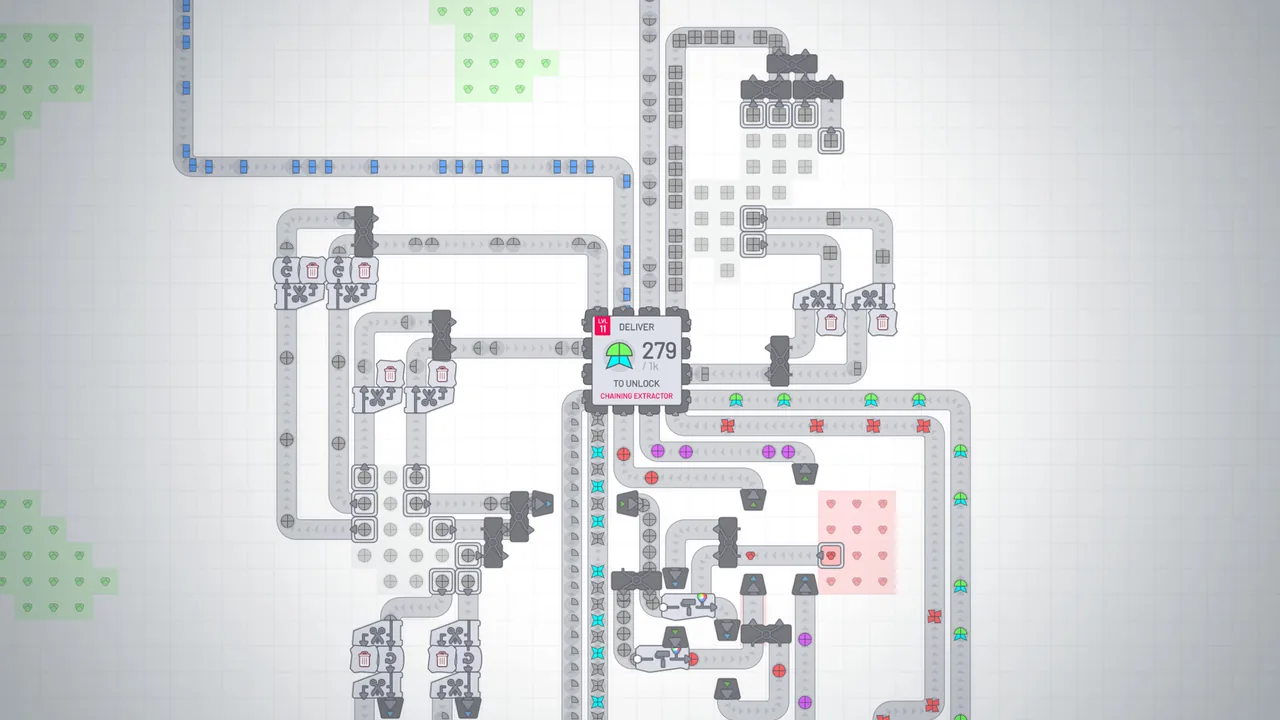
Every shape in the game is built from layers of quadrants, and the entire challenge is reverse engineering a target diagram into a sequence of cutters, rotators, stackers and painters that produces it, then building a machine that does that reliably at scale. There's no reflex test here and no resource pressure — shapez.io's own storefront pitch calls it explicitly "low-stakes," and it means it. Miners never run dry, buildings are free to place and free to delete, and the only cost of a wrong guess is a few seconds spent undoing it. That's a genuinely different kind of puzzle from Factorio's throughput math: instead of balancing numbers, you're pattern-matching a static image into a construction sequence, and the moment a complicated shape finally clicks into place is a real, earned "aha."
The early hours are close to perfect at this. New buildings arrive at a pace that respects the player — shapez never front-loads every mechanic and then just scales the numbers for the remaining twenty hours, the trap a lot of automation games fall into. Extraction gives way to cutting, cutting gives way to combining multiple shapes into new ones, and colour extraction and mixing arrive right around when pure geometry starts feeling solved. It's a tightly paced curriculum for a game with no formal tutorial screens to speak of.
Where the curve gets rough
The trouble starts once the milestone ladder introduces mechanics it doesn't explain. Two independent strands of negative player feedback single out "floating layers" and the so-called rocket shape — mechanics that arrive with little to no in-game guidance, to the point that players describe them as feeling like an undocumented quirk rather than a designed system. For a game whose entire pitch is calm, legible puzzle-solving, that's a real inconsistency: the early game explains itself through the tutorial rhythm of new-building-then-new-shape, and the late game abruptly stops.
The other recurring pattern sits around level 26, where players typically unlock the tools to build a general-purpose "make anything" factory — exactly the kind of self-sufficient machine the game's own store description dares you to build. Once that factory exists, a consistent share of reviews describe the remaining content as repetition rather than new problems: more shapes, the same solved trick applied again. That's not a flaw unique to shapez — it's the same tension shapez 2 was built to answer with three-dimensional platforms and a genuinely structured Manufacture Mode — but the original never solved it. It just ends when the player's patience does.
Wires, and the ceiling above the milestone ladder
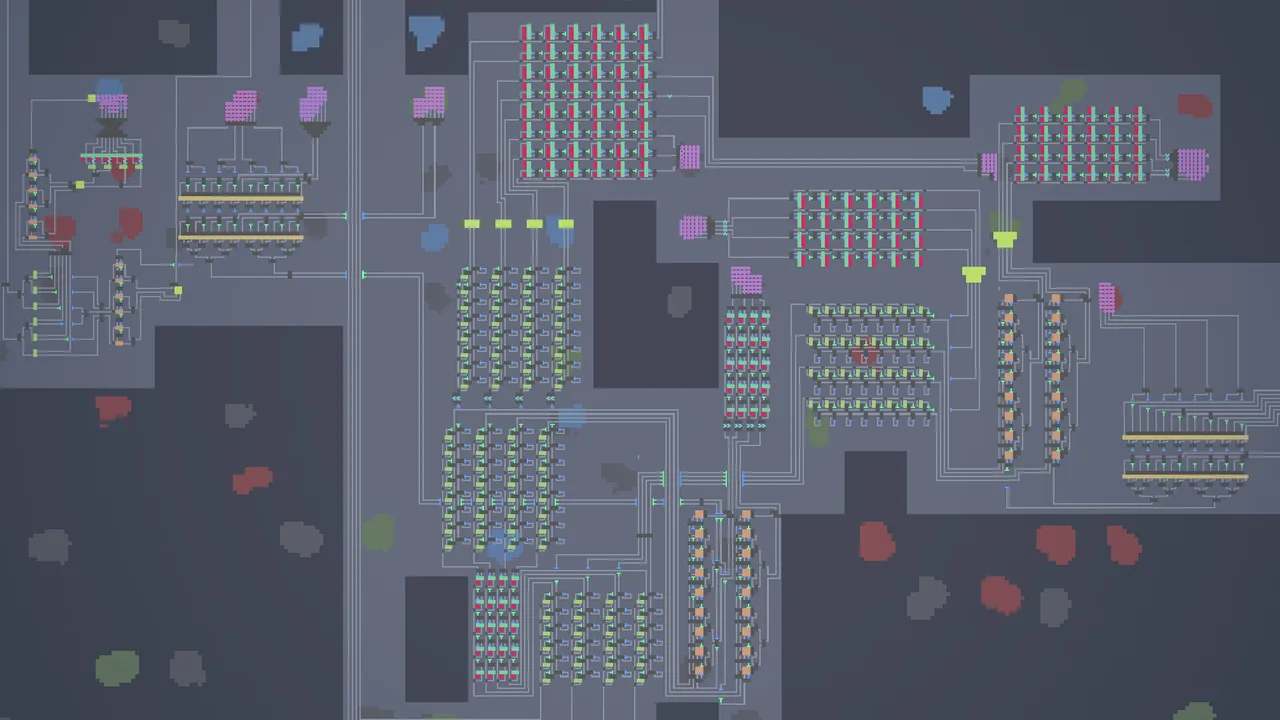
Past the main progression, shapez layers in optional wiring and logic gates, letting players build genuinely programmable factories: sensors that read shape composition, gates that route production conditionally, and enough logic primitives to build a machine that can, in principle, assemble almost anything on demand. It's a real systems-design sandbox bolted onto a puzzle game, and it's where the "make anything machine" players reference actually lives. Whether that reads as a natural extension or a wall depends entirely on what kind of player you are — it's a from-scratch logic system with no dedicated tutorial, which is exactly why so much of the critical feedback around it describes confusion rather than difficulty. Players who enjoy programming-adjacent puzzles will find a genuinely deep toy here; players who came for shape-cutting and nothing else are liable to bounce off it entirely.
Interface, performance and presentation
This is where the age of the game shows most. Controls and UI friction come up constantly across negative Steam reviews — awkward belt placement, cramped menus, and a colourblind mode that several players report does almost nothing to actually help distinguish shape colours, despite being listed in the game's accessibility categories. None of it is broken, exactly, but it's consistently described as friction rather than the kind of clean, obvious interface a genre built on precise placement really wants.
Performance carries its own asterisk. shapez runs on a custom engine built on a single-threaded core, and a minority but recurring thread of feedback describes visible lag once a factory grows large — a structural limitation the game never patched around, since tobspr Games' engineering effort has gone into shapez 2 for years now. The visual style — flat, geometric, deliberately minimalist — reads as clean early on and gets repetitive over very long sessions, a fair trade for a game this small but a real one. The soundtrack is the clear presentation highlight: composer Petter Sumelius, who went on to score shapez 2 as well, gives the game an understated ambient backdrop that suits its unhurried pace far better than the interface does.
An abandoned original, and a demo that isn't the full game
Two facts matter for anyone deciding how to actually buy this. First, tobspr Games' own GitHub repository states plainly that the project is "no longer actively maintained" now that development has moved to shapez 2, pointing players toward an unofficial, community-run fork — the shapez Community Edition — for any further patches. The game is fully open source under the GPL-3.0 licence, which is exactly what makes that fork possible, but it does mean the version you buy on Steam today is the same one the original studio stopped touching some time ago.
Second, the free browser build at shapez.io is explicitly labelled an "Online Demo" by the developer's own README, not the complete game — a genuinely different situation from, say, an open-source project that ships its full feature set for free and charges only for convenience. Steam is where the full milestone ladder, wiring and logic system, Steam Cloud saves and achievements actually live. Several Steam reviews describe getting hooked on the web version and then paying for the full release anyway, which is honestly the intended funnel — just don't go in expecting the browser build to substitute for ownership.
Value
At its usual heavily discounted price — NZ$1.47 against a NZ$14.75 list, checked 2 August 2026 — shapez is close to the cheapest way into this entire genre that exists on Steam. The two DLCs are genuinely optional: the Puzzle DLC repackages the shape-cutting logic into bite-sized, constrained levels rather than an open sandbox, and the Soundtrack DLC is exactly what it says. Neither gates anything the base game does. For a title with no ads, no premium currency and a price this low, the monetisation is about as honest as it gets — the only real caveat is that the studio's attention has clearly moved on to its sequel.
Players who like the idea of production ticking along quietly, just with people and quests attached rather than pure geometry, may find a different flavour of that appeal in Wanderer's gathering and crafting loops. Anyone deciding between the two shapez games should read our shapez 2 review — it's the same core idea rebuilt in 3D with a real endgame and none of the interface friction described above. Readers who want the higher-stakes end of the automation genre, biters included, should also see our Factorio review.
Verdict
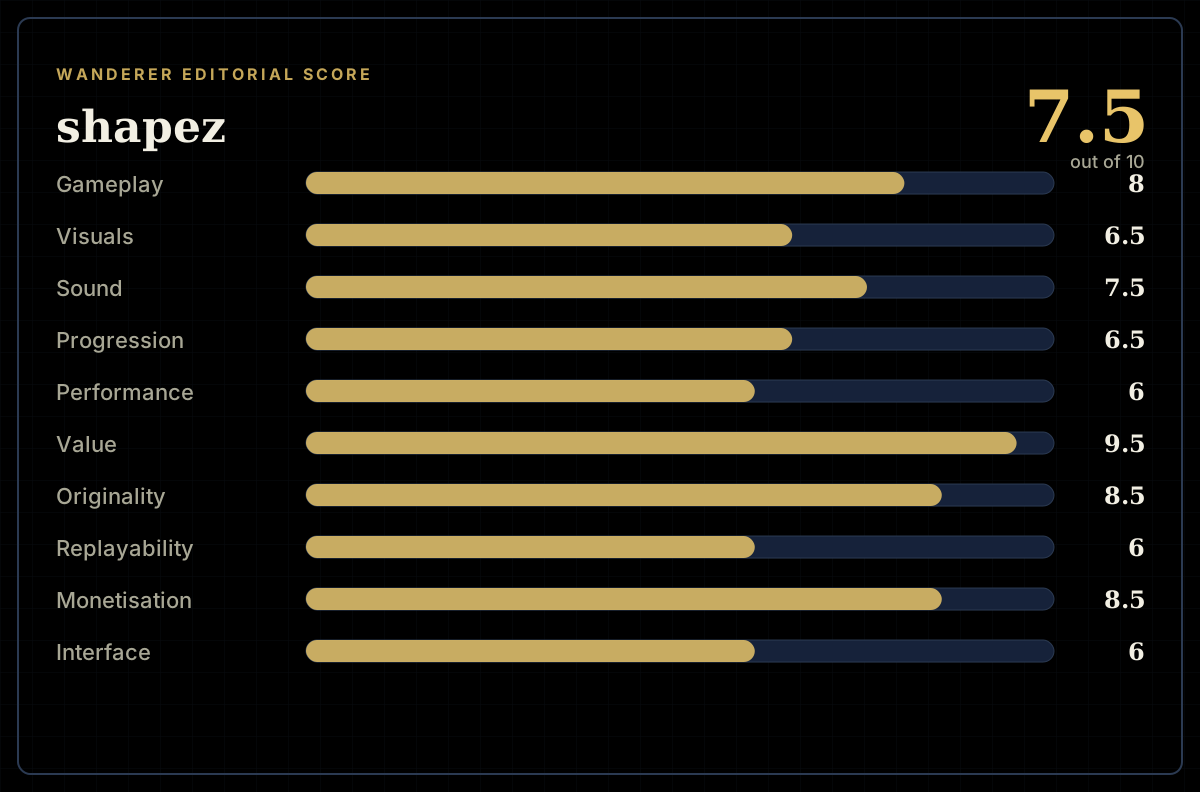
7.5 out of 10. shapez earns its place in this genre's history by proving, first, that an automation game can be built from spatial logistics alone and still be genuinely gripping — the core cutting-and-stacking loop is a real, original idea, not a Factorio reskin, and the early milestone pacing is close to ideal. What keeps the score below its own sequel is everything that idea's execution hasn't kept up with: an interface players consistently describe as clunky, a wiring layer that expects you to figure it out alone, a single-threaded engine that shows its age under load, and a studio that has openly moved its attention elsewhere. None of that erases what's good here, and at the price this usually sells for, it's an easy recommendation regardless. Just know you're buying the rough draft, and the finished version has a name of its own.
Price and platform details checked 2 August 2026.
Pros and cons
Pros
- The shape-cutting, rotating, stacking and painting loop is a genuinely original puzzle idea that shapez 2 expanded rather than replaced
- Routinely discounted to around NZ$1-2, it's one of the cheapest complete automation games ever sold on Steam
- Optional wiring and logic gates let players chase a self-sufficient "make anything" factory without the game ever requiring it
- Fully open source under GPL-3.0, with an active unofficial Community Edition fork continuing development tobspr Games stepped away from
- The soundtrack, from the same composer who later scored shapez 2, holds up well across long building sessions
Cons
- Controls and UI friction are a recurring complaint in negative reviews, down to a colourblind mode several players say does almost nothing
- The engine's single-threaded core produces visible stutter once a factory sprawls, with no official fix ever shipped
- Floating layers and the rocket-shape mechanic arrive with next to no in-game explanation, confusing players independently in multiple reviews
- Once a general-purpose "make anything" factory exists around level 26, a consistent share of reviews describe the remaining levels as repetition rather than new problems
- tobspr Games has stopped actively maintaining this codebase in favour of shapez 2, leaving further fixes to an unofficial community fork
- The free shapez.io browser build is an explicitly limited demo, not the full game, so it can't fully substitute for buying
Screenshots
-

shapezImage: tobspr Games via Steam -
shapezImage: tobspr Games via Steam -
shapezImage: tobspr Games via Steam -
How the review scores each part of the gameWanderer Editorial -
The short versionWanderer Editorial