Game review
shapez 2
8 / 10
- Developer
- tobspr Games
- Publisher
- tobspr Games
- Released
- 23 April 2026
- Platforms
- Windows, macOS, Linux
- Genre
- Factory automation puzzle
- Monetisation
- Premium, one-off purchase — no ads, no premium currency, no subscription. Two small optional DLCs exist: a purely cosmetic Hyper Skin pack for trains, and a Supporter Edition Upgrade bundling 50 extra minutes of music and the full soundtrack with two decorative rail pieces. Neither gates content or gameplay
- Players
- None. shapez 2 is entirely single-player
The short version
shapez 2 takes the factory-automation genre and removes everything that isn't the puzzle: no enemies, no starvation, no timers, no cost. What's left is shape geometry distilled into quadrants and layers, built across a genuinely clever 3D platform system, and it's the closest thing this genre has produced to a pure mathematics toy.
That purity is also the argument against it. With nothing pushing back, the endgame becomes a question of whether you still want to optimise once nothing is forcing you to, and the game's own performance starts to buckle right around the point where the answer would otherwise be yes.
Biggest strengths
- Shapes decompose into quadrants and layers, so every delivery target is a genuine spatial-logic puzzle rather than just a bigger belt
- Multi-layer 3D platforms let a single factory occupy three stacked production layers instead of sprawling sideways forever
- Four Classic-mode difficulties plus an experimental Hexagonal mode each demand a differently shaped factory, not just a harder version of the same one
Biggest weaknesses
- Factories visibly stutter once machine counts climb into the high hundreds of thousands, and there is no DLSS, FSR or XeSS upscaling to claw performance back
- No enemies, no resource scarcity and no fail state at all mean the tension some automation veterans specifically want has been engineered out of the game entirely
- Once a player builds a general-purpose shape-producing block, a recurring complaint in negative reviews is that the remaining difficulty tiers feel like more of the same rather than new problems
Who it's for: Players who like Factorio's ratio-solving but find its biters and its onboarding cliff more annoying than essential, and anyone who wants a factory game they can pick up without clearing an evening for it. Less suited to players who need stakes, a base to defend or a reason besides curiosity to keep building.
Our recommendation: Worth buying at the current discounted price, and arguably worth it at full price too — this is a complete, polished 1.0 release rather than an Early Access promise. Just know that the ceiling is soft rather than hard: nothing stops you building forever, but the game also stops giving you new reasons to once the milestones run out.
8 / 10
Ask an automation-game veteran what they'd cut from Factorio if they could, and most will name something on the same short list: the biters, the onboarding cliff, the fifteen minutes of tutorial before the game trusts you with a wire. shapez 2 is the answer to that question taken to its logical end. There are no enemies. Resources never run out. Every building is free and placing the wrong one costs you nothing but a delete key. What remains, once all of that friction is gone, is something closer to a physical puzzle than a strategy game — cut a shape, rotate it, stack it, paint it, deliver it — and it turns out that's more than enough to build a genuinely excellent game around. Whether it's enough to build an endless one is the actual question this review has to answer.
One point of housekeeping first, since the Steam store page currently causes real confusion. The listing name today reads "shapez 2 - Factory," which looks at a glance like it could be an edition tag or a spin-off. It isn't. It's Steam's current label for the same appid (2162800) that has carried shapez 2 since Early Access began on 15 August 2024, through its full 1.0 release on 23 April 2026 and the Update 1.1 patch that followed on 25 June 2026 — confirmed by the storefront's own DLC records, which point their fullgame field straight back at this listing, and by Steam's search index, which turns up no separate, unsuffixed "shapez 2" entry to confuse it with. Developer, press and the community all still just call it shapez 2. Treat the subtitle as a Steam-side quirk, not a different product.
It's also worth one sentence on the original. shapez, released in 2020, began life as a free, open-source browser game at shapez.io before also reaching Steam as a small paid release with achievements and a puzzle-focused DLC. shapez 2 keeps the shape-cutting DNA but rebuilds everything else: 2D becomes 3D, the flat white void becomes a space station, and — pointedly — the sequel is a paid product from day one, no free browser version waiting in the wings.
Geometry as the entire game
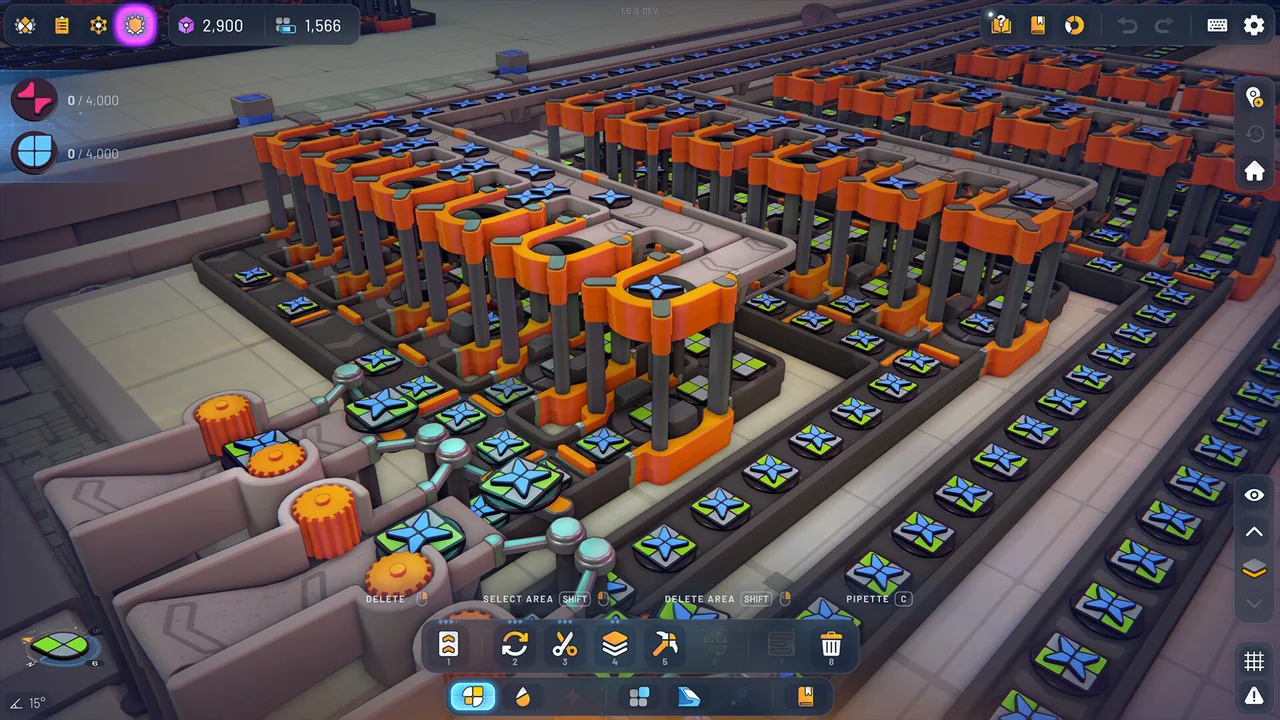
The core loop is disarmingly simple to describe and takes hours to master. Every shape in shapez 2 is built from up to four layers, each split into four quadrants, and your factory's job is to extract raw shapes, cut them into quarters, rotate and stack those quarters, and paint them the right colour before delivering an exact match to the Vortex. There's no combat skill here and no reflexes required — the entire challenge lives in figuring out, from a target shape's diagram, what sequence of cutters, rotators, stackers and painters produces it, and then building the machine that does that at scale.
That's a genuinely different kind of puzzle from Factorio's ratio math, and it's shapez 2's best idea. Where Factorio asks you to balance throughput numbers, shapez 2 asks you to reverse-engineer a static image into a construction sequence, which scratches an entirely different part of the brain — closer to a spatial-reasoning puzzle than an engineering problem. Early shapes are trivial. By the midgame you're decomposing four-layer, sixteen-quadrant targets that require genuinely clever machine chains to assemble, and the moment a complicated shape finally clicks together correctly is one of the best "aha" feelings the genre has produced.
Three layers, one factory
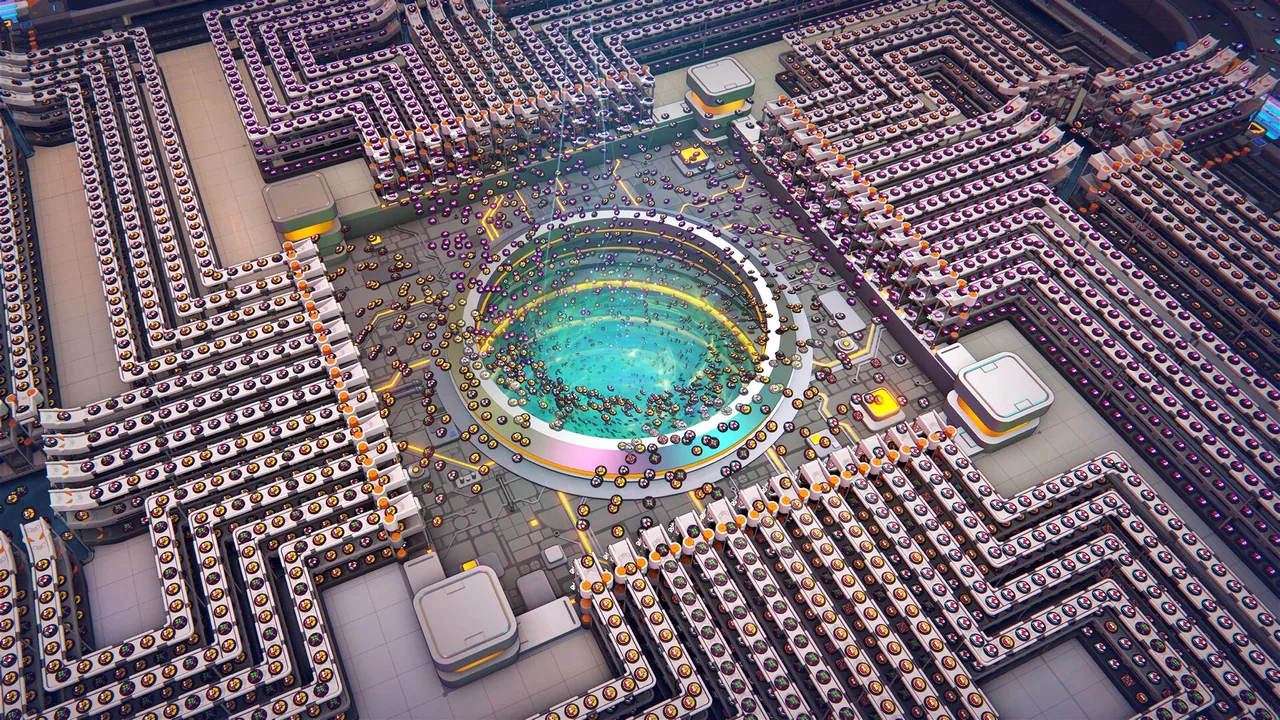
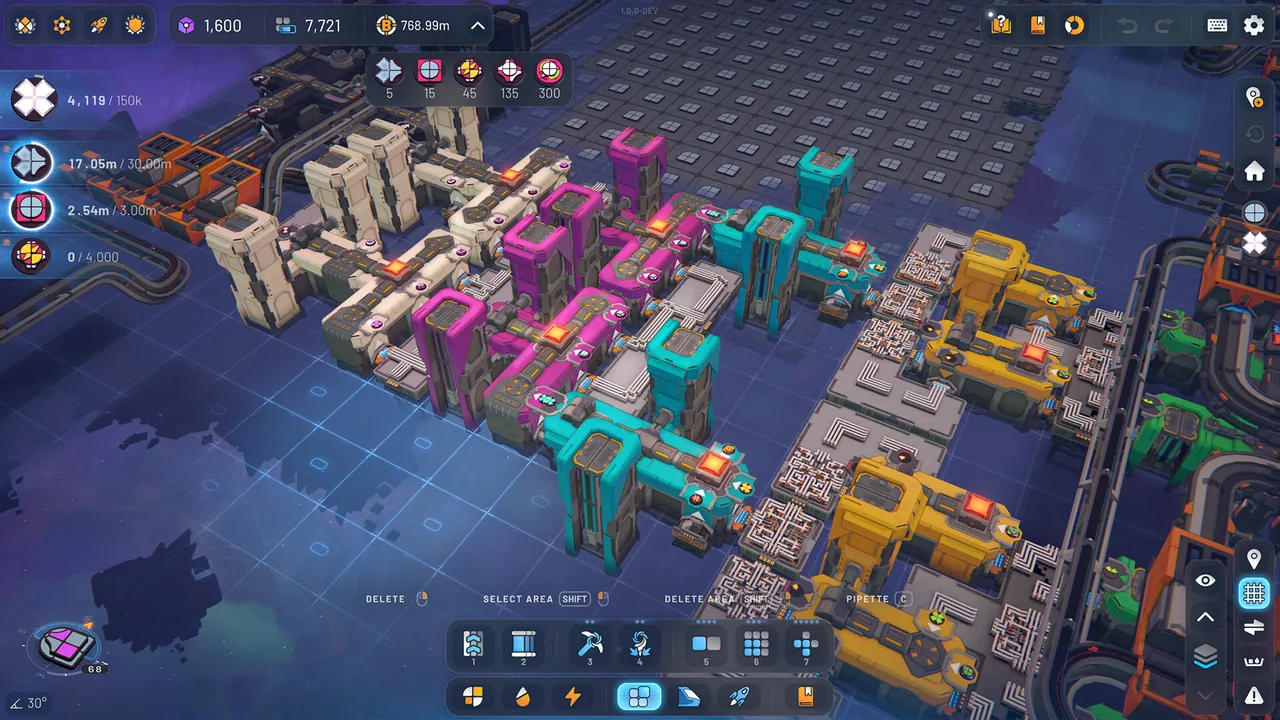
The sequel's other headline idea is spatial rather than logical: shapez 2 moved from 2D to full 3D, and it uses the extra dimension for something more interesting than set dressing. Factories are built on modular platforms that stack across three distinct building layers, so a single tile of map real estate can host three separate, independently wired production lines rather than one. Combined with space trains that move goods between platforms, this turns the mid-game from "build sideways forever" into a genuine layout puzzle in three dimensions — deciding what goes on which layer, and how to route material vertically between them, is a real design skill the original shapez never asked for.
It's an elegant solution to the problem every automation game eventually hits: infinite horizontal sprawl gets ugly and hard to navigate. Building up instead of just out keeps a factory's footprint legible even once it's producing thousands of shapes a minute, and the open, animated buildings — you can always see the belt spinning and the cutter blade swinging inside, rather than staring at a sealed box — make even a sprawling base readable at a glance. Presentation and function are doing the same job here, which isn't always true in this genre.
Four difficulties, four different factories
shapez 2 splits into modes that behave more like separate games sharing an engine than difficulty sliders. Classic Mode's milestone ladder comes in Normal, Hard and Insane presets, and the jump between them isn't just "bigger numbers" — Insane in particular demands logical leaps between milestones that Normal never asks you to make, so choosing a difficulty is really choosing how much of the puzzle-solving you want handed to you versus worked out cold. Sitting alongside that is an experimental Hexagonal mode that swaps every shape from four quadrants to six, which sounds like a skin but changes the actual geometry you're reasoning about.
The most consequential addition, though, arrived with the 1.0 release: Manufacture Mode, a structured alternative to the milestone-driven Classic ladder that hands you specific production targets — fixed inputs, defined output goals, sometimes explicit constraints on which buildings you're allowed to use — and asks you to hit them with a permanent, recipe-driven factory rather than a disposable one built for a single delivery. tobspr Games has been open that going straight into open-ended megafactory building can overwhelm new players, which is why it sits as an optional mode rather than the default; Update 1.1's Manufacture Hard Mode, added in June 2026, pushes that same structure further for players who found the first pass too forgiving. Together, Classic and Manufacture give the 1.0 release two genuinely different reasons to keep playing rather than one ladder with a harder rung bolted on top.
Research paces the reveal, then stops
Progression outside those production modes runs on a milestone and research system: deliver specific shapes to the Vortex, unlock new buildings and mechanics, and use those unlocks to make harder shapes for the next milestone. Early player feedback consistently describes this as generously slow — reviewers with single-digit hours logged commonly report clearing only two or three milestones out of the game's full ladder — which is the right kind of slow for a genre that lives or dies on whether new mechanics keep arriving. Nothing here front-loads its best ideas and spends the rest of the runtime just scaling numbers, the exact trap a lot of automation games fall into around hour twenty.
Where it's more honest to be critical is what happens after the ladder ends. A meaningful share of negative reviews describe reaching a "make anything machine" — a general-purpose production block capable of assembling most target shapes on demand — and finding that the remaining content, including the harder difficulty presets, doesn't introduce a genuinely new problem so much as ask you to run the same solved puzzle again under slightly different constraints. That's a fair criticism, and it's the direct cost of designing out every external pressure: with nothing forcing you to keep expanding, "why build more" becomes a question only the puzzle itself has to keep answering, and once the puzzle's basic shape has been solved, it runs out of new things to say faster than a game with combat, scarcity or a rival faction would.
Blueprints, mods, and a real scale ceiling
The tools for building at scale are excellent. Blueprints let you save any section of a factory and stamp out copies elsewhere, fifty steps of undo and redo make aggressive redesign genuinely low-risk, and full Steam Workshop support at 1.0 opens the door to community-made buildings and tools the way Factorio's Lua mod scene did for that genre years ago.
What undercuts that ambition is performance. A consistent thread in both community discussion and the minority of negative Steam reviews describes visible stutter once a factory's machine count climbs into the high hundreds of thousands, with the advised workaround being to physically tear down old, no-longer-needed production lines to claw frame time back — an odd thing to have to do in a game whose entire premise is that nothing costs you anything to build. It doesn't help that shapez 2 relies on MSAA for anti-aliasing with no DLSS, FSR or XeSS upscaling option, which leaves real performance headroom on the table for exactly the kind of high-entity-count scenes this genre is built to celebrate. A handful of Intel-integrated Mac users separately report rendering bugs that reportedly go back to the Early Access period and remain unfixed. None of this makes the game unplayable — the median factory never gets remotely close to the scale where it bites — but a genre built on "how big can you make this" deserves an engine that doesn't start protesting well short of the ambitions its own marketing describes.
Interface and sound
The interface is dense but legible: cut, copy and paste work exactly as you'd want, the blueprint library is easy to browse, and the open, transparent buildings do a lot of silent work explaining what's actually happening inside a machine without a separate diagnostic screen. It's built entirely around mouse and keyboard, though, with no controller support of any kind — a genuine gap for a game whose calm, methodical pace would otherwise suit a couch session well.
The soundtrack, composed by Petter Sumelius (who also scored the original shapez) with additional tracks by Patrik Pettersson, gets singled out often and deservedly — a synth-forward, space-tinged score that suits the game's unhurried tone without becoming wallpaper. It's good enough that the optional Supporter Edition Upgrade, which unlocks fifty extra minutes of it alongside two cosmetic rail pieces, reads as a fan-support purchase rather than a cynical unlock.
Value
At NZ$29.94 on its current 40% discount — or NZ$49.90 at full price — shapez 2 is a fair ask for a complete, no-strings 1.0 release rather than an Early Access promise still being paid off. The monetisation is about as clean as this genre gets: no premium currency, no ads, and the only two paid add-ons are a cosmetic train skin and a music-and-cosmetics supporter pack, neither of which touches what you can build or how well you can build it. Owners who bought in during Early Access got the full 1.0 update, including Manufacture Mode, at no extra cost, which is the right way to treat a community that funded two years of development.
Players who like the idea of a factory that keeps producing quietly whether or not anyone's watching it — just with people, quests and a world attached rather than pure geometry — may find a gentler cousin of that appeal in Wanderer's gathering and crafting loops. Readers who want the denser, higher-stakes end of this same genre should also look at our Factorio review, which keeps the biters shapez 2 throws out and argues they're worth the trouble.
Verdict
Eight out of ten. shapez 2 takes automation gaming's core appeal — noticing a problem, solving it, watching the solution run — and isolates it more completely than anything else in the genre, wrapped in a 3D platform system and a shape-decomposition puzzle that are both genuinely original ideas, not just fresh coats of paint on Factorio's formula. The milestone pacing is generous, Manufacture Mode gives the 1.0 release real staying power, and the monetisation is as honest as premium PC gaming gets.
What keeps it from sitting higher is the direct cost of that same purity: with nothing pushing back, the late game becomes a question the puzzle has to keep answering by itself, and enough players report it running dry once a general-purpose factory exists that it's a real pattern, not an outlier complaint. Performance at the scale the game's own marketing celebrates isn't fully there yet either. None of that undoes what shapez 2 gets right for its first fifty or so hours — it's a tighter, calmer, more approachable puzzle than Factorio for players who want the ratio-solving without the siege — but it's worth knowing the ceiling is soft, not absent, before you start building toward it.
Price and platform details checked 30 July 2026.
Pros and cons
Pros
- Shapes decompose into quadrants and layers, so every delivery target is a genuine spatial-logic puzzle rather than just a bigger belt
- Multi-layer 3D platforms let a single factory occupy three stacked production layers instead of sprawling sideways forever
- Four Classic-mode difficulties plus an experimental Hexagonal mode each demand a differently shaped factory, not just a harder version of the same one
- Manufacture Mode, added at 1.0, gives the game a genuine endgame of permanent, recipe-driven production goals instead of stopping once research runs out
- Blueprints, fifty-step undo and redo, and full Steam Workshop mod support make large-scale redesign fast rather than punishing
- A one-off purchase with no premium currency, no ads and only two small, entirely optional cosmetic and music DLCs
Cons
- Factories visibly stutter once machine counts climb into the high hundreds of thousands, and there is no DLSS, FSR or XeSS upscaling to claw performance back
- No enemies, no resource scarcity and no fail state at all mean the tension some automation veterans specifically want has been engineered out of the game entirely
- Once a player builds a general-purpose shape-producing block, a recurring complaint in negative reviews is that the remaining difficulty tiers feel like more of the same rather than new problems
- No controller support of any kind, despite a presentation that would suit a couch session
- Save-file handling is limited enough that it shows up as a standalone complaint in an otherwise positive review base
- Some Intel-integrated Mac users report rendering bugs that reportedly date back to Early Access and remain unresolved
Screenshots
-
shapez 2 - FactoryImage: tobspr Games via Steam -
shapez 2 - FactoryImage: tobspr Games via Steam -
shapez 2 - FactoryImage: tobspr Games via Steam -
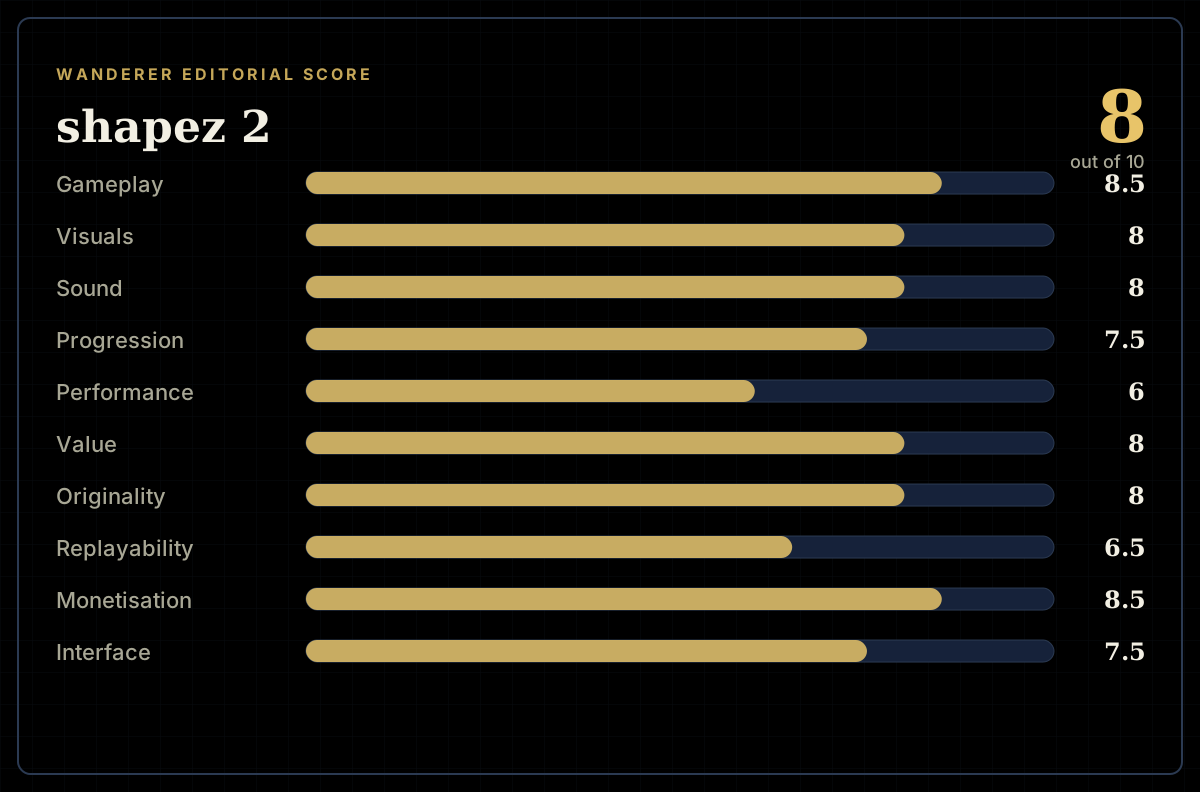
How the review scores each part of the gameWanderer Editorial -
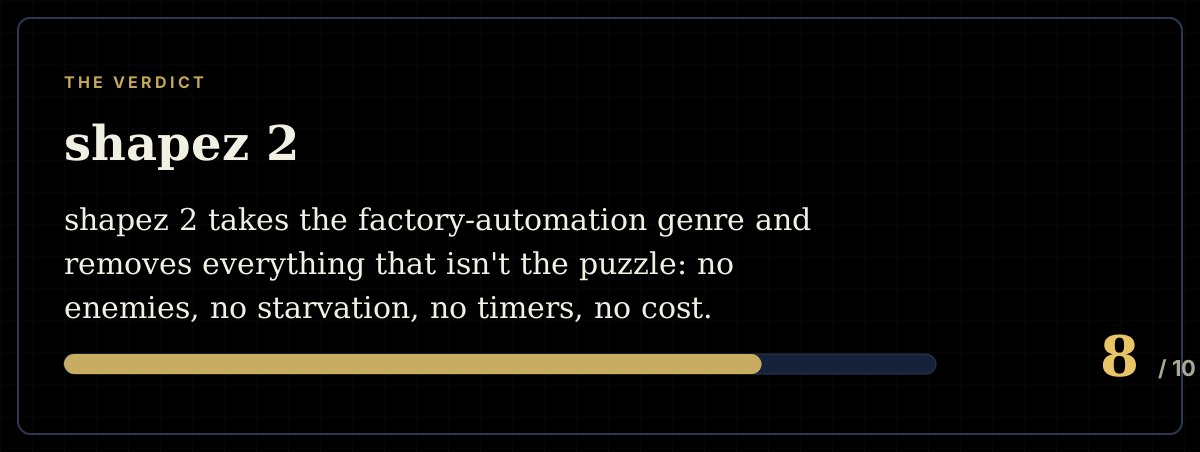
The short versionWanderer Editorial