Game review
Modulus: Factory Automation
7 / 10
- Developer
- Happy Volcano
- Publisher
- Kwalee
- Released
- 2 April 2026
- Platforms
- Windows
- Genre
- Factory automation puzzle simulation
- Monetisation
- Premium, one-off purchase for the base game. A soundtrack, a digital artbook, and a Deluxe Upgrade Pack are each sold as separate optional add-ons
- Players
- Single-player only, no online or co-op mode of any kind
The short version
Modulus turns factory automation into a literal engineering puzzle. Instead of slotting down catalogue parts, you cut, stamp, and paint raw voxel blocks into the precise module shape a building needs, then route the result to a crane that's often fussier about its inputs than it should be. Sky islands impose a genuine, purchasable ceiling on how much space you get, which gives every layout decision real weight in a genre that usually hands you infinite flat ground. It's a calmer, prettier, more puzzle-forward spin on the automation loop Factorio and Satisfactory made famous, and Steam's user base — sitting at "Very Positive" across several hundred reviews — mostly agrees it earns the label.
It isn't friction-free. Some late-game buildings only accept crane deliveries and only output to drones, forcing goods onto an air route even when the next station is a few tiles away. The three-monument endgame wants hundreds of near-identical modules once the actual puzzle-solving is done, and the recommended specs ask for an RTX 3060-class card just to hold 60fps on a large factory — a steep bar for a stylised voxel game. At NZ$35.99 with no multiplayer, it's a good purchase rather than an essential one next to genre veterans with years of free content behind them.
Biggest strengths
- Cutting, stamping, and painting raw blocks into bespoke modules feels like real engineering rather than picking parts off a shelf
- Sky islands with a hard, purchasable build ceiling force genuine layout compromises that flat, unlimited terrain in Factorio and Satisfactory never demands
- Day/night lighting sells the sci-fi setting convincingly, especially once a factory's lit windows and glowing belts show up against a dark sky
Biggest weaknesses
- Several late-game buildings accept input only via crane and output only via drone, forcing goods onto an air route even when the next station sits a few tiles away
- The three Neural Monuments that form the endgame each need hundreds of near-identical modules, and a loop that feels like a puzzle in hour two feels like a checklist by hour forty
- Recommended specs ask for an RTX 3060-class card just to hold 60fps once a factory grows large, a heavy bar for a stylised voxel game
Who it's for: Players who prefer Shapez's piece-crafting puzzle logic to Factorio's raw scale, and anyone drawn to a slower, better-looking automation game without hostile creatures or a ticking clock. A weaker fit for veteran factory-builders chasing the sprawling, endlessly-modded scope of Satisfactory or Factorio, or anyone hoping to share a factory with friends.
Our recommendation: Worth the asking price if "cut and paint your own factory parts on a floating island with a hard size limit" sounds like your kind of puzzle — it's polished, attractive, and has enough research depth to hold attention for dozens of hours. Hold off if you already own Factorio or Satisfactory and want something that out-scales them, or if a genuinely demanding, repetitive endgame grind isn't what you're after.
7 / 10
Most factory games solve the space problem by removing it. Factorio and Satisfactory both hand you a map so large that running out of room is never really the challenge — throughput and ratios are. Modulus: Factory Automation takes the opposite bet: your factory sits on a sky island with a hard edge, more islands cost real currency to unlock, and every belt run, crane arm, and storage silo you place is competing for a footprint that will never quietly expand on its own. It's a smaller-scale, more deliberately constrained take on the genre, and that single decision does more to define the game than anything else in it.
Cutting your own parts instead of picking them off a shelf
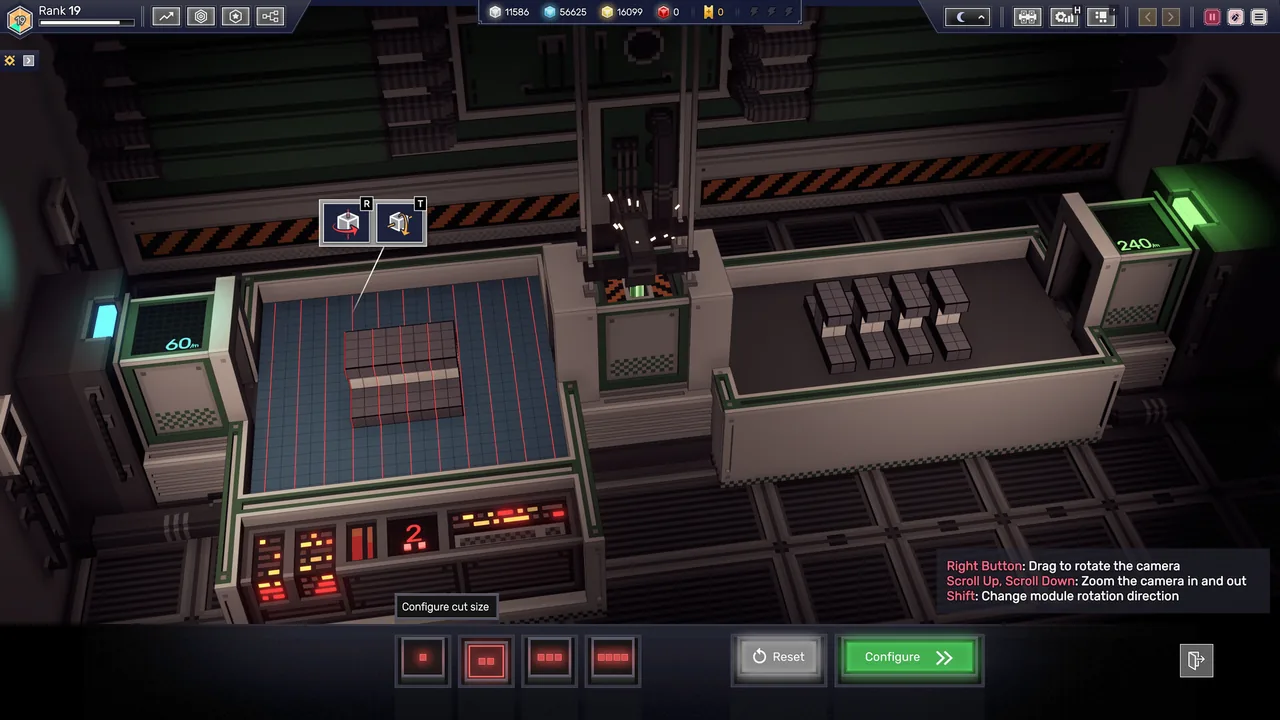
The core loop starts with mining Polyrock from surface deposits, feeding it down a belt to a furnace, and coming out the other end with raw voxel blocks. From there, Cutters slice those blocks into shapes, Assemblers combine them, Stampers press surface detail into flat faces, and Painters apply colour — a genuine little production chain just to make the parts that other production chains will consume. It's a deliberate step beyond Shapez's shape-and-colour puzzle formula: instead of combining pre-defined shapes, you're sculpting the actual building components a structure asks for, which makes early deliveries feel closer to bespoke manufacturing than logistics arithmetic. Scrapper operators exist specifically to recycle obsolete modules when you inevitably redesign an island's layout, which is a quiet admission from the developers that your first attempt at any given building almost never survives contact with your second.
A sky island is not an open plain
Where this pulls furthest away from Factorio and Satisfactory is what happens once you run out of room. There's no infinite green field to keep sprawling into — you buy additional islands, each with its own resources and its own footprint, and every one of them has to be reached, wired up, and defended from becoming a cramped mess in its own right. That turns a decision Factorio veterans barely think about — "where do I put this next building?" — into a real constraint with a real price tag attached. It's a smart differentiator, and it's also the game's most honest answer to the recurring criticism that Modulus doesn't do anything Shapez 2 or Factorio don't already do, arguably better: the sky-island ceiling is the one mechanic those games simply don't have, because they were built around the opposite assumption.
No clock, no threats, and a research tree that gates the good stuff
Modulus never introduces hostile creatures, a survival timer, or any external pressure — this is automation as a calm, unhurried puzzle rather than a defended base. New buildings and capacity increases come through a research tree that consumes data cubes and requires hitting specific milestones, and optional deliveries to a central Dock earn research points and cosmetic unlocks on top of the mandatory path. That leisurely pace is a deliberate choice, and it mostly pays off: the early hours ask you to build basic floor pieces before easing into genuinely optional production, and the ramp into multi-coloured components that require resources from multiple islands is well-judged. It also means Modulus offers nothing for players who want tension, threat, or a reason to hurry — if Factorio's alien attacks or Satisfactory's creature encounters are part of what you enjoy about the genre, none of that exists here.
An interface that mostly gets out of your way
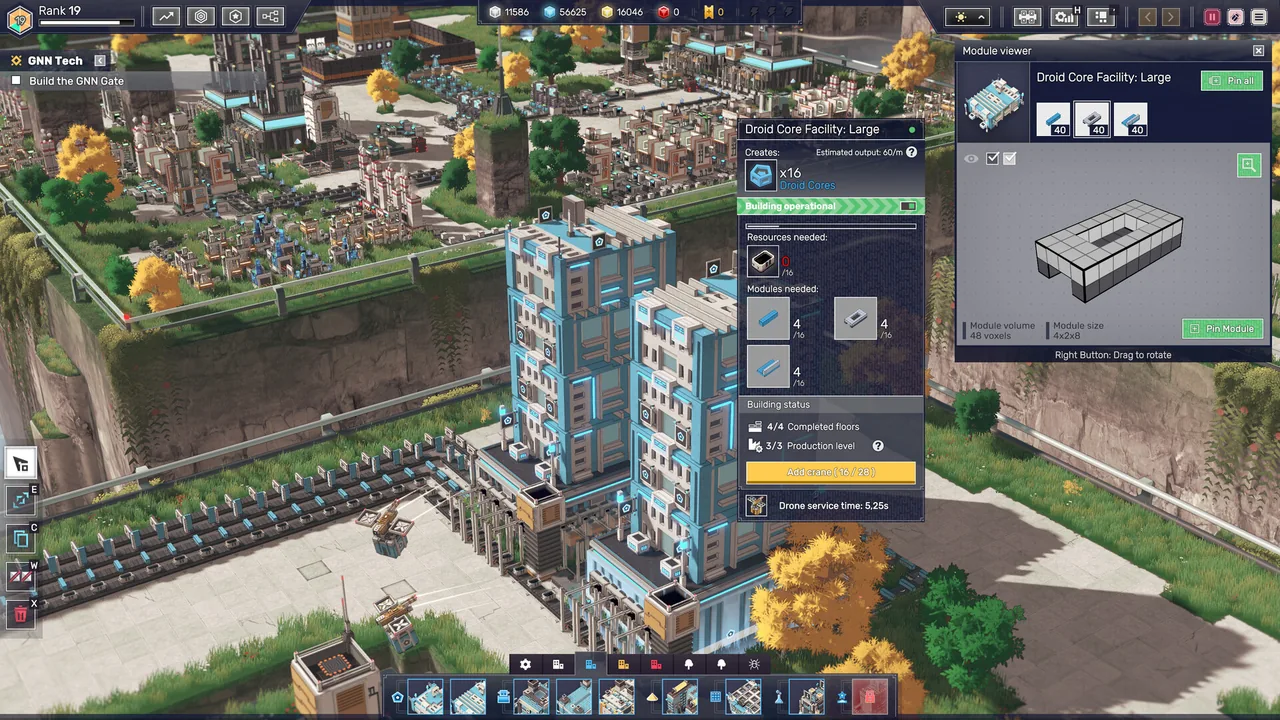
The UI is a genuine strength for most of the game. Switching between operators is quick, the hotbar organises tools by production tier instead of dumping everything into one long list, and pinned piece previews keep the shape you're building toward visible on screen instead of buried in a menu. Where it falls down is in a handful of late-game buildings that only accept deliveries by crane and only ship output by drone — a design choice that forces goods onto an air route even when the next stage of production is sitting a few tiles away with a belt connection that would obviously make more sense. It's a small thing on any individual building, but it recurs often enough in the back half of the tech tree to become a genuine irritation rather than a one-off.
Three monuments and a lot of repetition
The stated endgame is building three Neural Monuments that respond to signals from a Grand Neural Network somewhere off-world, and each one demands hundreds of modules, actively managed cranes, and belts running at full tilt for an extended stretch. That's an ambitious capstone, and it gives the mid-game a clear direction that a lot of open-ended sandboxes lack. It's also where the design puzzle that made the first ten hours interesting starts to feel like a checklist — once you've solved the shape of a given module family, building the two-hundredth copy of it is closer to busywork than problem-solving. Blueprints help enormously here, letting you stamp down a solved design instead of hand-placing it again, but they can only soften the grind, not remove it. Creative Mode sits alongside the campaign with unlimited resources, no objectives, and expanded module sizes, and it's a genuinely good release valve for anyone who'd rather design than grind toward a monument.
Pretty at night, demanding once you scale up
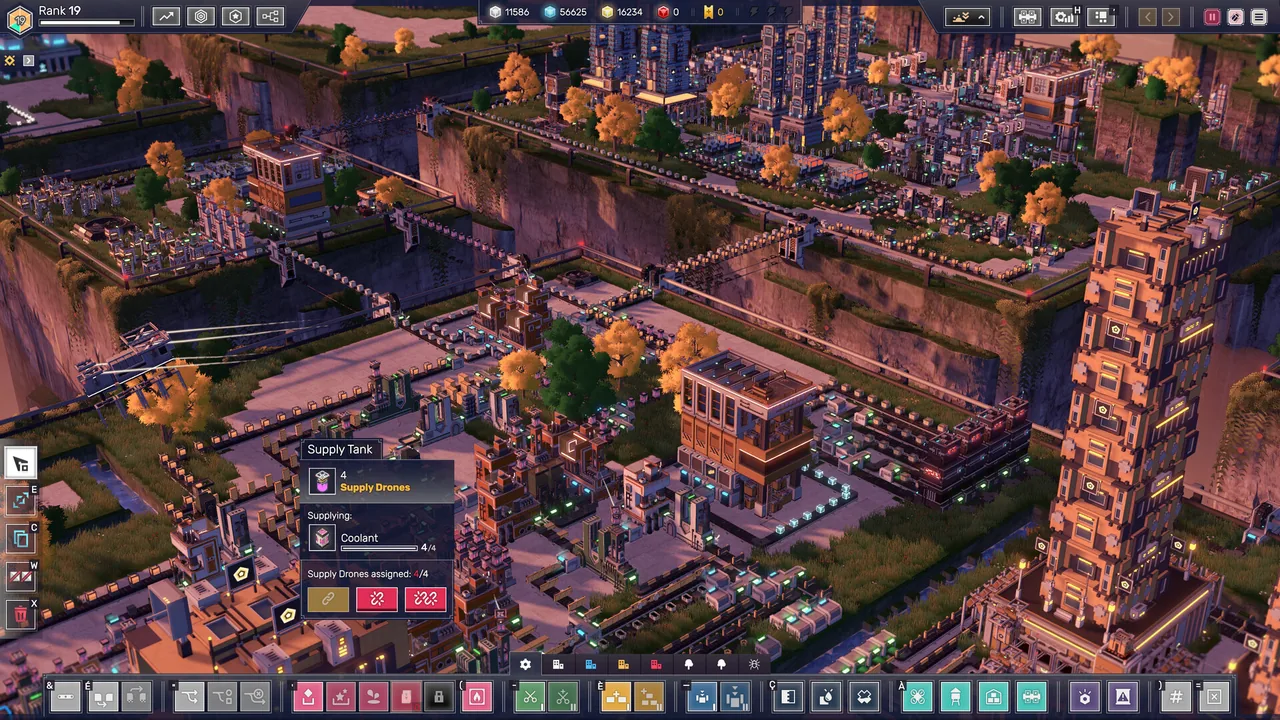
The day/night cycle is where Modulus earns its visual reputation — a factory lit up against a dark sky, conveyor lines glowing and windows lit in its cute robot-populated buildings, sells the sci-fi setting far better than the daytime palette alone. That polish comes with a cost the system requirements make explicit: the minimum spec (a GTX 1660-class card) is only rated for 30fps on large factories, and hitting 60fps at scale is listed as needing an RTX 3060 or RX 6600 XT. That's a heavier ask than the stylised voxel presentation suggests, and it's a fair warning that a genuinely sprawling, multi-island save will tax mid-range hardware the same way big Satisfactory or Captain of Industry bases do — a shared family trait of physically-simulated production games rather than a unique flaw, but a real one worth knowing about before committing to a big build.
Reception, and where the cracks are
Steam's user reviews sit at "Very Positive," with roughly 91% of just over 770 reviews recommending the game — a strong result for a debut premium release from a studio without a prior automation-genre track record. The praise clusters around exactly what this review has focused on: the parts-crafting puzzle, the island-space constraint, and the presentation. The recurring criticism is just as consistent: some players feel the internal machine design is too simplistic to justify comparison with Factorio's depth, that the crane-and-drone routing on certain buildings is an unforced annoyance, and that the endgame's raw module count wears out its welcome. None of that is a minority complaint dressed up as a pattern — it shows up often enough in player feedback to be treated as a real, structural limitation rather than noise.
Is it worth the asking price
At NZ$35.99, Modulus lands close to what Factorio and Satisfactory cost, and both of those games offer years of free updates, workshop or mod support, and a scale of systems Modulus doesn't attempt to match. That's the honest comparison anyone shopping in this genre will make, and it's not one Modulus wins outright. What it does offer instead is a tighter, more visually distinctive, more puzzle-forward experience that neither of those games really provides — the module-crafting loop and the sky-island space limit are genuinely its own, not a reskin of an established formula. Optional add-ons (soundtrack, artbook, and a Deluxe Upgrade Pack, each NZ$7.39) are all cosmetic-adjacent extras rather than anything the base game gates behind a paywall, which keeps the monetisation picture clean even if the base price itself is a real ask for a singleplayer-only title.
Players who like watching a system run and grow on its own terms, rather than one built purely around a loot table, will recognise a distant cousin of that appeal in Wanderer's own gathering and crafting loop, scaled down to something you can check in on between sessions rather than one you have to actively pilot.
Verdict
Modulus: Factory Automation succeeds at the one thing it set out to do differently: make space itself a resource you fight for, and make the parts of your factory something you manufacture rather than select from a menu. Both ideas are genuinely distinctive inside a genre that's otherwise dominated by infinite terrain and pre-defined buildings, and the presentation — especially at night — backs them up.
It doesn't fully escape the shadow of the games it's inevitably compared against. The endgame leans on repetition rather than fresh puzzles, a handful of buildings insist on inconvenient crane-and-drone logistics, hitting 60fps at scale asks for real hardware, and NZ$35.99 for a singleplayer-only game sits right alongside genre veterans offering more scope and years more support. Buy it for the parts-crafting puzzle and the island-space constraint, both of which are worth experiencing on their own merits — just go in knowing it's a good factory game standing next to some genuinely great ones, not a replacement for them.
Price, platform, and review-score details checked 31 July 2026.
Pros and cons
Pros
- Cutting, stamping, and painting raw blocks into bespoke modules feels like real engineering rather than picking parts off a shelf
- Sky islands with a hard, purchasable build ceiling force genuine layout compromises that flat, unlimited terrain in Factorio and Satisfactory never demands
- Day/night lighting sells the sci-fi setting convincingly, especially once a factory's lit windows and glowing belts show up against a dark sky
- Creative Mode strips away resource costs and research gates entirely for players who just want to design without a scoreboard
- Blueprint unlocks meaningfully cut down late-game repetition once the basic module shapes stop being interesting to place by hand
Cons
- Several late-game buildings accept input only via crane and output only via drone, forcing goods onto an air route even when the next station sits a few tiles away
- The three Neural Monuments that form the endgame each need hundreds of near-identical modules, and a loop that feels like a puzzle in hour two feels like a checklist by hour forty
- Recommended specs ask for an RTX 3060-class card just to hold 60fps once a factory grows large, a heavy bar for a stylised voxel game
- No multiplayer or co-op of any kind, so there's never a second factory to compare notes against
- At full price it sits close to Factorio and Satisfactory, games with years of free updates and community content behind them, and Modulus doesn't yet offer that scale of long-term support
Screenshots
-
Modulus: Factory AutomationImage: Kwalee via Steam -
Modulus: Factory AutomationImage: Kwalee via Steam -
Modulus: Factory AutomationImage: Kwalee via Steam -
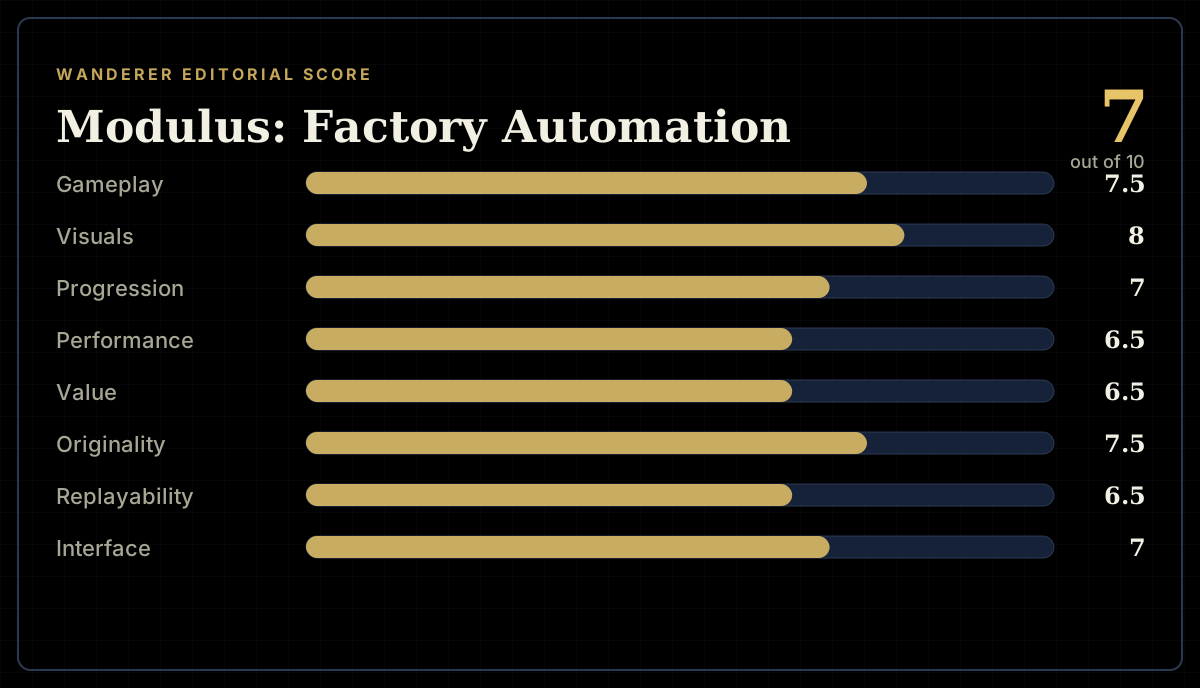
How the review scores each part of the gameWanderer Editorial -
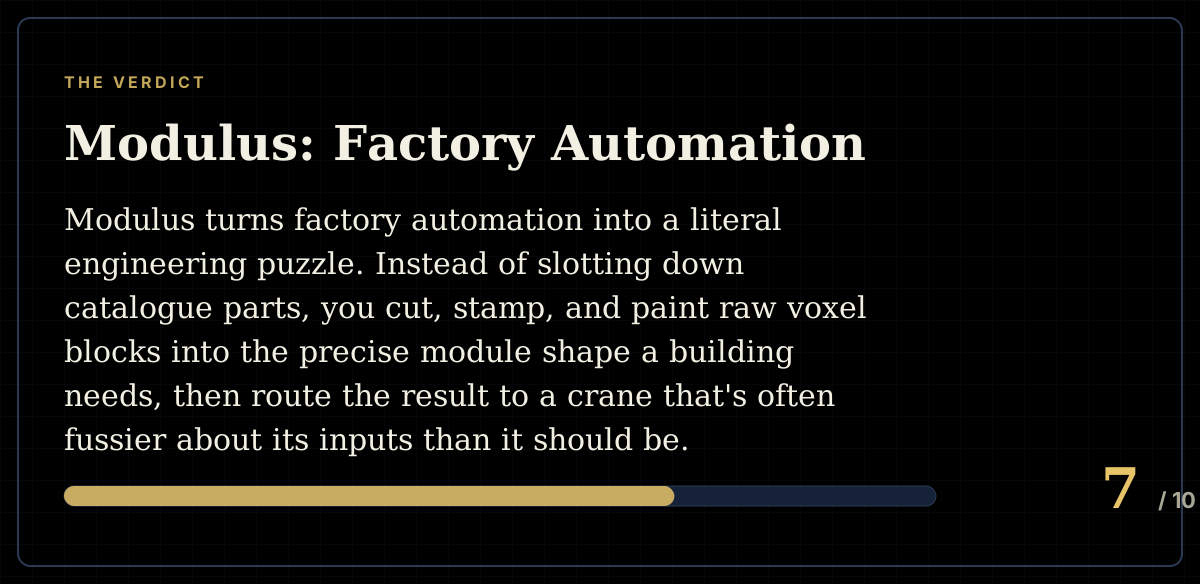
The short versionWanderer Editorial