Game review
Stellar Settlers: Space Base Builder
5.5 / 10
- Developer
- Tinymice Entertainment
- Publisher
- Rogue Duck Interactive, Gamersky Games
- Released
- 22 February 2025
- Platforms
- Windows, macOS, Linux
- Genre
- Colony Sim
- Monetisation
- One-time purchase, no in-app purchases, no ads, no subscription
- Players
- Single-player, with Steam Remote Play Together for local co-op
The short version
Stellar Settlers' central idea is the kind of thing colony-sim veterans notice immediately: you don't just spread a base sideways across a map, you tunnel down and stack modules vertically too, turning every settlement into something closer to an ant farm than a city grid. It's a genuinely uncommon structural hook for the genre, and reviewers who click with the "connect the pods, feed the settlers, launch the rocket" loop describe losing hours to it without noticing.
What holds it back from being an easy recommendation is everything around that hook. Its own production-speed math has a documented bug that inverts what a percentage bonus is supposed to do, its Steam page opens on AI-generated character portraits that a recurring slice of reviewers say cost the game their trust before they even started building, and the rocket-launch finale that caps every planet is close to universally disliked. Full release landed 22 February 2025 with a steady flow of Early Access patches behind it; a small bugfix update followed three days later, and then the public patch notes go almost quiet for the better part of a year. On a Steam page currently split almost exactly down the middle — Mixed, 102 positive to 103 negative — this review draws on all 103 of those negative reviews, not a skimmed selection of the loudest ones.
Biggest strengths
- The vertical-plus-horizontal building mechanic is a genuinely distinctive spin on the colony sim/base builder formula — several reviewers compare it to a hamster cage or an ant farm, and it's the one thing almost nobody in the negative reviews complains about
- A relaxed, "chill" tone that a large share of both positive and negative reviewers use unprompted — pastel art, mellow music and a design that, for better or worse, has no real fail state
- Ten distinct planets with different hazards and visual themes give the loop room to vary its dressing even where the underlying systems repeat
Biggest weaknesses
- AI-generated character portraits and landscape art on the game's own store page and opening screens are called out repeatedly and specifically across the negative reviews, with several reviewers saying it cost the game their interest before they'd even started playing
- A documented math bug in the production-speed system: percentage speed bonuses are supposed to stack multiplicatively but are applied as if they subtract directly from build delay, so — by one reviewer's worked example — a "40% increase" can functionally behave like a 286% increase, while other bonus types behave differently again
- The end-of-planet rocket-building minigame is close to universally disliked in the negative reviews: sparse feedback on what to fix, parts that explode on repeated launch attempts, and a feel disconnected from the base-building loop that precedes it
Who it's for: Colony-sim and base-building fans specifically curious about vertical building as a mechanic, and players who want a low-stakes, can't-really-lose puzzle to half-watch while doing something else — not players looking for a challenging management sim or a polished finale.
Our recommendation: Worth trying on a sale if the vertical-stacking hook appeals to you; go in expecting a rough, sometimes-buggy first half and a widely disliked rocket-building endgame, and don't expect much post-launch support beyond what's already patched.
5.5 / 10
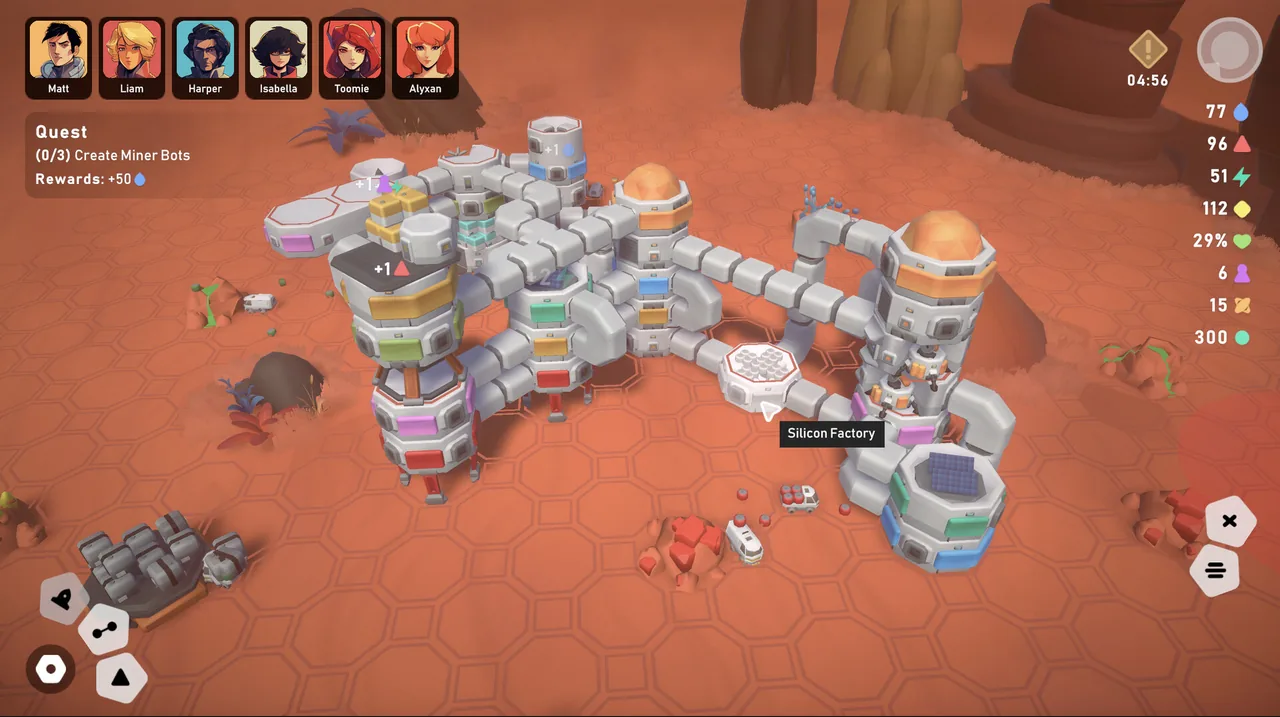
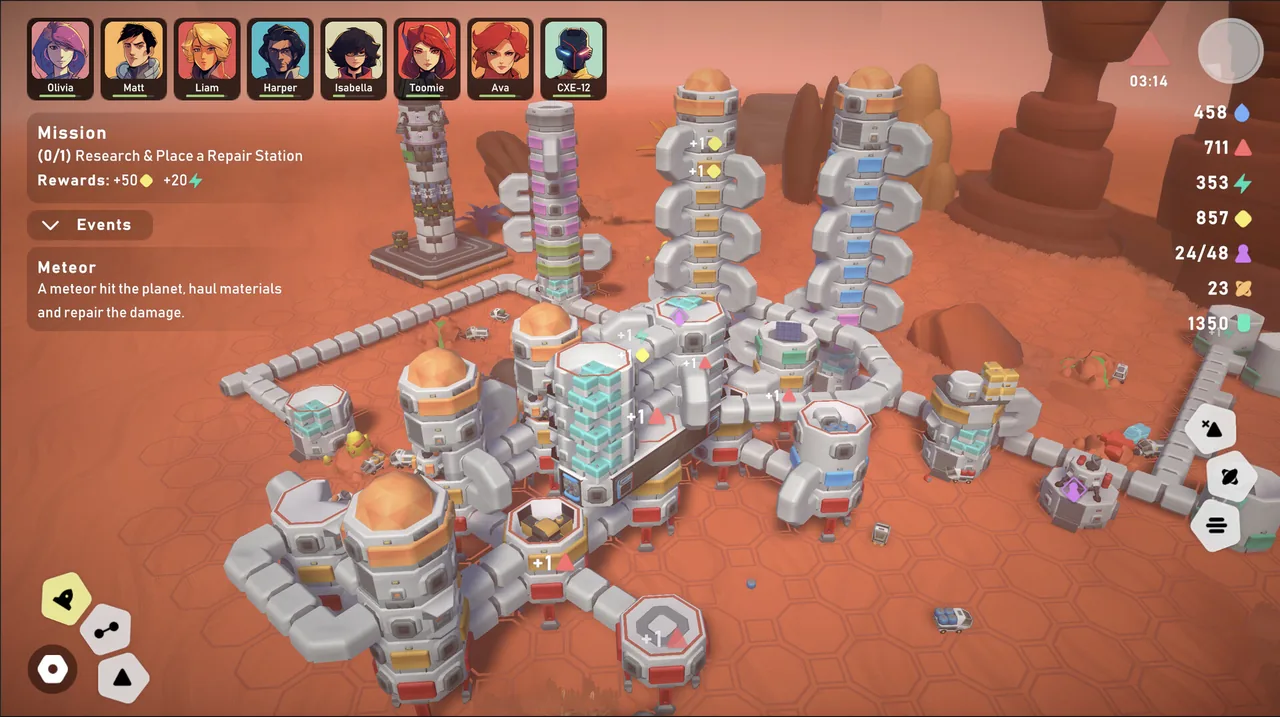
Colony sims live and die on one structural decision most of them never question: the base spreads sideways, across a flat map, until you run out of room. Stellar Settlers: Space Base Builder, the debut release from Tinymice Entertainment, asks what happens if you don't accept that constraint — you can dig down as freely as you build across, stacking resource pods, habitats and research modules into something closer to a hamster's tunnel farm than a city grid. One reviewer put it better than any marketing line could: it's "like a Hamster cage... only without Hamsters leaving little raisins everywhere they go." It's a small idea, executed as the entire spine of the game, and it's the one thing that survives contact with the negative reviews almost completely intact. Everything built around that spine is where the game's Mixed rating — 102 positive to 103 negative of 205 total reviews at time of writing — comes from, and because that negative side sits at a manageable 103 reviews, this piece is built on reading every single one of them rather than a sample of the most-voted.
A genuinely different shape for the genre
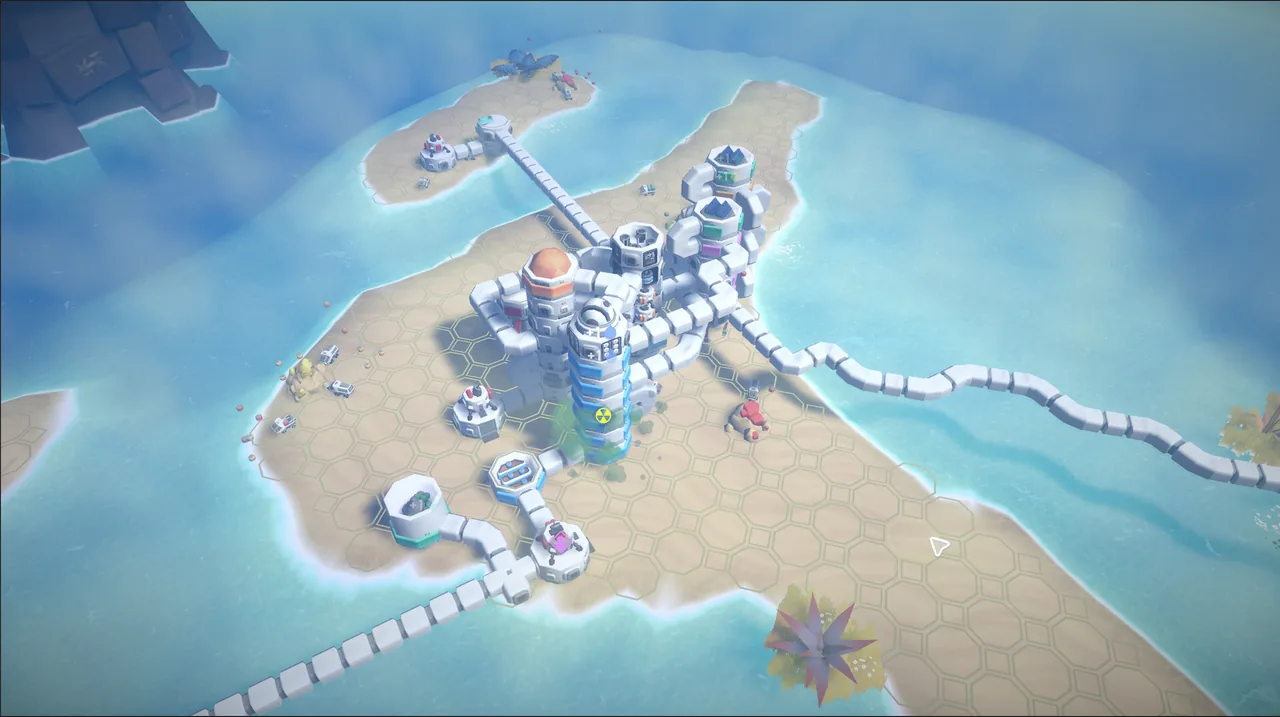
The loop, as reviewers describe it, is straightforward to state and takes longer to master: land on a planet, place resource-generating pods, connect them to each other and to your base with tunnels, staff them with settlers who arrive periodically, and research new pod types that trade one resource for another at a profit if you plan the chain right. What makes it distinctive is that none of that has to happen on a single plane. You can tunnel straight down through a planet's crust and keep building, and several of the ten planets on offer specifically reward doing so — asteroid and moon maps in particular push resource nodes underground where a flat-map colony sim would have no reason to. "The ability to build vertically is a very interesting mechanic for the city-building or base-building genre," one otherwise disappointed reviewer wrote. "Very few games can do this." That's the throughline across almost the entire review sample, positive and negative alike: nobody disputes that the core building mechanic is a fresh idea, well executed at the level of placing and connecting individual pods.
The tone matters here too. Reviewers reach for the word "chill" or "cozy" constantly, and it's not just marketing copy landing — the pastel-and-soft-glow art direction, the ambient synth-adjacent soundtrack and the almost complete absence of a real fail state (you can't lose a planet outright, only stall) all point the same direction. For a meaningful share of the audience, that's exactly the pitch: "a very fun, low-stakes game — like Mini Motorways but with planning skyscrapers instead of traffic routes," as one reviewer summarised it, praising the puzzle of connection over any sense of threat. For another, equally large share, the same absence of stakes reads as the absence of a game: "This is not a game, there is no gameplay. You cant lose, there is no threat or challenge. Numbers go up, you wait." Both descriptions are accurate. Which one you land on says more about what you want from a colony sim than it does about a flaw in the build.
The rocket problem
Every planet in Stellar Settlers ends the same way: gather enough advanced materials to design and launch a physics-based rocket, and a successful launch is the win condition that unlocks the next world. On paper it's a satisfying capstone — a distinct mechanical system layered on top of the base-building loop, testing a different kind of planning. In the negative reviews, it's close to the single most consistently despised part of the game. The complaints cluster tightly: minimal feedback on why a launch configuration failed ("the tip telling you to just optimize it bro"), components with a flat chance of exploding on each attempt regardless of how carefully they were placed, and — repeatedly — a sense that the whole system was bolted onto a game it doesn't share a design language with. "The final building of the physics rocket has absolutely nothing to do with the rest of the game," one reviewer wrote, and several others independently used almost the same phrase. One reviewer described the required resource investment as so disproportionate to the base game's pacing that they were placing nine redundant safety modules just to nudge a failure chance down by single-digit percentages, on a five-square grid that couldn't comfortably fit them.
That disconnect matters more than a single disliked minigame normally would, because the rocket launch isn't optional flavour — it's the only way to progress past a given planet, which means every player who wants to see planet two has to clear the part of the game the negative reviews like least.
Bugs, and one that undermines its own numbers
A colony sim's core promise is that the numbers it shows you are the numbers actually governing the simulation, and several reviewers report specific, reproducible cases where that promise breaks. The most striking is a documented error in how production-speed bonuses stack: one reviewer, in a review titled "Cute, but Fundamentally Flawed," walked through the math directly — "the speed doubling works, by halving the production delay, but every other speed increase is broken (e.g. a 40% production increase will add to a 15% increase, which is 65%, but this is erroneously subtracted out of the delay, resulting in just a 35% delay, which is equivalent to a 286% [100/35] increase in production)." Whether that specific arithmetic is generous or punishing to the player depends on which bonuses you're stacking, but either way it means the percentages the game displays aren't reliably describing what the game does — a serious problem for a genre whose whole appeal is optimising visible numbers.
Beyond that headline bug, the pattern across the negative reviews is a long tail of smaller, recurring breakages rather than one catastrophic flaw: raw materials not persisting through a save, haulers that stop delivering without explanation, tunnel connections that silently fail to register despite being visually attached, repair modules that report as connected but don't repair, and a base-defense mode that one reviewer called "LITERALLY BROKEN" because settlers placed in buildings get removed by the game itself, making that mode unwinnable. There's no incremental autosave, so a crash — several reviewers report crashes on long sessions or on minimising the window — can cost real progress; one reviewer specifically asked for "an auto-save feature for the amount of crashes."
AI art on the store page
A specific, recurring complaint sits apart from the general bug list and deserves its own treatment: a meaningful slice of the negative reviews call out AI-generated artwork — character portraits and landscape scenes shown on the store page and in-game — as a dealbreaker independent of how the game plays. "I care a lot about worldbuilding in games, and to be honest, I cannot take the game seriously when the first screen shows dozens of AI-generated character portraits and landscapes," one wrote. "That AI-generated stuff made me lose 100% of my interest in the game." Another, more bluntly: "AI portraits are cringe at the best of times, but these are some of the worst AI portraits I've seen." A third framed it as a matter of principle rather than quality: "I would never buy a game with genAI anything on its own, for any amount of money." This isn't the largest single complaint category by volume, but it's notable for showing up as a stated reason to refund or avoid the game entirely, disconnected from any opinion about the building mechanics — and it sits at odds with the warm reception the game's environmental art and UI otherwise gets from the same review pool.
What the achievement data shows
Stellar Settlers ships thirty Steam achievements, and the ten headline "reach this planet" achievements lay out the shape of the whole playerbase's actual experience more plainly than review text can. Global completion drops off a cliff almost immediately: 96.5% of everyone who has ever launched the game clears planet one, but only 19.0% reach planet two, 8.8% reach planet three, 5.3% reach planet four and just 3.4% ever reach planet five — and the curve keeps thinning from there for the remaining five worlds. That's a much steeper collapse than a typical progression game shows, and it corroborates two separate strands of the negative reviews at once: complaints that the loop "becomes repetitive after 10 minutes" or "quickly becomes unmanageable," and complaints that the rocket-launch gate between planets is difficult and unrewarding enough that most players who bounce off the game do so right at that wall, rather than drifting away gradually over many hours.
Support since launch
Stellar Settlers spent close to a year in Early Access, from March 2024 to February 2025, and the public patch notes from that period show a developer patching often — balance passes, performance fixes, localization corrections and a full "Combat Update" adding an asteroid-defense planet type arrived at a steady clip. Full release landed 22 February 2025, followed three days later by a small "v1.0.1 — Bug Fixes & Improvements" patch addressing quest tracking and a few specific issues. After that, the public patch-notes trail goes largely quiet: the next community post on record is a Steam Awards nomination request dated late November 2025, nine months later, asking players to nominate the game rather than announcing new content or fixes. One reviewer, writing around the game's half-year mark, put the practical consequence plainly: "how is it in current state? You reboot the game, all the mining spots come back... but all your mining truck disappears. UI doesn't remember anything." Another, more bluntly, called it abandonware. Whether that reads as a broken promise or a reasonable place to stop supporting a budget-priced 1.0 release is a judgment call, but it does mean most of the specific bugs catalogued above — the production math, the save issues, the rocket feedback — were, as of this review, still present well after launch.
Final verdict
Stellar Settlers earns real credit for a structural idea most of its genre never attempts: building down through a planet's crust as freely as across its surface, staffed and connected the same way a horizontal base would be. That idea alone is strong enough to have kept a meaningful share of reviewers charmed for twenty-plus hours. But the game around that idea is rough in ways that compound rather than isolate — a production-math bug that undercuts trust in its own numbers, a near-universally disliked rocket-launch gate standing between every planet and the next, a still-controversial reliance on AI-generated art on its own storefront, and a patch history that goes quiet within days of the release the whole Early Access period was building toward. A Mixed, almost exactly 50/50 Steam rating is the honest outcome of that mix: worth a look for players specifically drawn to the vertical-building hook and a low-stakes pace, and a harder sell for anyone hoping a full 1.0 release meant the rough edges were behind it.
Pros and cons
Pros
- The vertical-plus-horizontal building mechanic is a genuinely distinctive spin on the colony sim/base builder formula — several reviewers compare it to a hamster cage or an ant farm, and it's the one thing almost nobody in the negative reviews complains about
- A relaxed, "chill" tone that a large share of both positive and negative reviewers use unprompted — pastel art, mellow music and a design that, for better or worse, has no real fail state
- Ten distinct planets with different hazards and visual themes give the loop room to vary its dressing even where the underlying systems repeat
- Reasonably priced for the genre at US$11.99, and several long-session reviewers (20+ hours) say it more than earns that price for them specifically
- Full feature set for a budget release: Steam Achievements, Cloud saves, Trading Cards and Remote Play Together are all wired in
Cons
- AI-generated character portraits and landscape art on the game's own store page and opening screens are called out repeatedly and specifically across the negative reviews, with several reviewers saying it cost the game their interest before they'd even started playing
- A documented math bug in the production-speed system: percentage speed bonuses are supposed to stack multiplicatively but are applied as if they subtract directly from build delay, so — by one reviewer's worked example — a "40% increase" can functionally behave like a 286% increase, while other bonus types behave differently again
- The end-of-planet rocket-building minigame is close to universally disliked in the negative reviews: sparse feedback on what to fix, parts that explode on repeated launch attempts, and a feel disconnected from the base-building loop that precedes it
- Recurring reports of lost or corrupted saves, disconnected tunnels/connections after a reload, haulers that stop delivering, and no incremental autosave, so a mid-session crash can cost genuine progress
- Steam's own achievement data shows a steep cliff after the first planet — 96.5% of players who ever launch the game clear planet one, but only 19.0% reach planet two and just 3.4% reach planet five of the ten on offer, which lines up with reviewer complaints about repetition and a punishing pacing wall
- UI complaints recur across the negative reviews: a single horizontal scrolling bar holds every buildable structure, there's no drag-to-connect for tunnels, edge-panning can't be disabled, and post-launch reviewers still report no UI scaling option and screen tearing
- Patch notes were frequent through Early Access but taper sharply after the 22 February 2025 launch — one small bugfix patch three days later, then no further patch notes on record for the rest of 2025 aside from a Steam Awards nomination post, which several reviewers read as the game having been abandoned post-launch
Screenshots
-
Stellar Settlers: Space Base BuilderImage: Rogue Duck Interactive via Steam -
Stellar Settlers: Space Base BuilderImage: Rogue Duck Interactive via Steam -
Stellar Settlers: Space Base BuilderImage: Rogue Duck Interactive via Steam -
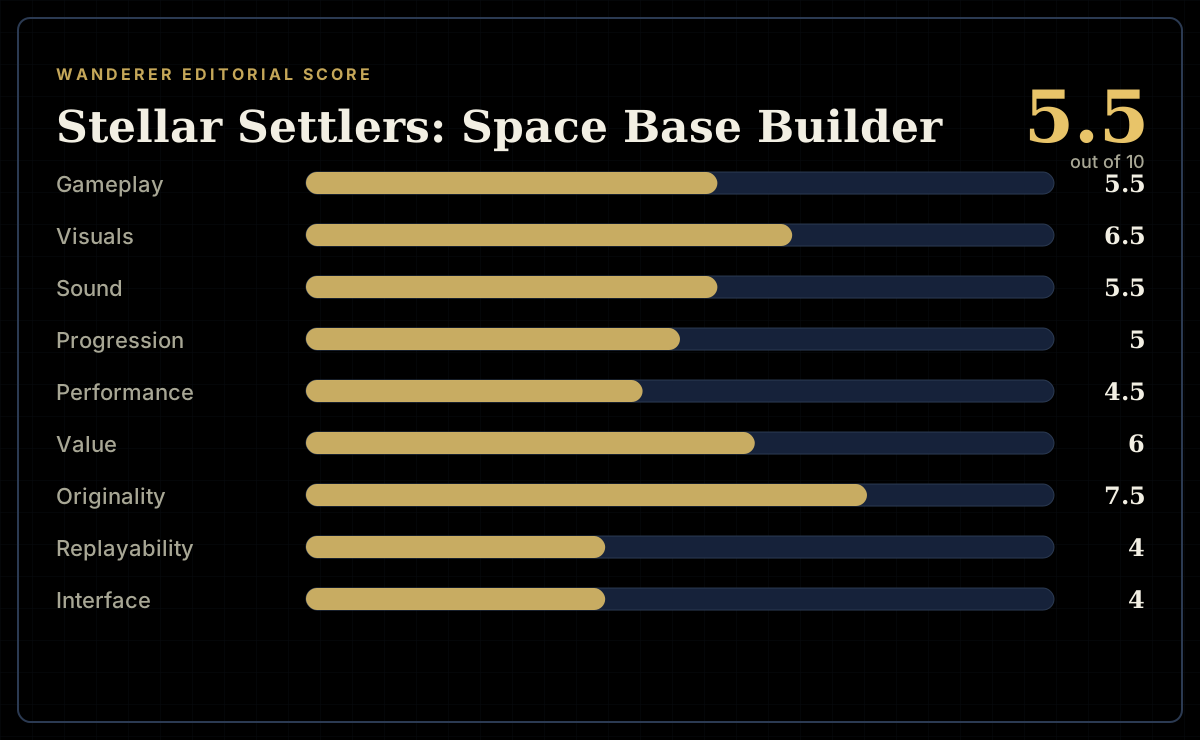
How the review scores each part of the gameWanderer Editorial -
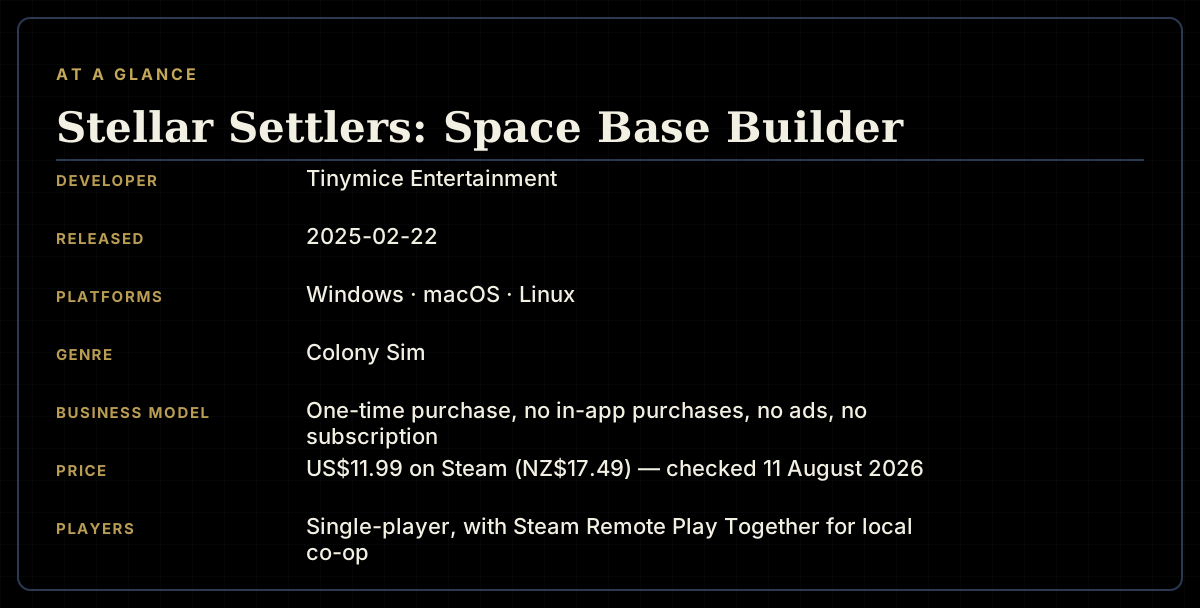
The essentials at a glanceWanderer Editorial -
The short versionWanderer Editorial