Game review
Don't Drop The Cake Review
7 / 10
- Developer
- Midoriyama
- Publisher
- Midoriyama
- Released
- 30 August 2026
- Platforms
- ["Windows"]
- Genre
- Horror
A Joke Premise That Isn't Joking Around
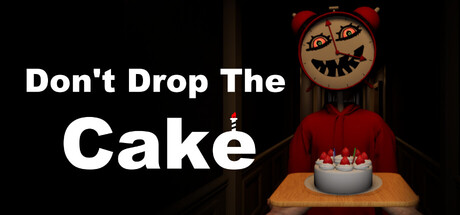
Don't Drop The Cake, released August 30, 2026 by solo Japanese developer Midoriyama, sells itself on a deliberately absurd hook: you play a delivery person tasked with carrying a precariously balanced cake through a monster-infested, horror-tinged world using nothing but careful mouse control. It spent roughly two years building an audience through a free prologue and a Steam Next Fest demo before its full $6.99 release, and the review pool, 42 of 50 English reviews positive, is remarkably consistent about one thing: almost nobody who bought it expecting a silly streamer-bait jumpscare game got what they were expecting. Instead, reviewer after reviewer describes being blindsided by a genuinely emotional story about a father's love, several admitting outright to crying by the end of what they walked in assuming would be a two-hour joke.
Balance The Cake, Manage Everything Else
The core mechanic is simple to describe and, according to the review pool, trickier to master than it sounds: tilt and steady a cake on its plate with mouse movement while simultaneously navigating corridors, dodging environmental hazards, and reacting to monster encounters. One reviewer broke down why it works as tension rather than gimmick: "First, you need to avoid dropping the cake, obviously. Second, you need to navigate the environment. Third, you need to avoid certain dangers. It doesn't seem like much, but it's easy to focus too much on one thing while ignoring the others, and thus losing balance." That juggling act, rather than traditional horror-game combat or puzzle-solving, is the entire skill test the game is built around, and for a chunk of its runtime that's more than enough to carry a session.
The Twist That Made People Cry
What separates this from a one-joke novelty is the narrative payoff that multiple reviewers single out as the real reason to finish it. Several describe an unexpected emotional gut-punch buried in what looked like a silly horror romp: one reviewer called it "a wonderful story about a Father's love and depth of care to find peace," while another wrote bluntly, "I did NOT expect to be crying my little dad eyes out for the last half of the game play." A third put it in genre terms, comparing the shift in tone to Angel Beats. This isn't one isolated reaction; it's the single most repeated sentiment across the entire positive side of the review pool, and it's clearly the thing Midoriyama built the whole cake-balancing gimmick to set up.
The Same Six Buttons, Over And Over
The most consistent criticism, and the one shared across several negative reviews, is that the moment-to-moment gameplay doesn't evolve much past its opening hour. One reviewer flagged reused jumpscares directly, and another described the second chapter specifically as "becoming tedious in balance walking to 6 points on a large map and a parade of corridors," language echoed almost exactly by a separate reviewer complaining about having to "press 6 buttons to proceed" over and over. When two unrelated reviewers independently zero in on the same repeated interaction pattern as the game's weakest stretch, that's a real structural pacing problem in the middle of the experience, not a one-off nitpick, even against a backdrop of otherwise strong sentiment.
Difficulty Options And Generous Checkpoints
On the accessibility side, the game earns real credit for how it handles its own tension. One reviewer who documented a full hardest-difficulty run noted that "the game creators put in a lot of check points so it's not something where you have to have one amazing extremely stressful run to get through the game," which matches the broader tone of the pool: several reviewers explicitly call the game forgiving on failure despite its horror trappings, framing the challenge as skill-based tension rather than punishing trial and error. That's a deliberate design choice that pays off, letting the emotional story stay the focus even for players who aren't naturally good at the balancing mechanic.
Rough Edges Around The Story's Edges
Not every complaint is about repetition. At least one reviewer flagged performance directly, writing that the game "needs some optimization" even while otherwise praising it, and a separate reviewer took issue with pacing on the narrative side, arguing the "endless dialogue wasn't needed" and that heavy dialogue stretches were a poor fit for streaming. A reviewer who had followed the two-year gap between the original demo and the full release also voiced some disappointment that the finished product didn't feel like it had grown as much as the wait implied, calling the overall experience "very random and wild" in a way that undercuts its own more serious ambitions. None of these sink the experience on their own, but together they paint a picture of a genuinely ambitious solo project that occasionally outran its own polish.
Verdict
Don't Drop The Cake is a small, strange, mostly successful bet: take a mechanic that sounds like a joke, dress it in horror-adjacent trappings, and use it as a Trojan horse for a story that reviewer after reviewer describes as unexpectedly moving. The cake-balancing itself is a genuinely clever tension generator early on, the difficulty options and generous checkpoints make the horror side approachable rather than punishing, and the emotional payoff at the end is corroborated by a striking number of independent reviewers admitting they weren't ready for it. Where it stumbles is in the middle stretch, where two or more reviewers independently call out the same repeated "walk to six points, press the same buttons" loop as padding, and a couple of technical and pacing rough edges that a two-year, single-developer project understandably didn't fully smooth out.
At $6.99, it's a small enough ask that the repetition in its middle chapters doesn't outweigh what most players walk away remembering: not the jumpscares, not the balancing mechanic itself, but the sincere, oddly effective story hiding underneath both. It's not a polished horror showcase, and it doesn't pretend to be one, but for a solo developer's long-gestating passion project, landing an ending that made this many strangers cry over a cartoon cake is a genuinely rare thing to pull off.
Screenshots
-
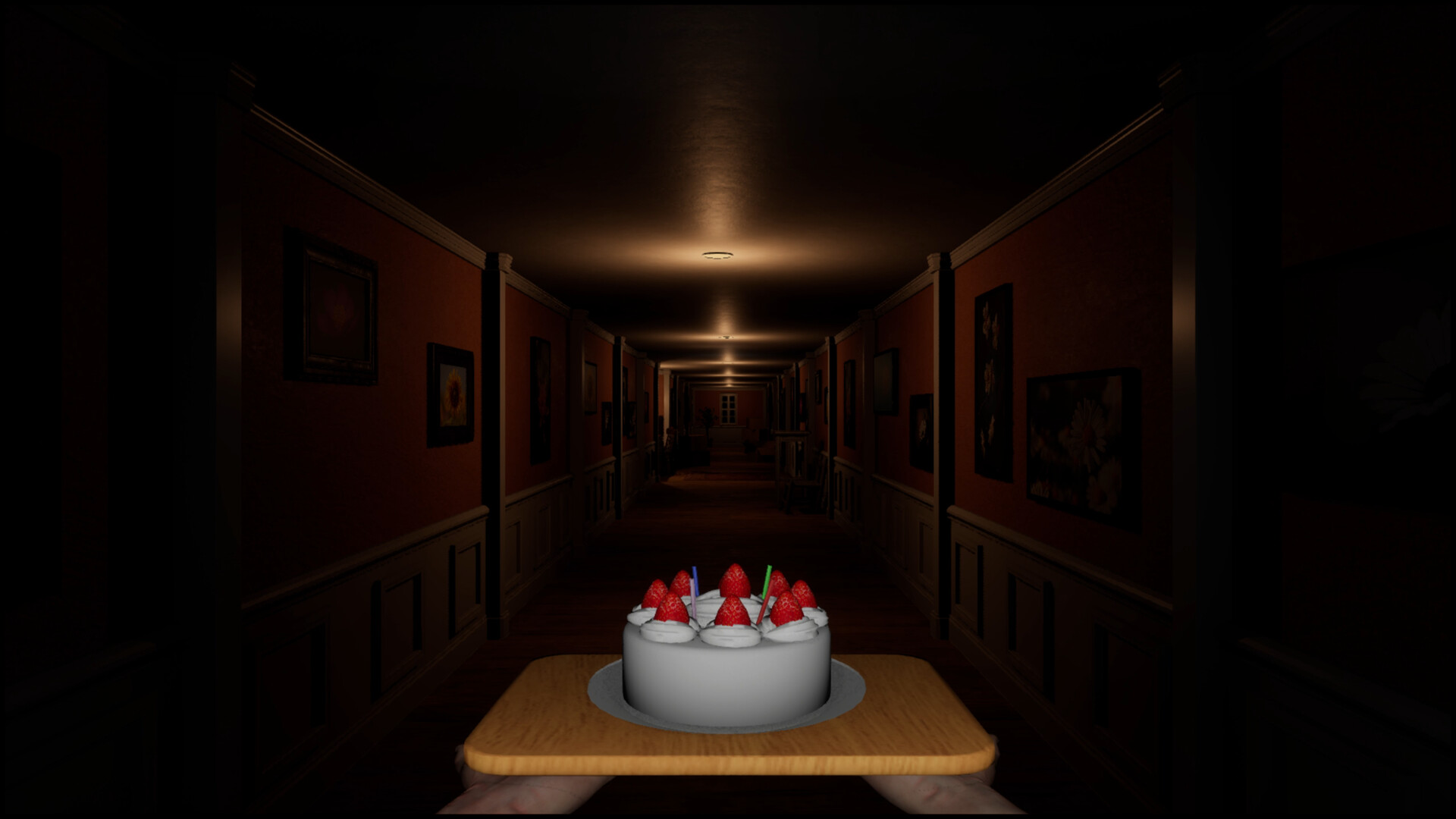
The core view for most of the run: hands out, cake balanced on a tray, threading a dim corridor lined with paintings.Image: Midoriyama via Steam -
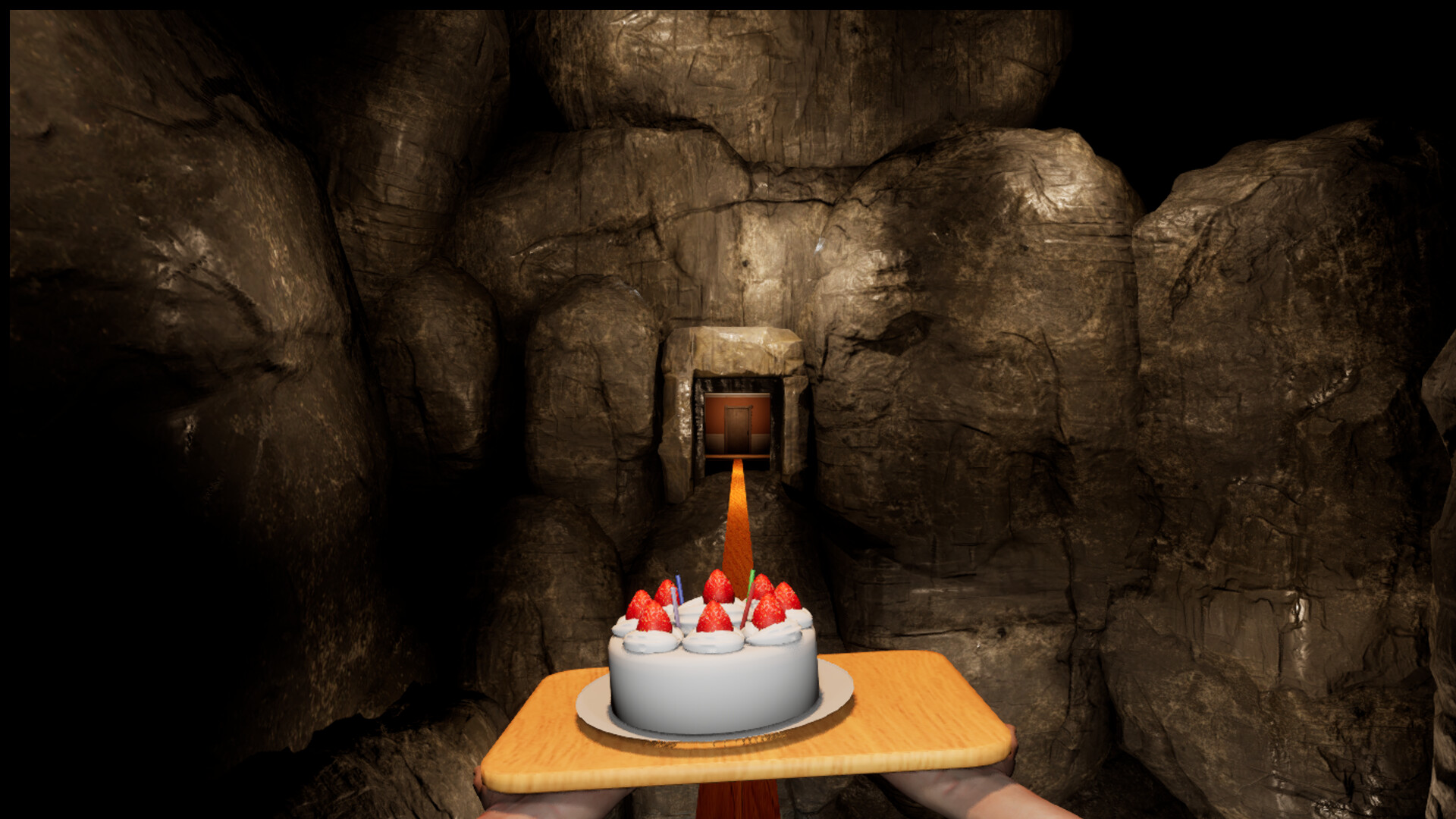
One of several environment shifts, out of the hallways and into a cave passage leading toward a distant door.Image: Midoriyama via Steam -
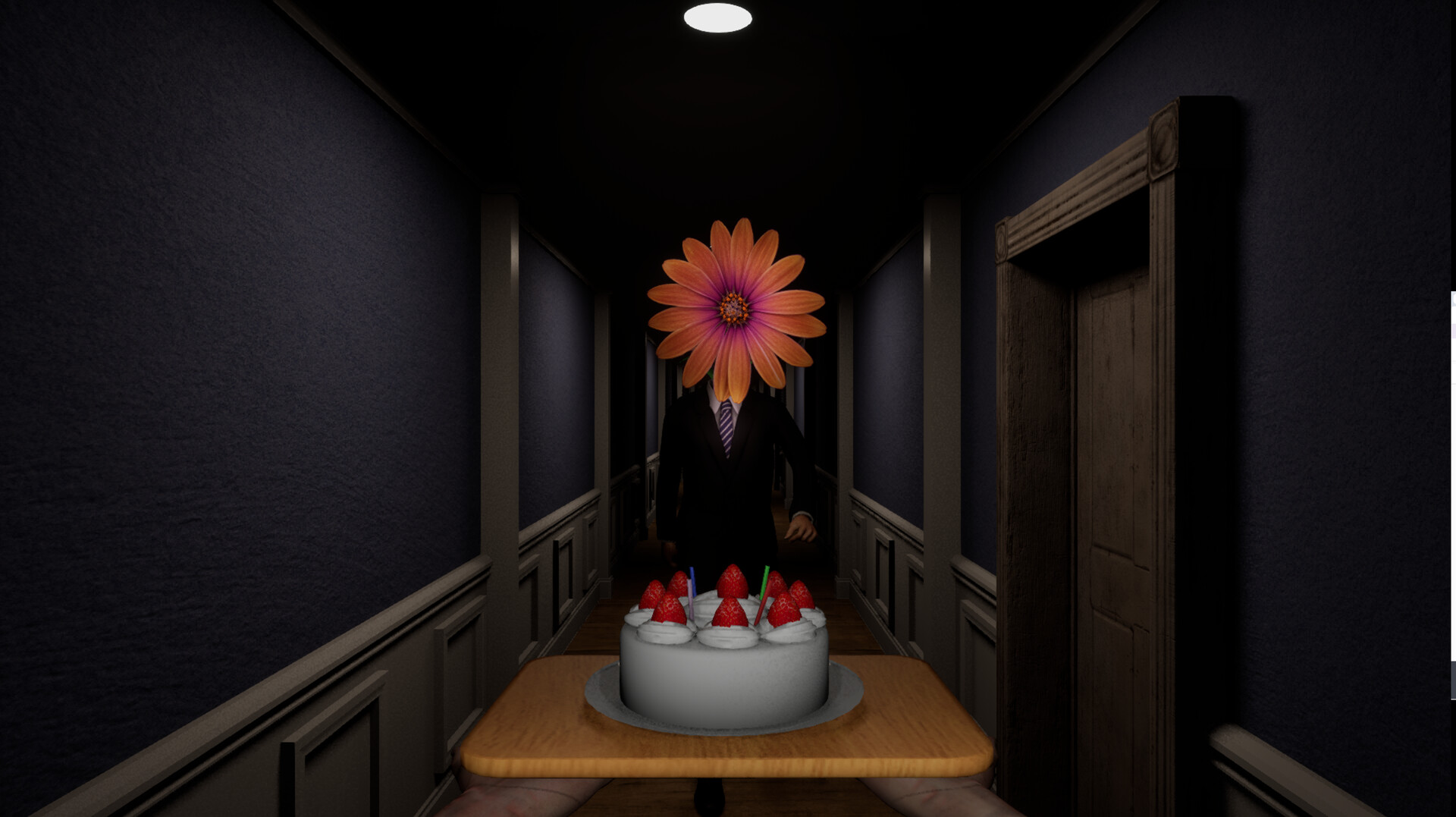
One of the game's stranger monster encounters, the surreal flower-headed figure that tips the tone from silly toward unsettling.Image: Midoriyama via Steam