Game review
The Elder Scrolls Online
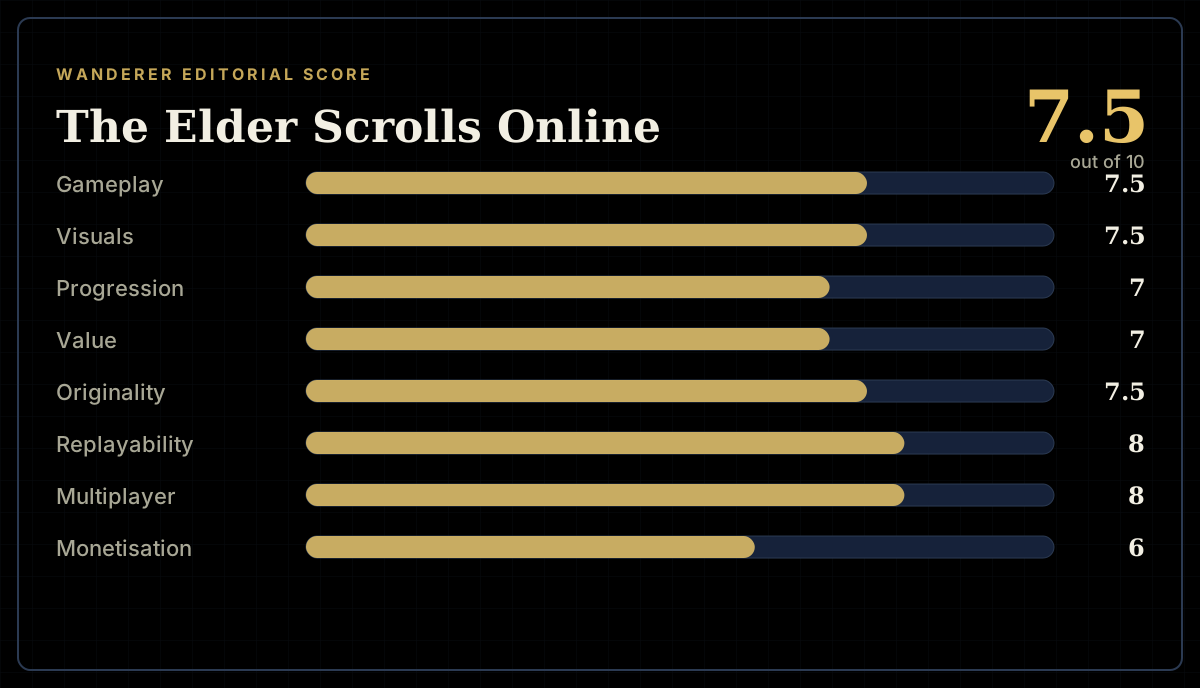
7.5 / 10
- Developer
- ZeniMax Online Studios
- Publisher
- Bethesda Softworks
- Released
- 4 April 2014
- Platforms
- Windows, macOS, PlayStation 4, PlayStation 5, Xbox One, Xbox Series X|S
- Genre
- MMORPG
- Monetisation
- Buy-to-play base game plus eight paid Chapters, an optional ESO Plus subscription that grants access to all Chapters and DLC while active and is the only way to unlock the crafting bag, and a Crown Store selling cosmetics, mounts, character slots, convenience items and randomised Crown Crates for real-money Crowns
- Players
- Massively multiplayer persistent world — open-world PvE with four-player dungeons, four- and twelve-player trials, and Cyrodiil's three-faction Alliance War PvP running as one continuous open battlefield rather than an instanced arena
The short version
The Elder Scrolls Online's decision to scale every zone to the player, rather than the player to the zone, is still the thing that makes it stand apart from almost every other themepark MMO: you can start in any of eight Chapters' worth of Tamriel and never hit a dead zone or a wall of grey text. That freedom comes at a real cost, though — build choices barely matter until Champion Points kick in at endgame, and untangling what a new account actually owns, and what an active subscription is quietly gating, takes more homework than a "buy once, play anywhere" pitch should require.
Biggest strengths
- One Tamriel level-scaling means every zone, from 2014's launch content to July 2026's Thieves Guild story, stays fully playable and worth doing regardless of visit order
- Any class can slot any weapon or armour skill line, so a Templar can carry a two-handed greatsword or a Sorcerer can respec into a Restoration Staff healer without rolling a new character
- Nine years of writing have built one of the most explorable, lore-dense versions of Tamriel on the market, and the fully voiced main and side quests hold up as stories in their own right
Biggest weaknesses
- The crafting bag, the single most requested quality-of-life fix in the game's history, is still locked behind an active ESO Plus subscription instead of sold as a one-time unlock
- Combat's light-attack "weaving" technique is an unusual, undocumented execution skill that quietly caps damage output for anyone who never learns it exists
- Working out what a fresh account actually owns is genuinely confusing in 2026 — Standard Edition includes only the 2017 Morrowind chapter, and reaching the current game means buying Deluxe, subscribing, or assembling chapters individually
Who it's for: Elder Scrolls fans who want to keep exploring Tamriel with other people, and anyone who wants an MMO where buying an old expansion years late doesn't mean playing content nobody else is doing. A poor fit for players who want combat to reward precise mechanical execution from level one, or who resent a subscription gating a basic inventory quality-of-life feature.
Our recommendation: Buy the Standard Edition and play the free trial zones and Morrowind first — the level-scaling system means you'll get an honest read on the combat and quest writing without committing to anything else. If it clicks, the Deluxe Edition is the one purchase that removes every chapter-gating headache at once; add a short ESO Plus block only when you're deep enough into crafting to actually feel the missing bag space.
7.5 / 10
Twelve years after launch, The Elder Scrolls Online is still answering a question most MMOs never even ask: what happens if every zone stays useful forever? Its answer, One Tamriel, scales enemies and quest rewards to whoever walks in rather than gating content behind a level requirement, and it is the single decision that makes this game feel different from Guild Wars 2's horizontal mastery track or World of Warcraft's expansion-locked levelling path. You can buy Morrowind in 2026 and it will play exactly as well as it did in 2017, mechanically and socially, because nobody outlevelled it and it never got quietly deprecated. That's the pitch. What it costs to get there — in flattened stakes early on and in genuinely confusing purchase decisions later — is where this review spends most of its time.
A world with no wrong turn
Before October 2016's One Tamriel update, ESO worked like every other themepark MMO: Daggerfall Covenant players levelled through Daggerfall Covenant zones, Ebonheart Pact players did the same in their own corner of the map, and stepping outside your faction's level-appropriate territory meant getting mulched by content built for a different character level entirely. One Tamriel tore that down. Every zone in the base game, and every Chapter released since, now scales to the player standing in it, and any character from any faction can walk into any of them from the moment they finish the tutorial. The practical effect, a decade on, is that ESO has no dead zones. Reaper's March isn't a levelling corridor you blow through once and never revisit; it's exactly as viable an afternoon's destination in 2026 as it was in 2014, because nothing about it has aged out of relevance.
That's a genuinely rare thing for an MMO to sustain across eight expansions, and it's the strongest argument for buying in late. A player who starts today isn't behind — they're choosing which of nine years of stories to do first, in whatever order the box art or a friend's recommendation suggests. Compare that to a rising-level-cap MMO where the first six expansions become a levelling formality you rush through to reach the one that currently matters, and ESO's design looks considerably more respectful of a new player's time.
The trade-off is that "everywhere is viable" also means "nowhere demands a build." Because content scales to you rather than the other way around, the difference between a carefully optimised character and a thrown-together one barely registers until Champion Points and Veteran-difficulty content start punishing sloppy itemisation at endgame. The forty-to-sixty hours most players spend getting there can feel numerically inert — quests get done, loot drops, nothing about gearing up ever feels urgent, because nothing in the open world is calibrated to make it urgent. Players coming from a harder gear-treadmill MMO sometimes read that flatness as a lack of depth. It isn't; the depth is real, but it's backloaded almost entirely into endgame trials and Veteran dungeons, and the review can't pretend the forty hours before that carry the same weight.
Combat and classes: freedom purchased with an unusual skill floor
ESO's class system is more flexible than it looks from the outside. Seven classes — Dragonknight, Sorcerer, Nightblade, Templar, Warden, Necromancer and Arcanist — each bring a distinct class skill line, but weapon and armour skill lines sit outside class entirely and are available to everyone. A Templar can carry a two-handed greatsword and never touch a healing staff. A Necromancer can respec into a full Restoration Staff support build without deleting the character and starting over. That's a meaningfully different design from games where class defines role, and it means the class you pick at character creation is closer to a starting flavour than a permanent cage.
Combat itself is where ESO asks more of new players than the marketing admits. Damage output is built around "weaving" — cancelling the animation recovery of a light or heavy weapon attack by immediately following it with a skill, repeated on a tight rhythm throughout every fight. Done well, it roughly doubles a build's damage output. Done badly, or not at all, a character quietly underperforms and nothing in the interface tells the player why. It's an execution skill more associated with fighting games than MMOs, it isn't taught anywhere in the tutorial, and it's one of the more common reasons a new player's first Veteran dungeon run goes badly despite following a build guide to the letter. Once learned it becomes close to muscle memory, and long-time players generally defend it as giving combat a real skill ceiling missing from tab-target competitors — but it's a genuine barrier to entry that the game does nothing to flag.
The 2025–26 pivot: four seasons instead of one chapter
For eight straight years, ESO's content model was simple to describe: one paid Chapter a year, each adding a full new zone, a class or major system, and a story arc that closed out by the time the next one launched. Morrowind, Summerset, Elsweyr, Greymoor, Blackwood, High Isle, Necrom, Gold Road — that cadence ran from 2017 to 2024 without a miss. In December 2024, ZeniMax announced it was ending that model. 2025 shipped as "Season Zero" instead: two dungeon DLC packs (Fallen Banners and Feast of Shadows), a two-part story and zone saga called Seasons of the Worm Cult that unlocked across the year, and a cooperative in-game event, all bundled as the "2025 Content Pass" rather than sold as a single expansion box. Season One, Return of the Thieves Guild, went live on 8 July 2026 as Update 50, continuing the same episodic structure.
It's a defensible change on ZeniMax's own terms — smaller, more frequent releases mean less time between meaningful content drops and less risk riding on a single yearly launch — but it changes what a "year" of ESO actually delivers. The old model gave every subscriber and buyer one obvious headline destination annually: a new zone worth a dedicated weekend, discussed as a single unit. The seasonal model spreads a comparable amount of work across smaller, less singular releases, and the Steam storefront reflects that shift structurally: unlike Gold Road or Necrom, the 2025 Content Pass isn't listed as its own standalone purchase there at the time of writing — it only appears bundled inside the Deluxe Edition. Whether that's a net win depends entirely on whether a player values four medium updates over one big one; it isn't obviously worse, but it is a different product than the one the "yearly chapter" era trained veterans to expect.
ESO Plus and the crafting bag: the subscription that isn't optional
This is where the review has to be blunt, because it's the detail new players get burned by most. ESO Plus costs NZ$23.95 a month, or NZ$229.95 for a year at a 20% discount, and while subscribed it grants access to every Chapter and DLC dungeon pack currently released, 1,650 Crowns a month, a 10% bonus to XP and gold, and — critically — the crafting bag. The crafting bag is a single, unlimited, account-wide storage container for every raw crafting material in the game, and it is close to essential for anyone who engages seriously with ESO's genuinely deep crafting system: seven distinct crafting lines, dozens of trait combinations, and a research system that rewards hoarding materials you won't use for weeks. Without it, a serious crafter is managing a dozen inventory slots' worth of ore, wood and reagent stacks by hand, which is exactly the kind of friction most modern MMOs solved years ago with a stash tab or account bank.
The problem isn't that the crafting bag exists as a subscriber perk — MMOs have sold storage convenience for a decade. It's that ESO has never offered any other way to get it. There's no one-time Crown Store purchase, no gold sink, no achievement unlock. The only door is an active subscription, indefinitely, for as long as a player wants the convenience. That design is common enough in the genre not to be scandalous, but it sits at odds with a game whose central pitch — buy once, play any zone forever — is otherwise unusually generous. It's the one place where ESO asks for a recurring payment to remove friction the game itself created, rather than for new content.
The Crown Store and what a year actually costs
Strip away the framing and price out an honest first year. A new player who wants to own everything currently released outright — the base game, all eight Chapters through Gold Road, and the 2025 Content Pass — buys the Deluxe Edition once for NZ$102.95. That purchase never expires and survives a lapsed subscription; Chapters and Season content bought outright stay owned. Layer a full year of ESO Plus on top, for the crafting bag, the monthly Crowns and the XP/gold bonus, and that's another NZ$229.95. All in, a completionist's honest first year lands around NZ$332.90 before a single Crown is spent in the Crown Store itself — which sells cosmetic mounts, pets, costumes, character slots, name changes and, notably, randomised-odds Crown Crates for rarer cosmetics on top of that.
That's not an outrageous number for a genre where a full year of a traditional subscription MMO can run comparably high without ever unlocking a single expansion. But it's a considerably murkier number to arrive at than Guild Wars 2's flat per-expansion pricing, precisely because ESO layers three separate monetisation tracks — one-time Chapter and Content Pass purchases, a recurring subscription that gates a genuine quality-of-life feature, and a cosmetics-and-gacha Crown Store — on top of each other, and expects the player to work out which combination actually gets them what they want. It's worth crediting Update 49, in March 2026, for removing the Crown Store price tag from vampire and lycanthropy bite cures specifically — a small, genuinely player-favourable rollback that suggests the current team is willing to walk purchases back rather than only ever adding more. It doesn't offset the crafting-bag problem, but it's a data point worth having in the ledger.
Group content, Cyrodiil and the multiplayer backbone
Where ESO's design pays off most cleanly is in group content that never locks anyone out of anyone else's progress. Four-player dungeons and four- or twelve-player trials scale to whoever shows up, public world events run the same way, and none of it walls a story behind a private instance the way some competitors do. Cyrodiil, the three-faction Alliance War zone, is the clearest expression of that philosophy at scale: it's a single, continuous, open PvP battlefield — keeps changing hands, siege weapons get built and torn down, and a campaign runs for weeks without resetting to a lobby between fights. It's slower and messier than a matchmade arena shooter, and that's the point; nothing about it is instanced or curated, which is increasingly rare in a genre that trends toward smaller, safer, more controlled PvP formats.
Presentation and performance, a decade in
ESO's Gamebryo-derived engine shows its age in exactly the ways you'd expect from a 2014 game still receiving quarterly content — animation work and facial performance in particular look dated next to anything built in the last five years, and large-scale Cyrodiil battles with dozens of players and active siege weapons can bring frame rates down hard on modest hardware. Zone and interior art direction has held up considerably better than the engine underneath it; ZeniMax's environment artists have consistently made distinct visual identities work for each region — Morrowind's mushroom architecture reads nothing like Elsweyr's savannah, and neither reads like Necrom's Telvanni spires — in a way that outlasts the technical limitations around it.
Verdict
The Elder Scrolls Online earns its reputation honestly: One Tamriel's level scaling is still one of the smarter structural decisions the MMO genre has made, and it's held up under nine years and eight Chapters of stress-testing without a single zone quietly going stale. Class flexibility, a genuinely deep crafting system, and PvP that refuses to shrink into an instanced arena all back that up. What keeps it from scoring higher is that the freedom to start anywhere doesn't come with much reason to care what you're wearing until Champion Points kick in, and the layered purchase structure — a Standard Edition that includes exactly one 2017 chapter, a Deluxe Edition that bundles the rest, and a subscription that's the only door to a feature as basic as bag space — asks more homework of a new player than a "no subscription required" pitch really should. None of that touches the writing or the world, which remain genuinely excellent. It does mean a completionist's honest first year runs past NZ$300, and that number deserves to be part of the decision before anyone commits.
Players who like the idea of a world that never gates you out of old content, but would rather their progress kept ticking along solo without a subscription tier gating basic conveniences, might also want to look at Wanderer — a much smaller game, but one where nothing you've already earned is ever locked back behind a monthly payment.
Pros and cons
Pros
- One Tamriel level-scaling means every zone, from 2014's launch content to July 2026's Thieves Guild story, stays fully playable and worth doing regardless of visit order
- Any class can slot any weapon or armour skill line, so a Templar can carry a two-handed greatsword or a Sorcerer can respec into a Restoration Staff healer without rolling a new character
- Nine years of writing have built one of the most explorable, lore-dense versions of Tamriel on the market, and the fully voiced main and side quests hold up as stories in their own right
- Group content scales cleanly from four-player dungeons to twelve-player trials, and Cyrodiil's three-faction war still runs as one genuinely open, persistent battlefield rather than an instanced arena
- Update 49 quietly removed the Crown Store price tag from vampire and lycanthropy cures in March 2026, a small but real sign the current team will walk back a bad monetisation call
Cons
- The crafting bag, the single most requested quality-of-life fix in the game's history, is still locked behind an active ESO Plus subscription instead of sold as a one-time unlock
- Combat's light-attack "weaving" technique is an unusual, undocumented execution skill that quietly caps damage output for anyone who never learns it exists
- Working out what a fresh account actually owns is genuinely confusing in 2026 — Standard Edition includes only the 2017 Morrowind chapter, and reaching the current game means buying Deluxe, subscribing, or assembling chapters individually
- The 2025 pivot from one large yearly chapter zone to four smaller seasonal drops delivers less single headline destination per year than the Morrowind-through-Gold-Road era did
- Champion Points and build-defining gear barely matter before endgame, leaving the levelling arc numerically flat next to MMOs with a harder gear curve
Screenshots
-
The Elder Scrolls® OnlineImage: Bethesda Softworks via Steam -
The Elder Scrolls® OnlineImage: Bethesda Softworks via Steam -
The Elder Scrolls® OnlineImage: Bethesda Softworks via Steam -
How the review scores each part of the gameWanderer Editorial -
The short versionWanderer Editorial