Game review
Old School RuneScape
8.5 / 10
- Developer
- Jagex
- Publisher
- Jagex
- Released
- 22 February 2013
- Platforms
- Windows, macOS, Android, iOS
- Genre
- MMORPG
- Monetisation
- Free to play with restrictions, unlocked fully by a paid membership subscription; Bonds convert either real money or in-game gold into membership time
- Players
- Massively multiplayer persistent world, also fully playable solo
The short version
Old School RuneScape is still the clearest proof that a skill grind can carry an entire game when the systems underneath it are wired together properly, and its polling system remains the most consequential piece of player-facing game design in the genre — a standing veto that has kept the game recognisably itself for well over a decade.
None of that makes it cheap or easy to love in 2026. Membership rose again in March, Bonds tie the in-game economy directly to a real-money price, and the grind that makes max level mean something is exactly as long as it has always been. This is a masterclass in a very specific, very demanding kind of game design, not a pick-up-and-put-down MMO.
Biggest strengths
- The poll system gives players an actual veto over content, not a feedback form Jagex can quietly ignore
- Free-to-play is a real slice of the game — 15 of 24 skills and 24 quests, not a fenced-off demo
- A Bond turns gold earned through play into membership time, so a subscription never strictly needs a credit card
Biggest weaknesses
- March 2026's price change pushed the annual rate up by roughly a third since late 2024, and grandfathered rates only cover players whose subscription never lapsed
- Efficient late-game progression still costs dozens of hours per percentage point of experience, a design choice that filters players hard in the first few weeks
- The interface and 2007-rooted art direction are functional rather than attractive next to any current MMO
Who it's for: Grinders and systems players who want an MMO that respects a decision they made twelve years ago as much as one they made this afternoon. Poor fit for anyone who wants combat with reflexes at the centre, or progression measured in days rather than months.
Our recommendation: Start free. Fifteen skills, twenty-four quests and most of the map are genuinely playable without paying anything, and that is enough time to find out whether the loop holds you before a Bond or a subscription enters the picture.
8.5 / 10
Old School RuneScape's founding trick is that it refuses to be finished, and refuses to be changed without permission. It began in 2013 as a snapshot of the August 2007 build of RuneScape, restored because enough players asked for the version of the game before it started chasing modern MMO trends, and Jagex made a promise that turned out to define everything that followed: nothing gets added unless the players vote for it. Thirteen years later that promise is still the single most important fact about this game, more than its skills, its quests or its bosses. Everything else is downstream of it.
The grind is the content
Strip away the polling system and Old School RuneScape is, mechanically, an old-fashioned skill-based sandbox. Twenty-four skills — Attack, Mining, Slayer, Farming, and twenty more — each level up through repeated actions, and almost nothing in the game exists outside that framework. Combat is a skill. Cooking is a skill. Even the newest addition, Sailing, folds into the same experience-bar logic as everything from 2007. There is no separate gearscore system, no talent tree layered on top; your character is the sum of twenty-four numbers going up.
What keeps that from feeling thin is how thoroughly the skills lean on each other. High-level Slayer tasks demand gear that only Smithing and Crafting can produce economically. Efficient Farming runs are built around travel unlocked by Agility and teleports unlocked by Magic. Boss fights that look like pure combat checks are frequently gated by a Firemaking-lit brazier or a potion brewed at 80 Herblore. The game rarely tells you this directly — you learn it by hitting a wall and working out which of the other twenty-three skills is the door.
The cost of that design is time. Levels 1 to 70 in most skills move quickly enough to feel like progress every session; 92 to 99 in the same skill can eat tens of hours for a single level, and the game does not apologise for it or offer a difficulty slider. That grind is precisely the point for the audience this game has kept for over a decade, and precisely the wall that turns away nearly everyone else within the first few sessions. There is no dishonesty in it — Old School RuneScape has never marketed itself as a fast MMO — but it is worth saying plainly before anything else in this review: if levelling itself doesn't interest you, nothing downstream of it will change your mind.
Government by poll booth
The reason this grind still feels earned rather than arbitrary is the mechanism sitting above it. Any significant change to Old School RuneScape — a new skill, a new area, a rebalance of an existing system — has to clear an in-game poll before it ships, and a "yes" option needs a 70% supermajority to pass. Eligibility isn't free: a voter needs a total level of 300 and at least 25 hours logged, a bar low enough that any invested player clears it but high enough to keep the vote inside the community that actually plays the game. Voting itself moved off the website and into in-game poll booths a few years back, tying the decision-making process to the same client everyone else is standing inside.
2026 brought the biggest overhaul of that system since 2013: multiple polls can now run concurrently instead of queuing behind one headline vote, and Jagex can float early-stage ideas as informal surveys before committing them to a binding proposal. Both changes matter more than they sound. The old single-poll model meant a controversial cosmetic change could hold an entire content update hostage for weeks; running polls in parallel lets Jagex ship the uncontested 90% of an update while a genuinely divisive piece keeps debating. The survey stage means player sentiment gets tested before Jagex has sunk months of art and code into something the community was always going to reject.
Handing this much authority to a playerbase is not free of cost, and it's worth being honest about what it produces. The 70% bar is conservative by design, which means Old School RuneScape moves slowly and rarely takes creative risks — genuinely experimental ideas tend to die in committee, because "different" reads as "risky" to a voter base that skews toward players who already like the game as it is. What it buys in exchange is trust: nothing gets pushed through over the community's objection, there is no battle pass or seasonal reset imposed from outside, and the game seventeen years on is still recognisably an evolution of what it was rather than a live-service pivot chasing this quarter's engagement numbers. Whether that trade is worth it depends entirely on whether you want an MMO that changes fast or one that changes carefully. Old School RuneScape has picked its lane and never wavered from it.
Free game or free demo?
Free-to-play access here is unusually generous by 2026 standards, and it's worth being specific about what it actually includes rather than waving at "some restrictions." A non-member account gets 15 of the game's 24 skills — the four melee and ranged combat stats, Hitpoints, Prayer, Magic, Runecraft and the core gathering and production skills — plus 24 free quests worth 46 quest points, three Grand Exchange trading slots against members' eight, and roughly a third of the full map. Nine skills stay locked to members entirely: Agility, Herblore, Thieving, Fletching, Slayer, Farming, Construction, Hunter and Sailing. That's not a trivial cut — Slayer and Farming in particular are load-bearing for a huge amount of the mid-and-late game — but it is a real, playable game rather than a walled-off tutorial with a subscription wall bolted three minutes in. Plenty of MMOs that call themselves free-to-play offer less actual game before asking for a card number.
What membership costs now
The number that will actually decide whether most readers try this game is the subscription price, and it moved this year. From 10 March 2026, new membership purchases run US$14.99 for one month or US$131.88 for twelve (roughly US$10.99 a month, marketed as "twelve months for the price of nine"), which on the Steam storefront lands at NZ$21.95 monthly or NZ$191.88 annually. Existing monthly and annual subscribers kept the old pricing through their current term and were moved onto the new rate from 9 April 2026 — except for accounts that have held a continuous, never-lapsed subscription since before 27 September 2024, which Jagex is letting keep their older rate indefinitely as long as the subscription never breaks. Jagex's own framing is that the increase funds infrastructure and ongoing content rather than introducing battle passes or aggressive monetisation, and relative to most live-service MMOs that claim holds up — there is still no cash shop selling power, no season pass, no loot boxes.
Player reaction to the change has been sharper than that framing suggests, and it's worth reporting rather than smoothing over. On Old School RuneScape's own Steam forums, players tallied the annual rate rising from roughly €90 to €120 across about eighteen months and called it a 33% increase against wages that haven't moved anywhere near as fast; others flagged that the new pricing quietly drops the regional discounts some markets, Brazil among them, previously received, and that shorter renewal options are being squeezed out in favour of pushing everyone onto the twelve-month plan. This wasn't the year's first flashpoint either — in 2025, a Jagex survey asking players how they'd feel about in-game ads and further price changes triggered a genuine Steam review bomb, the kind of reaction that doesn't happen to a game whose community feels secure about where the monetisation is heading. None of this makes membership bad value in absolute terms; it does mean the "simple, honest subscription" pitch is being tested by its own players in real time, not just accepted at face value.
Bonds are the pressure valve Jagex built for exactly this tension. One Bond buys fourteen days of membership for US$9.99, or it can be bought entirely with in-game gold — roughly 12 to 13 million at the time of writing — and either purchase converts one-for-one into playtime. That means a skilled or simply patient player never technically has to spend real money to stay a member, provided they can generate that much gold through play or trading. It's a legitimate answer to the free-to-play grind, and it's also the clearest evidence that gold has a hard real-world price tag in this economy, which matters for the next point.
Bots, gold and the tax nobody sees
Because Bonds convert gold into a fixed real-money value, gold itself is priced, and that has made Old School RuneScape a permanent target for gold-farming bots and real-world-trading operations for as long as the genre has existed. Jagex bans the practice outright, treats macroing as an account-ending offence, and has run detection systems aimed at bot rings for nearly two decades — this is not a new fight, and it is not one that ever fully ends for a game with a player-driven economy this large. What it means in practice for an honest player is subtle rather than dramatic: certain low-effort, high-gold activities stay permanently suppressed in value because bots farm them around the clock, new accounts face restrictions on trading and dropping items until they clear playtime and level thresholds specifically to slow down bot account creation, and the Grand Exchange's prices sit a little lower on bottable commodities than they would in a perfectly clean economy. It's a tax nobody itemises, but every long-term player eventually notices it in how certain items are priced relative to how tedious they are to farm legitimately.
Same game, smaller screen
Mobile has been a first-class citizen since October 2018, and it earns that description. It shares one account and one game world with desktop, so a character built on PC logs straight into the same bank, the same friends list and the same in-progress quest on a phone. The one documented gap is the Orb of Oculus, a free camera tool that has no touch equivalent — everything else, including the full skill list and every members feature, carries over. A November 2024 interface pass added customisable side panels and hotkeys built specifically for touch, which matters more than it sounds: OSRS's interface was designed around a mouse and a keyboard first, and retrofitting twenty-four skills' worth of menus onto a six-inch screen without that work would have made mobile a compromise rather than a genuine alternative.
Starting in 2026
A new player's best move is still to do nothing but play for the first few weeks. Free-to-play alone is fifteen skills and twenty-four quests deep, easily enough time to find out whether levelling itself is enjoyable before Bonds, membership pricing or the polling system become relevant decisions at all. If that loop holds, the free-to-gold-to-Bond path means the first membership purchase never has to be a real-money one — it can be earned. Only once Slayer, Farming or one of the other members-locked skills becomes the thing blocking further progress is it worth weighing a real subscription against the March 2026 pricing, and by then the game has usually already made its case on its own terms.
Verdict
Old School RuneScape earns its reputation the hard way: not through spectacle, but through a skill grind with genuine cross-system consequences and a governance model that has kept the game honest to its own players for thirteen years running. Both of those things are still, in 2026, better executed here than almost anywhere else in the genre. What keeps this from scoring higher is squarely on the business side — membership climbed again this year, the grandfathering rules only protect players who never let their card lapse, and the community's own reaction shows this isn't a settled question even among people who clearly love the game. Free-to-play remains the right way in for almost everyone, and it's generous enough to answer the only question that matters before spending a cent: whether pulling one thread of this skill web and watching three others move is something you actually want to do for months at a time.
Players who like the idea of a long, steady climb but would rather it kept running while they're away from the keyboard might also want to look at Wanderer — a different answer to the same instinct, built around one continuous road instead of a poll booth.
Pros and cons
Pros
- The poll system gives players an actual veto over content, not a feedback form Jagex can quietly ignore
- Free-to-play is a real slice of the game — 15 of 24 skills and 24 quests, not a fenced-off demo
- A Bond turns gold earned through play into membership time, so a subscription never strictly needs a credit card
- Mobile carries almost the entire desktop game on the same account, missing only the Orb of Oculus camera tool
- Two decades of accumulated quests, minigames and bosses mean a dedicated player rarely runs out of goals
Cons
- March 2026's price change pushed the annual rate up by roughly a third since late 2024, and grandfathered rates only cover players whose subscription never lapsed
- Efficient late-game progression still costs dozens of hours per percentage point of experience, a design choice that filters players hard in the first few weeks
- The interface and 2007-rooted art direction are functional rather than attractive next to any current MMO
- Bonds put a visible real-money price on gold, and gold-farming bots remain a permanent, policed-but-never-solved pressure on the economy
- One character per account with no server transfers makes an early mistake, or a burned-out community world, expensive to undo
Screenshots
-
Old School RuneScapeImage: Jagex Ltd via Steam -
Old School RuneScapeImage: Jagex Ltd via Steam -
Old School RuneScapeImage: Jagex Ltd via Steam -
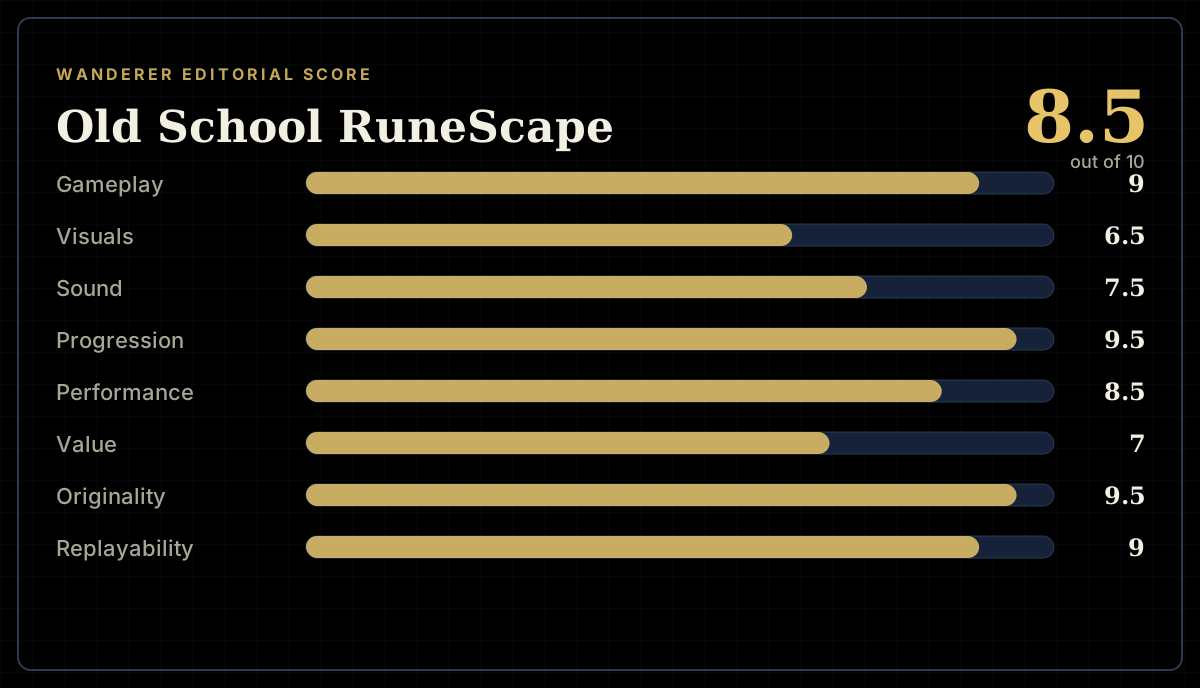
How the review scores each part of the gameWanderer Editorial -
The short versionWanderer Editorial