Game review
Albion Online
7.5 / 10
- Developer
- Sandbox Interactive
- Publisher
- Sandbox Interactive
- Released
- 17 July 2017
- Platforms
- Windows, macOS, Linux, Android, iOS, Xbox Series X|S
- Genre
- Sandbox MMORPG
- Monetisation
- Free to play. Premium status can be earned entirely with in-game silver or bought with real money; cosmetic bundles and founder-style packs are also sold for cash.
- Players
- Full persistent-world MMO — guilds of up to 300, territory and castle sieges, large-scale ZvZ battles, three separate regional servers (Americas, Europe, Asia)
The short version
Albion Online is still the most complete expression of the full-loot sandbox idea on the market: a classless gear system, an economy where players make literally everything, and a world where every fight outside the safe zones has real stakes. Nine years of continuous development, culminating in a genuine visual overhaul and a 2026 Xbox launch, have kept it from calcifying the way most MMOs its age do.
The catch hasn't moved. Full loot is a brilliant pressure system for people who already understand it and a blunt instrument against people who don't, and Albion still does very little to protect new players from veterans who have built entire playstyles around finding them. It's free to install and genuinely free to play — but "free" and "not costly" are different claims, and the review is honest about which one is true.
Biggest strengths
- Every weapon, mount, ship and building in the world was made by another player, and the market reflects that in real time
- The classless "you are what you wear" system means one character can be a miner, a mage and a mounted duelist depending on what's equipped
- Premium status is genuinely earnable through play — there is no real-money floor under participation
Biggest weaknesses
- Full-loot zones are also where veteran players go specifically to farm undergeared newcomers, and the game does little to stop it
- The transition out of the tutorial into the open world is abrupt for anyone who hasn't played a sandbox MMO before
- Large-scale ZvZ battles still strain the client when fifty-plus players converge on one fight
Who it's for: Players who liked the idea of EVE Online's player-built economy but wanted it on foot, in a fantasy setting, without a subscription wall. Best for people willing to lose gear on purpose a few times before they understand why the game is built this way.
Our recommendation: Roll a free character, spend your first weeks entirely in the safer zones learning to gather, craft and sell before ever setting foot somewhere loot drops on death. The systems reward patience; the community, less reliably, rewards it back.
7.5 / 10
Most MMOs sell you a character. Albion Online sells you a blank slate and then asks the rest of the world to decide what happens to it. There are no classes, no talent trees that lock you into a build, and no armour you didn't either make yourself or buy from someone who did. Strip the gear off a max-level warrior and you're left with the same naked, unremarkable body as a day-one account. Everything that matters is worn, crafted, traded or looted — and in large parts of the map, all of it can be taken from you the moment you die.
That single design decision is the whole game. Everything Albion does well and everything it does badly traces back to it.
The loop: gather, craft, wear, risk, repeat
Albion's core cycle is simple to describe and genuinely deep to run. You gather raw resources — ore, fibre, wood, stone, hide — refine them, and use the refined product to craft weapons, armour, tools, mounts and buildings. Nearly every item in the game exists because a player made it from resources another player (or the same one) pulled out of the ground. There's no vendor economy propping things up in the background. Prices on the player-run market move because supply and demand actually move, and a guild deciding to flood the market with plate armour after a big smelting run will visibly crash the price for a day.
What makes this more than a spreadsheet is the classless equipment system. Swap from a fire staff to a bow and you're playing an entirely different kit — different abilities, different combat rhythm, different role in a group fight. A single character can plausibly be your main crafter, your raid healer and your solo ganker, and the only investment separating those roles is which gear you made or bought and how much time you've spent leveling proficiency with it. That flexibility is rare in the genre, where most MMOs ask you to commit to a class at character creation and live with it for a hundred hours. Albion asks you to commit to nothing and rewards you for staying adaptable.
Full loot: the best economic loop in the genre, or just the most punishing one?
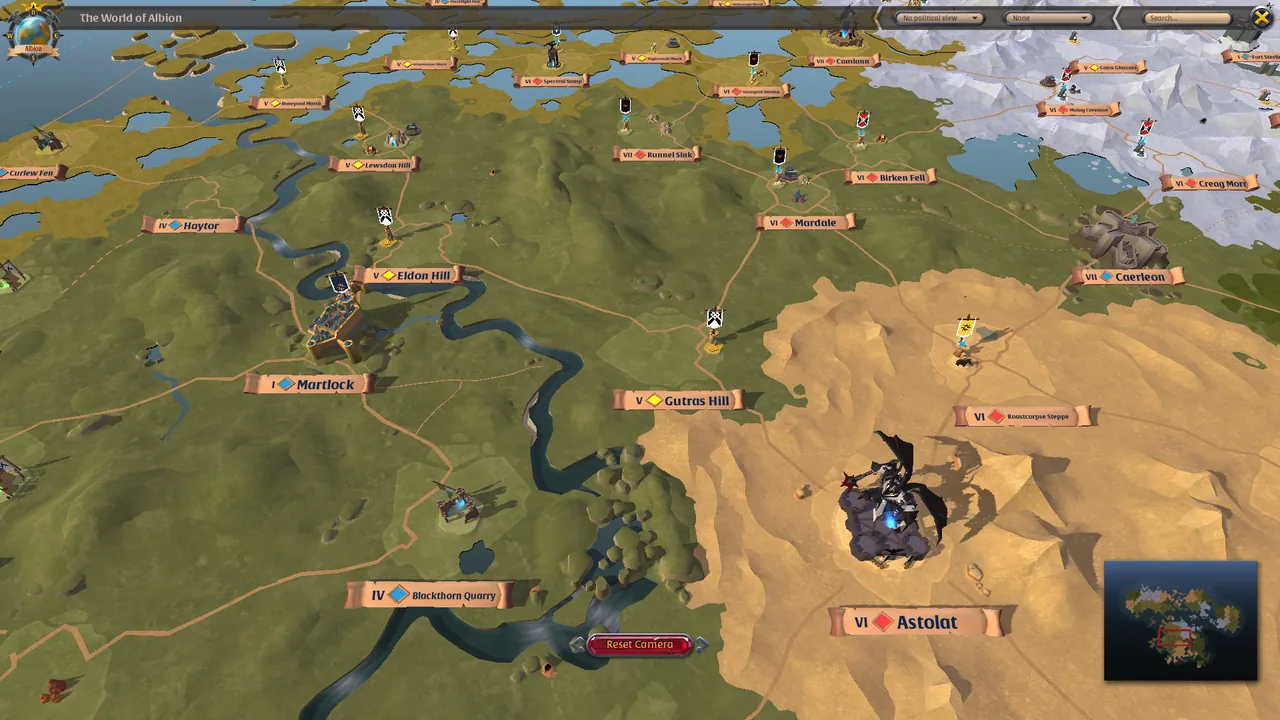
Here's the part that decides whether Albion is your game. The world is divided into zones by colour. Blue and yellow zones are relatively safe — PvP is limited or non-lethal, and dying costs you little. Red and black zones are where the game actually happens for anyone chasing the best resources, the best dungeons and the best fights, and in those zones, dying means dropping your entire equipped loadout for whoever killed you to loot.
Sandbox Interactive's pitch is that this is what gives the economy weight. If gear could never be destroyed, the market would eventually saturate and stagnate — everyone who wanted a set of the best armour would have one, and crafters would run out of reasons to keep crafting. Full loot manufactures permanent demand. Every death is a market event: a weapon comes off someone's back and either goes back into circulation as loot or gets destroyed outright, and either way, someone needs to make another one. It's an elegant answer to the problem that kills most player-driven economies, and it's the reason Albion's market has stayed active for nine years while games with far bigger budgets have watched their economies flatline within eighteen months.
It's also, bluntly, a system that punishes ignorance far more than it punishes bad decisions. A player who understands the risk, gears appropriately for the zone they're entering and accepts the loss as the cost of participation is playing exactly the game Sandbox Interactive designed. A player who wanders into a red zone in their best gear because nothing told them not to has just paid a tax for not knowing the rules yet — and the people collecting that tax are, disproportionately, veterans who have built entire builds and playstyles around finding exactly those players. "Learn by losing your gear" is a real design philosophy and it does produce careful, engaged players over time. It also serves the predatory side of the playerbase first and the new player second, and the gap between those two outcomes is measured in real losses, not abstract lesson-learning. Community feedback around Albion consistently returns to this same friction point: new characters in unprotected zones are, in practice, treated as a resource by players who have long since stopped needing anything a newcomer's gear could offer them except the fight itself.
Whether that's "the best economic loop in the genre" or "the most punishing" depends entirely on which side of the kill you're used to being on. Both descriptions are true of the same system.
Onboarding: better than it was, still asking a lot
Sandbox Interactive knows the harsh-landing problem exists — the tutorial has been reworked more than once, and the early game now walks new characters through gathering, crafting and basic combat in fully protected space before the map opens up. That part works. What still doesn't quite work is the seam between the tutorial and the open world, where a player who has never touched a sandbox MMO is abruptly handed a map with colour-coded death zones and expected to already understand what they mean.
Compare this to something like EVE Online, Albion's clearest spiritual ancestor: EVE is at least honest about being a hostile, unforgiving universe from the first login screen. Albion's fantasy presentation — bright colours, familiar RPG iconography, mobile availability — sets an expectation of approachability that the actual systems don't fully honour once you leave the tutorial zones. Players coming from theme-park MMOs, where death is a minor inconvenience and gear is basically permanent, are the ones most likely to get burned learning this the hard way. The game would benefit from a louder, more persistent warning the first time a character crosses into a full-loot zone. Right now that warning exists, but it's easy to miss and easier to ignore.
Guilds, territory and the multiplayer game that actually justifies the risk
Solo play in Albion is real and viable — you can gather, craft and sell without ever joining a guild — but the game's best content is built for groups. Guilds of up to 300 members fight over territories and castles in large-scale battles the community calls ZvZ, and the seasonal structure around this (recurring guild seasons with their own leaderboards and rewards) gives serious guilds a reason to keep showing up for months at a stretch rather than burning out after one big siege.
This is where full loot stops being a punishment and starts being the point. A fifty-versus-fifty territory fight where every player is risking their actual, player-made equipment carries a weight that consequence-free MMO combat simply can't match. Losses matter, wins matter, and the aftermath — salvaging the field, restocking from the guild bank, gearing back up for the next fight — is its own loop layered on top of the individual one. It's the strongest argument for the whole design philosophy, and it's also content that's functionally invisible to a solo new player for a long time, since it requires a guild, a schedule and enough gear stockpiled to absorb repeated losses.
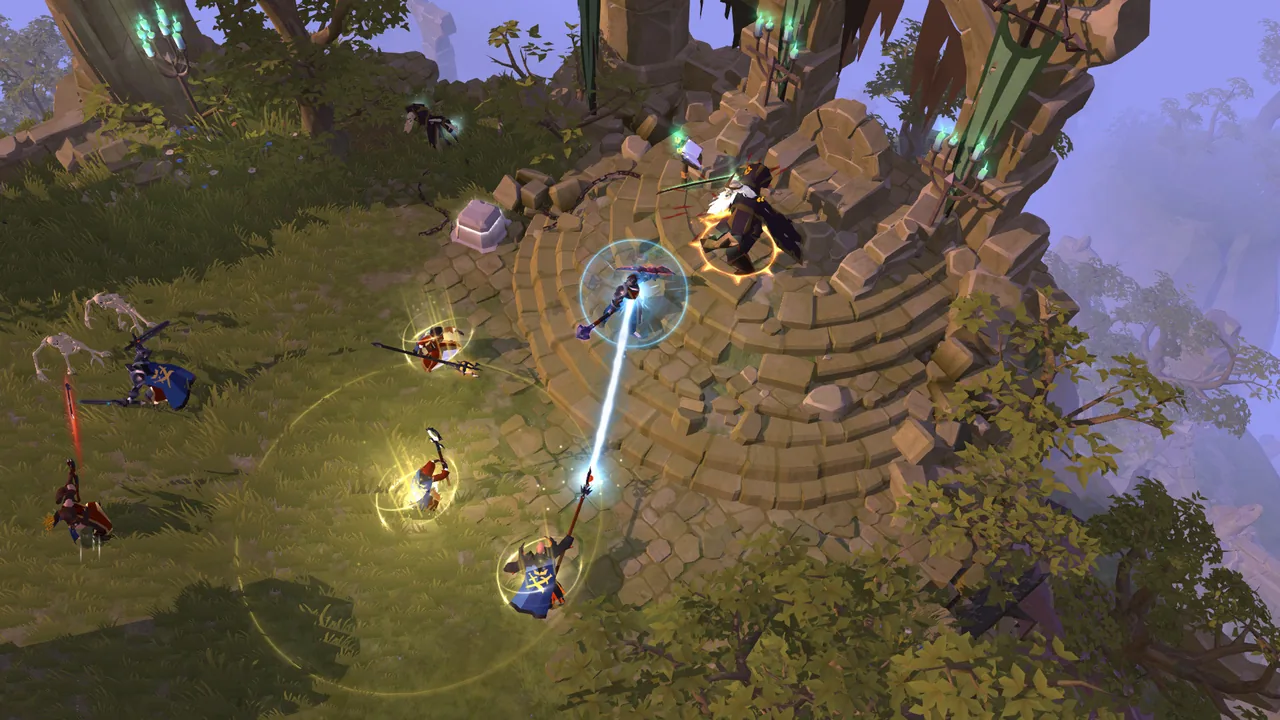
Large fights are also where the engine shows its age. When fights scale past a few dozen players on screen, ability effects and hit registration visibly strain, and Sandbox Interactive has spent real effort on server-side and client-side optimisation over the past couple of updates without fully solving it. It's an old problem for the genre — mass-PvP MMOs have never handled hundred-player brawls gracefully — but it's worth knowing that the game's headline content is also its least technically comfortable.
Presentation: a real upgrade, still not a looker
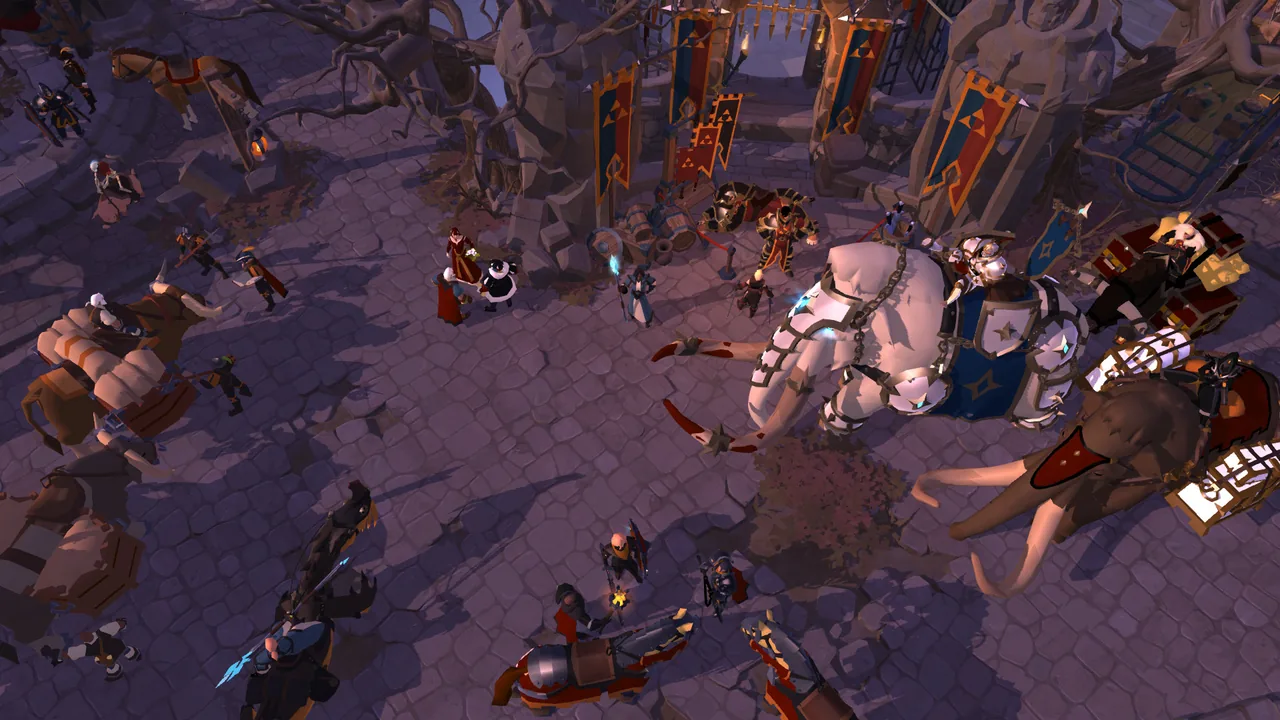
The Radiant Wilds update, which landed in April 2026, gave the open world its first serious visual overhaul in years — reworked lighting, refreshed terrain and environment art, and a client-side performance pass alongside it. It's a meaningful improvement and it shows in the parts of the map it's touched, but Albion is still not chasing photorealism or a distinctive art direction the way some of its newer competitors are. The isometric camera and readable, icon-driven UI are built for function — parsing a fifty-player fight or a crowded market screen quickly — over spectacle, and that's the right trade for what the game actually asks you to do. It just means screenshots undersell it compared to games built to be looked at rather than played efficiently.
The same update introduced an Armory build-planning system and a 1v1 Arena mode, both aimed squarely at making the game legible to players who don't want to commit to full sandbox chaos on day one — a small, sensible concession to the onboarding problem discussed above.
Xbox, cross-platform, and what "one game" actually means here
Albion Online's Xbox Series X|S launch on 21 April 2026 is the biggest platform news the game has had since it went free-to-play. Crucially, it isn't a separate product — Xbox players share the same regional servers, the same economy and the same account progression as PC and mobile players, with full crossplay. Existing accounts link straight across with nothing lost. That matters more for a game like this than for most: a sandbox economy only works if the market has enough participants feeding it, and folding console players into the same regional worlds rather than spinning up an isolated Xbox-only economy keeps the whole system coherent instead of fragmenting it.
The regional split itself hasn't changed: Albion still runs three fully separate server worlds — Americas, Europe and Asia — each with its own economy, its own guild seasons and its own player base. Europe is the newest of the three, having opened in 2024; Americas and Asia have been running for longer and carry correspondingly more entrenched guild politics. Picking a region is a real, mostly permanent choice, not a cosmetic setting.
The free-to-play question, honestly
Albion is free to download and free to fully play — there is no content wall that requires spending real money, and every meaningful system, including endgame guild warfare, is reachable on a free account. Premium status is the game's main paid convenience: it boosts fame and silver earned from most activities by roughly half, speeds up the Focus resource used to guarantee better crafting and gathering yields, and cuts the tax on market sales. As of 30 July 2026, Premium can be bought outright with real money through a subscription in the official shop, or earned entirely by playing — gold, the game's premium currency, is bought and sold by players on an in-game market using silver, so a self-sufficient crafter or trader can fund Premium indefinitely without ever opening a wallet.
That's a genuinely fair structure, and it's the reason Albion doesn't read as pay-to-win in the way the term usually means: nobody can buy a stronger sword than a skilled crafter can make, and nobody can buy their way past full-loot risk. What real money actually buys is a smoother, faster version of the same progression everyone else is grinding toward, plus cosmetics and the occasional anniversary bundle — Sandbox Interactive ran a ninth-anniversary event through early August 2026 with free login rewards and paid vanity bundles alongside it, a fairly restrained way to mark the milestone.
Where the honesty gets more complicated is the tax gap: non-premium accounts pay double the market sell tax that premium accounts do. That's not pay-to-win in the competitive sense, but it is a persistent, compounding tax on staying free, and it means the practical cost of "playing seriously" — running an efficient crafting business, gearing a guild, participating fully in the market — trends upward the longer you avoid paying anything at all. You can absolutely play Albion for free indefinitely. Playing it efficiently for free is a much longer, more deliberate project than the marketing "free to play" tag implies.
Verdict
Nine years in, Albion Online remains the sandbox MMO other games in the genre get measured against, and the past year has been a genuinely strong stretch for it — a real visual overhaul, a console launch that expanded the shared economy instead of fragmenting it, and a monetisation model that, whatever its friction, never actually locks anyone out of the real game. The classless gear system and the fully player-made economy are still the best version of this idea on the market, and the territory warfare built on top of them delivers stakes that scripted, consequence-free MMO combat can't touch.
It doesn't score higher because the thing that makes the economy work — full, permanent loss of your gear to another player — is also the thing the game is least honest about with newcomers. The tutorial has improved; the moment you step past it hasn't gotten any gentler, and the players most equipped to exploit that gap are exactly the ones a new account is most likely to meet first. Full loot is a legitimately brilliant answer to a real economic problem. Whether it's the genre's best idea or its most punishing one is a question this game answers differently depending on whether you're the one holding the sword or the one who just lost it, and Albion still leans harder into that asymmetry than it needs to for a game that genuinely wants new players to stay.
Play it free, start in the safe zones, join a guild before you ever cross into a red one, and go in knowing exactly what the risk buys you. If you already like the idea of a world where nothing is handed to you and everything can be lost, nothing else currently does it this completely.
Facts, pricing and monetisation checked 30 July 2026.
Players who like the idea of a persistent world with real stakes but want their progress to survive being logged off, rather than being lost to another player, may find Wanderer a gentler version of the same itch.
Pros and cons
Pros
- Every weapon, mount, ship and building in the world was made by another player, and the market reflects that in real time
- The classless "you are what you wear" system means one character can be a miner, a mage and a mounted duelist depending on what's equipped
- Premium status is genuinely earnable through play — there is no real-money floor under participation
- The Radiant Wilds update's visual pass and 1v1 Arena mode give the game a modern front door it didn't have a year ago
- Guild seasons and territory conquest give large groups a reason to keep logging in for months, not days
Cons
- Full-loot zones are also where veteran players go specifically to farm undergeared newcomers, and the game does little to stop it
- The transition out of the tutorial into the open world is abrupt for anyone who hasn't played a sandbox MMO before
- Large-scale ZvZ battles still strain the client when fifty-plus players converge on one fight
- Non-premium accounts sell into the market at double the tax of premium ones, which quietly nudges everyone toward paying eventually
- The visual style is far more legible than it used to be but still reads as dated next to newer fantasy MMOs
Screenshots
-
Albion OnlineImage: Sandbox Interactive GmbH via Steam -
Albion OnlineImage: Sandbox Interactive GmbH via Steam -
Albion OnlineImage: Sandbox Interactive GmbH via Steam -
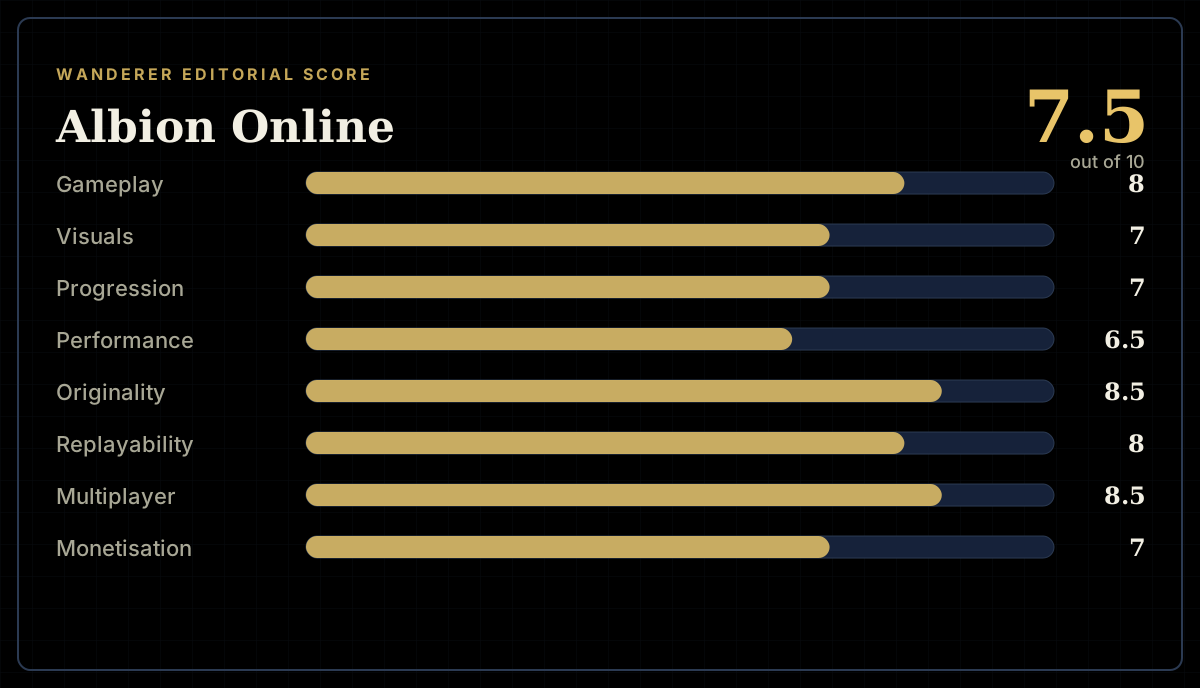
How the review scores each part of the gameWanderer Editorial -
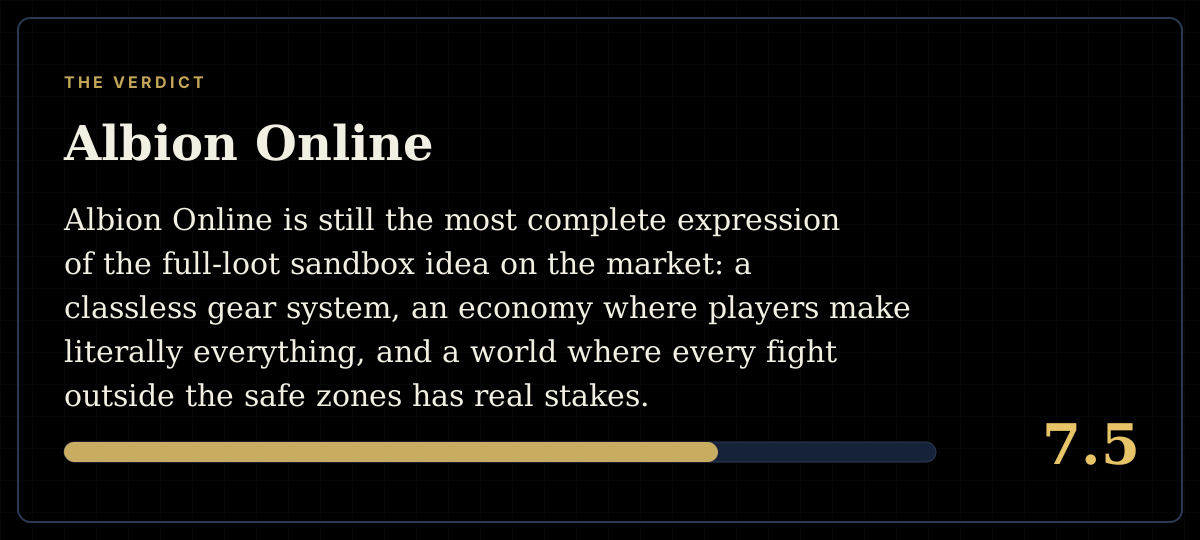
The short versionWanderer Editorial