Game review
Upgradia
7 / 10
- Developer
- Mytharia
- Publisher
- Mytharia
- Released
- 3 August 2026
- Platforms
- Windows
- Genre
- MMORPG
- Monetisation
- One-time purchase (NZ$15.75, 20% launch discount) plus an in-game cash shop; player reports describe the shop's functional items as also obtainable through dungeon drops, with cosmetics as the purchase-only tier, though this account comes from early players rather than a published item list
- Players
- Full MMO structure — guilds, party dungeons for up to five players, PvP duels and ranked arenas, a player-driven Trading Post economy, cross-platform multiplayer
The short version
Upgradia doesn't hide its influences: it's a tabbed, skill-driven RuneScape-and-Melvor-Idle hybrid, dressed as a "cozy Semi-Idle MMORPG" and built around thirteen-plus trainable professions, guild structures, and a world map that gates content by level band from Training Plains up to the Ascended Plane. Two days into Early Access, that structure is already mostly in place, and a developer that's shipped multiple hotfixes within 48 hours suggests real commitment to seeing it through.
What's less settled is everything you'd expect from a two-day-old MMO: quest and inventory bugs the patch notes are actively chasing, a login issue serious enough that one reviewer couldn't get back in, and a live disagreement in the review section over whether the cash shop sitting alongside a paid entry price crosses a line. None of that is unusual for an Early Access MMO launch. It does mean this review is closer to a snapshot of a promising foundation than a verdict on a finished game.
Biggest strengths
- A genuinely deep, familiar skill web — farming, fishing, foraging, mining, smithing, cooking, alchemy, crafting, combat, magic and more — that RuneScape and Melvor Idle players will recognise instantly and settle into fast
- Real MMO structure on day one: guilds with rotating challenges, party dungeons for up to five players, PvP duels and ranked arenas, and a Trading Post economy
- A world map with explicit level-banded zones, from Training Plains (Lv1-20) up to the Ascended Plane (Lv90-100), giving long-term structure to thousands of promised levels
Biggest weaknesses
- Launched with real bugs still being chased down, including quest display issues, inventory problems and at least one reviewer reporting an inability to log back in through Steam
- Combining a paid entry price with an in-game cash shop has already drawn direct criticism in the review section, and the counter-argument — that shop items are farmable in-game — comes from player testimony rather than a published, verifiable item list
- One detailed review alleges a group of banned players, caught exploiting an in-game economy bug, are review-bombing in retaliation; this review cannot verify that claim independently and reports it only as one player's account
Who it's for: RuneScape and Melvor Idle fans who want that skilling structure wrapped in a real MMO — guilds, party dungeons, PvP, a live economy — and who don't mind installing something two days into Early Access rather than waiting for it to settle.
Our recommendation: A reasonable buy for skiller fans willing to ride out early bugs, with the understanding that the cash shop's fairness and the game's day-to-day stability are both live questions right now rather than settled facts.
7 / 10
One of Upgradia's own early reviewers put it about as well as anyone could: they were looking for something that mixed RuneScape with Melvor Idle, and Upgradia does exactly that. It's a tabbed, browser-style MMORPG built around a long list of trainable skills — farming, fishing, foraging, mining, smithing, cooking, alchemy, crafting, combat, magic, defense, melee, archery — each one levelling independently, each one another route through a world map explicitly divided into level bands. It launched into Early Access two days before this review, and it already looks like a real MMO rather than a proof of concept: guilds, party dungeons, ranked PvP, a player-run economy. What it doesn't yet have is time — and a two-day-old MMO's problems are, almost by definition, still being actively fixed as this is written.
A familiar skeleton, built out properly
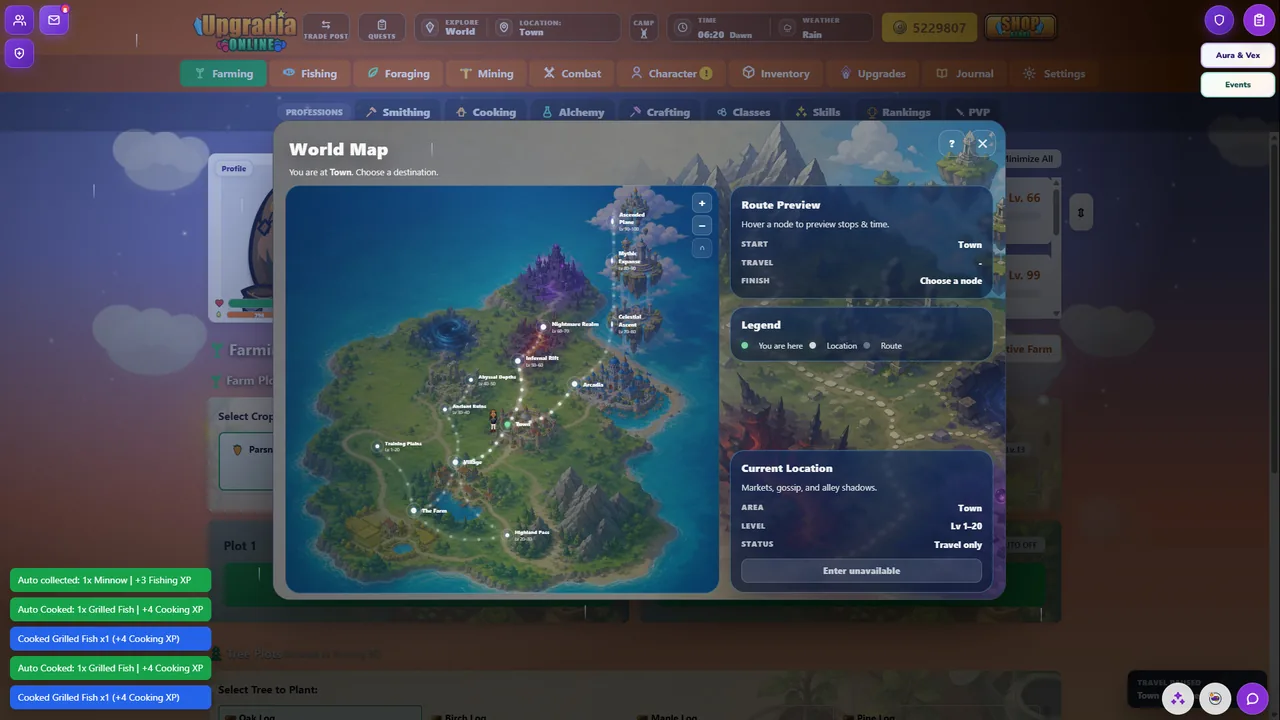
Upgradia's marketing calls itself a "cozy Semi-Idle MMORPG," and that's an accurate description of the balance it's aiming for: skills tick along with auto-collection and auto-cooking logs scrolling in the corner of the screen, while combat, dungeons and PvP ask for active attention. The world map backs this up with real structure — Training Plains at levels 1-20, Highland Pass around 20-33, up through Abyssal Depths, Infernal Rift, Nightmare Realm and Arcadia, capping out at the Ascended Plane around levels 90-100. That's a lot of scaffolding for a two-day-old game to already have in place, and it suggests Upgradia was built with a long content runway in mind rather than assembled in a rush to hit a launch date.
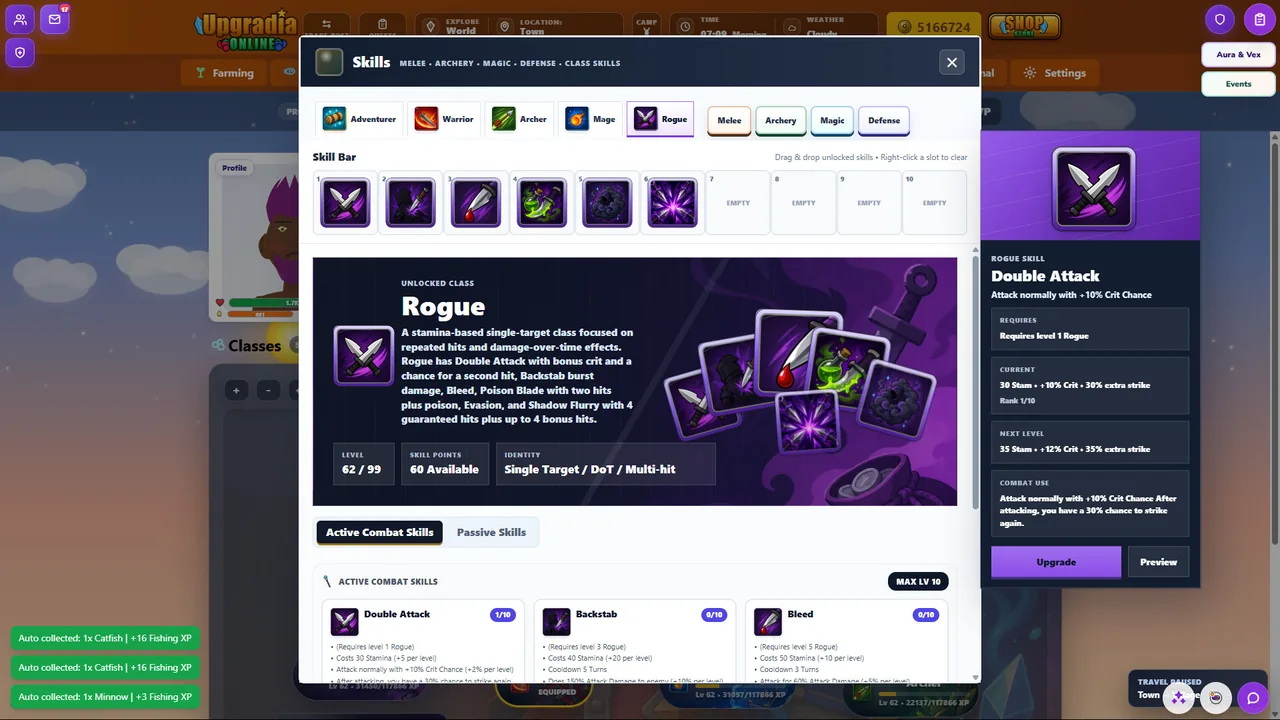
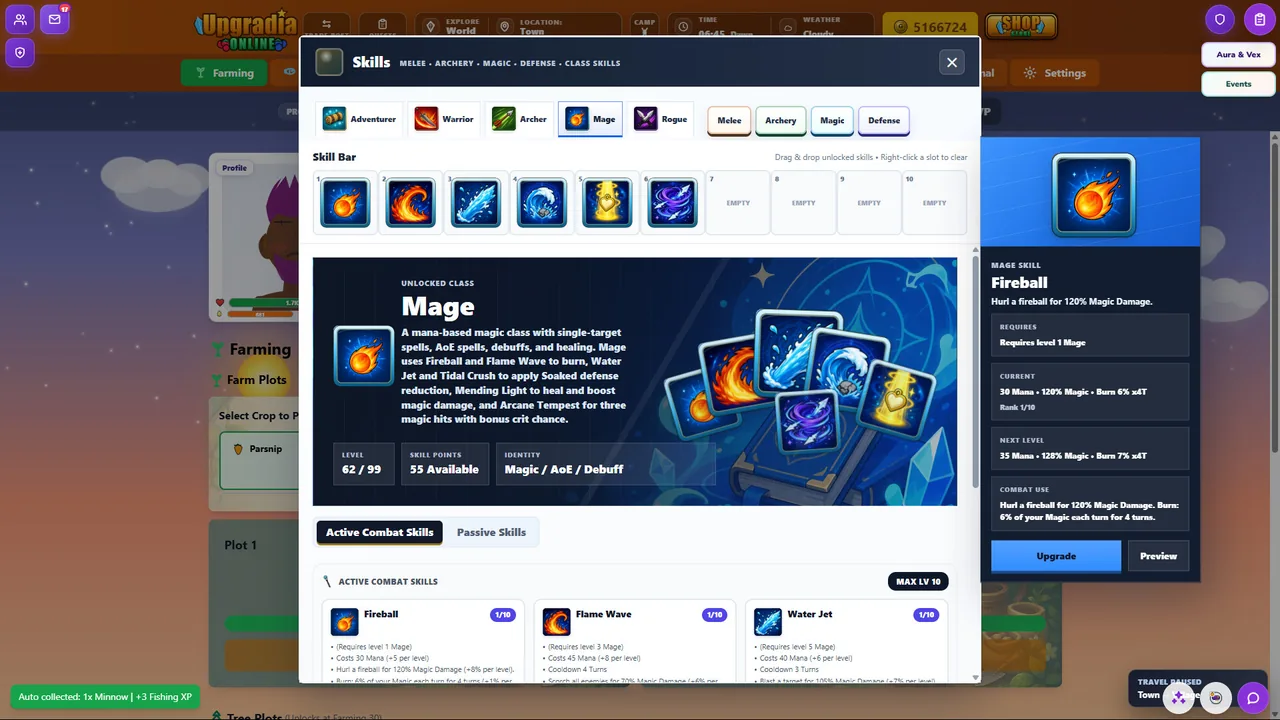
Combat is turn-based and built for both solo and group play, managing health, stamina and mana with class choices, stat points and gear layered on top — party up to five players for tougher encounters, or take on PvE and PvP separately. Four character classes exist at launch with more subclasses promised, according to one reviewer's account, and the skill list feeds directly into combat readiness rather than sitting as a separate system alongside it.
The part that will decide whether this sticks
The most interesting thing in Upgradia's small early review pool isn't a complaint about bugs — it's a live disagreement over its monetisation. Pairing a paid entry price with an in-game cash shop has already drawn a direct negative review calling out the combination. Multiple other reviewers push back specifically on that point, arguing the shop isn't pay-to-win and that its functional items — outside a cosmetic-only "deluxe" tier — can reportedly be farmed through dungeon chests instead of bought. That's a reasonable-sounding defence, but it's worth being precise about what it actually is: player testimony, not a published item list this review can verify independently. Anyone weighing whether Upgradia's economy is fair should treat that as an open question to check for themselves against the current shop contents, not a settled fact either direction.
A second, more pointed claim comes from the same corner of the review section: one detailed review states that a group of players were banned for exploiting an economy bug and not reporting it, and alleges those players are now review-bombing in retaliation. This review has no way to independently confirm bans, exploits or coordinated review activity, and reports the claim only as one player's account rather than a verified fact. It's mentioned here because it's exactly the kind of dispute that can quietly distort an aggregate review score during a game's first days, and readers checking Upgradia's Steam rating in the near future should know that context exists behind it.
Early roughness, and a developer responding to it
What isn't in dispute is that Upgradia launched with real bugs. Patch notes from its first 48 hours list fixes for quest display mismatches, inventory hand-in logic, farming reward quests pointing at removed steps, crafted arrows disappearing mid-combat, and a Settings screen that briefly stopped rendering correctly — all explicitly credited to player reports and screenshots in the patch notes themselves. One reviewer separately describes being unable to log back in through Steam at all. Taken together, that's a genuinely rocky first 48 hours, but it's also a developer visibly working through a real bug backlog in near-real time rather than going quiet after launch — the second update posted within a day of release opens by thanking players specifically for "the continued reports and screenshots."
Structurally, Upgradia also plays fair with time away from the game: progression is fully server-side, so a character keeps its state and can be checked on without the client running. The trade-off is that Upgradia is Steam-only at launch with no mobile client, which sits a little awkwardly against a skilling structure built around exactly the kind of short, frequent check-ins a phone would suit well — more than one player is likely to run into the same "remote desktop home to check my farm" workaround a reviewer describes here.
Final verdict
Two days in, Upgradia has the bones of something genuinely worth watching: a properly deep skill list, real guild and PvP structure, a level-banded world built for the long haul, and a developer patching multiple times a day in direct response to player reports. It also has everything you'd expect from something two days old — active bugs, a login issue serious enough to draw a refund complaint, and a monetisation dispute that hasn't settled yet either in the reviews or in this one.
For players who already know they want a RuneScape-and-Melvor-Idle hybrid with a real MMO wrapped around it, that's a reasonable trade to make at launch price. For anyone who'd rather let an Early Access MMO find its footing first, there's no cost to waiting a few weeks and checking back once the current disputes and the current bug list have both had time to resolve.
If a semi-idle skilling MMO with guilds and a live economy sounds appealing, Wanderer offers its own take on persistent, always-progressing fantasy adventure and is worth a look alongside it.
Pros and cons
Pros
- A genuinely deep, familiar skill web — farming, fishing, foraging, mining, smithing, cooking, alchemy, crafting, combat, magic and more — that RuneScape and Melvor Idle players will recognise instantly and settle into fast
- Real MMO structure on day one: guilds with rotating challenges, party dungeons for up to five players, PvP duels and ranked arenas, and a Trading Post economy
- A world map with explicit level-banded zones, from Training Plains (Lv1-20) up to the Ascended Plane (Lv90-100), giving long-term structure to thousands of promised levels
- The developer shipped a day-one hotfix and a second substantial patch within 48 hours, addressing quest logic, inventory bugs and settings issues raised directly by early players
- Full server-side offline progression means the character keeps advancing between sessions without needing the client left open
Cons
- Launched with real bugs still being chased down, including quest display issues, inventory problems and at least one reviewer reporting an inability to log back in through Steam
- Combining a paid entry price with an in-game cash shop has already drawn direct criticism in the review section, and the counter-argument — that shop items are farmable in-game — comes from player testimony rather than a published, verifiable item list
- One detailed review alleges a group of banned players, caught exploiting an in-game economy bug, are review-bombing in retaliation; this review cannot verify that claim independently and reports it only as one player's account
- Steam-only at launch, with no mobile client — a real limitation for a game built around frequent, short check-ins the way its skilling structure invites
- At least one reviewer specifically criticises character model quality, even while praising the systems underneath them
Screenshots
-
UpgradiaImage: Mytharia via Steam -
UpgradiaImage: Mytharia via Steam -
UpgradiaImage: Mytharia via Steam -
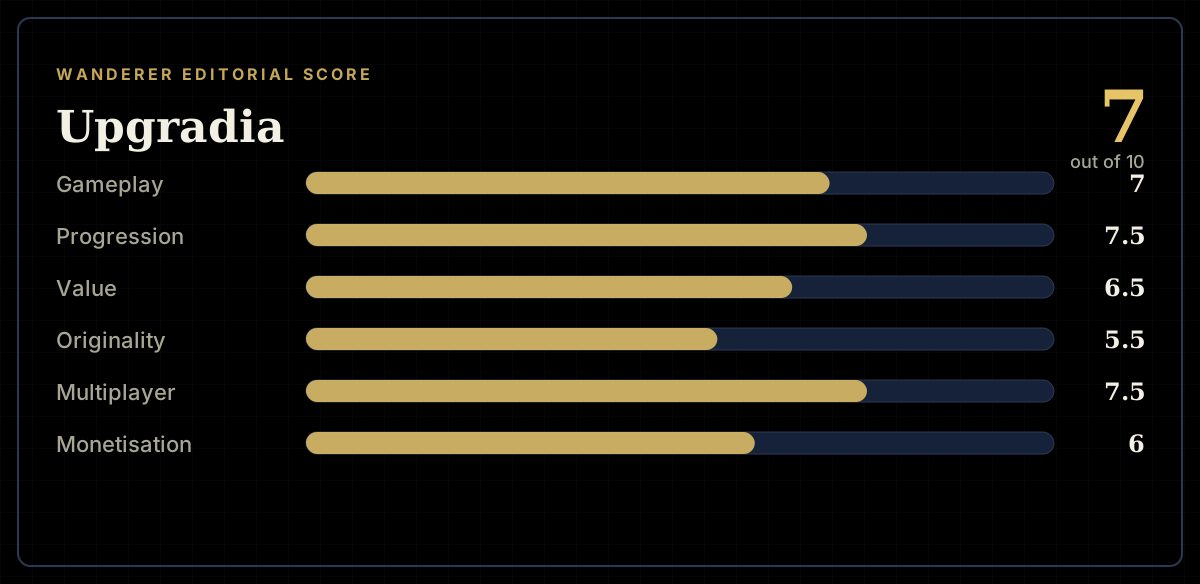
How the review scores each part of the gameWanderer Editorial -
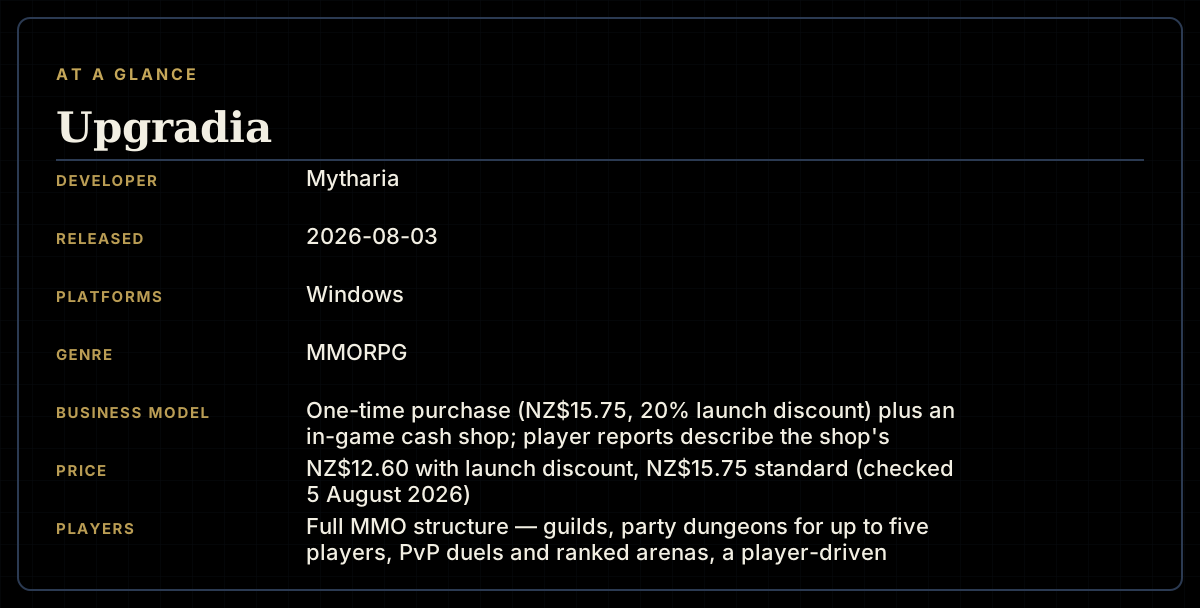
The game at a glanceWanderer Editorial -
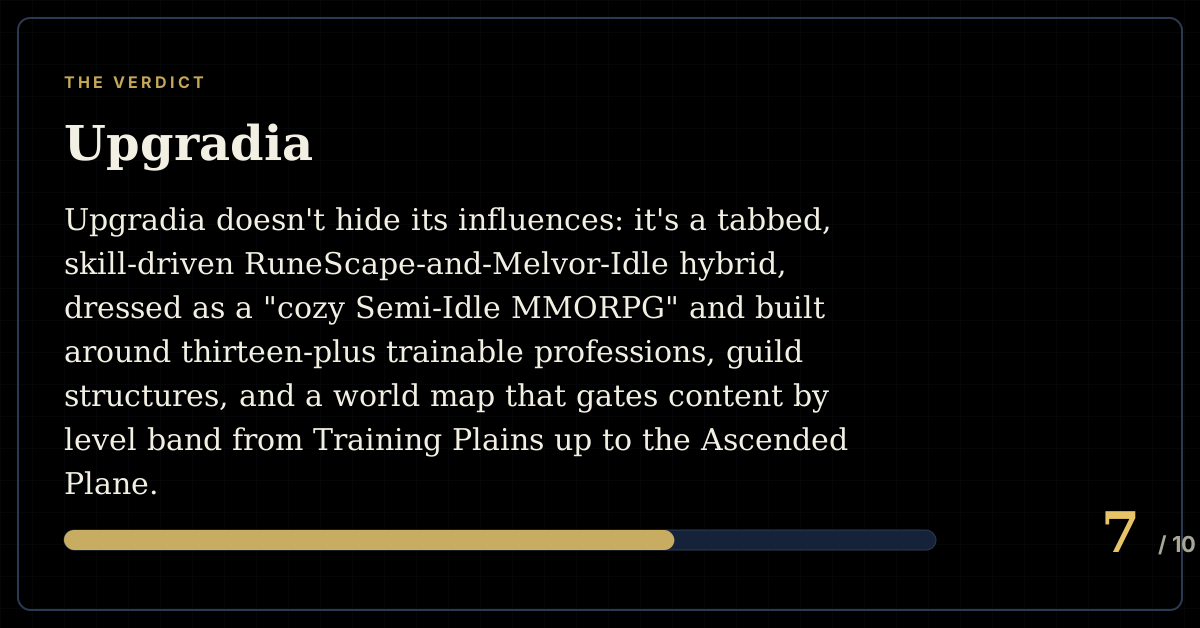
The short versionWanderer Editorial